Publish date: 2 May 2026
Warsaw 02:05:2026 1:03 PM Steve Walker
Europe is entering a more unstable world.
For decades, much of Europe’s industrial model depended on the assumption that energy, fuels and industrial feedstocks would remain globally available, relatively affordable and politically accessible. Large international supply chains made it possible to import molecules from distant regions while focusing domestic policy primarily on consumption and efficiency.
That world is changing.
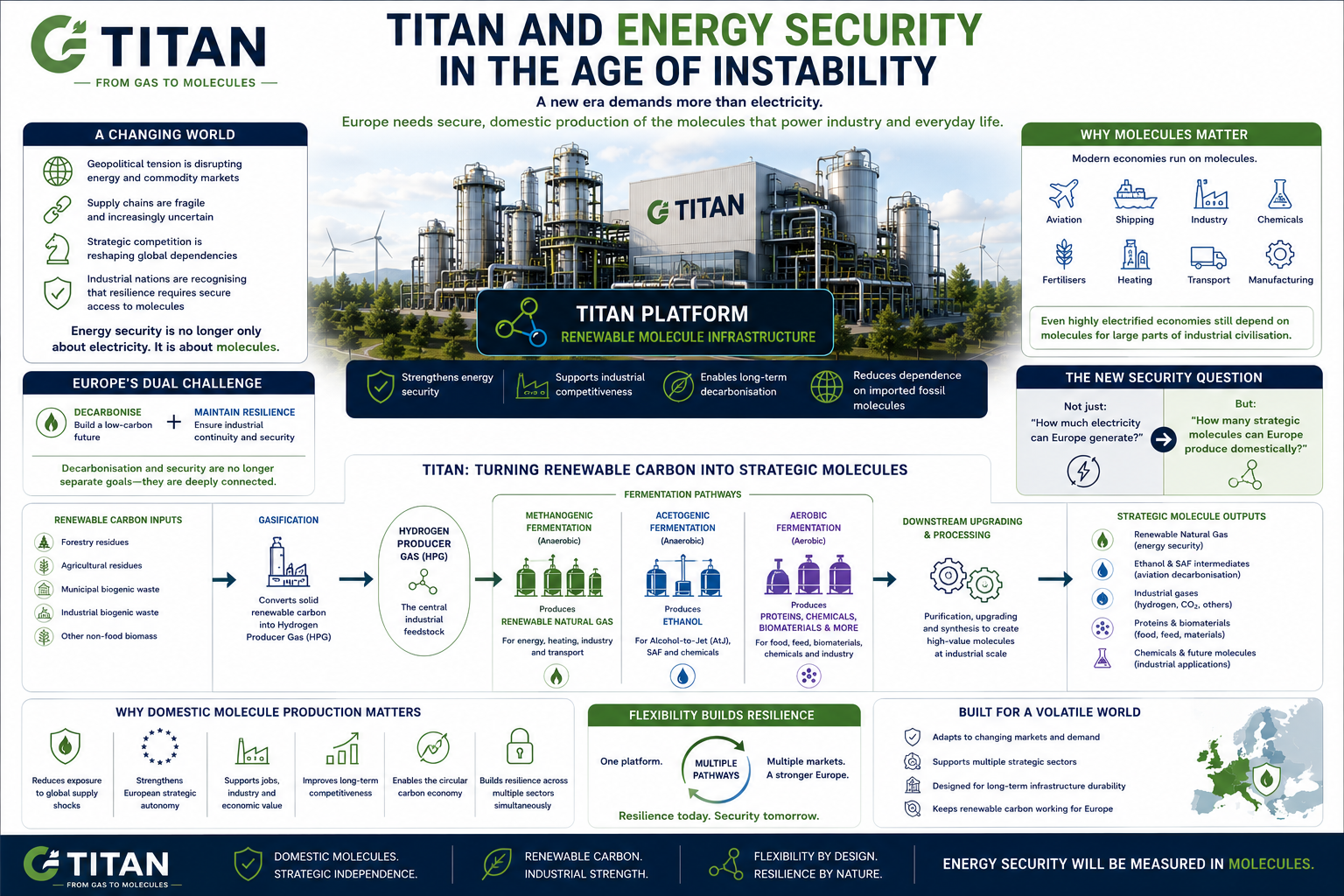
Geopolitical tension has returned to energy markets. Supply chains have become more fragile. Strategic competition is increasing. Industrial nations are beginning to recognise that long-term resilience depends not only on electricity generation, but also on secure access to molecules.
This distinction matters.
Modern economies do not run on electricity alone.
Heavy industry, aviation, shipping, chemicals, fertilisers, district heating and industrial transport all require molecular products: gas, liquid fuels, carbon feedstocks and industrial gases. Even highly electrified economies still depend on molecules for large parts of industrial civilisation.
Europe therefore faces a dual challenge.
It must decarbonise.
But it must also maintain industrial continuity and strategic resilience.
These objectives are often treated separately. In reality, they are becoming increasingly connected.
The transition away from fossil carbon is not simply an environmental transition. It is also an industrial and geopolitical transition.
Countries capable of producing strategic molecules domestically will likely possess stronger long-term resilience than countries dependent on imported carbon systems.
This is where renewable molecule infrastructure becomes important.
TITAN was designed for this emerging industrial environment.
The platform converts renewable carbon into Hydrogen Producer Gas and then upgrades that gas into valuable industrial molecules through fermentation and downstream processing pathways. The objective is not only renewable energy generation. The objective is domestic molecule production at industrial scale.
This changes the role of infrastructure.
Traditional renewable systems often focus primarily on electricity generation. TITAN focuses on renewable molecules: Renewable Natural Gas, ethanol, future SAF intermediates, industrial gases, proteins, chemicals and future carbon-derived materials.