

Warsaw 03:05:2026 11.52 AM Steve Walker
For most of the twentieth century, industrial energy systems were built around baseload.
Large plants operated continuously. Power stations produced electricity day and night. Refineries processed fuels at steady volume. Industrial systems were designed for predictability, fixed flows and long operating cycles.
That model shaped the modern economy.
But the energy system is changing.
Renewable electricity is growing. Demand is becoming more variable. Energy prices move more quickly. Industrial customers need lower-carbon fuels, gases and feedstocks. Supply chains are exposed to geopolitical pressure. Markets are no longer as stable as they once appeared.
In this new environment, baseload alone is no longer enough.
The future belongs to infrastructure that can adapt.
This is especially true for molecules.
Electricity is only one part of the transition. Europe also needs gas, fuels, chemicals and industrial feedstocks. These are not simply energy products. They are molecular products. They support aviation, shipping, heavy transport, heating, industry and manufacturing.
The challenge is that molecule demand is not static.
Gas demand changes by season. Aviation fuel demand changes with travel and regulation. Chemical demand changes with industry. Carbon prices, fuel mandates and geopolitical conditions all affect which molecules are most valuable at any given time.
A single-output plant struggles in this environment.
If an installation is designed to make only one product, it is exposed to that product’s market cycle. When demand is strong, the plant performs well. When demand weakens, the plant has limited choices.
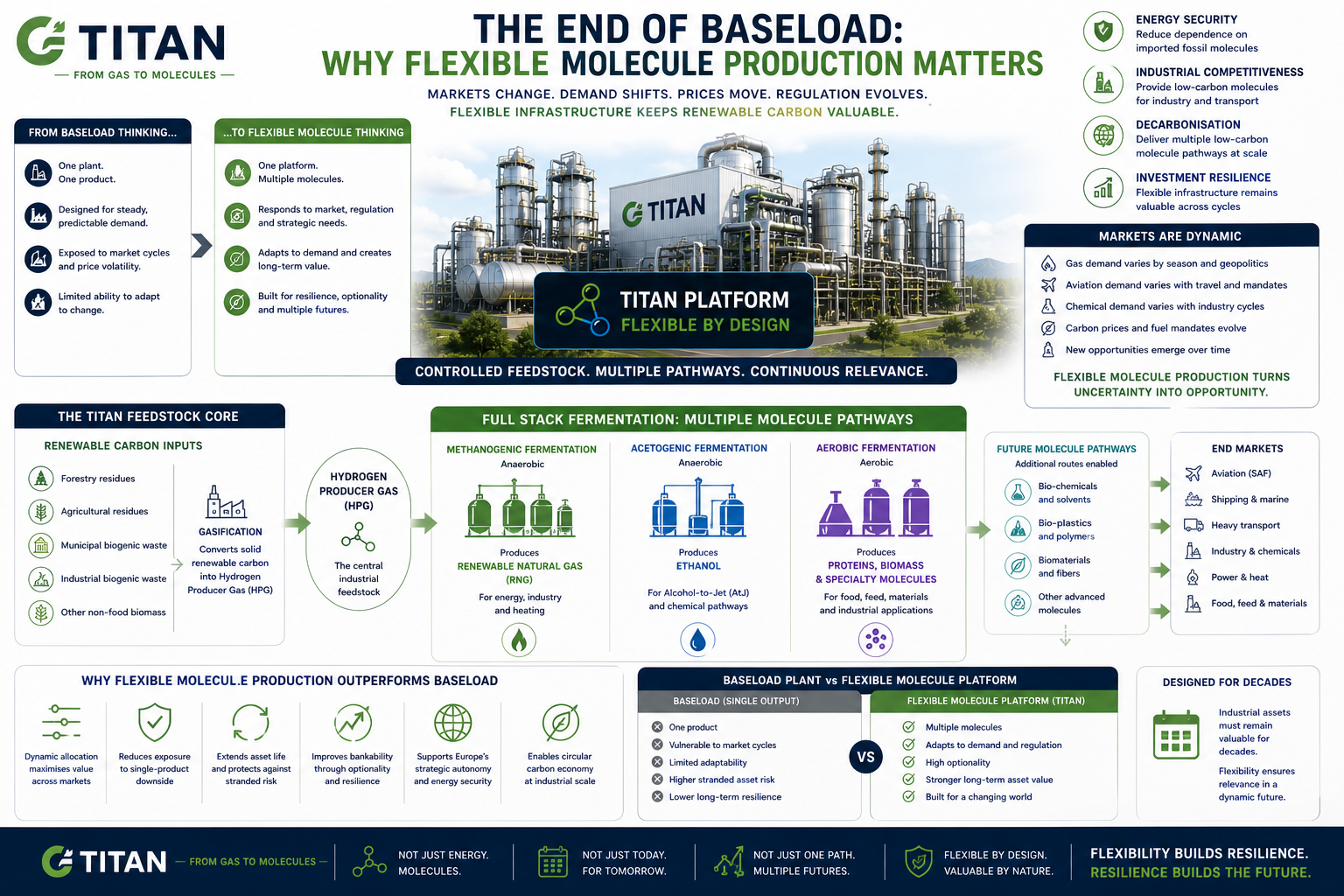
Flexible molecule production changes this logic.
Instead of locking infrastructure into one output, flexible platforms can direct a controlled feedstock into different production pathways.