

Publish date: 1 May 2026
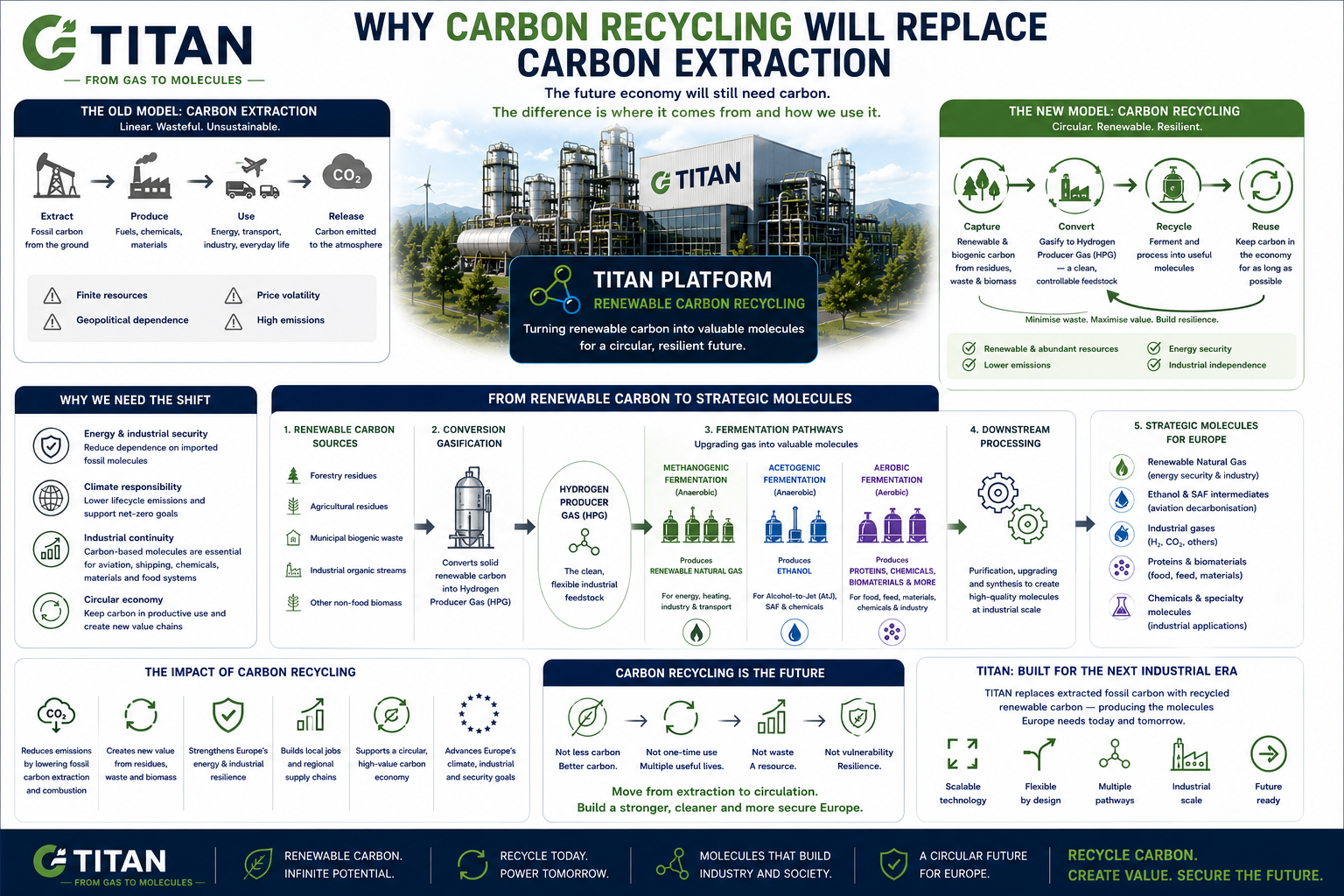
For more than a century, industrial growth has depended on carbon extraction.
Coal, oil and natural gas were taken from the ground, refined, transported and converted into energy, fuels, chemicals and materials. This model powered the modern economy. It created mobility, manufacturing, aviation, plastics, fertilisers and global trade.
But it also created a structural problem.
The industrial economy became dependent on fossil carbon.
Carbon was extracted once, used briefly, and then released into the atmosphere. This linear model was efficient during the age of cheap fossil resources, but it is no longer compatible with Europe’s long-term climate, industrial and security objectives.
The next industrial era will require a different model.
Carbon cannot simply be treated as something to extract, burn and discard.
It must be treated as something to recover, recycle and reuse.
This is the logic of carbon recycling.
Carbon recycling does not mean stopping the use of carbon. That would be impossible for many parts of the economy. Aviation, shipping, chemicals, materials, agriculture, food systems and industrial manufacturing all depend on carbon-based molecules.
The real question is not whether society will use carbon.
The question is where that carbon comes from.
In the old model, carbon came from fossil extraction.