The Virtual Pipeline Economy

Publish date: 25 March 2026
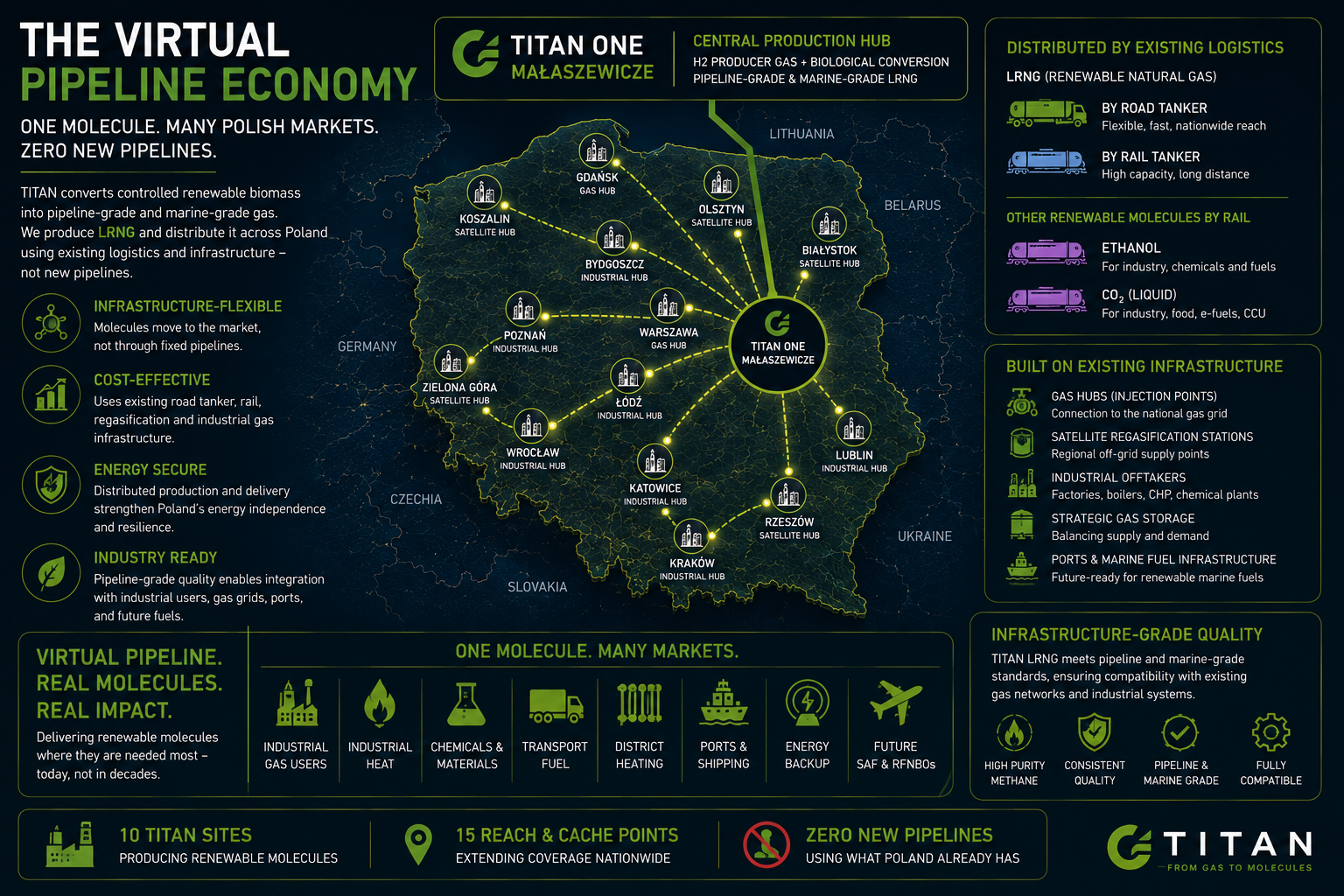
(Polska wersja poniżej.)

For more than a century, industrial gas distribution has depended on fixed pipeline systems.

Pipelines transformed economies because they allowed energy molecules to move continuously between production centres and industrial users. Heavy industry, chemicals, district heating, shipping and manufacturing all developed around this infrastructure model.

But building entirely new national pipeline systems is slow, expensive and politically difficult.

At the same time, Poland faces a growing challenge.

The country requires increasing volumes of renewable molecules for industry, transport, chemicals, heating and future fuel systems, while much of the existing renewable energy discussion remains focused almost entirely on electricity.

Electricity matters.

But molecules matter too.

Factories require molecules.

High-temperature industrial heat requires molecules.

Shipping requires molecules.

Chemicals require molecules.

Future aviation fuels require molecules.

The question is not simply how to produce renewable molecules.

The question is how to distribute them efficiently across the country without waiting decades for entirely new infrastructure to be built.

This is where the virtual pipeline economy begins.
Swing–Swing — Bankability Through Molecule Choice

(Przewiń w dół, aby zobaczyć wersję polską.)

Published March 20 2026

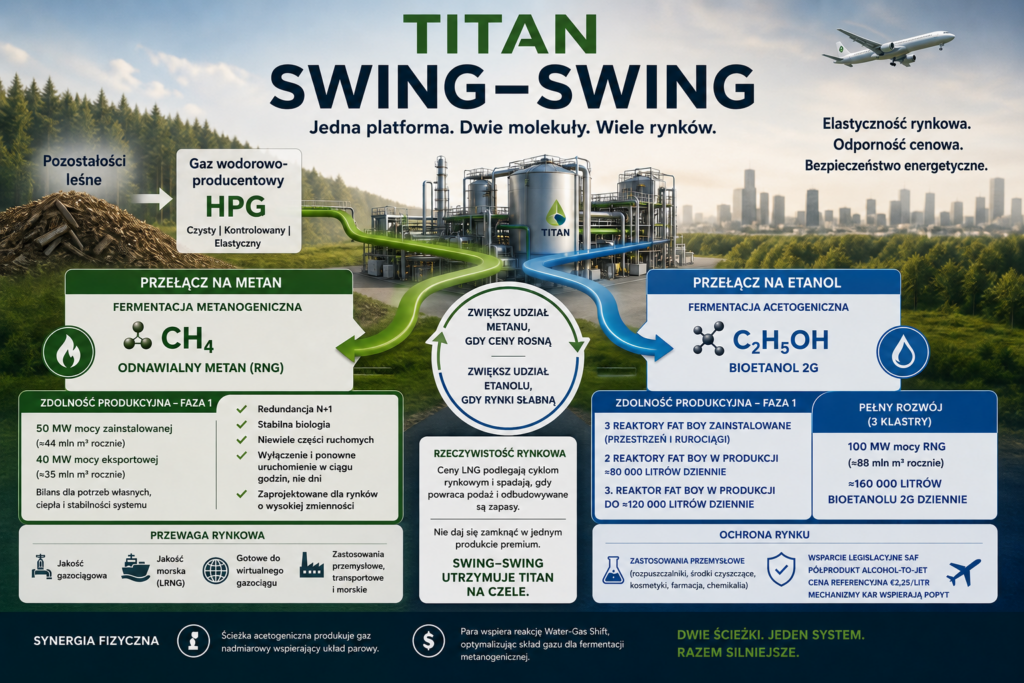
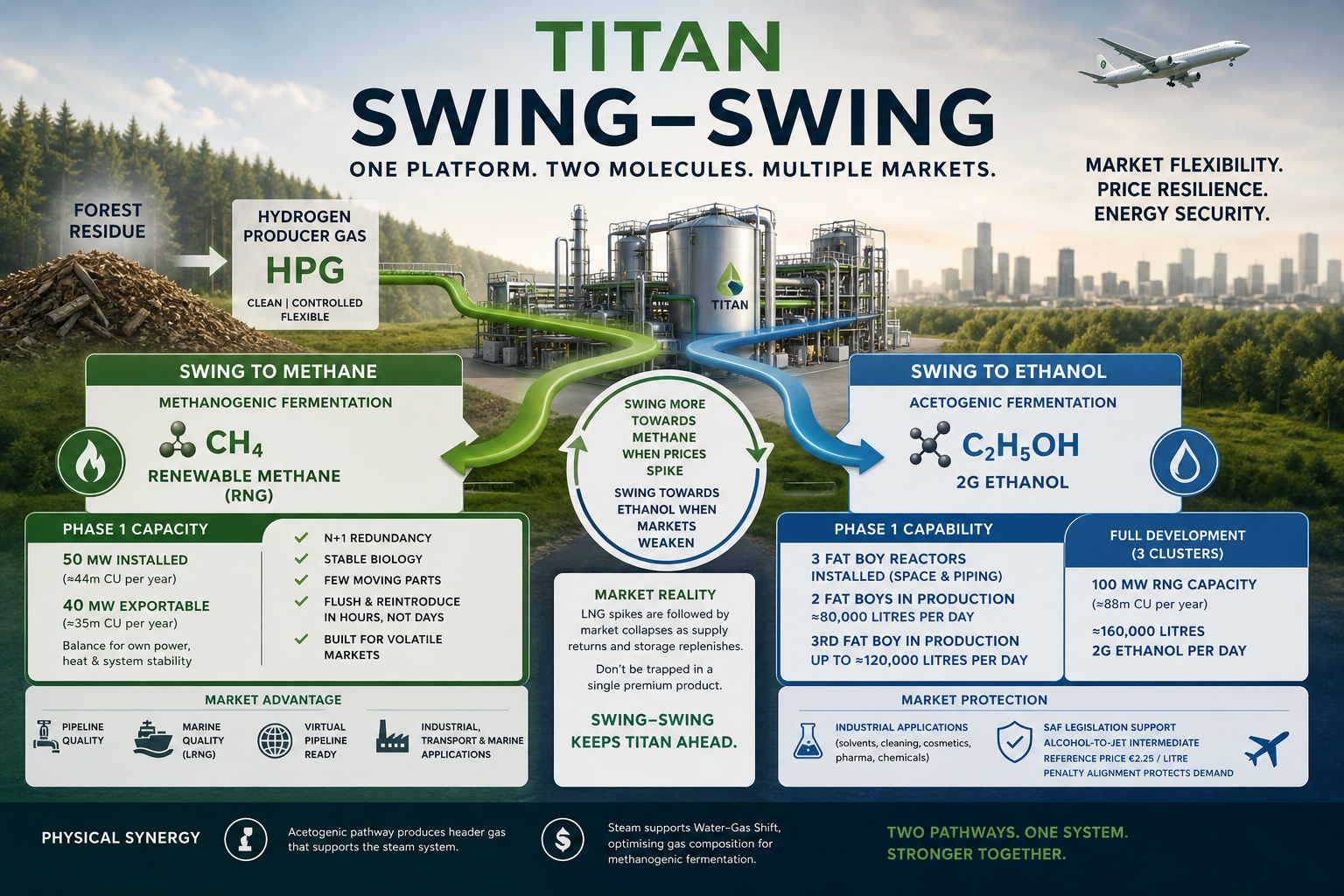
TITAN is built as a molecule platform, not a single-output plant.

In Phase 1, the local materiality case is methane-led. Poland needs a bankable, scalable renewable gas solution, and TITAN answers that need by converting forest residue into Hydrogen Producer Gas and then into renewable methane through methanogenic fermentation. This is the right starting point. It connects directly to existing gas infrastructure, supports energy security, and creates an immediate route to market.

But TITAN is not simply an RNG plant.

The platform is designed from the beginning to move between renewable methane and 2G ethanol. This is the meaning of Swing–Swing 25MW RNG (circa 22m CU per year) + 80,000 litres of 2G EtOH daily.

Phase 1 installs 50 MW (Circa 44m CU a year) of RNG capacity. In normal operation, around 40 MW (circa 35m CU a year) can be exported, while the balance is retained for own power, heat and system stability. The additional installed capacity provides N+1 redundancy, but not because the biology is weak. Methanogenic fermentation is stable. The archaea operate as efficient replicating colonies, with very few moving parts. Once established, the colony regime is unlikely to change materially within a 12-month cycle, and if intervention is needed, flushing and reintroduction are measured in hours, not days.

The redundancy is justified because the market is volatile.

If LNG or gas prices spike, TITAN can swing more gas toward methane and capture that value. If methane prices weaken or collapse as they often do after spikes), the platform is not trapped. It can direct gas toward acetogenic fermentation, producing ethanol instead.

Full Stack Carbon Refining

Publish Date: 11 March 2026

(Przewiń w dół, aby zobaczyć wersję polską.)

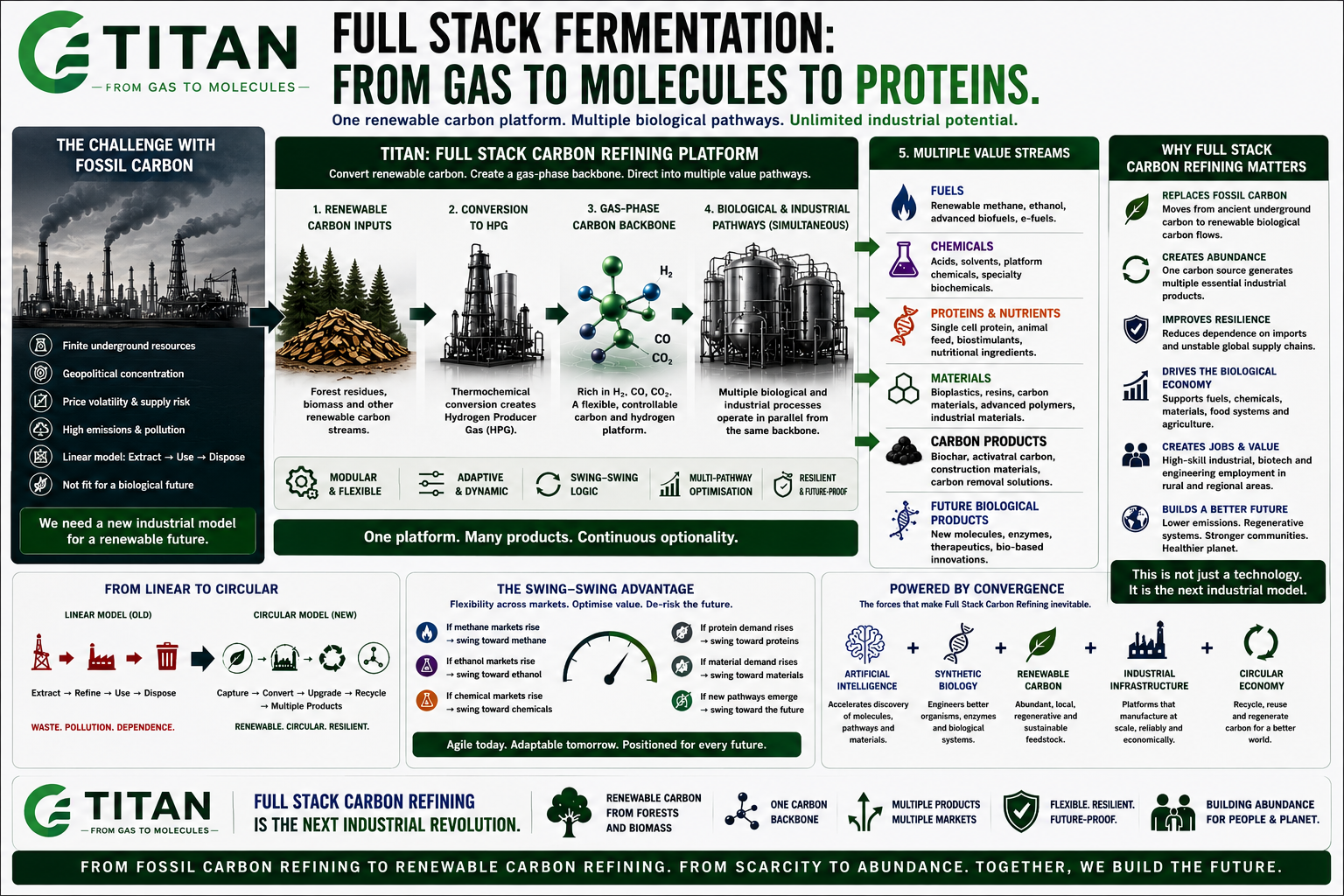
For more than a century, industrial civilisation has been built around fossil carbon refining.

Oil refineries transformed crude oil into fuels, chemicals, plastics, solvents and industrial materials. Gas infrastructure supplied heat, power and industrial feedstocks. Petrochemical systems became the molecular foundation of the modern economy.

That system created enormous prosperity.

But it also created dependence on finite underground carbon resources extracted from geopolitically concentrated regions of the world.

The next industrial transition may not simply replace fossil energy.

It may replace fossil carbon itself.

This is where Full Stack Carbon Refining begins.

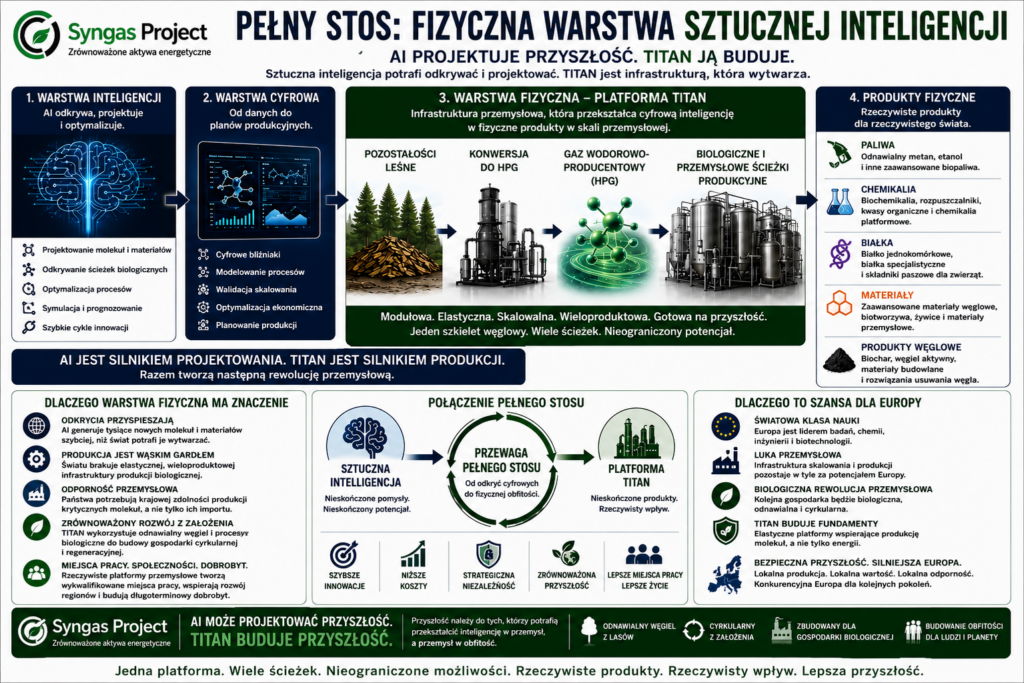
Syngas Project believes the future economy will increasingly require platforms capable of converting renewable carbon into multiple industrial outputs simultaneously.

Not only energy.

But fuels, chemicals, materials and nutrients.