
Warsaw 02:02:2023 08:16 AM Steve Walker
Methanogenic Microbes
The Anaerobic Dark Side
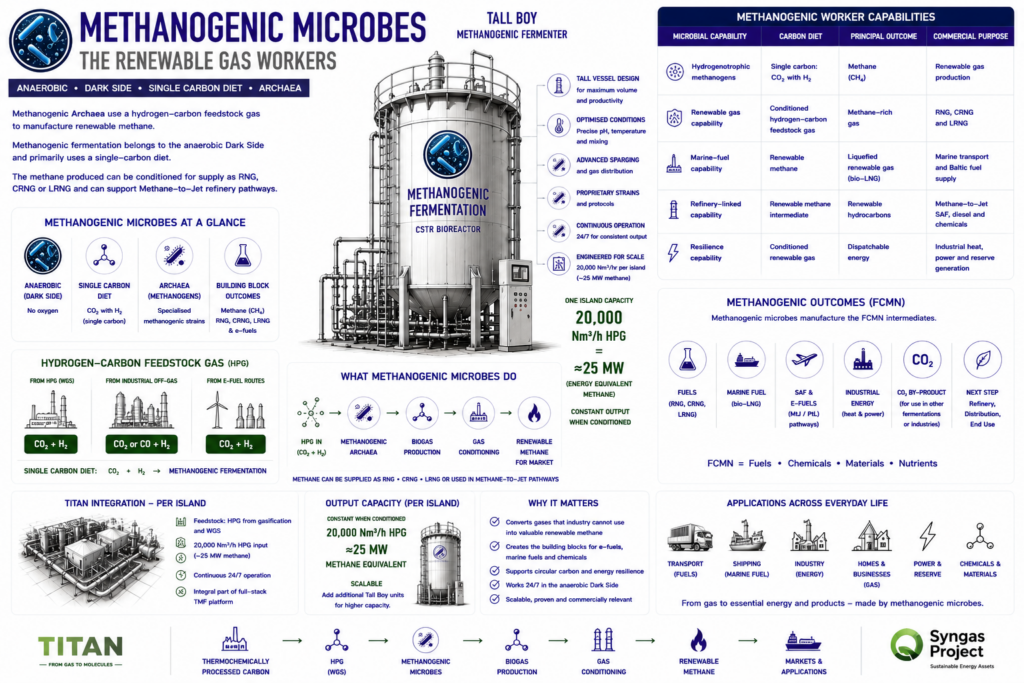
Methanogenic microbes are Archaea, the same microbial family widely used in anaerobic digestion to manufacture methane. Within Targeted Microbial Fermentation, they belong to the anaerobic Dark Side because they work without oxygen.
Methanogenic workers produce very little microbial biomass. Their commercial purpose is not to grow large quantities of cells, proteins or materials. Their purpose is focused: they convert a clean hydrogen–carbon gaseous diet into Renewable Natural Gas — RNG.
Syngas Project supplies their food in controlled industrial conditions. The gas is prepared thermochemically and delivered as a clean, consistent gaseous feed rather than as decomposing organic material.
This distinction is important.
Conventional anaerobic digestion can produce biogas containing siloxanes, sulphur compounds, moisture and other contaminants that require extensive cleaning. Methanogenic Microbial Capability deployed behind the TITAN gas train receives a prepared gaseous diet that is free from siloxanes and controlled within the requirements of the contracted biological package.
Methanogenic workers have a relatively low tolerance for impurities. They are therefore particularly well suited to:
- the clean TITAN gas train;
- conditioned industrial gases;
- renewable hydrogen and carbon dioxide;
- e-fuel production environments.
The detailed strains, reactor internals and operating protocols remain protected under the contractual arrangements with specialist Handlers and Biofoundries.
Methanogenic Worker Profile
| Characteristic | Methanogenic profile |
|---|---|
| Microbial family | Archaea |
| Fermentation family | Anaerobic Dark Side |
| Carbon diet | Double-carbon gaseous diet |
| Principal outcome | Renewable Natural Gas |
| Biomass production | Very light |
| Oxygen tolerance | Very low |
| Impurity tolerance | Low and worker-specific |
| Preferred environment | Clean, conditioned gas |
| Best applications | TITAN gas trains and e-fuel production |
| Syngas Project role | Feed preparation, platform integration and industrial deployment |
The Microbes Simply Wait
TITAN is also designed to register balancing capacity for the local electricity grid.
During normal operation, Hydrogen Producer Gas is supplied to the methanogenic fermentation trains. When additional local electricity capacity is required, some or all of the HPG can be diverted temporarily to the TITAN gas engines.
The engines generate dispatchable electricity.
The methanogenic microbes simply wait.
They remain inside their controlled anaerobic environment until the gaseous diet returns. When HPG supply resumes, renewable methane production continues in accordance with the operating protocols of the contracted Microbial Capability.
This gives TITAN an important flexibility advantage: the same HPG can support renewable gas production or short-duration balancing power without permanently changing the biological process.
The TITAN Methanogenic Stack
Each TITAN location is developed through three phases. The methanogenic stack grows alongside Acetogenic and Aerobic capability, allowing the platform to balance renewable gas production with second-generation ethanol and future biological products.
Phase One — Swing
Phase One installs four vertical methanogenic fermentation trains, known as the Tall Boys.
| Phase One design basis | Capacity |
|---|---|
| Tall Boy trains | 4 |
| Nominal capacity per train | 12.5 MW |
| Installed methanogenic capacity | 50 MW |
| Maximum net renewable gas transfer | Approximately 40 MW |
The preferred commercial configuration pairs Methanogenic and Acetogenic Microbial Capability within the same cluster.
A total HPG flow of 40,000 Nm³ per hour is divided between:
| Product | Continuous production |
|---|---|
| Renewable methane | 25 MW |
| Second-generation ethanol | 80,000 litres per day |
This balanced configuration combines renewable gas income with an Alcohol-to-Jet SAF intermediate. TITAN can swing towards all-RNG production, but the paired methane and ethanol configuration provides stronger product diversification and commercial resilience.
Phase Two — Full-Stack Fermentation
Phase Two completes the planned Tall Boy foundations and establishes full-stack fermentation across the TITAN platform.
| Phase Two position | Planned status |
|---|---|
| HPG production | 40,000 Nm³ per hour |
| Total Tall Boy foundations occupied | 100% |
| Installed methanogenic capacity | 100 MW |
| Fermentation families | Methanogenic, Acetogenic and Aerobic |
By this stage, TITAN is no longer a single-product renewable gas facility. It becomes a complete microbial manufacturing platform capable of producing renewable gas, ethanol, proteins, chemicals and future biological products.
Phase Three — Swing, Swing, Swing
At full development, TITAN can optimise production between Methanogenic, Acetogenic and Aerobic outcomes according to market demand.
The mature platform design supports:
| Full platform capability | Planned capacity |
|---|---|
| Methanogenic RNG capacity | Up to 100 MW |
| Second-generation ethanol | Up to 160,000 litres per day |
| Principal gas export form | LRNG |
| Principal ethanol market | Alcohol-to-Jet SAF |
From RNG to CRNG and LRNG
Methanogenic fermentation first produces RNG — Renewable Natural Gas.
Because the methane is manufactured from a clean gaseous diet, it is already separated from many of the contaminants associated with conventional biogas. It is then conditioned to the specification required by the downstream customer.
| Form | Process and commercial purpose |
|---|---|
| RNG | Renewable Natural Gas manufactured by Methanogenic Microbial Capability |
| CRNG | RNG compressed to replace conventional CNG in vehicles, transport fleets and local industrial applications |
| LRNG | RNG liquefied for storage and high-volume transport by road or rail tanker |
CRNG is suited to local use, including TITAN’s own transport operations.
At TITAN scale, however, the principal export format is LRNG. Liquefaction significantly reduces the volume of the gas and allows renewable methane to be transported efficiently to LNG island infrastructure, industrial users, transport customers and marine-fuel locations throughout Poland and the European Union.
LRNG is compatible with established LNG logistics:
- road tankers;
- rail tankers;
- storage terminals;
- LNG island infrastructure;
- marine-fuel and bunkering systems;
- pipeline injection following appropriate regasification and conditioning.
The 2035 Methanogenic Target
Syngas Project plans to roll out the TITAN platform as a repeatable network rather than as a single project.
The Methanogenic deployment target is:
| TITAN rollout target | 2035 objective |
|---|---|
| Continuous renewable methane capacity | 1 GW |
| Principal export form | LRNG |
| Geographic market | Poland and the European Union |
| Supporting liquid-fuel pathway | Second-generation ethanol for Alcohol-to-Jet SAF |
The objective is to establish 1 GW of constant renewable methane production by 2035, supported by regional TITAN locations connected to renewable carbon supply, rail and road logistics, and European LNG infrastructure.
Engineering prepares the clean gaseous diet.
Methanogenic Microbial Capability manufactures Renewable Natural Gas.
