Warsaw 03:03:2025 08:16 AM Steve Walker
Six platforms. One industrial logic.
Syngas Project is built around a simple idea: carbon is not waste. It is misplaced.
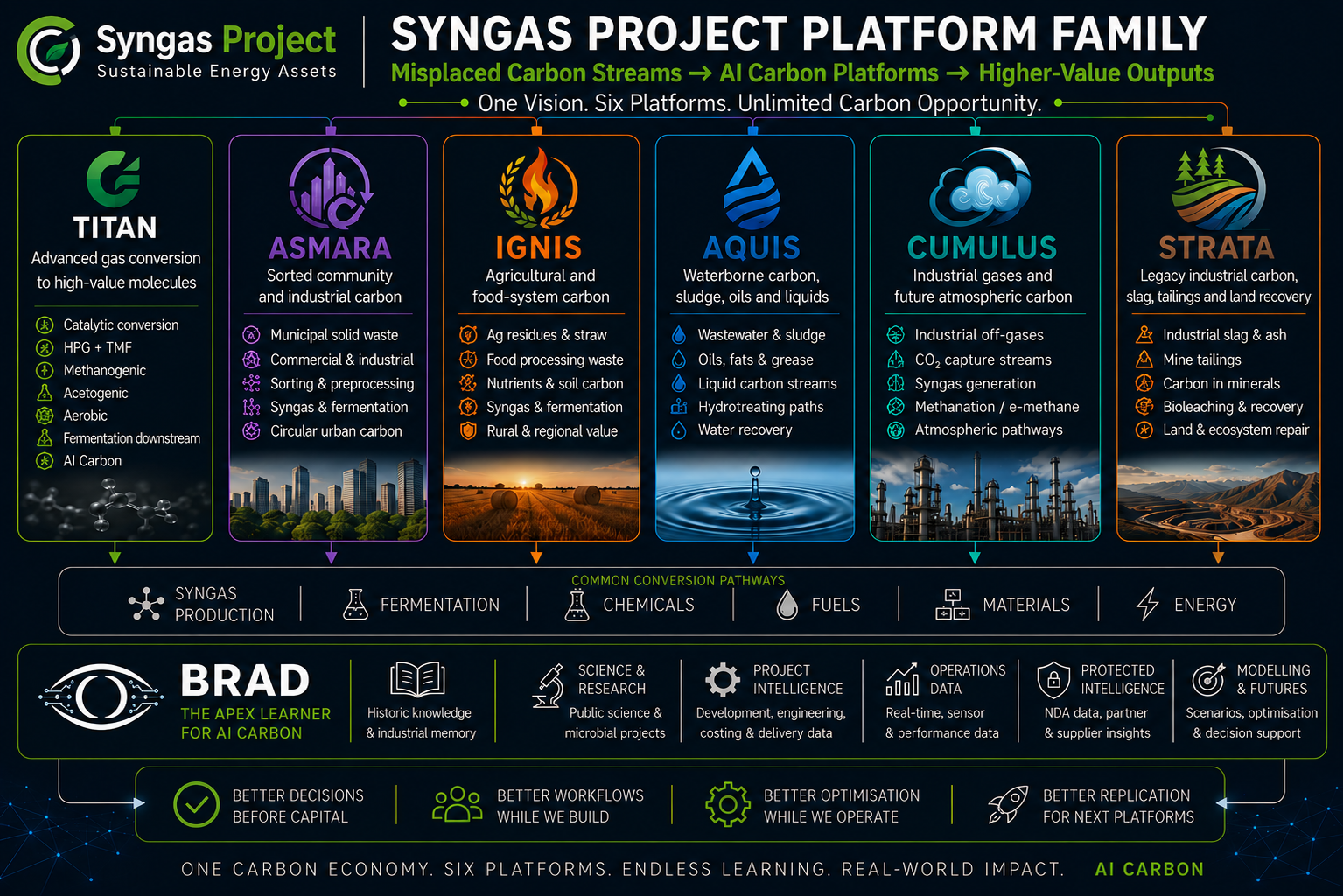
The Syngas Project Family turns different misplaced carbon streams into fuels, chemicals, materials, gases, nutrients and recovered minerals. Each platform focuses on a specific carbon source. Together, they form a practical deployment system for the circular economy.
TITAN is the flagship platform. It converts forest residues and non-virgin wood into Hydrogen Producer Gas and then into renewable products through Targeted Microbial Fermentation.
But TITAN is also the first member of a wider family.
The Six Pack
The Syngas Project Family consists of six deployment platforms:

TITAN converts solid forest carbon. TITAN is our leading platform. Click the icon above to find out more. Click here for the TITAN teaser. EU/ETS (plus Ukraine, Belarus and Georgia forest resources Click here

ASMARA converts solid community carbon from sorted municipal waste. Click the icon above to find out more, or click here for the ASMARA teaser. Click here for the ASMARA EU/ETS Country Summary

IGNIS converts agricultural and food carbon, including residues such as poultry litter. Click the icon above to find out more, or click here for the IGNIS Field Husbandry teaser or here for the IGNIS Poultry Husbandry teaser. Click here for the IGNIS Poultry Summary

AQUIS treats waterborne carbon, including sludge, spent filters, microplastics and contaminated residues. Click the icon above to find out more, or Click here for the AQUIS teaser. Click here for the AQUIS EU/ETS Waste Water Sludge Summary. Click here for the AQUIS EU/ETS extended AD Summary

CUMULUS manages gaseous carbon, including renewable gas, compressed gas and liquefied renewable gas. Click the icon above to find out more, or click here for the CUMULUS teaser.

STRATA recovers value from legacy carbon, minerals, ash, spoil, tailings and industrial residues. Click the icon above to find out more, or click here for the STRATA teaser.
Each platform has its own feedstock, business model and operating team. But the industrial logic is shared.
The common engine
The family is built around Hydrogen Producer Gas and Targeted Microbial Fermentation, and the full stack fermentation capability TMF has three

Methanogenic Microbes: Methanogenic pathways produce renewable gas. Click on the icon above to find out more

Acetogenic Microbes: Acetogenic pathways produce alcohols and chemical intermediates. Click on the icon above to find out more

Aerobic Microbes: Aerobic pathways support proteins, materials, water treatment and specialist microbial applications. Click on the icon above to find out more
One Common Currency
Hydrogen Producer Gas gives the platform family a common carbon and hydrogen intermediate. Targeted Microbial Fermentation then directs that intermediate into specific products.
This creates a flexible system. The platform does not depend on one feedstock, one product or one market. It converts different carbon streams into the products most needed by industry.
How does the TMF industry work?
Click here How the TMF Supply Chain Works to find out
Why the family matters
The circular economy does not have one waste problem. It has many misplaced carbon problems.
Forests produce residues.
Cities produce sorted waste.
Farms produce litter, digestate and organic residues.
Water systems collect plastics, sludge and metals.
Industry produces gas streams, ash, tailings and legacy materials.
Syngas Project does not treat these as separate problems. It treats them as connected industrial opportunities.
The Six Pack gives each carbon stream a home.
TITAN remains the flagship
The Platform page is now reserved for TITAN.
That matters.
TITAN is the foundation platform because forest residues provide scale, logistics, energy density and industrial discipline. TITAN proves the full stack: feedstock, gasification, gas cleaning, fermentation, energy integration, biochar, ash handling, certification and offtake.
Once TITAN is established, the same industrial DNA expands across ASMARA, IGNIS, AQUIS, CUMULUS and STRATA.
The Syngas Project Family is therefore not a collection of ideas. It is a deployment architecture.
Six platforms.
One circular industrial system.
Carbon misplaced.
Carbon recovered.
Carbon put back to work.