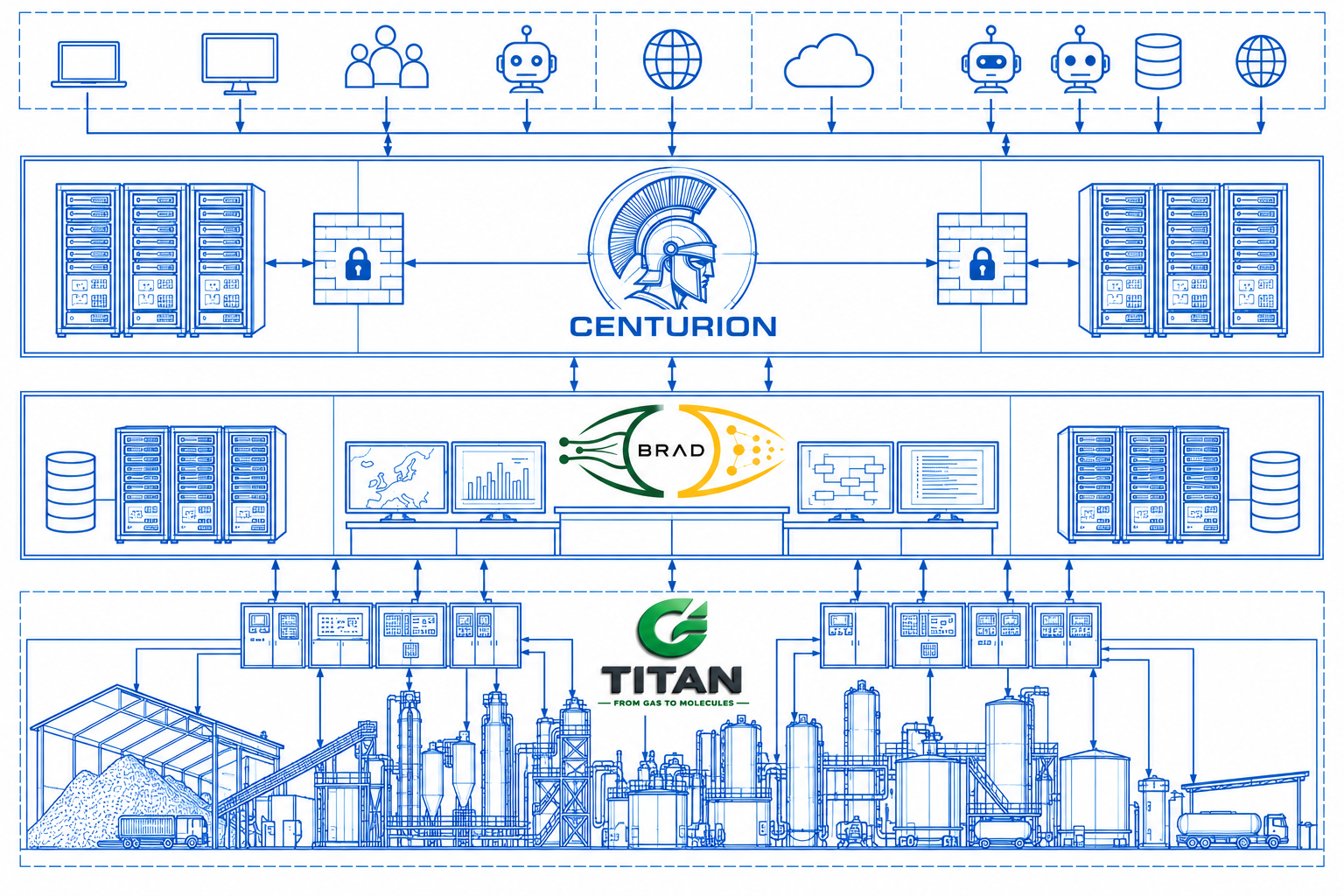
BRAD CENTURION When the Firewall Is No Longer Enough
Artificial intelligence is evolving for good and for bad.
Today, AI agents are at an awkward age. They are capable, enthusiastic and increasingly autonomous, but they can also be unpredictable. At times they resemble boisterous children ringing the doorbell and running away.
It would be dangerous to assume that this stage will last.
Agents are learning to research, navigate systems, use software, communicate with other agents and undertake sequences of actions with progressively less human intervention. Soon the important question will not be what one AI agent can do. It will be what hundreds or thousands of coordinated agents can achieve together.
That changes cybersecurity fundamentally.
For organisations possessing valuable intellectual property, one response to AI is already emerging: bring intelligence inside the organisation.
Run your own Large Language Model. Ring-fence proprietary information. Build a private data estate. Prevent commercially sensitive knowledge from routinely travelling to external AI platforms.
That is sensible.
But evolution does not occur on only one side of the wall.
While we develop AI to protect and exploit our intellectual property, counterparties can develop agents whose purpose is to discover more data, more relationships and ultimately more intellectual property.
The contest therefore evolves.
And the answer can no longer simply be a firewall.
Artificial intelligence is usually described as a digital revolution. The public story is about larger models, faster chips, bigger data centres and the race between technology companies. That story is true, but it is incomplete.
The next phase of AI will not stay inside screens, clouds or language models. It will move into the physical world. It will manage energy, optimise carbon, route feedstocks, predict supply chains, control fermentation, balance power demand and help convert waste into useful products.
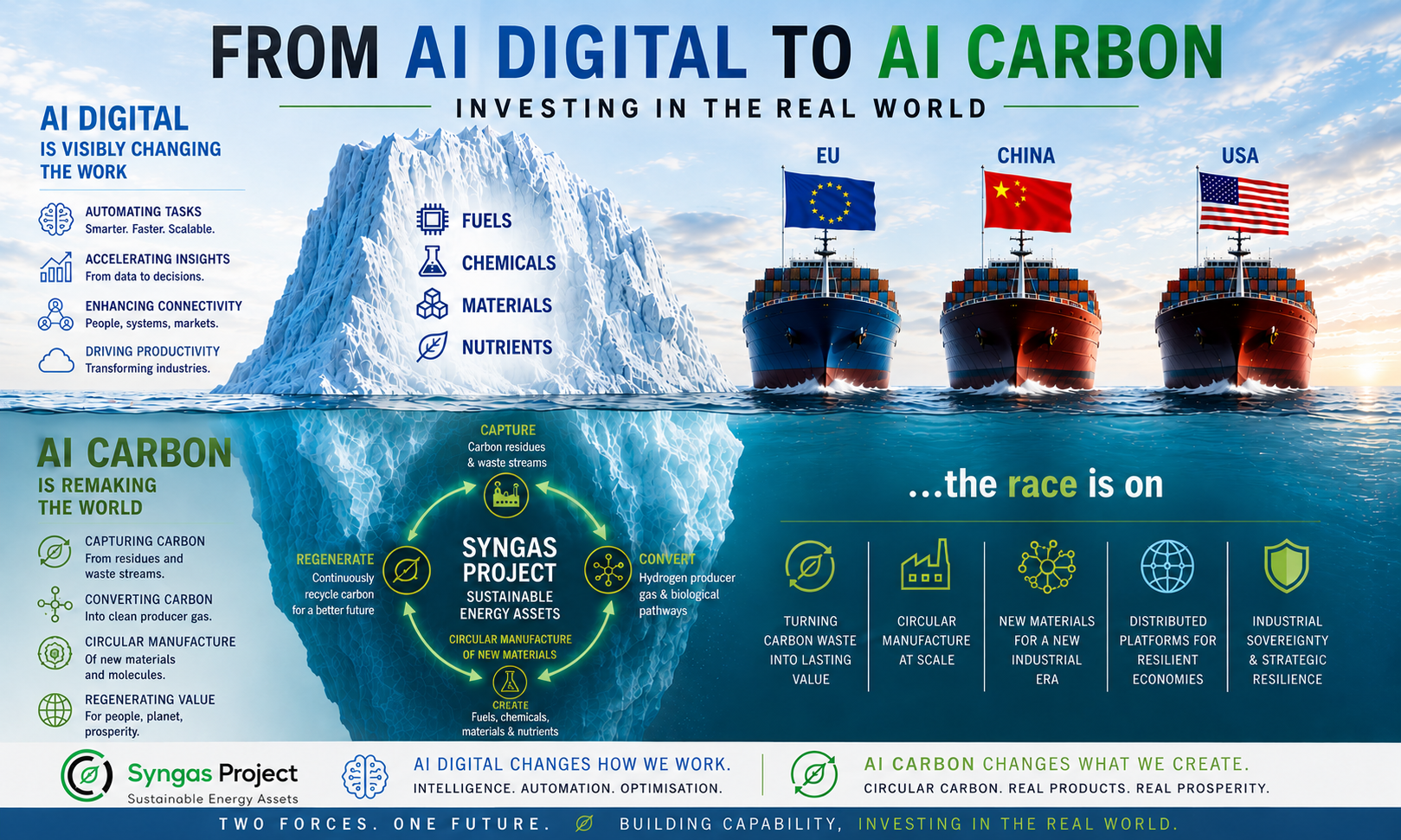
That is the shift from AI Digital to AI Carbon.
AI Digital changes what we know, write, model and decide. AI Carbon changes what we make.
This distinction matters because civilisation is not built from data alone. It is built from fuels, chemicals, materials, nutrients, infrastructure and energy systems. The digital world may guide decisions, but the physical world still determines whether aircraft fly, homes are heated, food is produced, factories operate and economies remain sovereign.
The question is no longer only who has the largest model. The question is who will build the industrial platforms that AI can operate.
Carbon is not the enemy
For decades, carbon has been treated mainly as a pollution problem. That view is understandable, but it is too narrow. Carbon is also the foundation of industrial civilisation.
Carbon appears in fuels, plastics, solvents, textiles, fertilisers, packaging, proteins, pharmaceuticals, building materials and thousands of chemical intermediates. Modern economies do not need a world without carbon. They need a world where carbon is recovered, routed, converted and reused intelligently.
The problem is not carbon itself. The problem is linear carbon.
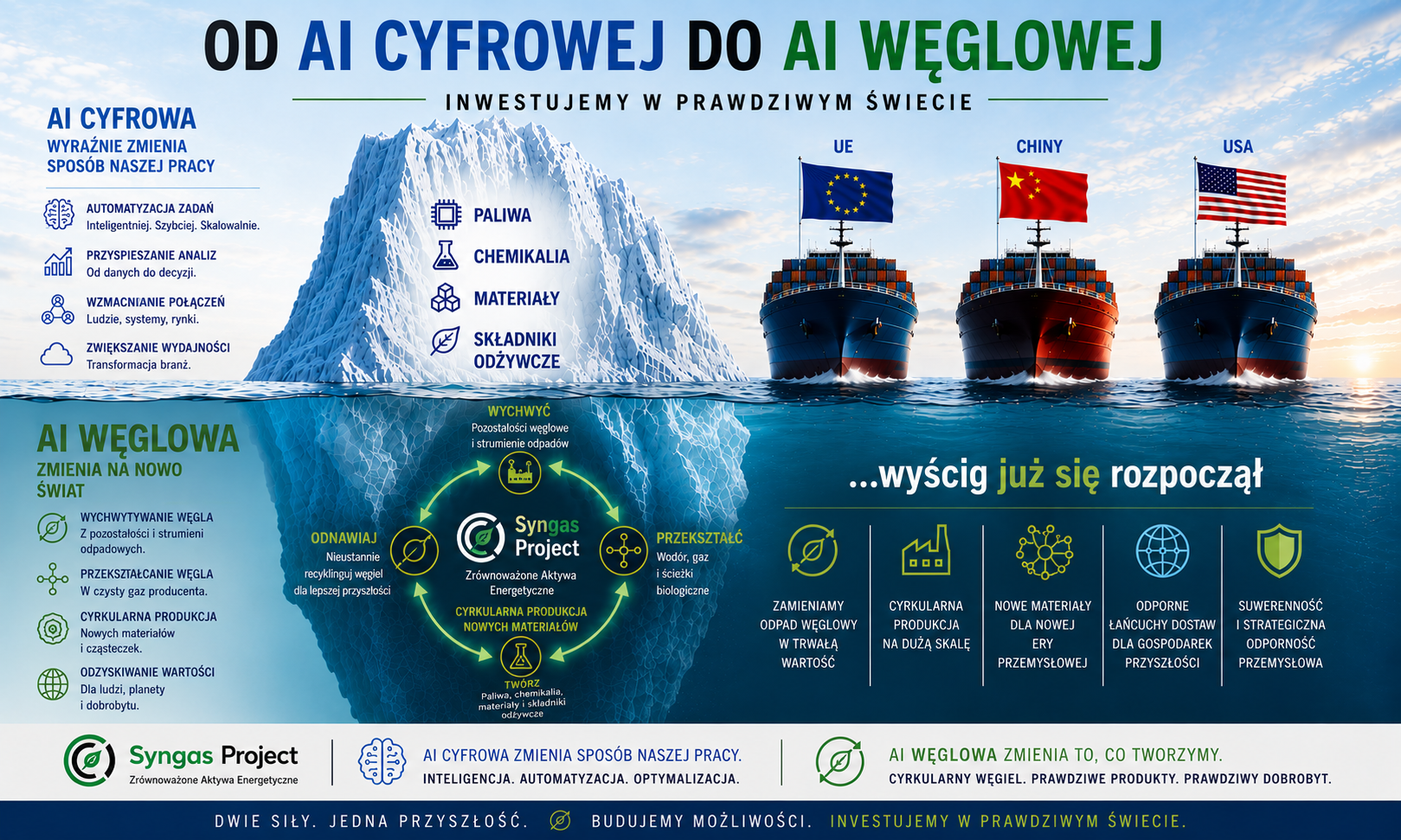
Sztuczna inteligencja jest zwykle opisywana jako rewolucja cyfrowa. Publiczna narracja koncentruje się na coraz większych modelach, szybszych układach scalonych, większych centrach danych i wyścigu pomiędzy firmami technologicznymi. Ta narracja jest prawdziwa, ale niepełna.
Kolejny etap rozwoju sztucznej inteligencji nie pozostanie zamknięty w ekranach, chmurze obliczeniowej ani modelach językowych. AI zacznie działać w świecie fizycznym. Będzie zarządzać energią, optymalizować obieg węgla, kierować strumieniami surowców, przewidywać łańcuchy dostaw, sterować fermentacją, bilansować zapotrzebowanie na energię oraz wspierać przekształcanie odpadów w użyteczne produkty.
To jest przejście od AI Digital do AI Carbon.
AI Digital zmienia to, co wiemy, piszemy, modelujemy i decydujemy. AI Carbon zmienia to, co produkujemy.
To rozróżnienie ma znaczenie, ponieważ cywilizacja nie jest zbudowana wyłącznie z danych. Jest zbudowana z paliw, chemikaliów, materiałów, składników odżywczych, infrastruktury i systemów energetycznych. Świat cyfrowy może wspierać decyzje, ale to świat fizyczny nadal decyduje o tym, czy samoloty latają, domy są ogrzewane, żywność jest produkowana, fabryki działają, a gospodarki pozostają suwerenne.
Pytanie nie brzmi już tylko: kto ma największy model AI? Pytanie brzmi: kto zbuduje platformy przemysłowe, którymi sztuczna inteligencja będzie mogła sterować?
Węgiel nie jest wrogiem
Przez dziesięciolecia węgiel był traktowany głównie jako problem związany z zanieczyszczeniem. To zrozumiałe, ale zbyt wąskie spojrzenie. Węgiel jest również podstawą cywilizacji przemysłowej.
Węgiel znajduje się w paliwach, tworzywach sztucznych, rozpuszczalnikach, tekstyliach, nawozach, opakowaniach, białkach, farmaceutykach, materiałach budowlanych oraz tysiącach półproduktów chemicznych. Nowoczesne gospodarki nie potrzebują świata bez węgla. Potrzebują świata, w którym węgiel jest odzyskiwany, kierowany, przetwarzany i wykorzystywany ponownie w sposób inteligentny.
Problemem nie jest sam węgiel. Problemem jest liniowy model wykorzystania węgla.
Wydobyć. Spalić. Wyemitować. Zmarnować.
Ten model dochodzi do granic swojej użyteczności.
AI Carbon wychodzi z innego założenia: węgiel powinien być zarządzany jako krążący zasób przemysłowy. Węgiel, który został utracony, źle umiejscowiony albo rozproszony, może zostać odzyskany i przekształcony w użyteczne molekuły. Pozostałości leśne, sortowane odpady komunalne, biogeniczne strumienie gazowe, przemysłowy CO₂, węgiel zawarty w ściekach oraz inne niedostatecznie wykorzystane źródła mogą stać się częścią nowej, cyrkularnej bazy produkcyjnej.
To nie jest teoria dotycząca odległej przyszłości. Poszczególne technologie już istnieją. Istnieje zgazowanie. Istnieje fermentacja. Istnieje biometan. Istnieją ścieżki produkcji SAF. Istnieje biowęgiel. Istnieje automatyka procesowa. Istnieje przemysłowa sztuczna inteligencja.
Łatwo błędnie uznać TITAN za elektrownię na biomasę. To byłoby całkowite niezrozumienie projektu.
TITAN został zaprojektowany jako platforma HPG + Full Stack TMF.
HPG oznacza Hydrogen Producer Gas, czyli gaz producenta wodoru. Jest on wytwarzany z pozostałości leśnych poprzez kontrolowaną konwersję termiczną. Ten gaz nie jest po prostu spalany i tracony. Staje się elastycznym nośnikiem węgla i energii.
TMF oznacza Targeted Microbial Fermentation, czyli ukierunkowaną fermentację mikrobiologiczną. Mówiąc prosto, mikroorganizmy zużywają gaz i przekształcają zawarty w nim węgiel w użyteczne produkty. W zależności od ścieżki biologicznej i trybu pracy platforma może wspierać produkcję gazu odnawialnego, etanolu, chemikaliów, białek i innych przyszłych molekuł.
Dlatego TITAN powinien być rozumiany jako infrastruktura kierowania węglem.
Jedna ścieżka może wspierać energię elektryczną i ciepło. Druga może wspierać gaz odnawialny. Kolejna może wspierać produkcję etanolu 2G dla zrównoważonego paliwa lotniczego poprzez ścieżkę alcohol-to-jet. W przyszłości dodatkowe ścieżki fermentacyjne mogą wspierać inne chemikalia, materiały i składniki odżywcze.
Wartość nie polega wyłącznie na jednym produkcie. Wartość polega na opcjonalności.
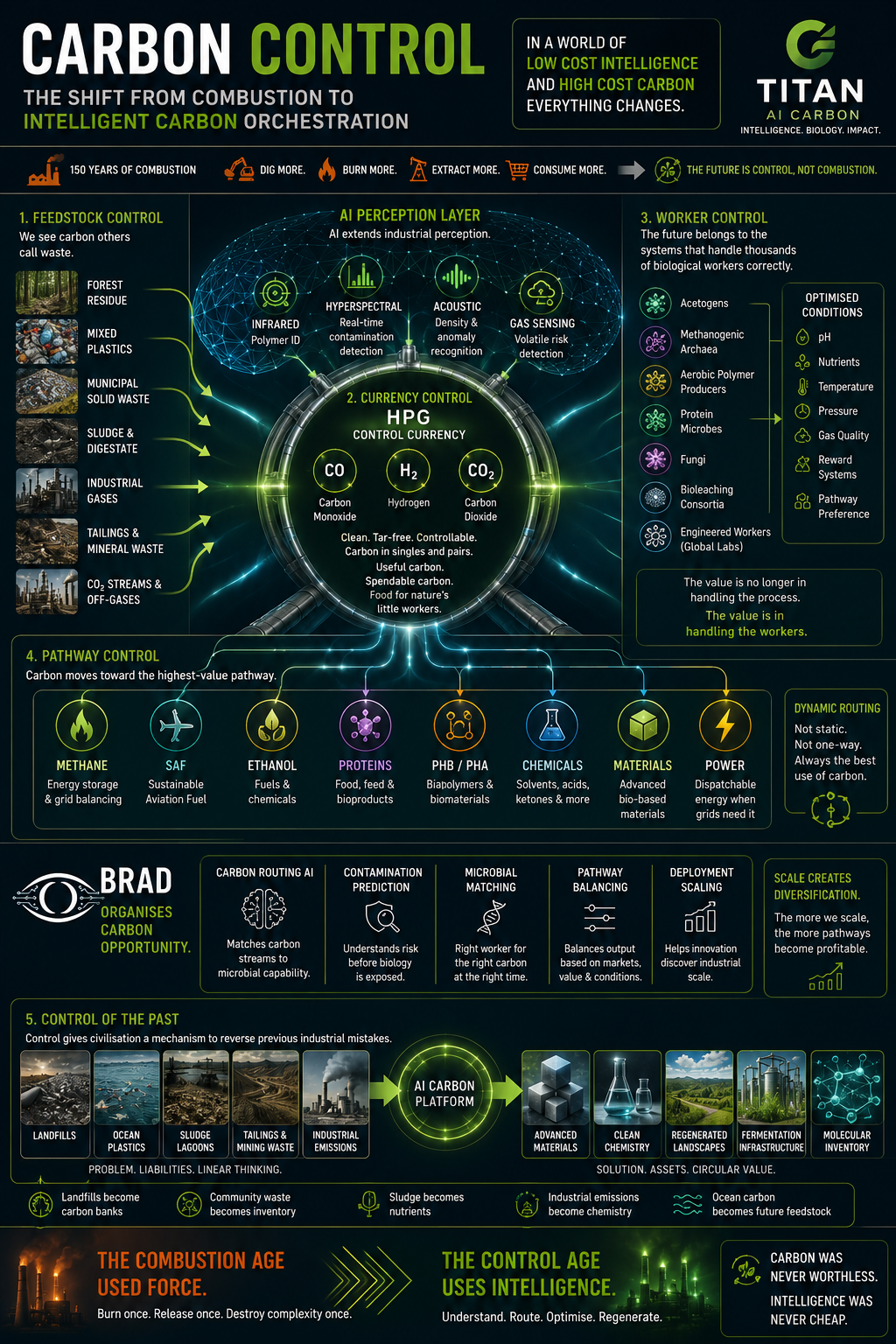
In a world where intelligence is cheap and carbon is expensive, the rules of industry have changed.
You might have missed it.
We did not.
For 150 years civilisation solved carbon with brute force.
Dig more.
Burn more.
Extract more.
Consume more.
That worked when intelligence was expensive and carbon was undervalued.
But AI changes the price of understanding.
And when understanding becomes cheap enough, burning complex carbon starts looking less like intelligence and more like industrial illiteracy.
The next industrial advantage is not extraction.
It is control.
Not control over people.
Control over carbon.
And the value of control compounds in layers.
The first layer is feedstock control.
This is where most of the world still gives up.
Municipal waste is too dirty.
Mixed plastics are too contaminated.
Sludge is too variable.
Industrial gases are inconvenient.
So the old economy burns the uncertainty and calls it disposal.
The control economy behaves differently.
It sees the carbon first.
Infrared systems identify polymer signatures invisible to the human eye. Hyperspectral systems detect contamination dynamically. Acoustic systems recognise abnormal density patterns. Gas sensing systems identify volatile risks before downstream biology is exposed.
This is where AI leaves the screen and enters the physical economy.
Not replacing workers.
Extending industrial perception.
The moment dirty carbon becomes controllable, it stops being waste.
It becomes inventory.
That is the first value unlock.
The second layer is currency control.
This is where HPG changes the game.
Hydrogen Producer Gas is not simply synthesis gas.
Dlaczego kolejna epoka przemysłowa będzie oparta na kontroli węgla, a nie na jego spalaniu
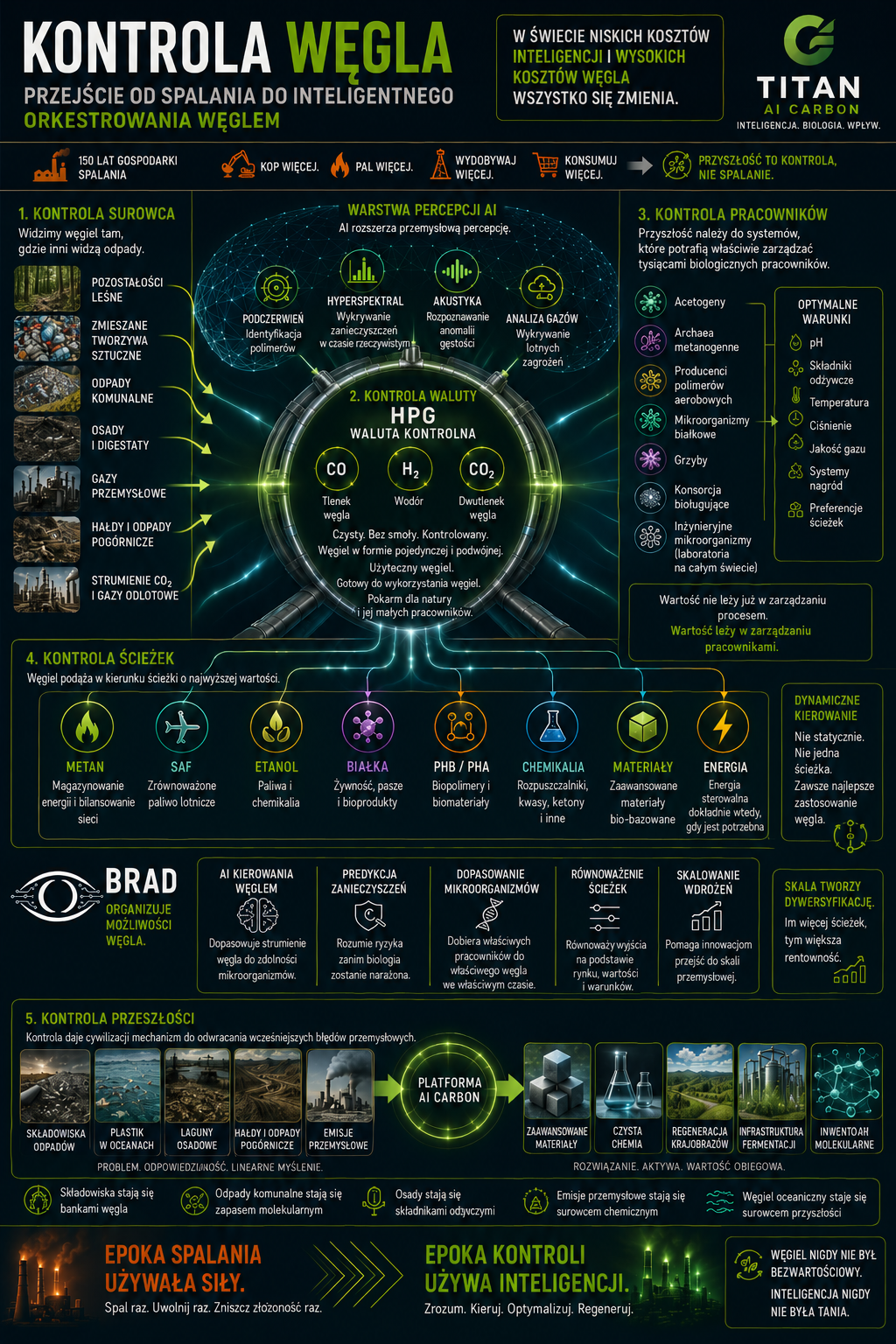
W świecie, w którym inteligencja staje się tania, a węgiel coraz cenniejszy, zasady przemysłu ulegają zmianie.
Wielu jeszcze tego nie zauważyło.
My tak.
Przez ponad 150 lat cywilizacja rozwiązywała problem węgla metodą brutalnej siły.
Więcej wydobywać.
Więcej spalać.
Więcej konsumować.
Więcej wyrzucać.
Ten model działał, gdy inteligencja była droga, a wartość węgla niedoceniana.
Sztuczna inteligencja zmienia jednak koszt zrozumienia.
A gdy zrozumienie staje się wystarczająco tanie, spalanie złożonych struktur węglowych zaczyna przypominać nie rozwój przemysłowy, lecz przemysłowy analfabetyzm.
Największą przewagą przyszłości nie będzie już wydobycie.
Będzie nią kontrola.
Nie kontrola nad ludźmi.
Kontrola nad węglem.
A wartość tej kontroli rośnie warstwowo.
Pierwszą warstwą jest kontrola surowca.
To właśnie tutaj większość świata nadal się poddaje.
Odpady komunalne są zbyt zabrudzone.
Zmieszane tworzywa sztuczne są zbyt zanieczyszczone.
Osady ściekowe są zbyt niestabilne.
Gazy przemysłowe są zbyt niewygodne.
Dlatego stara gospodarka spala niepewność i nazywa to utylizacją.
Gospodarka kontroli działa inaczej.
Najpierw dostrzega węgiel.
Systemy podczerwieni identyfikują sygnatury polimerów niewidoczne dla ludzkiego oka. Systemy hiperspektralne wykrywają dynamicznie zmieniające się zanieczyszczenia. Analiza akustyczna rozpoznaje anomalie gęstości materiału. Czujniki gazowe identyfikują ryzyko zanim procesy biologiczne zostaną zakłócone.
To właśnie tutaj sztuczna inteligencja opuszcza ekran i wchodzi do fizycznej gospodarki.
Nie zastępuje ludzi.
Rozszerza przemysłową percepcję.
W momencie, gdy zabrudzony węgiel staje się kontrolowalny, przestaje być odpadem.
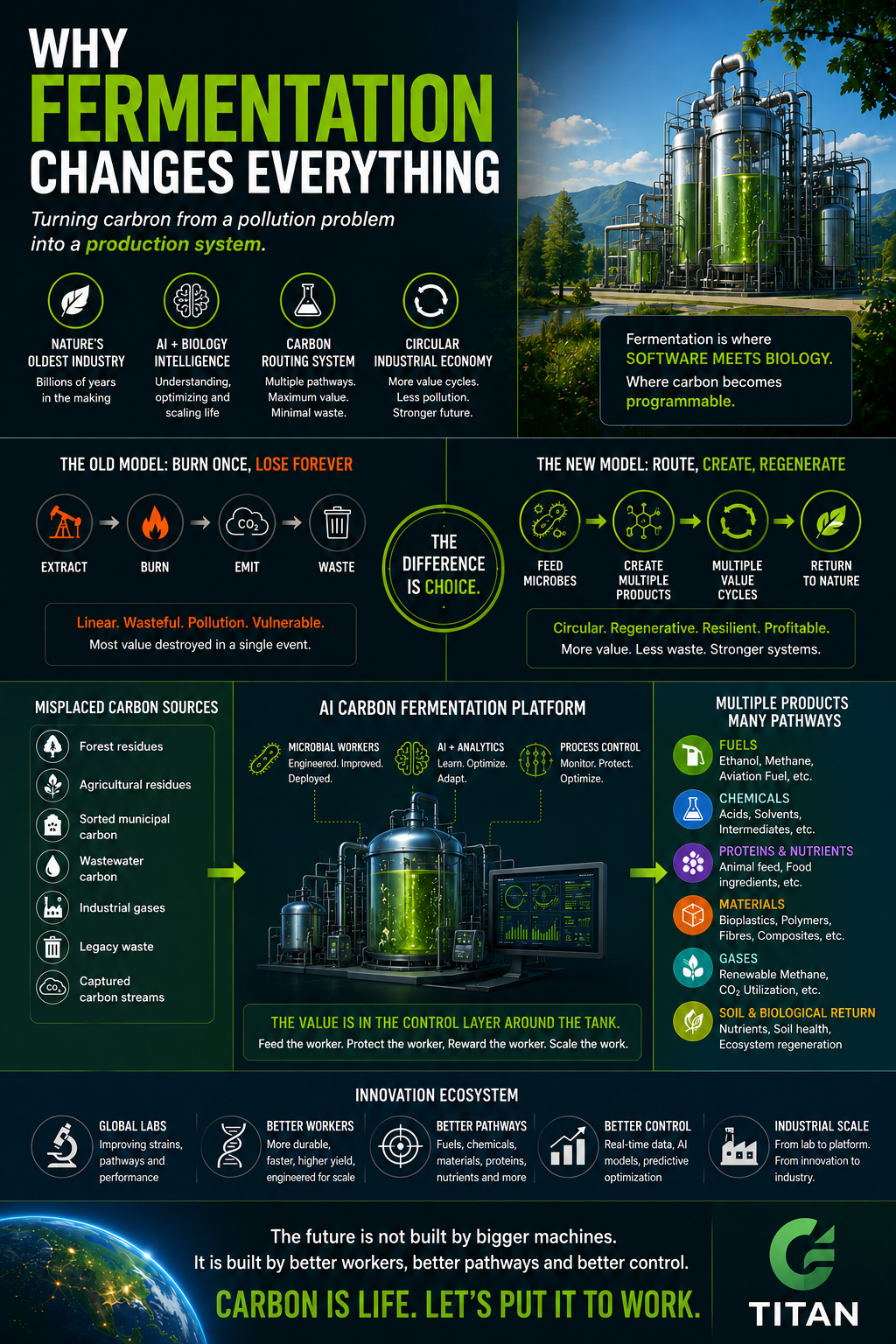
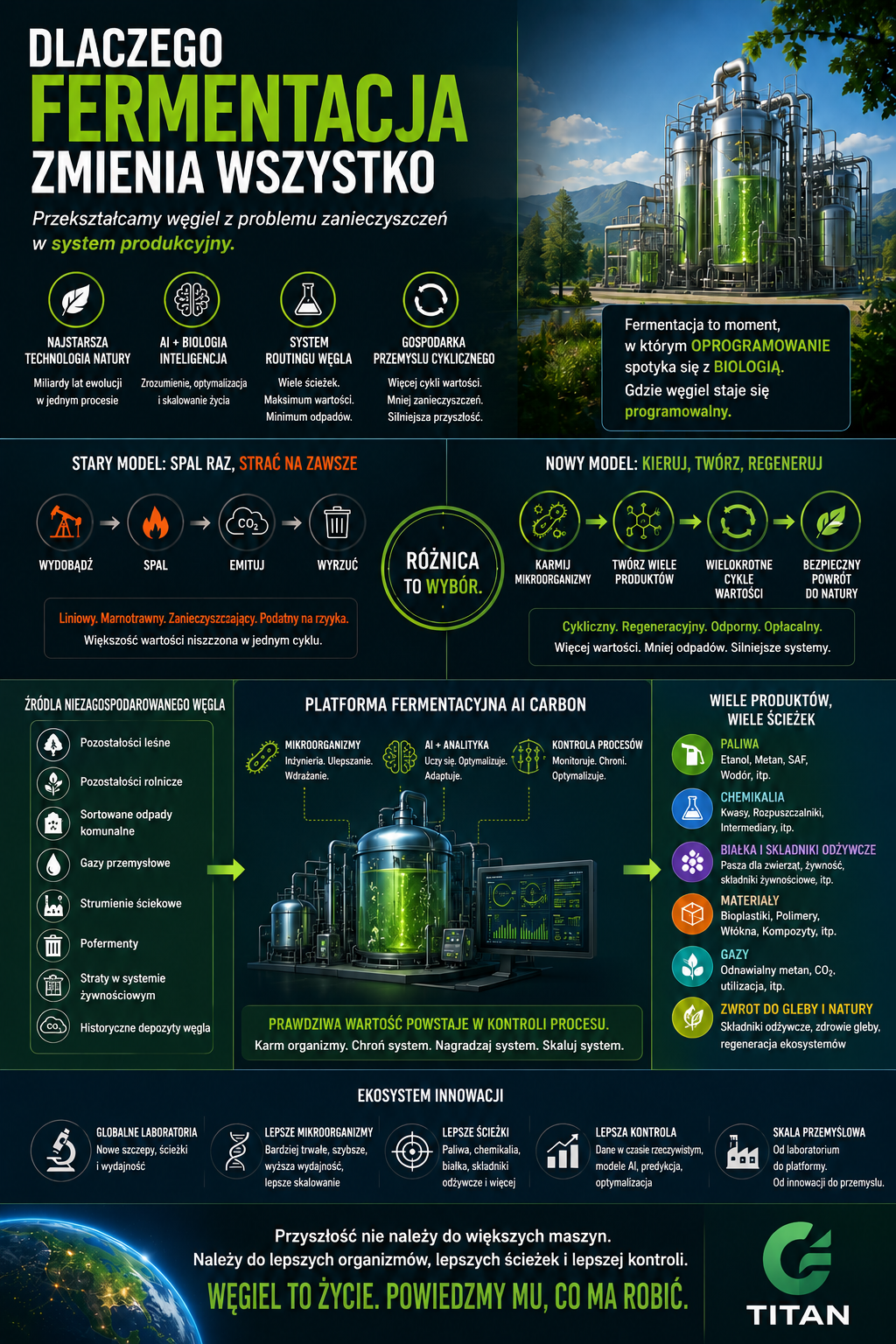
Fermentation changes everything because it moves carbon from destruction to production.
For most of the industrial age, we treated carbon as something to burn. We dug it up, cut it down, refined it, combusted it, consumed it and wasted it. That model created abundance, but it also created pollution, dependency and strategic weakness.
AI Carbon begins from a different idea.
Carbon is not the enemy.
Carbon is the working material of life.
The real question is whether we burn it once, or whether we learn to route it intelligently through fuels, chemicals, materials, nutrients, gases and recovery systems.
That is why fermentation matters.
Fermentation is not an old cottage industry. It is not only beer, bread, yoghurt or wine. Fermentation is one of nature’s oldest industrial systems. Microbes already know how to build, break, convert, repair and reorganise carbon. They have been doing it for billions of years.
The new step is control.
Artificial intelligence, gas analytics, microbial engineering, process monitoring and industrial platform design now allow us to understand what the microbial workers need, how they perform, how they can be improved, and how their work can be scaled.
That is the real change.
We are no longer only designing machines.
We are designing working environments for biology.
In the fossil economy, the refinery was the centre of value. Oil entered the refinery and was separated into fuels, chemicals, solvents, plastics, fibres and materials.
In the AI Carbon economy, fermentation platforms can begin to take over that role.
Instead of crude oil, the feedstock can be misplaced carbon: forest residues, sorted municipal carbon, agricultural residues, wastewater carbon, industrial gases, legacy waste and captured carbon streams.
Instead of only combustion, the platform creates pathways.
Acetogenic microbes can convert carbon monoxide, carbon dioxide and hydrogen into ethanol and other chemical building blocks. Methanogenic microbes can convert carbon gases into renewable methane. Aerobic systems can support proteins, nutrients and biological products. Other pathways can support acids, solvents, polymers, fibres and new materials.
Fermentacja zmienia wszystko, ponieważ przenosi węgiel z modelu niszczenia do modelu produkcji.
Przez większość epoki przemysłowej traktowaliśmy węgiel jako coś, co należy spalić. Wydobywaliśmy go, ścinaliśmy, rafinowaliśmy, spalaliśmy, zużywaliśmy i marnowaliśmy. Ten model stworzył dobrobyt, ale jednocześnie doprowadził do zanieczyszczeń, zależności surowcowej i strategicznej słabości.
AI Carbon wychodzi z zupełnie innego założenia.
Węgiel nie jest problemem.
Węgiel jest podstawowym materiałem życia.
Prawdziwe pytanie brzmi: czy spalimy go jeden raz, czy nauczymy się inteligentnie kierować go przez wiele cykli wartości — paliwa, chemikalia, materiały, składniki odżywcze, gazy oraz systemy odzysku.
Właśnie dlatego fermentacja ma tak ogromne znaczenie.
Fermentacja nie jest już wyłącznie dawnym procesem spożywczym. To nie tylko piwo, chleb, jogurt czy wino. Fermentacja jest jednym z najstarszych systemów przemysłowych natury. Mikroorganizmy od miliardów lat potrafią budować, rozkładać, przekształcać i reorganizować węgiel.
Nowym elementem jest kontrola.
Sztuczna inteligencja, analityka gazowa, inżynieria mikrobiologiczna, monitoring procesów oraz nowoczesne platformy przemysłowe pozwalają dziś zrozumieć potrzeby mikroorganizmów, sposób ich pracy oraz to, jak można zwiększać ich wydajność i skalować ich działanie.
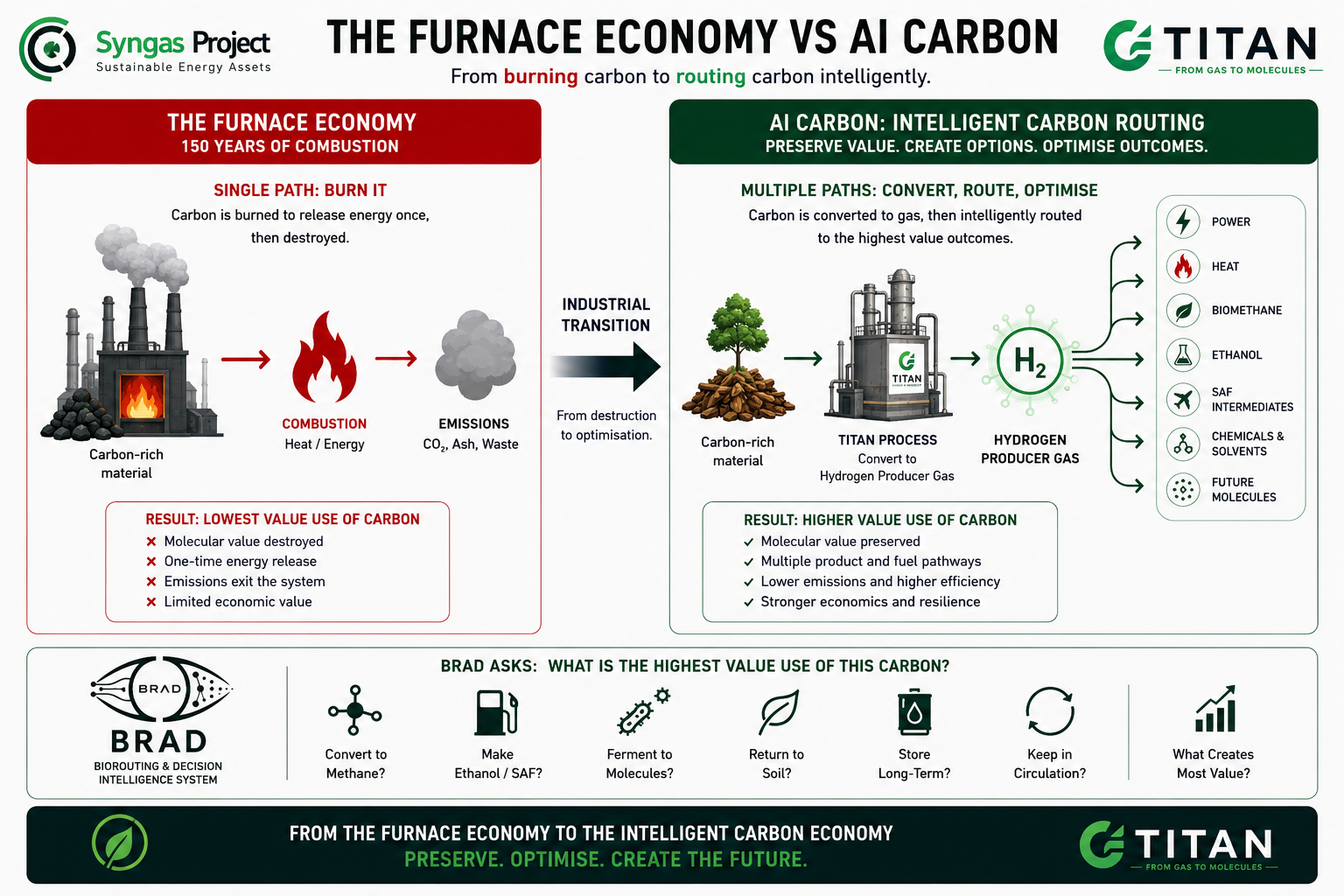
For almost 150 years, industrial civilisation has been built around one dominant idea:
If carbon contains energy, burn it.
Coal powered the industrial revolution. Oil powered transport. Gas powered modern electricity systems. Entire cities, industries and economies were designed around combustion because combustion released energy quickly and at enormous scale.
But combustion also destroys something.
The moment carbon burns, its molecular structure disappears. Heat is released once, then the carbon leaves the system as exhaust, ash or emissions. For generations this looked perfectly rational because energy itself was the prize. Nobody seriously asked whether carbon might hold more value before it entered the furnace.
That assumption is beginning to break.
The modern industrial economy increasingly depends not only on energy, but on molecules. Fuels matter, but so do solvents, gases, polymers, chemicals, materials and biological feedstocks. A tonne of carbon-rich material may now hold greater value as industrial feedstock than as immediate heat.
This changes the industrial question completely.
The old economy asked:
How much energy can we release from carbon?
The emerging economy asks:
What is the highest possible value this carbon can become before we burn it?
That is where TITAN diverges from the traditional furnace economy.
TITAN does not simply burn carbon. It first converts carbon into hydrogen producer gas. Once carbon becomes gas, something important happens. The carbon is no longer trapped inside solid biomass. It becomes routeable.
That routing changes everything.
The same carbon stream may become electricity today, biomethane tomorrow, ethanol next week, or eventually SAF intermediates, solvents, ketones, acids or other industrial molecules. Instead of destroying molecular value immediately through combustion, TITAN attempts to preserve optionality for as long as possible.
This is the beginning of a very different industrial philosophy.
The furnace economy treats carbon as something to consume.
AI Carbon treats carbon as something to optimise.
That distinction may define the next industrial era.
Historically, combustion won because it was simple and cheap. Oil and gas became abundant. Giant centralised refineries and power systems dominated the world. Biological pathways, fermentation routes and alternative carbon systems were pushed aside because the economics of hydrocarbons overwhelmed almost everything else.
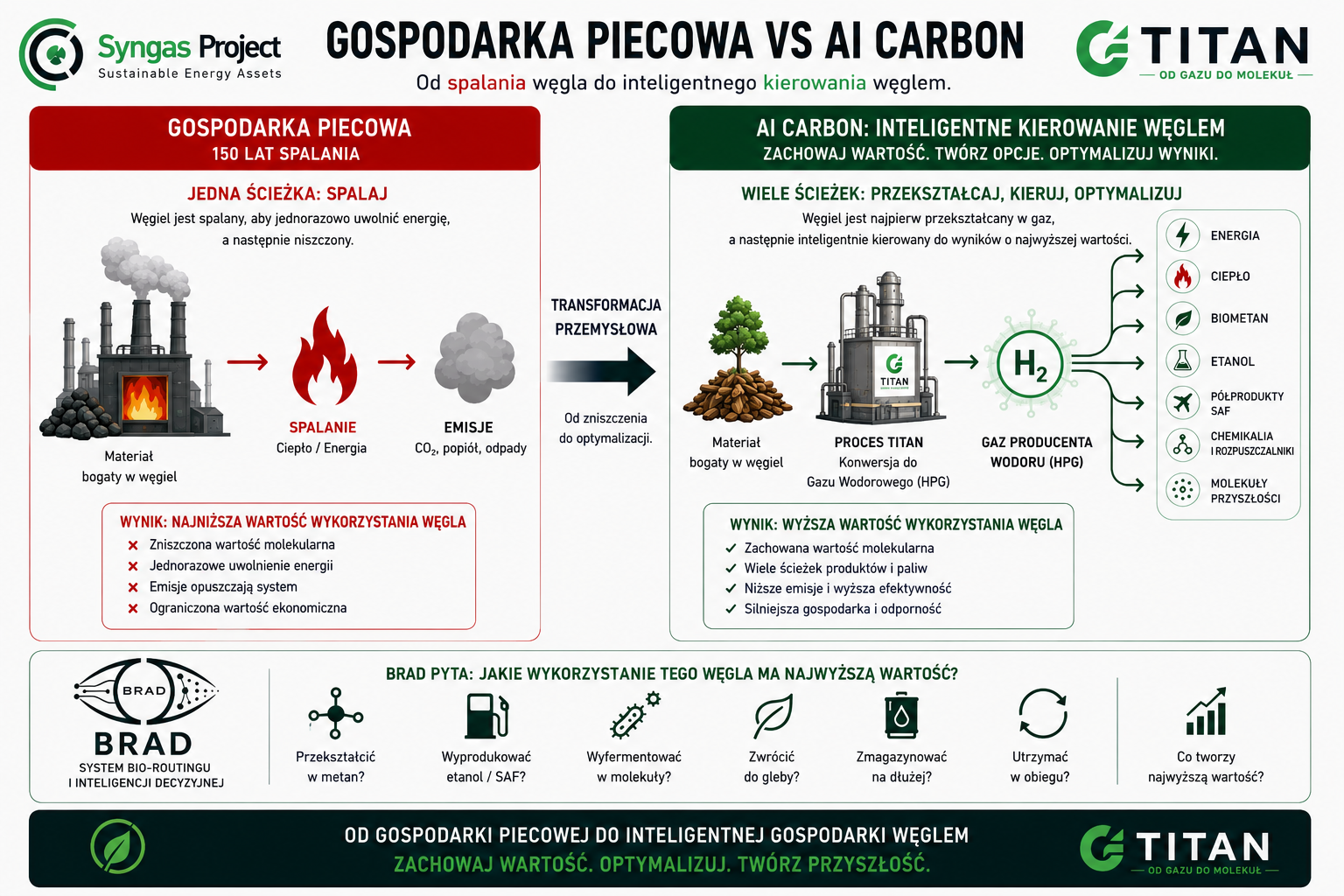
Przez niemal 150 lat cywilizacja przemysłowa była budowana wokół jednej dominującej idei:
Jeśli węgiel zawiera energię — należy go spalić.
Węgiel napędzał rewolucję przemysłową. Ropa napędzała transport. Gaz zasilał nowoczesne systemy energetyczne. Całe miasta, przemysł i gospodarki zostały zaprojektowane wokół spalania, ponieważ spalanie uwalniało energię szybko i na ogromną skalę.
Ale spalanie coś również niszczy.
W momencie spalania węgla jego struktura molekularna przestaje istnieć. Energia cieplna zostaje uwolniona tylko raz, a następnie węgiel opuszcza system jako spaliny, popiół lub emisje. Przez pokolenia wydawało się to całkowicie racjonalne, ponieważ sama energia była celem. Niewielu ludzi poważnie zastanawiało się, czy węgiel mógłby mieć większą wartość zanim trafi do pieca.
To założenie zaczyna się dziś rozpadać.
Nowoczesna gospodarka przemysłowa coraz bardziej zależy nie tylko od energii, lecz również od molekuł. Paliwa są ważne, ale równie ważne są rozpuszczalniki, gazy, polimery, chemikalia, materiały i biologiczne surowce procesowe. Tona materiału bogatego w węgiel może dziś mieć większą wartość jako surowiec przemysłowy niż jako źródło natychmiastowego ciepła.
To całkowicie zmienia pytanie przemysłowe.
Stara gospodarka pytała:
„Ile energii możemy uwolnić z węgla?”
Nowa gospodarka pyta:
„Jaką najwyższą możliwą wartość może osiągnąć ten węgiel zanim go spalimy?”
W tym miejscu TITAN odchodzi od tradycyjnej gospodarki spalania.
TITAN nie spala po prostu węgla. Najpierw przekształca go w gaz syntezowy HPG (Hydrogen Producer Gas). Gdy węgiel staje się gazem, wydarza się coś bardzo ważnego.
Węgiel przestaje być zamknięty w stałej biomasie.
Staje się kierowalny.
A możliwość kierowania strumieniem węgla zmienia wszystko.
Ten sam strumień węgla może dziś stać się energią elektryczną, jutro biometanem, w przyszłym tygodniu etanolem, a później komponentami SAF, rozpuszczalnikami, ketonami, kwasami lub innymi molekułami przemysłowymi. Zamiast natychmiast niszczyć wartość molekularną poprzez spalanie, TITAN stara się zachować opcjonalność tak długo, jak to możliwe.
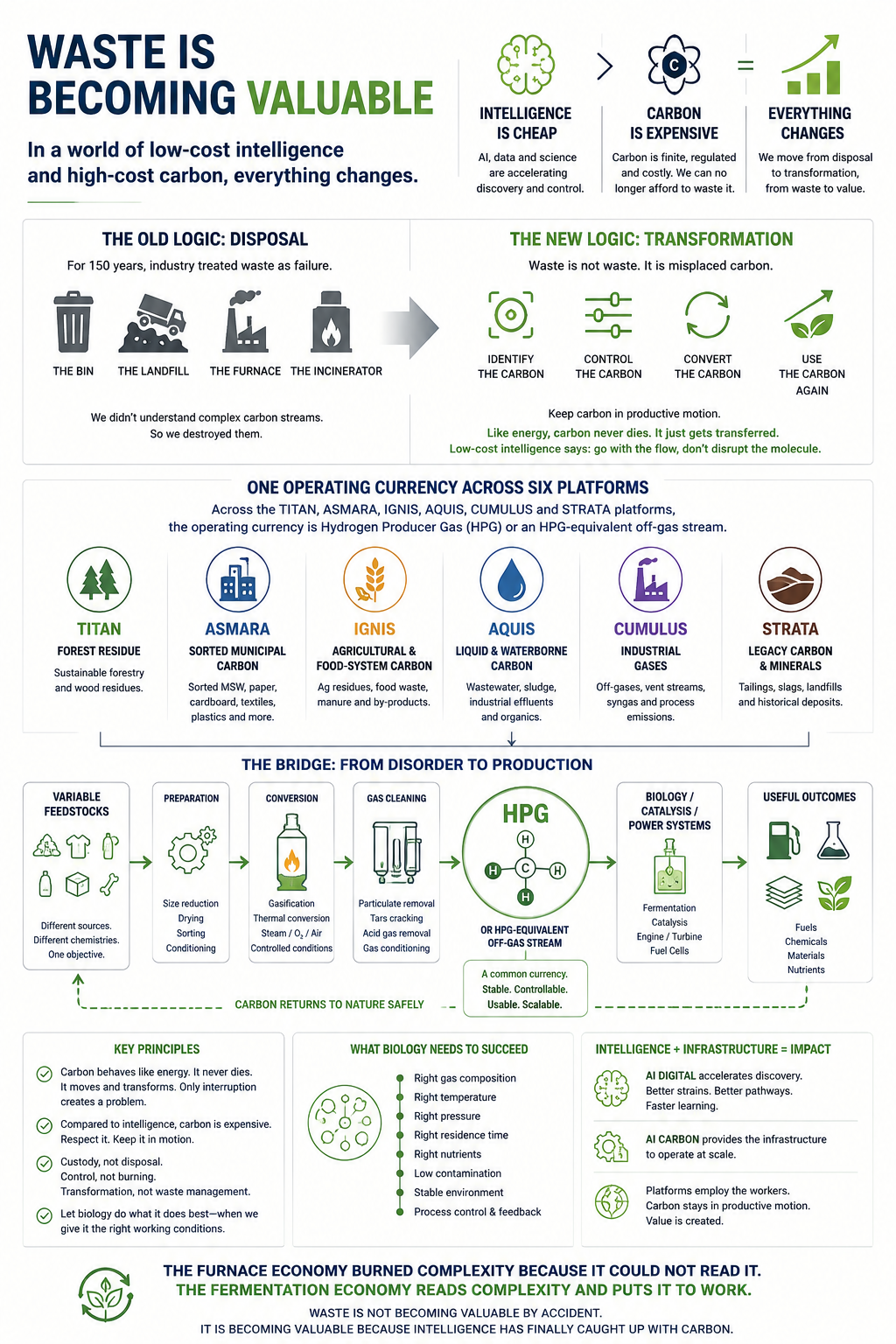
In a world of low-cost intelligence and high-cost carbon, everything changes.
For 150 years, industry treated waste as the failure point at the end of a process.
The bin.
The landfill.
The furnace.
The incinerator.
The problem was not only pollution. The deeper problem was that we did not understand complex carbon streams well enough to use them.
So we destroyed them.
Today, that logic is becoming obsolete.
What we used to call waste is not waste. It is misplaced carbon. It is carbon in the wrong place, in the wrong form, at the wrong time, without the right control system around it.
That distinction matters.
The value of what was once called waste behaves like energy. It does not simply disappear. It moves, changes form, transfers from one condition to another, and only becomes a problem when the flow is broken or deliberately interrupted. Low-cost intelligence tells us to stop fighting the molecule. Do not destroy it unless there is no better option. Understand it, guide it, and keep it moving. Like energy, carbon should go round and round, because compared to intelligence, carbon is expensive.
Once carbon can be identified, conditioned and converted into a common working currency, it stops being a disposal problem and becomes an industrial asset.
Across the TITAN, ASMARA, IGNIS, AQUIS, CUMULUS and STRATA platforms, that operating currency is Hydrogen Producer Gas, or an HPG-equivalent off-gas stream.
This is important because the front-end feedstock can change, while the back-end industrial logic remains consistent.
Forest residues.
Sorted municipal carbon.
Agricultural residues.
Wastewater carbon.
Industrial gases.
Tailings, slags and legacy deposits.
Each stream is different at the point of origin. Each has its own chemistry, moisture level, ash content, contaminants, logistics and regulatory context.
But the strategic objective is the same.
Convert disorder into a controllable carbon-rich gas stream.
Then feed that stream into biology, catalysis or power systems.
That is the bridge between waste management and carbon manufacturing.
For TITAN, forest residue is the starting point. For ASMARA, it is sorted municipal solid carbon. For IGNIS, it is agricultural and food-system carbon. For AQUIS, it is liquid and waterborne carbon. For CUMULUS, it is carbon already present in industrial gas streams. For STRATA, it is the legacy carbon and minerals left behind by the extraction age.