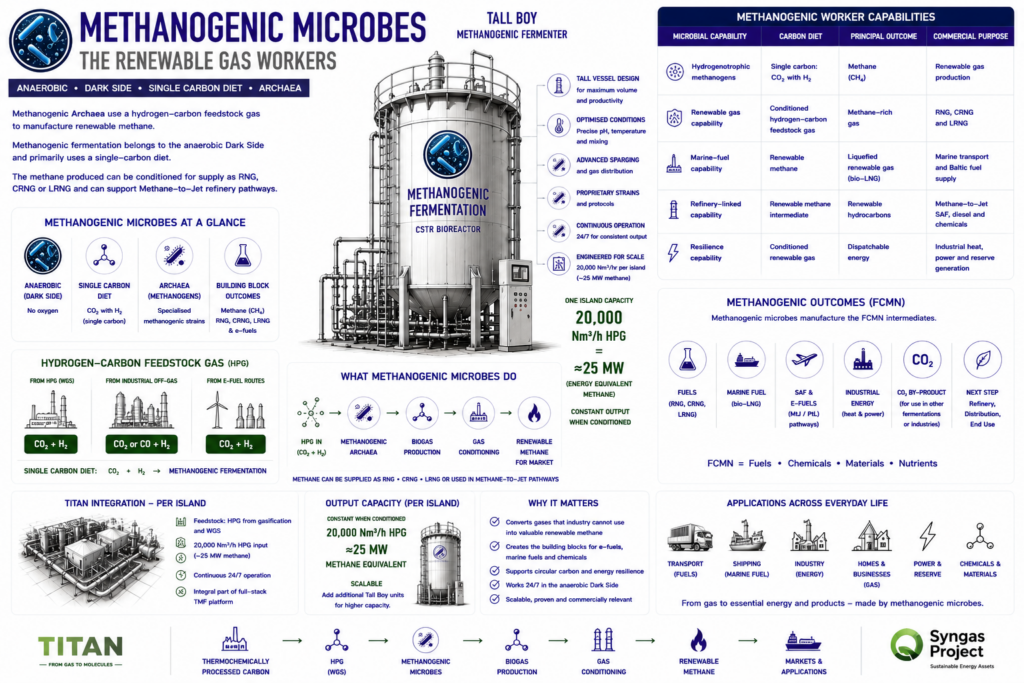
Methanogenic microbes are Archaea, the same microbial family widely used in anaerobic digestion to manufacture methane. Within Targeted Microbial Fermentation, they belong to the anaerobic Dark Side because they work without oxygen.
Methanogenic workers produce very little microbial biomass. Their commercial purpose is not to grow large quantities of cells, proteins or materials. Their purpose is focused: they convert a clean hydrogen–carbon gaseous diet into Renewable Natural Gas — RNG.
Syngas Project supplies their food in controlled industrial conditions. The gas is prepared thermochemically and delivered as a clean, consistent gaseous feed rather than as decomposing organic material.
This distinction is important.
Conventional anaerobic digestion can produce biogas containing siloxanes, sulphur compounds, moisture and other contaminants that require extensive cleaning. Methanogenic Microbial Capability deployed behind the TITAN gas train receives a prepared gaseous diet that is free from siloxanes and controlled within the requirements of the contracted biological package.
Methanogenic workers have a relatively low tolerance for impurities. They are therefore particularly well suited to:
the clean TITAN gas train;
conditioned industrial gases;
renewable hydrogen and carbon dioxide;
e-fuel production environments.
The detailed strains, reactor internals and operating protocols remain protected under the contractual arrangements with specialist Handlers and Biofoundries.
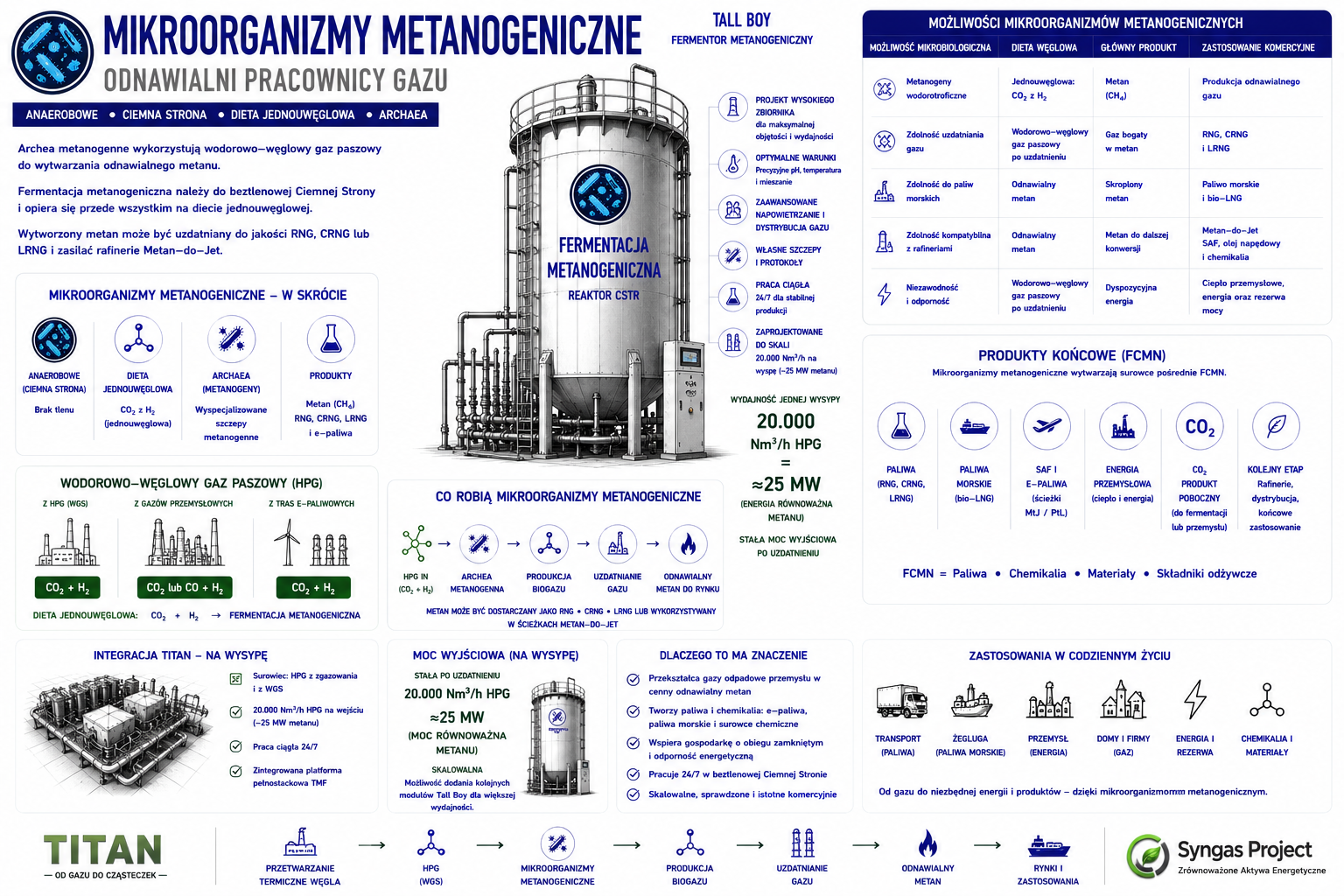
Mikroorganizmy metanogeniczne należą do domeny Archaea – tej samej grupy mikroorganizmów, która jest powszechnie wykorzystywana w procesach fermentacji beztlenowej do produkcji metanu. W ramach Ukierunkowanej Fermentacji Mikrobiologicznej (Targeted Microbial Fermentation – TMF) stanowią one część Beztlenowej Ciemnej Strony, ponieważ funkcjonują całkowicie bez udziału tlenu.
Mikroorganizmy metanogeniczne wytwarzają jedynie niewielkie ilości biomasy. Ich celem komercyjnym nie jest produkcja dużych ilości komórek, białek ani materiałów biologicznych. Ich zadanie jest znacznie bardziej wyspecjalizowane – przekształcają czysty gazowy substrat wodorowo–węglowy w Odnawialny Gaz Ziemny (Renewable Natural Gas – RNG).
Syngas Project dostarcza im pożywkę w ściśle kontrolowanych warunkach przemysłowych. Gaz jest przygotowywany metodami termochemicznymi i podawany jako czysty, jednorodny oraz stabilny gazowy substrat, a nie jako rozkładająca się materia organiczna.
To rozróżnienie ma zasadnicze znaczenie.
Konwencjonalna fermentacja beztlenowa wytwarza biogaz zawierający często siloksany, związki siarki, wilgoć oraz inne zanieczyszczenia wymagające rozbudowanych procesów oczyszczania. Natomiast Metanogeniczna Zdolność Mikrobiologiczna (Methanogenic Microbial Capability) stosowana za ciągiem technologicznym TITAN otrzymuje wcześniej przygotowany gazowy substrat pozbawiony siloksanów oraz utrzymywany w parametrach wymaganych przez zakontraktowany pakiet biologiczny.
Mikroorganizmy metanogeniczne wykazują stosunkowo niską tolerancję na zanieczyszczenia. Z tego względu najlepiej sprawdzają się w zastosowaniach obejmujących:
czysty ciąg technologiczny gazu TITAN,
uzdatnione gazy przemysłowe,
odnawialny wodór i dwutlenek węgla,
środowiska produkcji e-paliw.
Szczegółowe szczepy mikroorganizmów, konstrukcja reaktorów oraz protokoły prowadzenia procesu pozostają chronione zgodnie z warunkami umów zawartych z wyspecjalizowanymi Handlerami oraz Biofoundries.
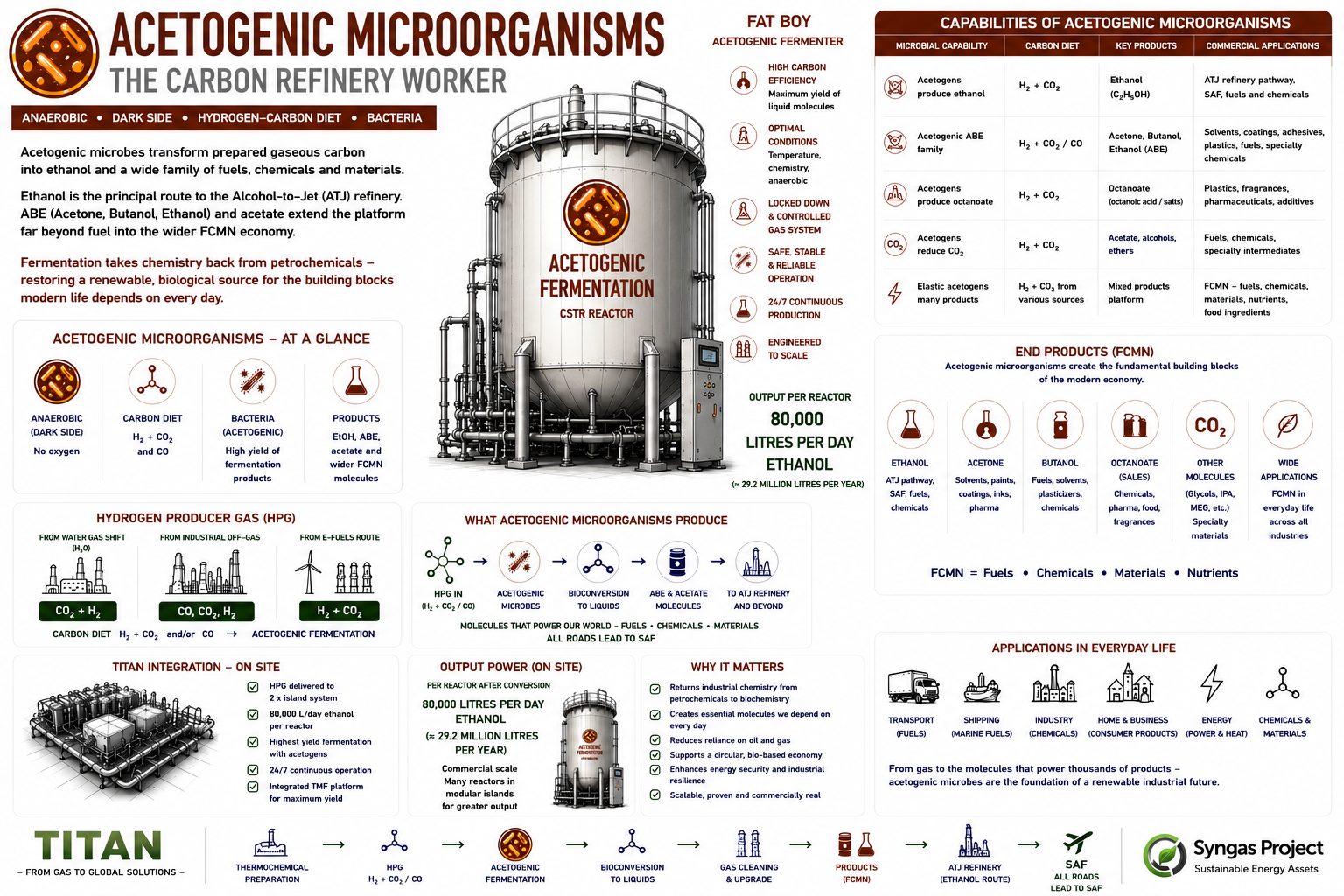
Acetogenic microbes are bacteria. Within Targeted Microbial Fermentation, they belong to the anaerobic Dark Side because they work without oxygen.
These workers produce more microbial biomass than Methanogenic Archaea, but biomass remains a secondary outcome. Their commercial purpose is to convert a clean, single-carbon gaseous diet into valuable liquid molecules.
Their carbon diet is based principally on carbon monoxide and carbon dioxide, supported by hydrogen. These gaseous molecules provide the carbon and energy required to manufacture ethanol and wider chemical intermediates.
The principal TITAN Acetogenic outcome is second-generation ethanol — 2G Ethanol.
Different Acetogenic Microbial Capabilities can also support pathways to acetone, butanol, acetate, acetic acid, isopropanol, 2,3-butanediol and other industrial molecules.
This does not mean that one worker produces every product simultaneously.
The target molecule depends on the selected microbial strain, commercial licence, reactor protocol, gas composition, operating conditions and downstream recovery system.
Syngas Project supplies their food in controlled industrial conditions. Hydrogen Producer Gas is prepared thermochemically, buffered, monitored and conditioned before entering the Acetogenic Fat Boy Tank.
The published TITAN Acetogenic route typically excludes the Water-Gas Shift. The HPG passes directly through buffering, monitoring and conditioning before fermentation.
Acetogenic workers generally produce more liquid broth than Methanogenic workers. This is why their industrial fermentation vessels are represented as Fat Boy Tanks: similar industrial height, but wider and designed around gas-to-liquid biological conversion.
Impurity tolerance varies between workers. The contracted Microbial Capability therefore defines the exact HPG specification and operating limits.
Acetogenic workers are particularly well suited to:
clean TITAN HPG gas trains;
conditioned industrial gases and off-gases;
hydrogen–carbon e-fuel environments;
second-generation ethanol production;
Alcohol-to-Jet refinery supply; and
fuels, chemicals and materials manufacturing.
The detailed strains, commercial licences, reactor internals, sparger technology and operating protocols remain protected under contractual arrangements with specialist Handlers and Biofoundries.
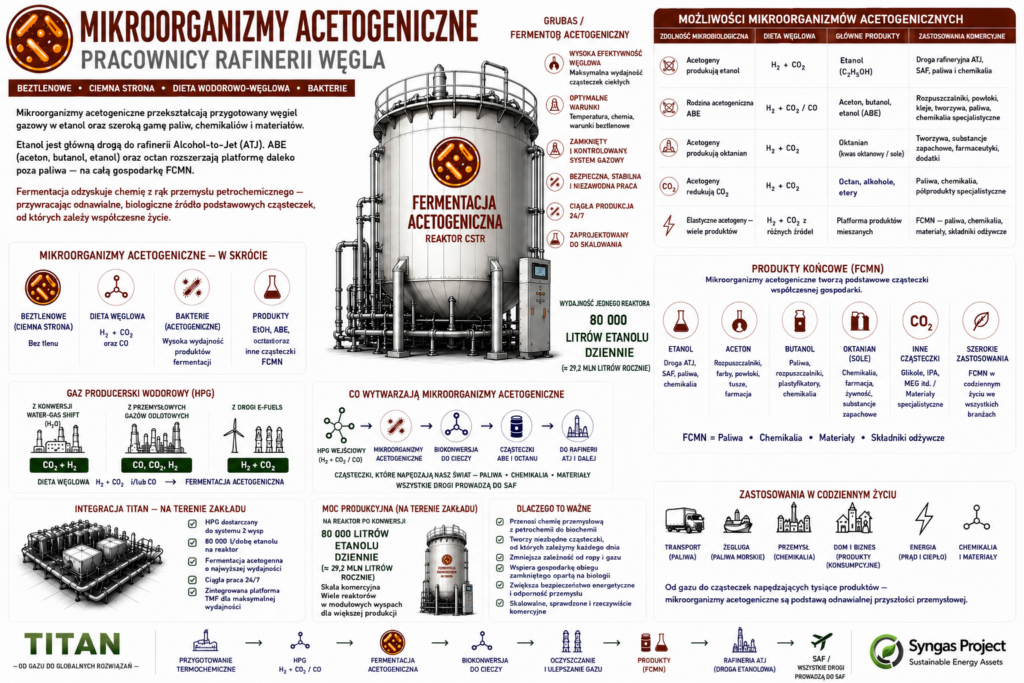
Mikroorganizmy acetogeniczne należą do grupy bakterii. W ramach Ukierunkowanej Fermentacji Mikrobiologicznej (Targeted Microbial Fermentation – TMF) stanowią część Beztlenowej Ciemnej Strony, ponieważ funkcjonują bez udziału tlenu.
Mikroorganizmy acetogeniczne wytwarzają więcej biomasy niż metanogeniczne Archaea, jednak biomasa pozostaje jedynie produktem ubocznym procesu. Ich podstawowym celem komercyjnym jest przekształcanie czystego, jednowęglowego gazowego substratu w wysokowartościowe ciekłe cząsteczki.
Ich dieta węglowa opiera się przede wszystkim na tlenku węgla (CO) oraz dwutlenku węgla (CO₂), wspomaganych przez wodór (H₂). Gazy te dostarczają zarówno węgla, jak i energii niezbędnych do syntezy etanolu oraz szerokiej gamy chemicznych produktów pośrednich.
Podstawowym produktem acetogenicznej platformy TITAN jest bioetanol drugiej generacji (2G Ethanol).
Różne Acetogeniczne Zdolności Mikrobiologiczne (Acetogenic Microbial Capabilities) mogą również prowadzić do produkcji acetonu, butanolu, octanu, kwasu octowego, izopropanolu, 2,3-butanodiolu oraz wielu innych cząsteczek wykorzystywanych w przemyśle.
Nie oznacza to jednak, że jeden mikroorganizm wytwarza wszystkie te produkty jednocześnie.
Końcowy produkt zależy od wybranego szczepu mikroorganizmów, licencji komercyjnej, protokołu prowadzenia reaktora, składu gazu, parametrów pracy oraz zastosowanego systemu odzysku produktu.
Syngas Project dostarcza mikroorganizmom pożywkę w ściśle kontrolowanych warunkach przemysłowych. Hydrogen Producer Gas (HPG) jest przygotowywany metodami termochemicznymi, następnie buforowany, monitorowany i kondycjonowany przed wprowadzeniem do Acetogenicznego Reaktora „Fat Boy”.
Publikowana ścieżka technologiczna TITAN dla procesu acetogenicznego zazwyczaj pomija etap Water-Gas Shift (WGS). HPG przechodzi bezpośrednio przez etap buforowania, monitorowania i kondycjonowania, a następnie trafia do fermentacji.
Mikroorganizmy acetogeniczne wytwarzają zazwyczaj znacznie większą ilość ciekłego bulionu fermentacyjnego niż mikroorganizmy metanogeniczne. Z tego względu ich przemysłowe fermentory przedstawiane są jako reaktory „Fat Boy” — mają zbliżoną wysokość do fermentorów metanogenicznych, lecz większą średnicę i zostały zaprojektowane specjalnie do biologicznej konwersji gaz–ciecz.
Tolerancja na zanieczyszczenia różni się w zależności od zastosowanej Zdolności Mikrobiologicznej. To właśnie zakontraktowana Acetogeniczna Zdolność Mikrobiologiczna określa dokładną specyfikację HPG oraz dopuszczalne granice pracy procesu.
Mikroorganizmy acetogeniczne najlepiej sprawdzają się w zastosowaniach obejmujących:
czyste ciągi technologiczne HPG platformy TITAN;
kondycjonowane gazy przemysłowe oraz gazy odpadowe;
środowiska produkcji e-paliw wykorzystujące wodór i węgiel;
produkcję bioetanolu drugiej generacji (2G Ethanol);
zasilanie rafinerii Alcohol-to-Jet (ATJ); oraz
produkcję paliw, chemikaliów i materiałów.
Szczegółowe szczepy mikroorganizmów, licencje komercyjne, konstrukcja wewnętrzna reaktorów, technologia spargerów oraz protokoły prowadzenia procesu pozostają chronione zgodnie z warunkami umów zawartych z wyspecjalizowanymi Handlerami oraz Biofoundries.