Warsaw 10:04:2026: 9:50 AM Steve Walker
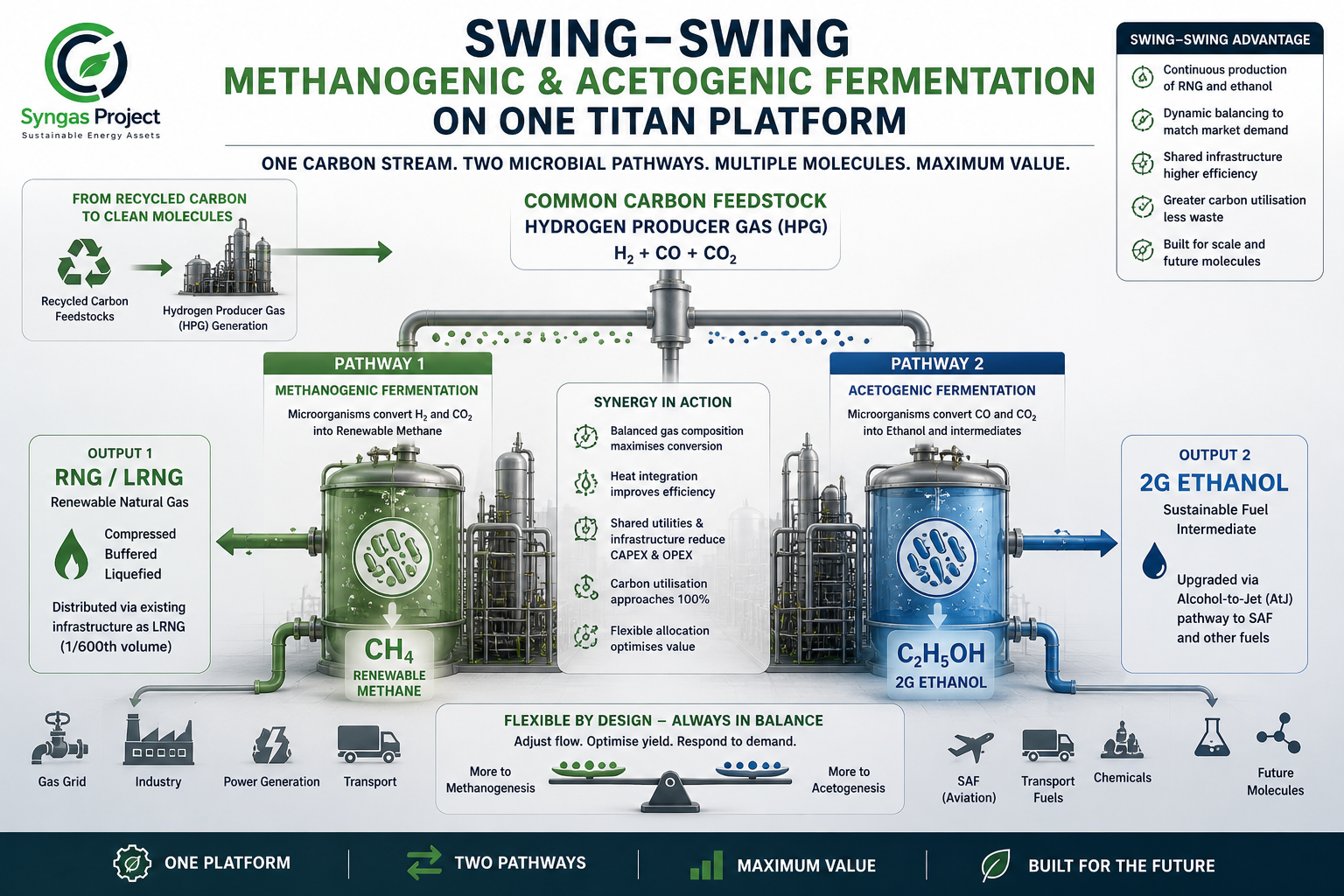
TITAN does not choose between renewable methane and ethanol. It produces both on the same platform, from the same carbon stream.
This is the foundation of Swing–Swing.
At the centre of TITAN is Hydrogen Producer Gas. It is not a waste gas. It is a controlled carbon feedstock, engineered to deliver a stable mixture of hydrogen, carbon monoxide and carbon dioxide. This gas becomes the interface between thermochemical conversion and biotechnology.
From this single gas stream, two biological pathways operate in parallel.
Methanogenic fermentation converts the gas into renewable methane.
Acetogenic fermentation converts the same gas into ethanol.
These are not competing processes. They are complementary.
Traditional systems force a choice. Gas is either burned, upgraded or directed into a single downstream pathway. That limits flexibility and reduces value. TITAN is designed differently. The gas is conditioned and distributed across a platform that can direct carbon where it creates the most value at any given time.
This is not a theoretical advantage. It is a system-level capability.
Methanogenic organisms favour hydrogen-rich conditions. They convert hydrogen and carbon dioxide into methane efficiently and reliably. This pathway produces renewable natural gas that can be compressed, liquefied and distributed as LRNG through existing infrastructure.
Acetogenic organisms operate differently. They consume carbon monoxide and carbon dioxide and convert them into ethanol and other intermediates. This pathway supports the production of 2G ethanol, which can be upgraded through the Alcohol-to-Jet pathway into sustainable aviation fuel.
Both pathways depend on gas quality, pressure, temperature and composition. In TITAN, those variables are controlled. Gas is not simply produced and sent downstream. It is managed, conditioned and directed.
This is where synergy begins.
Methanogenic fermentation can stabilise hydrogen levels in the system. Acetogenic fermentation can utilise carbon monoxide that would otherwise be underused. Heat integration between the two pathways improves overall system efficiency. Utilities, compression, gas handling, control systems and infrastructure are shared across the platform.
The result is not two plants operating side by side.
It is one system operating in balance.