Why TITAN Produces Pipeline and Marine Grade Gas

Publish date: 8 May 2026
Not all renewable gas is the same.

This is one of the most important realities often overlooked in public discussions surrounding biomethane, renewable gas and future decarbonisation systems.

Producing renewable molecules is only part of the challenge.

The second challenge is quality.

Industrial systems do not operate on slogans. They operate on specifications.

Pipelines require specification compliance.

Industrial burners require consistency.

Marine engines require fuel stability.

Cryogenic systems require purity.

Storage systems require predictable composition.

Large-scale logistics systems require standardisation.

Without these characteristics, renewable gas remains limited to small regional applications rather than becoming part of strategic national infrastructure.

This is one of the reasons TITAN was designed differently from the beginning.

The platform was not designed simply to produce “green gas.”

It was designed to produce infrastructure-grade renewable molecules capable of integration into real industrial systems.

This distinction matters enormously.

Many first-generation renewable gas systems were developed around local agricultural digestion projects where gas quality variability could often be tolerated within relatively small operating environments.

TITAN operates at a different industrial scale and under a different infrastructure philosophy.

The objective is not merely local energy recovery.

The objective is national-scale renewable molecule distribution through existing logistics and industrial infrastructure.

This requires molecule quality to become a central engineering priority.

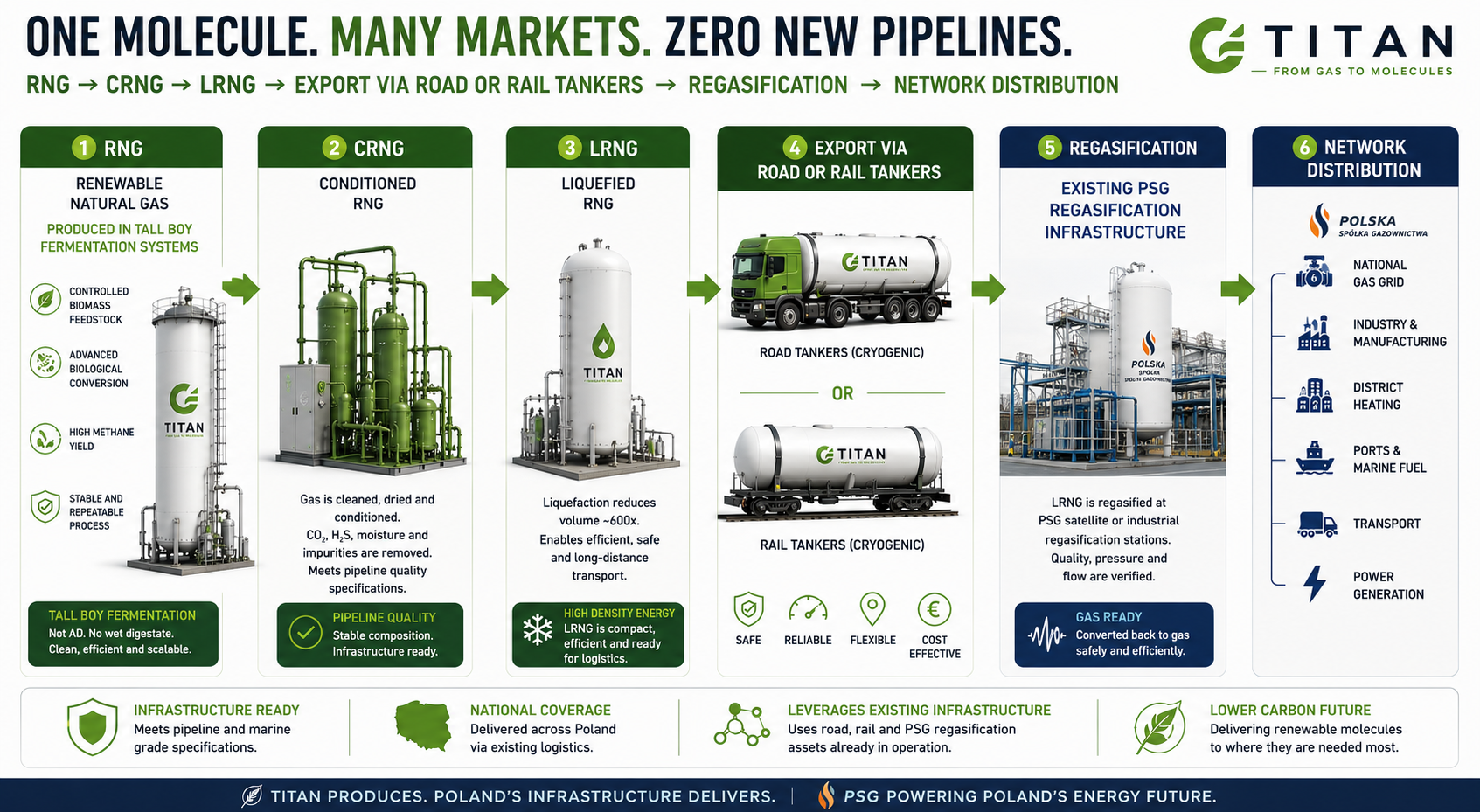
TITAN therefore focuses heavily on gas conditioning and polishing.

The Hydrogen Producer Gas platform creates a controlled gas-phase feedstock which is then biologically converted into Renewable Natural Gas through advanced methanogenic systems.

From there, the molecule undergoes additional upgrading and conditioning processes designed to produce stable, high-purity Renewable Natural Gas suitable for industrial use, liquefaction and infrastructure integration.

This is where pipeline-grade and marine-grade specifications become important.

Pipeline-grade gas means the molecule is compatible with national gas infrastructure requirements and industrial applications requiring stable composition and reliable performance.

Marine-grade gas means the molecule is suitable for future LNG-compatible marine fuel infrastructure, bunkering systems and heavy transport applications where consistency, cleanliness and energy density are critical.

These standards are not marketing terminology.

They are infrastructure requirements.
Dlaczego TITAN Produkuje Gaz o Jakości Sieciowej i Morskiej

Warsaw 08:05:2026 4:04 PM Steve Walker

Nie każdy odnawialny gaz jest taki sam.

To jedna z najważniejszych rzeczy często pomijanych w publicznych dyskusjach dotyczących biometanu, odnawialnego gazu i przyszłych systemów dekarbonizacji.

Produkcja odnawialnych molekuł to tylko część wyzwania.

Drugą częścią jest jakość.

Systemy przemysłowe nie działają na sloganach. Działają na specyfikacjach.

Gazociągi wymagają zgodności parametrów.

Palniki przemysłowe wymagają stabilności.

Silniki morskie wymagają stabilnego paliwa.

Systemy kriogeniczne wymagają wysokiej czystości.

Systemy magazynowania wymagają przewidywalnego składu.

Wielkoskalowe systemy logistyczne wymagają standaryzacji.

Bez tych cech odnawialny gaz pozostaje ograniczony do małych regionalnych zastosowań zamiast stać się częścią strategicznej infrastruktury krajowej.

To jeden z powodów, dla których TITAN od początku projektowano inaczej.

Platforma nie została zaprojektowana wyłącznie po to, aby produkować „zielony gaz”.

Została zaprojektowana do produkcji infrastrukturalnych odnawialnych molekuł zdolnych do integracji z rzeczywistymi systemami przemysłowymi.

To rozróżnienie ma ogromne znaczenie.

Wiele systemów odnawialnego gazu pierwszej generacji rozwijano wokół lokalnych instalacji fermentacji rolniczej, gdzie zmienność jakości gazu mogła być akceptowalna w stosunkowo niewielkich środowiskach operacyjnych.

TITAN działa w zupełnie innej skali przemysłowej i według innej filozofii infrastrukturalnej.

Celem nie jest wyłącznie lokalny odzysk energii.

Celem jest krajowa dystrybucja odnawialnych molekuł przy wykorzystaniu istniejącej infrastruktury logistycznej i przemysłowej.

To oznacza, że jakość molekuł staje się kluczowym priorytetem inżynieryjnym.

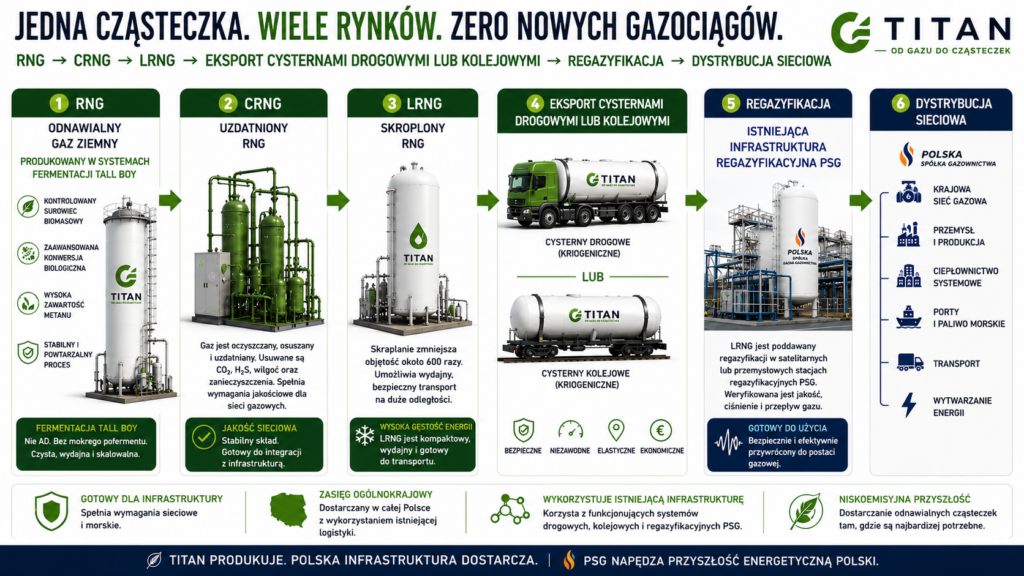
Dlatego TITAN koncentruje się na kondycjonowaniu i oczyszczaniu gazu.

Platforma Hydrogen Producer Gas tworzy kontrolowany gazowy surowiec, który następnie jest biologicznie przekształcany w Renewable Natural Gas przy wykorzystaniu zaawansowanych systemów metanogennych.

Następnie molekuła przechodzi dodatkowe procesy oczyszczania i stabilizacji mające na celu uzyskanie wysokiej jakości Renewable Natural Gas odpowiedniego dla zastosowań przemysłowych, skraplania i integracji infrastrukturalnej.

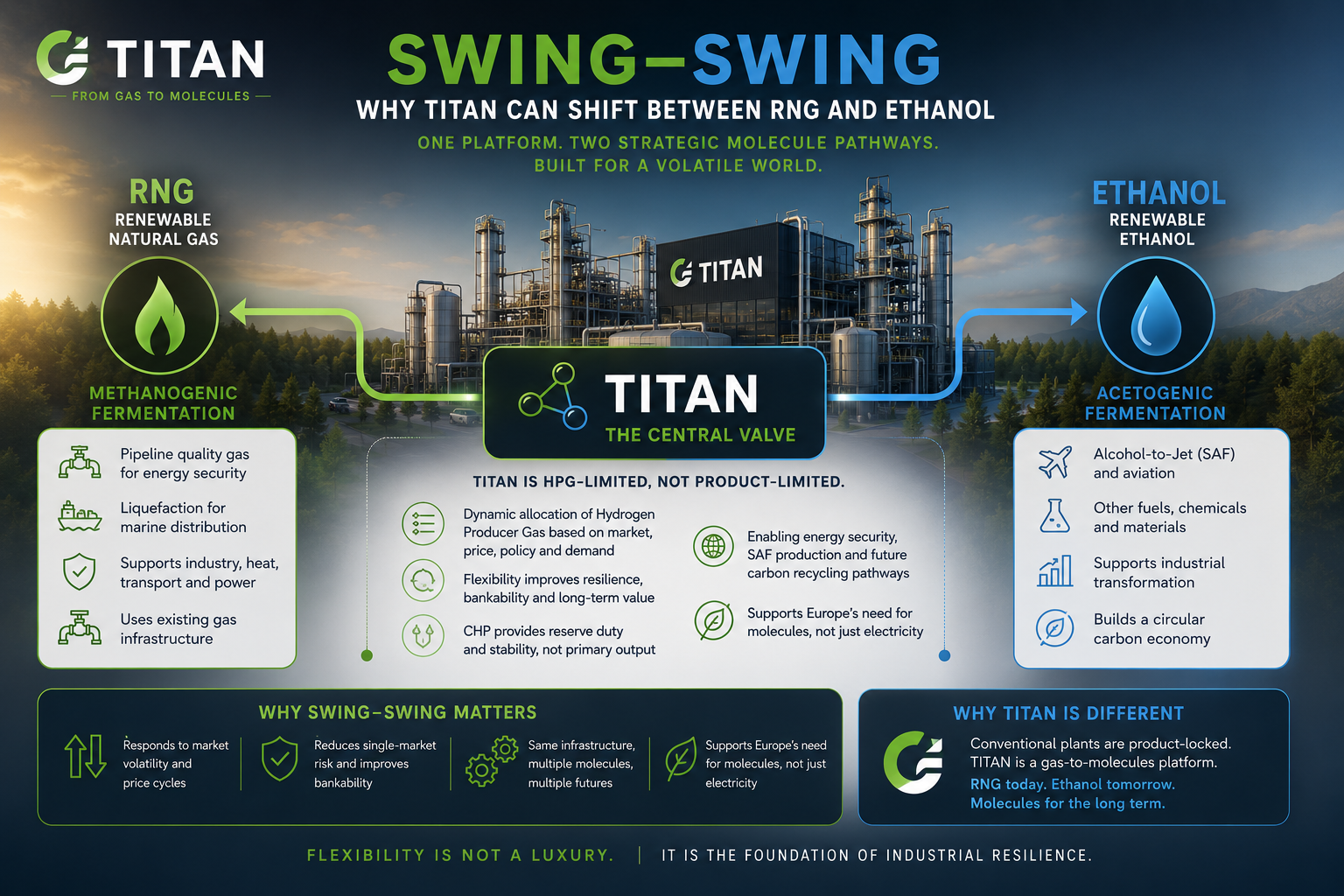
Why TITAN Can Shift Between RNG and Ethanol

Publish date: 7 May 2026

TITAN is designed around a simple industrial principle: do not lock a valuable feedstock into only one product.

At the centre of TITAN is Hydrogen Producer Gas. This gas is produced from forest residues and other renewable carbon resources. It contains the carbon and hydrogen needed to make useful molecules. Once this gas has been created, TITAN does not have to follow only one route.

It can shift.

This is what we call Swing–Swing.

In one operating mode, TITAN can direct more Hydrogen Producer Gas toward methanogenic fermentation to produce Renewable Natural Gas. RNG can be compressed, liquefied and distributed through existing gas and LNG logistics. It supports energy security, industrial heat, transport fuel and replacement of fossil natural gas.

In another operating mode, TITAN can direct more Hydrogen Producer Gas toward acetogenic fermentation to produce ethanol. This ethanol can support the Alcohol-to-Jet pathway for Sustainable Aviation Fuel, as well as other fuels, chemicals and materials.

The same platform can therefore support two strategic molecule markets: renewable methane and renewable ethanol.

This matters because energy markets are volatile. Gas prices move. Ethanol markets move. Aviation fuel policy develops over time. Industrial demand changes. A rigid plant is exposed to these changes. A flexible plant can respond to them.

TITAN is not product-limited. It is Hydrogen Producer Gas-limited.

That means the platform is built around the controlled production and allocation of gas. The value is not only in the final product. The value is in the ability to decide where the gas should go, based on demand, price, regulation and strategic need.

This is very different from a conventional biomethane project. A typical biomethane plant is built to make biomethane. That is its product. If market conditions change, the plant has limited options.

TITAN is different.

It is a gas-to-molecules platform. Methane is one output. Ethanol is another. Future pathways can include chemicals, proteins, materials and other fermentation products. The system is not designed as a single-output facility. It is designed as production infrastructure.

Swing–Swing also improves bankability.

Banks and investors do not like dependency on one market. They prefer assets that can survive different price cycles. A plant that can produce RNG when gas demand is strong, and ethanol when SAF demand grows, has stronger commercial resilience than a plant dependent on only one commodity.

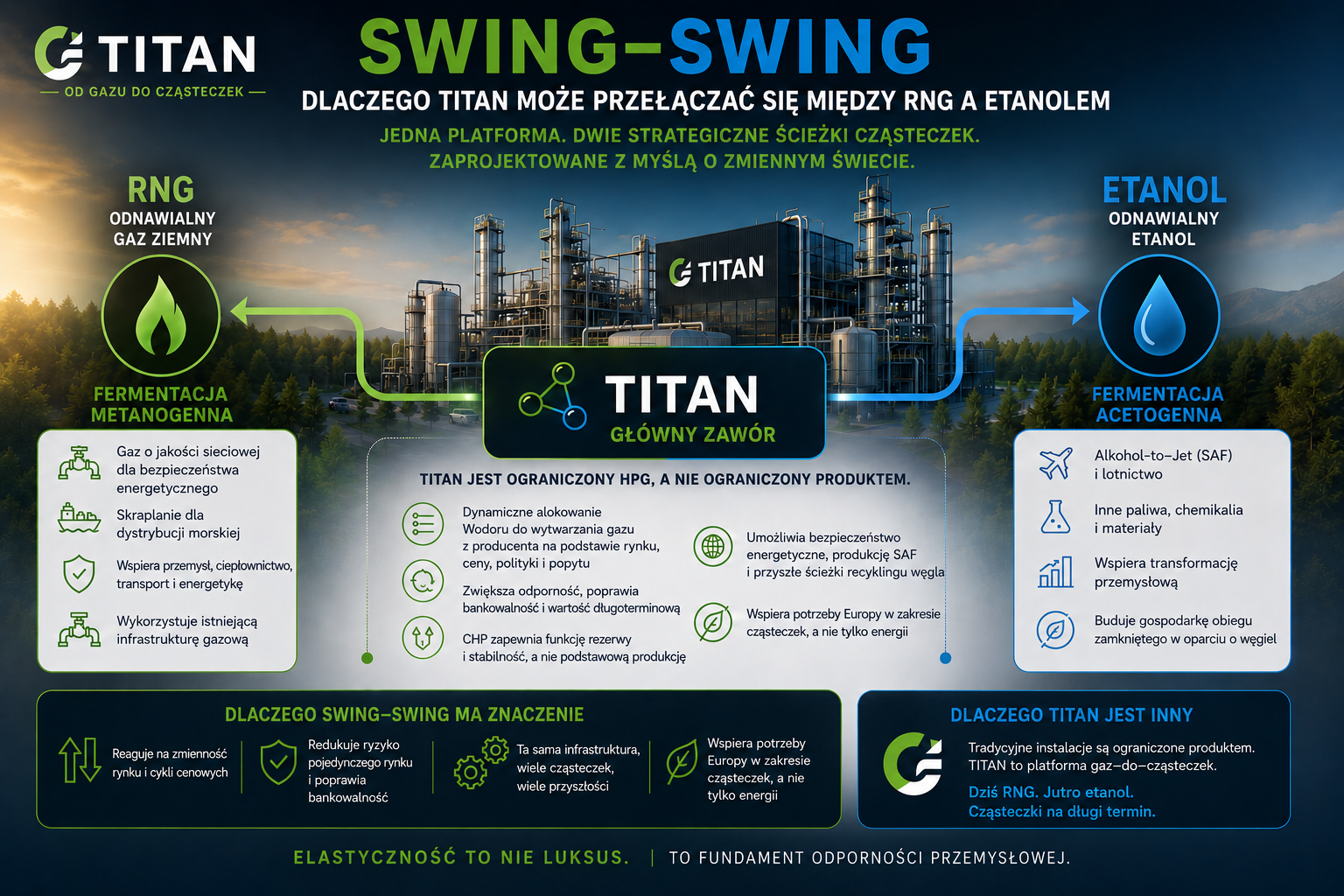
Swing–Swing: Dlaczego TITAN może przełączać się między RNG a etanolem

TITAN został zaprojektowany zgodnie z prostą zasadą przemysłową: wartościowego surowca nie należy blokować wyłącznie w jednym produkcie.

W centrum platformy TITAN znajduje się Hydrogen Producer Gas. Gaz ten powstaje z pozostałości leśnych oraz innych odnawialnych zasobów węgla. Zawiera węgiel i wodór potrzebne do produkcji użytecznych molekuł. Po wytworzeniu tego gazu TITAN nie musi podążać tylko jedną ścieżką.

Może się przełączać.

To właśnie nazywamy Swing–Swing.

W jednym trybie pracy TITAN może skierować większą część Hydrogen Producer Gas do fermentacji metanogennej w celu produkcji Renewable Natural Gas. RNG może być sprężany, skraplany i dystrybuowany z wykorzystaniem istniejącej infrastruktury gazowej oraz LNG. Wspiera bezpieczeństwo energetyczne, ciepło przemysłowe, paliwa transportowe oraz zastępowanie kopalnego gazu ziemnego.

W innym trybie TITAN może skierować większą część Hydrogen Producer Gas do fermentacji acetogennej w celu produkcji etanolu. Etanol ten może wspierać ścieżkę Alcohol-to-Jet dla Sustainable Aviation Fuel, a także produkcję innych paliw, chemikaliów i materiałów.

Ta sama platforma może więc obsługiwać dwa strategiczne rynki molekuł: odnawialny metan i odnawialny etanol.

Ma to znaczenie, ponieważ rynki energii są zmienne. Ceny gazu się zmieniają. Rynki etanolu się zmieniają. Polityka dotycząca paliw lotniczych rozwija się stopniowo. Zmienia się także popyt przemysłowy. Sztywna instalacja jest narażona na te zmiany. Elastyczna instalacja może na nie reagować.

TITAN nie jest ograniczony produktem. TITAN jest ograniczony ilością Hydrogen Producer Gas.

Oznacza to, że platforma została zbudowana wokół kontrolowanej produkcji i alokacji gazu. Wartość nie znajduje się wyłącznie w produkcie końcowym. Wartość znajduje się także w możliwości podjęcia decyzji, dokąd gaz powinien zostać skierowany, w zależności od popytu, ceny, regulacji i potrzeb strategicznych.

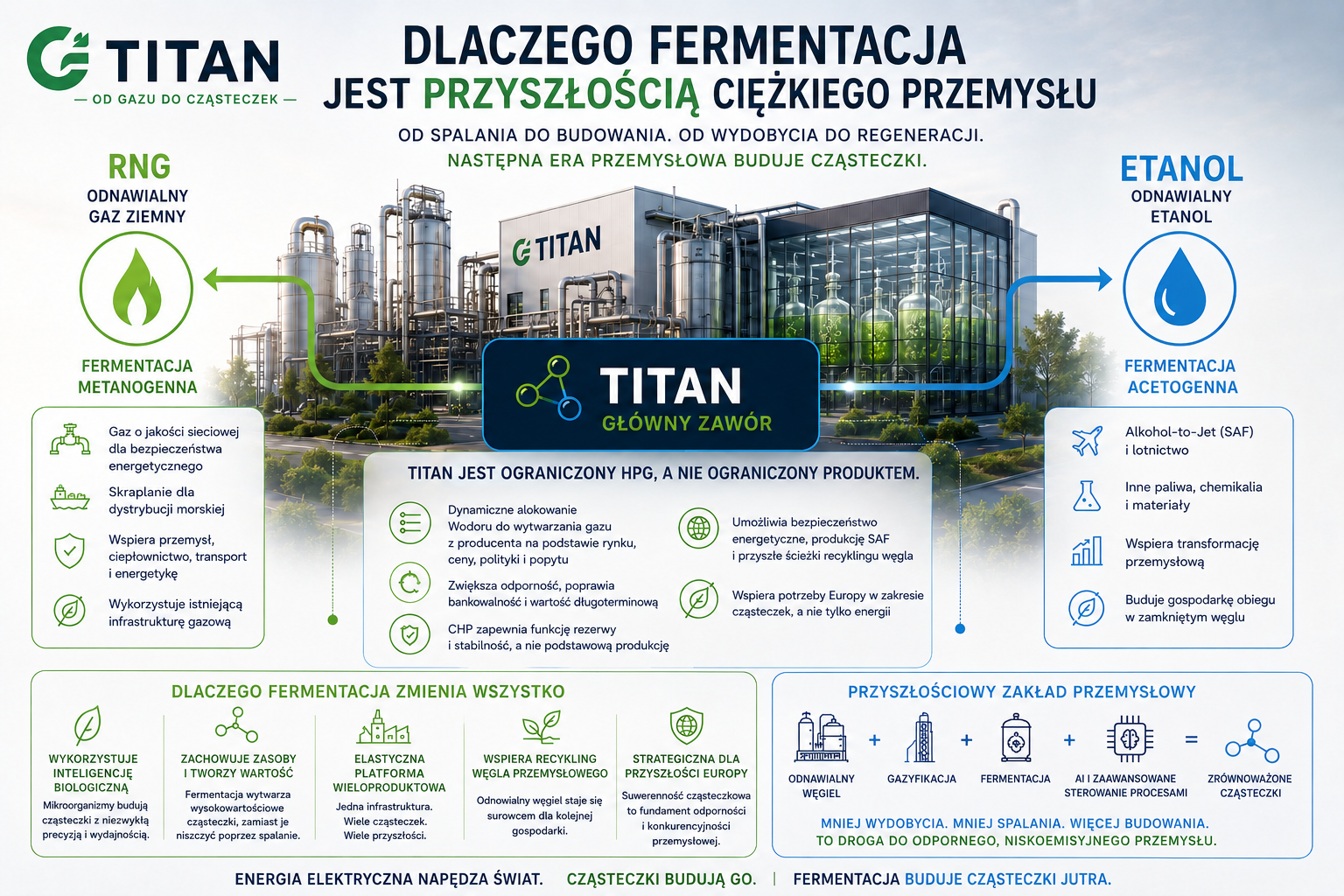
Dlaczego fermentacja jest przyszłością przemysłu ciężkiego

Warsaw 06:05:2026 10.40 AM Steve Walker

Przez ponad sto lat przemysł ciężki był oparty na spalaniu.

Spalamy węgiel, aby wytworzyć ciepło. Ciepło wykorzystujemy do produkcji ruchu, energii elektrycznej, ciśnienia i chemii przemysłowej. Ten model ukształtował współczesny świat. Hutnictwo, cementownie, przemysł chemiczny, rafinerie, transport i energetyka rozwijały się w epoce spalania.

Jednak spalanie ma swoje ograniczenia.

Spalanie skutecznie uwalnia energię, ale bardzo słabo zachowuje wartość molekularną. Gdy węgiel zostaje spalony, większość jego wartości przemysłowej znika do atmosfery w postaci dwutlenku węgla, niskotemperaturowego ciepła i emisji.

Kolejna epoka przemysłowa będzie coraz bardziej koncentrować się na czymś innym.

Nie na spalaniu molekuł.

Lecz na ich budowie.

W tym miejscu fermentacja staje się niezwykle ważna.

Fermentacja jest często źle rozumiana, ponieważ większość ludzi kojarzy ją z piwem, winem lub produkcją żywności. W rzeczywistości fermentacja jest jednym z najpotężniejszych systemów produkcyjnych, jakie kiedykolwiek opracowano. Współczesna fermentacja może produkować paliwa, chemikalia, białka, farmaceutyki, materiały i gazy przemysłowe na ogromną skalę.

Mikroorganizmy nie są prymitywną chemią.

Są fabrykami molekuł.

W każdym systemie fermentacyjnym biologia wykonuje niezwykle precyzyjne przemiany chemiczne z wykorzystaniem węgla, wodoru i energii. Zamiast wymuszać reakcje przy ekstremalnych temperaturach i ciśnieniach, fermentacja pozwala żywym organizmom budować molekuły z wyjątkową dokładnością.

To całkowicie zmienia logikę przemysłu.

Tradycyjny przemysł ciężki opiera się na sile termicznej. Fermentacja opiera się na biologicznej inteligencji rozwijanej przez miliardy lat ewolucji.

Przyszłość przemysłu będzie coraz częściej łączyć oba systemy.

Systemy termiczne nadal pozostaną ważne w takich obszarach jak zgazowanie, hutnictwo, ceramika i procesy wysokotemperaturowe. Jednak fermentacja będzie coraz częściej przejmować rolę precyzyjnej produkcji molekuł.

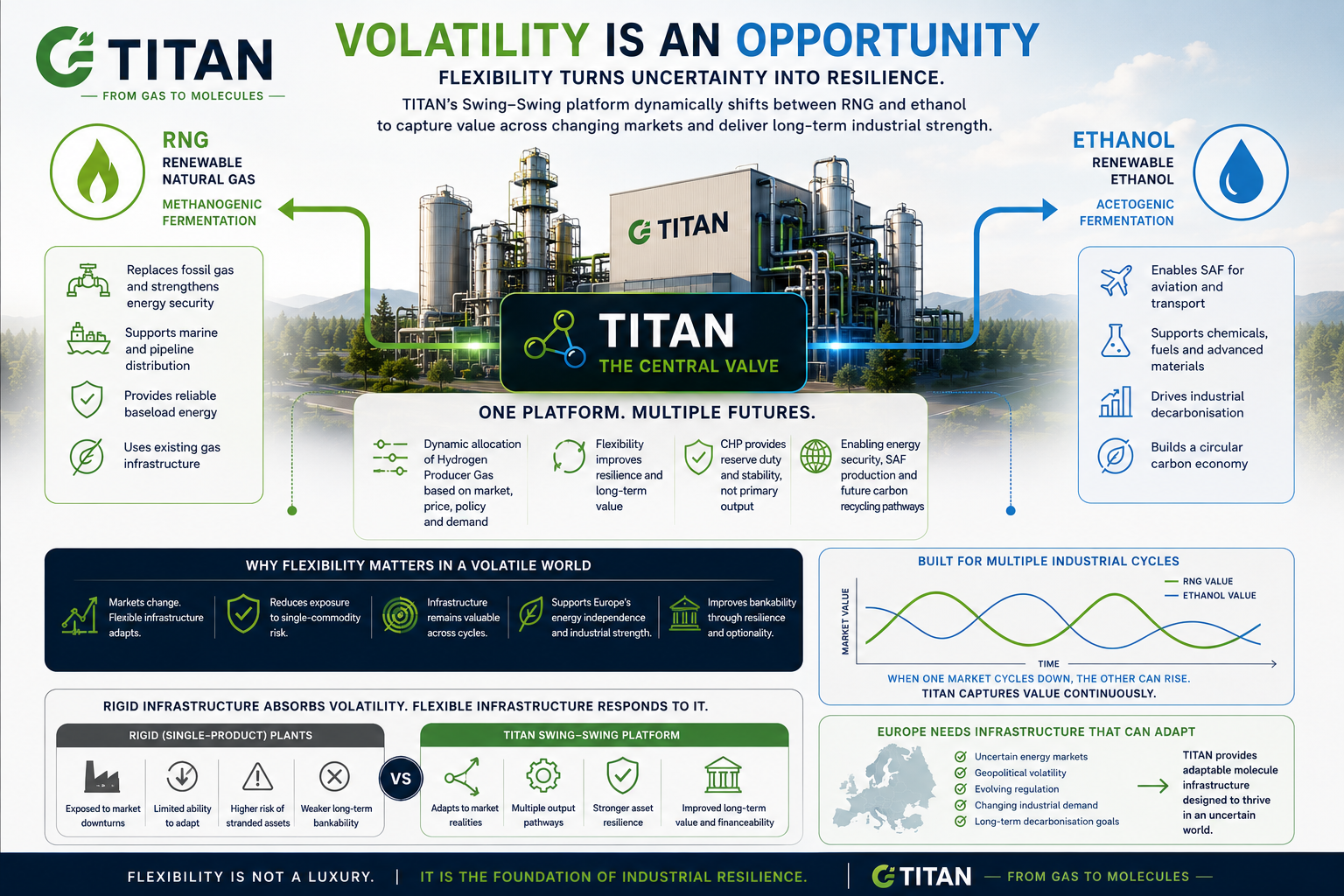
Volatility Is an Industrial Opportunity

For much of the industrial world, volatility is viewed as a threat.

Energy prices rise and fall. Commodity markets move unexpectedly. Regulation changes. Geopolitical tensions disrupt supply chains. Technologies evolve faster than expected. Entire sectors can become exposed to sudden shifts in economics or policy.

Traditional industrial infrastructure struggles in this environment.

Most industrial plants are designed around one core assumption: stability.

A refinery is optimised for a specific feedstock. A power plant is designed for a fixed operational profile. A conventional biomethane installation is built to produce biomethane. A chemical plant is often designed around a narrow process pathway.

This model worked well during periods of predictable markets and long industrial cycles.

But the world is changing.

Energy markets are becoming more dynamic. Carbon regulation is increasing. Molecule demand is evolving. Europe is attempting to reduce strategic dependence on imported fuels and industrial feedstocks while simultaneously decarbonising its economy.

In this environment, flexibility becomes increasingly valuable.

This is one of the reasons TITAN was designed differently.

TITAN is not built around a single product. It is built around controlled Hydrogen Producer Gas production and flexible molecule conversion pathways.

This distinction is important.

Traditional infrastructure often becomes vulnerable when its primary output loses competitiveness. A rigid system can only respond in limited ways to changing markets. If prices fall or regulation changes, the infrastructure itself may lose strategic value.

TITAN approaches this problem differently.

The platform is designed around optionality.

Hydrogen Producer Gas can be directed toward multiple downstream pathways depending on market conditions, regulation, demand and strategic priorities. In one operating environment, renewable methane may provide the strongest value proposition. In another, ethanol for Sustainable Aviation Fuel may become more attractive.

The same infrastructure remains relevant across multiple industrial cycles.

This changes the risk profile of the platform.

Volatility becomes less of a threat when infrastructure can adapt to it.

This does not eliminate risk entirely. All industrial systems face operational, regulatory and market challenges. But flexibility changes how those risks are managed.

A rigid system absorbs volatility.

A flexible system can respond to it.

This principle already exists in other forms of infrastructure. Modern logistics networks, data systems and manufacturing platforms increasingly rely on adaptability rather than fixed operational assumptions. The same logic is now beginning to emerge in industrial molecule production.

The future industrial economy will likely reward systems capable of continuous adjustment.

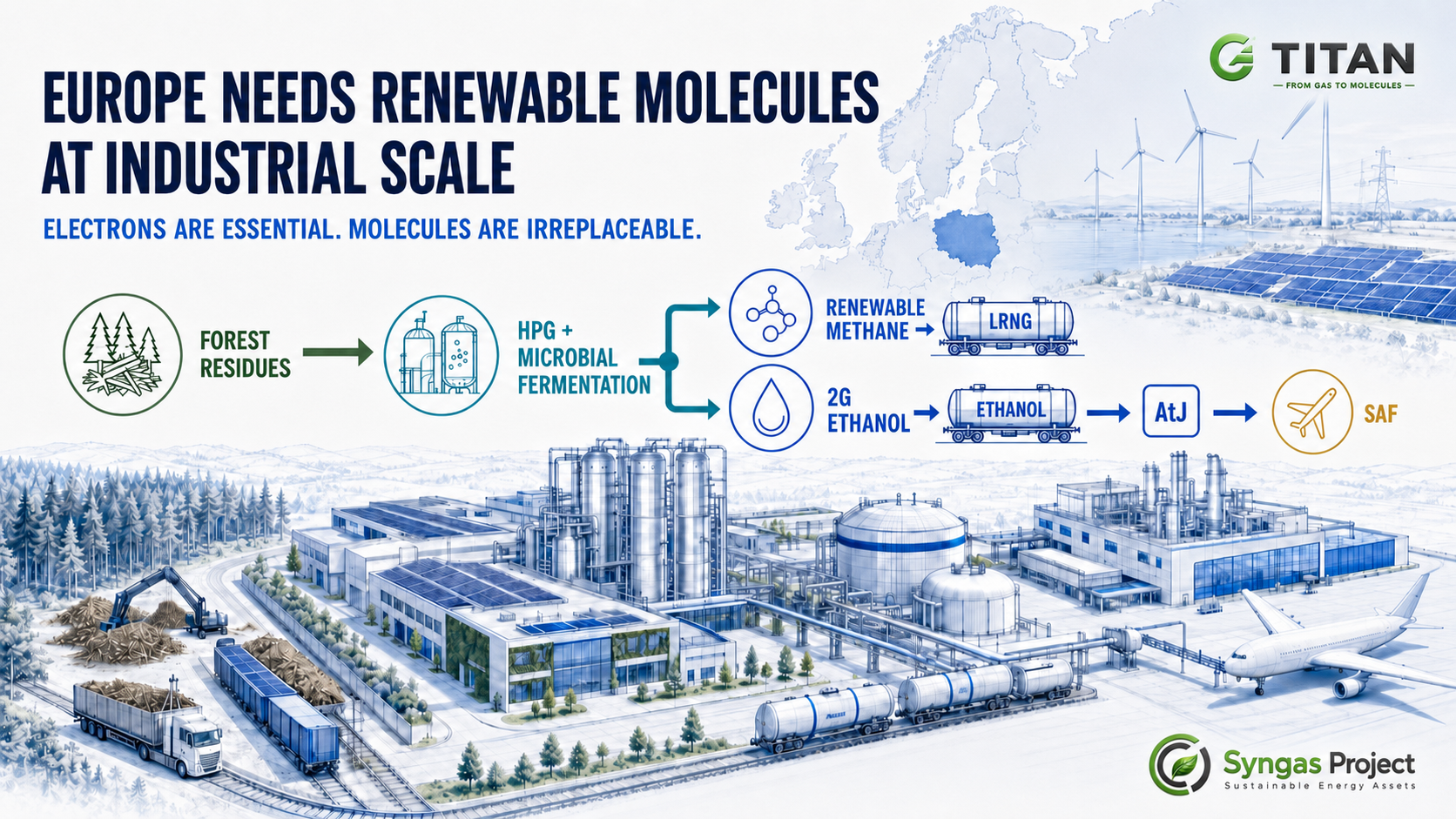
Europe Needs Renewable Molecules at Industrial Scale

Europe has made real progress in renewable electricity, but the molecule system remains exposed. Gas, liquid fuels, chemical feedstocks and future materials still rely heavily on fossil supply chains. These molecules cannot be replaced by electrons alone. They must be manufactured again, differently.

This is where TITAN changes the scale of the conversation.

A typical anaerobic digestion plant may produce around 2 million cubic metres of renewable gas per year. That is useful, but it does not move national energy security. TITAN is designed for a different class of output. In Phase One Swing–Swing mode, producing renewable methane and ethanol side by side, a TITAN site can produce around 22 million cubic metres of RNG equivalent per year. With the first 50 MW of a future 100 MW RNG capability installed in Phase One, the same site has the installed pathway to move beyond this level toward 44 million cubic metres of RNG, with one of ten planned full TITAN sites capable of more than 80 million cubic metres of RNG equivalent per year.

This is not a marginal improvement. It is a step-change in renewable molecule infrastructure.

TITAN achieves this scale by combining Hydrogen Producer Gas with industrialised biotechnology. Hydrogen Producer Gas creates the controllable carbon feedstock. Methanogenic fermentation converts that feedstock into renewable methane. Acetogenic fermentation converts it into 2G ethanol for SAF intermediates. These outputs are not competing products. They operate side by side in Swing–Swing mode, where shared gas supply, heat integration, utilities, operational flexibility and market optionality allow each pathway to support the other.

The result is not simply renewable gas production and not simply ethanol production. It is an integrated carbon-to-molecule platform.

This matters because Europe needs both gas and liquid fuels. Renewable methane can replace fossil LNG in existing gas logistics, virtual pipeline systems and industrial demand centres. 2G ethanol can support the alcohol-to-jet pathway for sustainable aviation fuel. Together, they create a stronger platform than either output alone.

Syngas Project’s first base is Poland. The long-term objective is to establish the platform capacity required to support a Polish SAF refinery capable of producing 1 million litres per day by 2035, while also building the renewable gas infrastructure needed to deliver approximately 1 GW of RNG-equivalent capacity through Swing–Swing deployment.

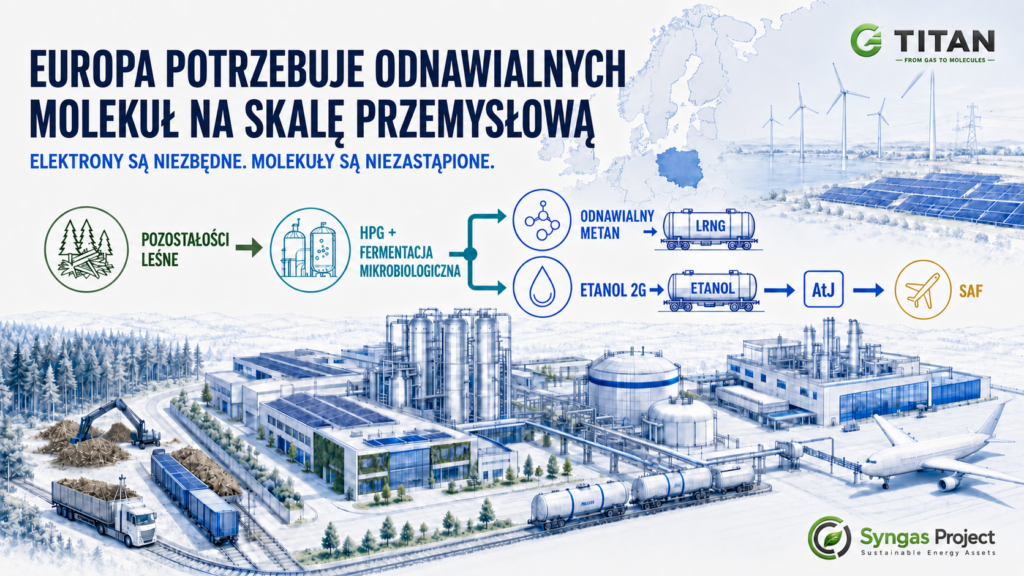
Europa potrzebuje cząsteczek odnawialnych w skali przemysłowej

Warsaw 04:05 4 2:10 pm Steve Walker

Europa potrzebuje cząsteczek odnawialnych w skali przemysłowej

Europa osiągnęła znaczący postęp w obszarze odnawialnej energii elektrycznej, jednak system cząsteczek pozostaje narażony. Gaz, paliwa ciekłe, surowce chemiczne oraz przyszłe materiały nadal w dużej mierze opierają się na łańcuchach dostaw opartych na paliwach kopalnych. Tych cząsteczek nie da się zastąpić wyłącznie energią elektryczną. Muszą być wytwarzane na nowo — w inny sposób.

W tym miejscu TITAN zmienia skalę dyskusji.

Typowa instalacja fermentacji beztlenowej produkuje około 2 milionów metrów sześciennych gazu odnawialnego rocznie. To użyteczne, ale nie wpływa na bezpieczeństwo energetyczne na poziomie krajowym. TITAN został zaprojektowany dla zupełnie innej klasy produkcji. W trybie Swing–Swing w Fazie Pierwszej, produkując równolegle metan odnawialny i etanol, pojedyncza instalacja TITAN może osiągnąć około 22 milionów metrów sześciennych ekwiwalentu RNG rocznie. Przy zainstalowanych w Fazie Pierwszej pierwszych 50 MW z docelowych 100 MW zdolności RNG, ta sama instalacja posiada ścieżkę wzrostu do około 44 milionów metrów sześciennych RNG, przy czym jedna z dziesięciu planowanych pełnoskalowych instalacji TITAN może przekroczyć 80 milionów metrów sześciennych ekwiwalentu RNG rocznie.

To nie jest marginalna poprawa. To skokowa zmiana w infrastrukturze odnawialnych cząsteczek.

TITAN osiąga tę skalę poprzez połączenie Hydrogen Producer Gas z uprzemysłowioną biotechnologią. Hydrogen Producer Gas tworzy kontrolowalny nośnik węgla. Fermentacja metanogenna przekształca go w metan odnawialny. Fermentacja acetogenna przekształca go w etanol drugiej generacji jako półprodukt dla SAF. Te produkty nie konkurują ze sobą. Działają równolegle w trybie Swing–Swing, gdzie wspólne zasilanie gazem, integracja cieplna, infrastruktura pomocnicza, elastyczność operacyjna oraz opcjonalność rynkowa pozwalają obu ścieżkom wzajemnie się wzmacniać.

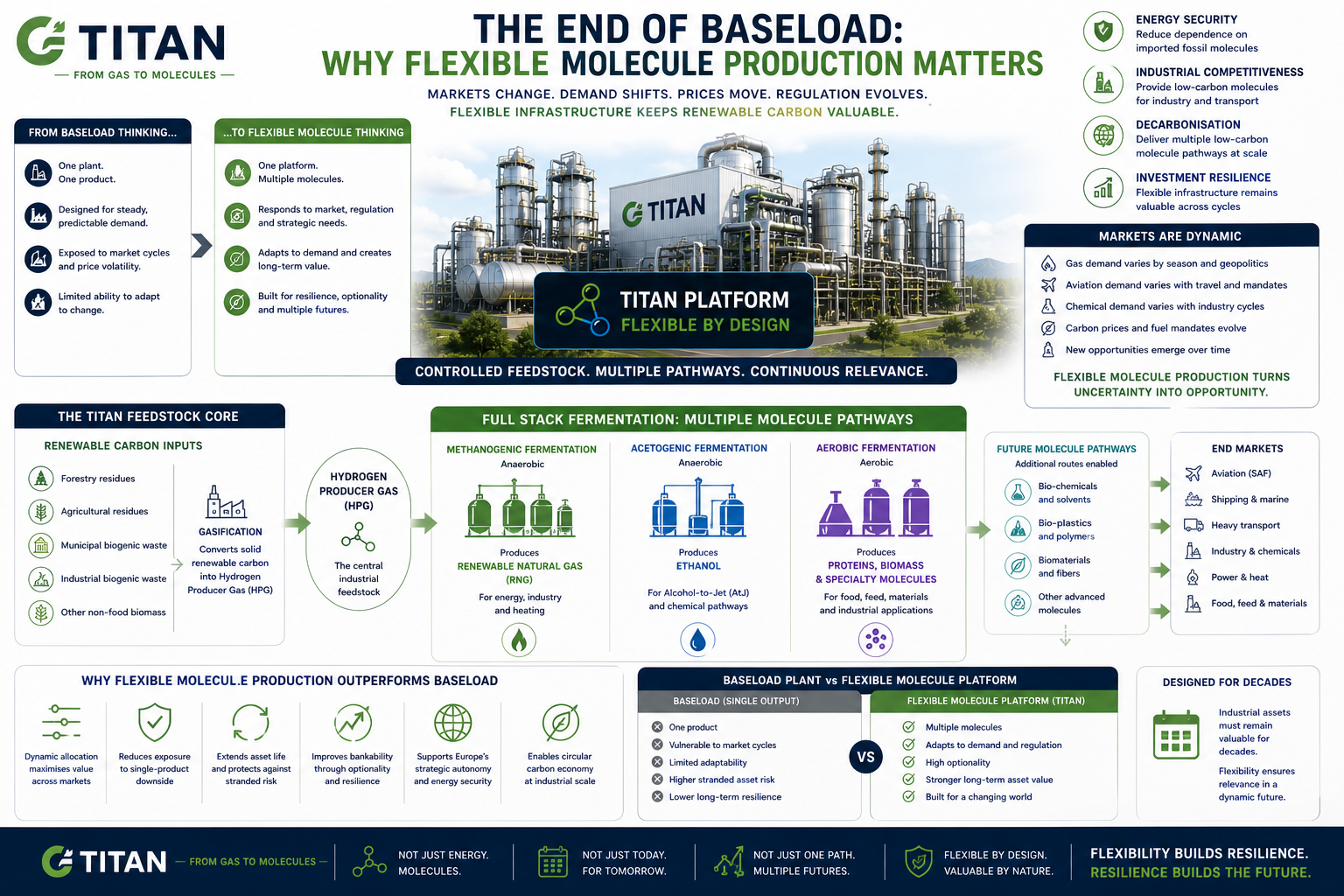
The End of Baseload: Why Flexible Molecule Production Matters

For most of the twentieth century, industrial energy systems were built around baseload.

Large plants operated continuously. Power stations produced electricity day and night. Refineries processed fuels at steady volume. Industrial systems were designed for predictability, fixed flows and long operating cycles.

That model shaped the modern economy.

But the energy system is changing.

Renewable electricity is growing. Demand is becoming more variable. Energy prices move more quickly. Industrial customers need lower-carbon fuels, gases and feedstocks. Supply chains are exposed to geopolitical pressure. Markets are no longer as stable as they once appeared.

In this new environment, baseload alone is no longer enough.

The future belongs to infrastructure that can adapt.

This is especially true for molecules.

Electricity is only one part of the transition. Europe also needs gas, fuels, chemicals and industrial feedstocks. These are not simply energy products. They are molecular products. They support aviation, shipping, heavy transport, heating, industry and manufacturing.

The challenge is that molecule demand is not static.

Gas demand changes by season. Aviation fuel demand changes with travel and regulation. Chemical demand changes with industry. Carbon prices, fuel mandates and geopolitical conditions all affect which molecules are most valuable at any given time.

A single-output plant struggles in this environment.

If an installation is designed to make only one product, it is exposed to that product’s market cycle. When demand is strong, the plant performs well. When demand weakens, the plant has limited choices.

Flexible molecule production changes this logic.

Instead of locking infrastructure into one output, flexible platforms can direct a controlled feedstock into different production pathways.

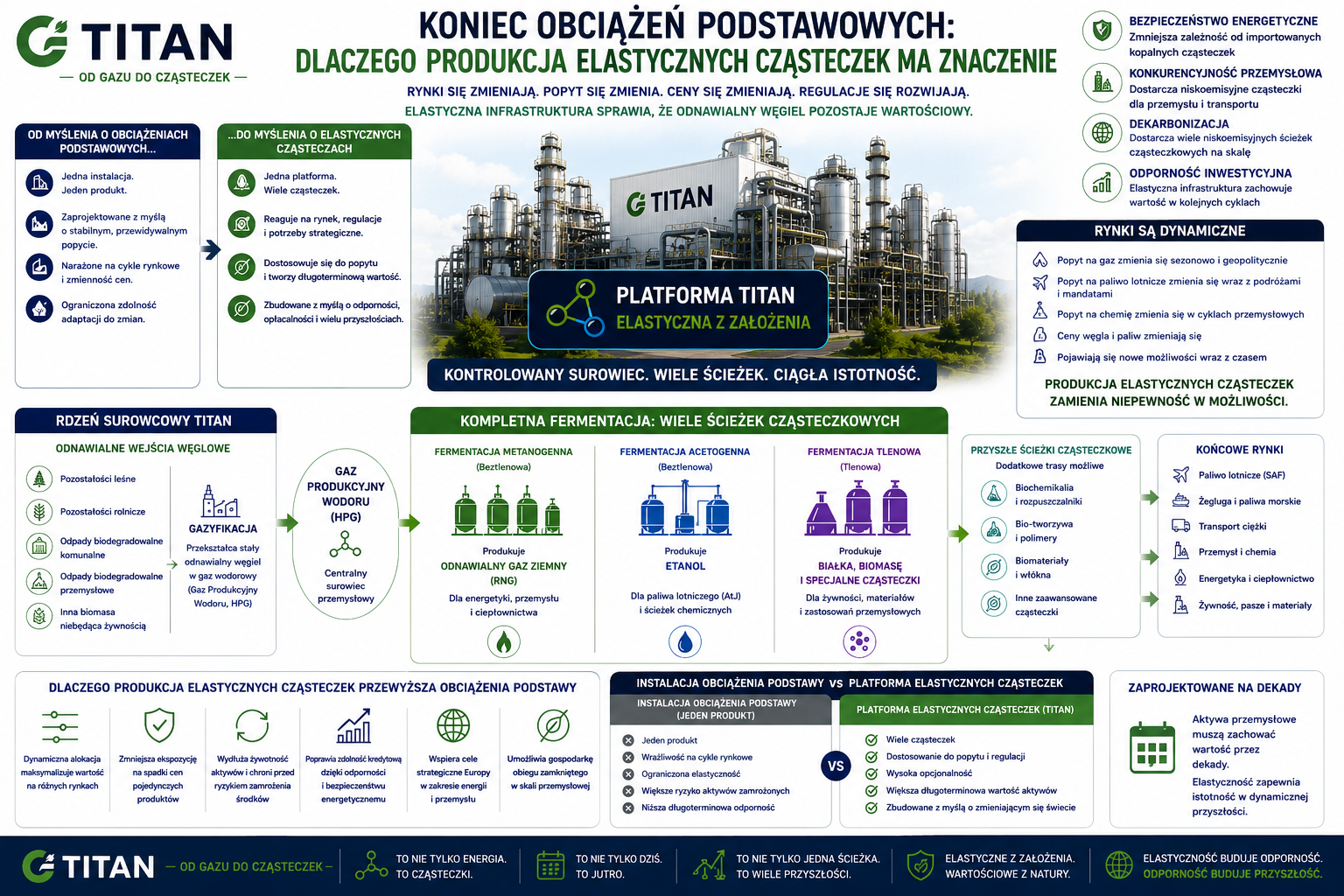
Koniec baseloadu: dlaczego elastyczna produkcja molekuł ma znaczenie

Przez większą część XX wieku przemysłowe systemy energetyczne były budowane wokół baseloadu.

Duże instalacje pracowały w sposób ciągły. Elektrownie produkowały energię elektryczną dzień i noc. Rafinerie przetwarzały paliwa w stałym wolumenie. Systemy przemysłowe były projektowane pod przewidywalność, stałe przepływy i długie cykle operacyjne.

Ten model ukształtował współczesną gospodarkę.

Jednak system energetyczny się zmienia.

Rośnie udział odnawialnej energii elektrycznej. Popyt staje się bardziej zmienny. Ceny energii poruszają się szybciej. Odbiorcy przemysłowi potrzebują paliw, gazów i surowców o niższej emisyjności. Łańcuchy dostaw są narażone na presję geopolityczną. Rynki nie są już tak stabilne, jak kiedyś się wydawało.

W tym nowym środowisku sam baseload już nie wystarcza.

Przyszłość należy do infrastruktury, która potrafi się dostosować.

Dotyczy to szczególnie molekuł.

Energia elektryczna jest tylko jedną częścią transformacji. Europa potrzebuje również gazu, paliw, chemikaliów i surowców przemysłowych. Nie są to wyłącznie produkty energetyczne. Są to produkty molekularne. Wspierają lotnictwo, żeglugę, transport ciężki, ciepłownictwo, przemysł i produkcję.

Problem polega na tym, że zapotrzebowanie na molekuły nie jest stałe.

Popyt na gaz zmienia się sezonowo. Popyt na paliwo lotnicze zmienia się wraz z ruchem lotniczym i regulacjami. Popyt na chemikalia zmienia się wraz z przemysłem. Ceny węgla, mandaty paliwowe i warunki geopolityczne wpływają na to, które molekuły są w danym momencie najbardziej wartościowe.

Instalacja jednego produktu ma trudności w takim środowisku.

Jeżeli zakład został zaprojektowany do produkcji tylko jednego produktu, jest narażony na cykl rynkowy tego produktu. Gdy popyt jest silny, instalacja działa dobrze. Gdy popyt słabnie, ma ograniczone możliwości reakcji.