Why TITAN Produces Pipeline and Marine Grade Gas

Publish date: 8 May 2026
Not all renewable gas is the same.

This is one of the most important realities often overlooked in public discussions surrounding biomethane, renewable gas and future decarbonisation systems.

Producing renewable molecules is only part of the challenge.

The second challenge is quality.

Industrial systems do not operate on slogans. They operate on specifications.

Pipelines require specification compliance.

Industrial burners require consistency.

Marine engines require fuel stability.

Cryogenic systems require purity.

Storage systems require predictable composition.

Large-scale logistics systems require standardisation.

Without these characteristics, renewable gas remains limited to small regional applications rather than becoming part of strategic national infrastructure.

This is one of the reasons TITAN was designed differently from the beginning.

The platform was not designed simply to produce “green gas.”

It was designed to produce infrastructure-grade renewable molecules capable of integration into real industrial systems.

This distinction matters enormously.

Many first-generation renewable gas systems were developed around local agricultural digestion projects where gas quality variability could often be tolerated within relatively small operating environments.

TITAN operates at a different industrial scale and under a different infrastructure philosophy.

The objective is not merely local energy recovery.

The objective is national-scale renewable molecule distribution through existing logistics and industrial infrastructure.

This requires molecule quality to become a central engineering priority.

TITAN therefore focuses heavily on gas conditioning and polishing.

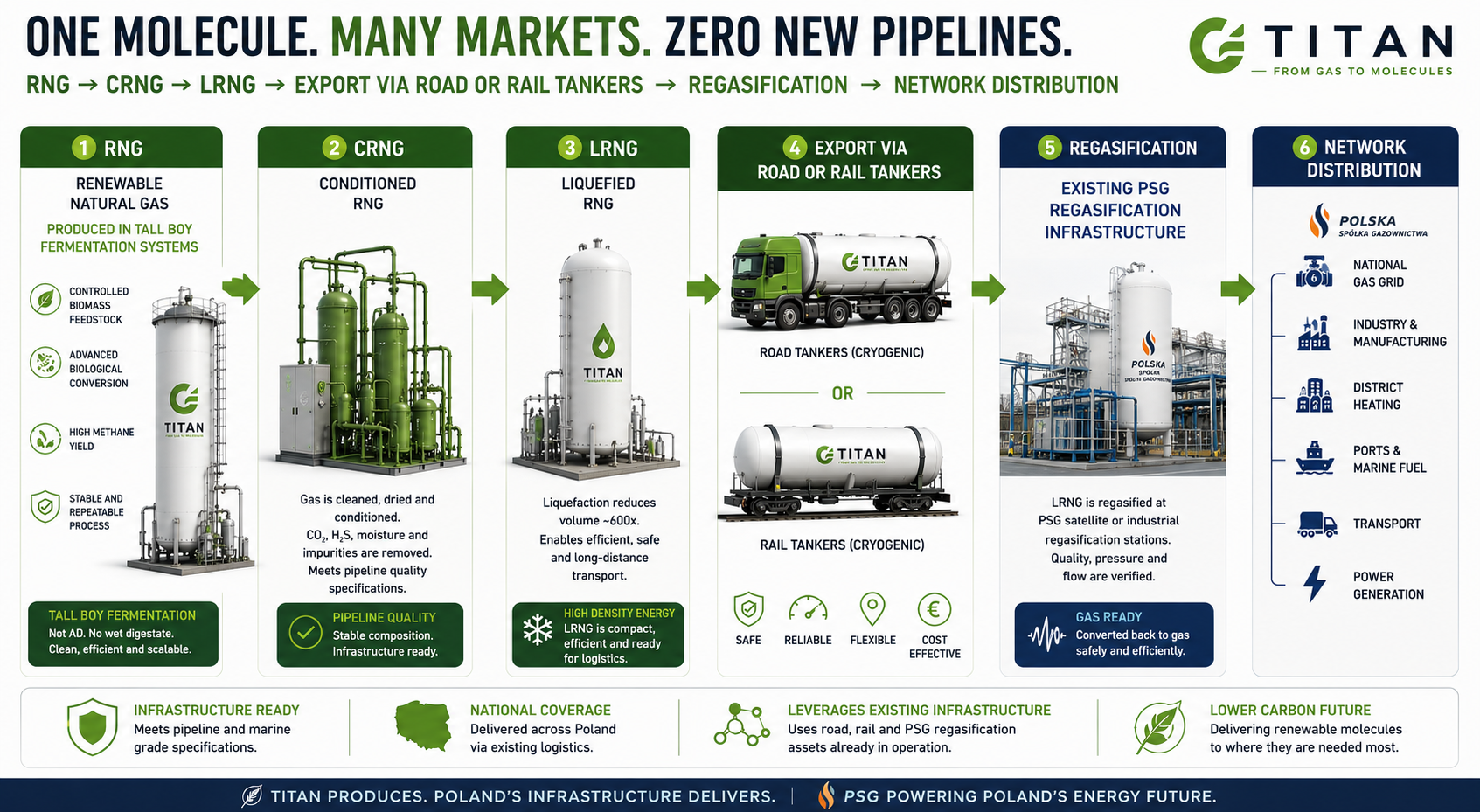
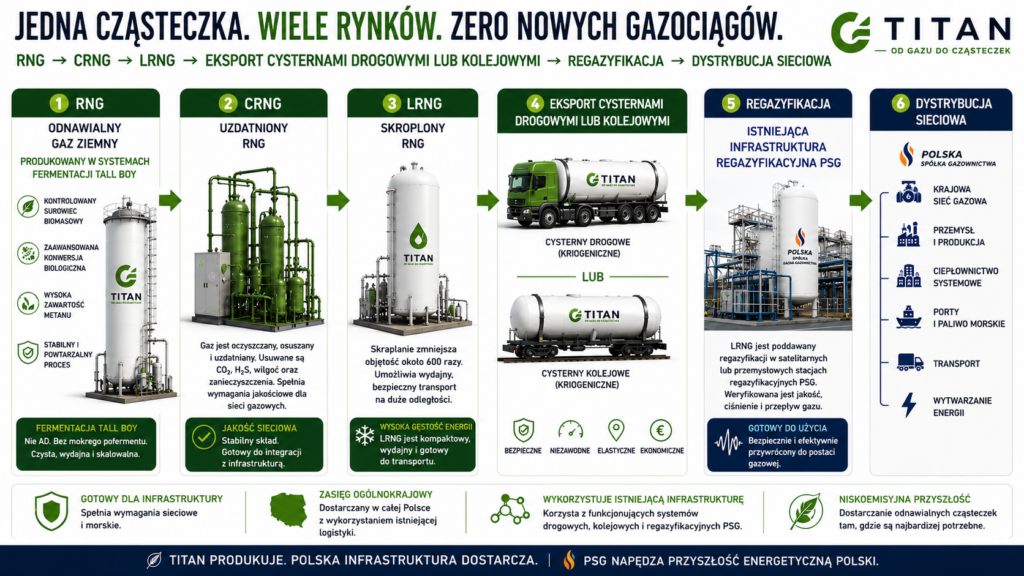
The Hydrogen Producer Gas platform creates a controlled gas-phase feedstock which is then biologically converted into Renewable Natural Gas through advanced methanogenic systems.

From there, the molecule undergoes additional upgrading and conditioning processes designed to produce stable, high-purity Renewable Natural Gas suitable for industrial use, liquefaction and infrastructure integration.

This is where pipeline-grade and marine-grade specifications become important.

Pipeline-grade gas means the molecule is compatible with national gas infrastructure requirements and industrial applications requiring stable composition and reliable performance.

Marine-grade gas means the molecule is suitable for future LNG-compatible marine fuel infrastructure, bunkering systems and heavy transport applications where consistency, cleanliness and energy density are critical.

These standards are not marketing terminology.

They are infrastructure requirements.
Dlaczego TITAN Produkuje Gaz o Jakości Sieciowej i Morskiej

Warsaw 08:05:2026 4:04 PM Steve Walker

Nie każdy odnawialny gaz jest taki sam.

To jedna z najważniejszych rzeczy często pomijanych w publicznych dyskusjach dotyczących biometanu, odnawialnego gazu i przyszłych systemów dekarbonizacji.

Produkcja odnawialnych molekuł to tylko część wyzwania.

Drugą częścią jest jakość.

Systemy przemysłowe nie działają na sloganach. Działają na specyfikacjach.

Gazociągi wymagają zgodności parametrów.

Palniki przemysłowe wymagają stabilności.

Silniki morskie wymagają stabilnego paliwa.

Systemy kriogeniczne wymagają wysokiej czystości.

Systemy magazynowania wymagają przewidywalnego składu.

Wielkoskalowe systemy logistyczne wymagają standaryzacji.

Bez tych cech odnawialny gaz pozostaje ograniczony do małych regionalnych zastosowań zamiast stać się częścią strategicznej infrastruktury krajowej.

To jeden z powodów, dla których TITAN od początku projektowano inaczej.

Platforma nie została zaprojektowana wyłącznie po to, aby produkować „zielony gaz”.

Została zaprojektowana do produkcji infrastrukturalnych odnawialnych molekuł zdolnych do integracji z rzeczywistymi systemami przemysłowymi.

To rozróżnienie ma ogromne znaczenie.

Wiele systemów odnawialnego gazu pierwszej generacji rozwijano wokół lokalnych instalacji fermentacji rolniczej, gdzie zmienność jakości gazu mogła być akceptowalna w stosunkowo niewielkich środowiskach operacyjnych.

TITAN działa w zupełnie innej skali przemysłowej i według innej filozofii infrastrukturalnej.

Celem nie jest wyłącznie lokalny odzysk energii.

Celem jest krajowa dystrybucja odnawialnych molekuł przy wykorzystaniu istniejącej infrastruktury logistycznej i przemysłowej.

To oznacza, że jakość molekuł staje się kluczowym priorytetem inżynieryjnym.

Dlatego TITAN koncentruje się na kondycjonowaniu i oczyszczaniu gazu.

Platforma Hydrogen Producer Gas tworzy kontrolowany gazowy surowiec, który następnie jest biologicznie przekształcany w Renewable Natural Gas przy wykorzystaniu zaawansowanych systemów metanogennych.

Następnie molekuła przechodzi dodatkowe procesy oczyszczania i stabilizacji mające na celu uzyskanie wysokiej jakości Renewable Natural Gas odpowiedniego dla zastosowań przemysłowych, skraplania i integracji infrastrukturalnej.

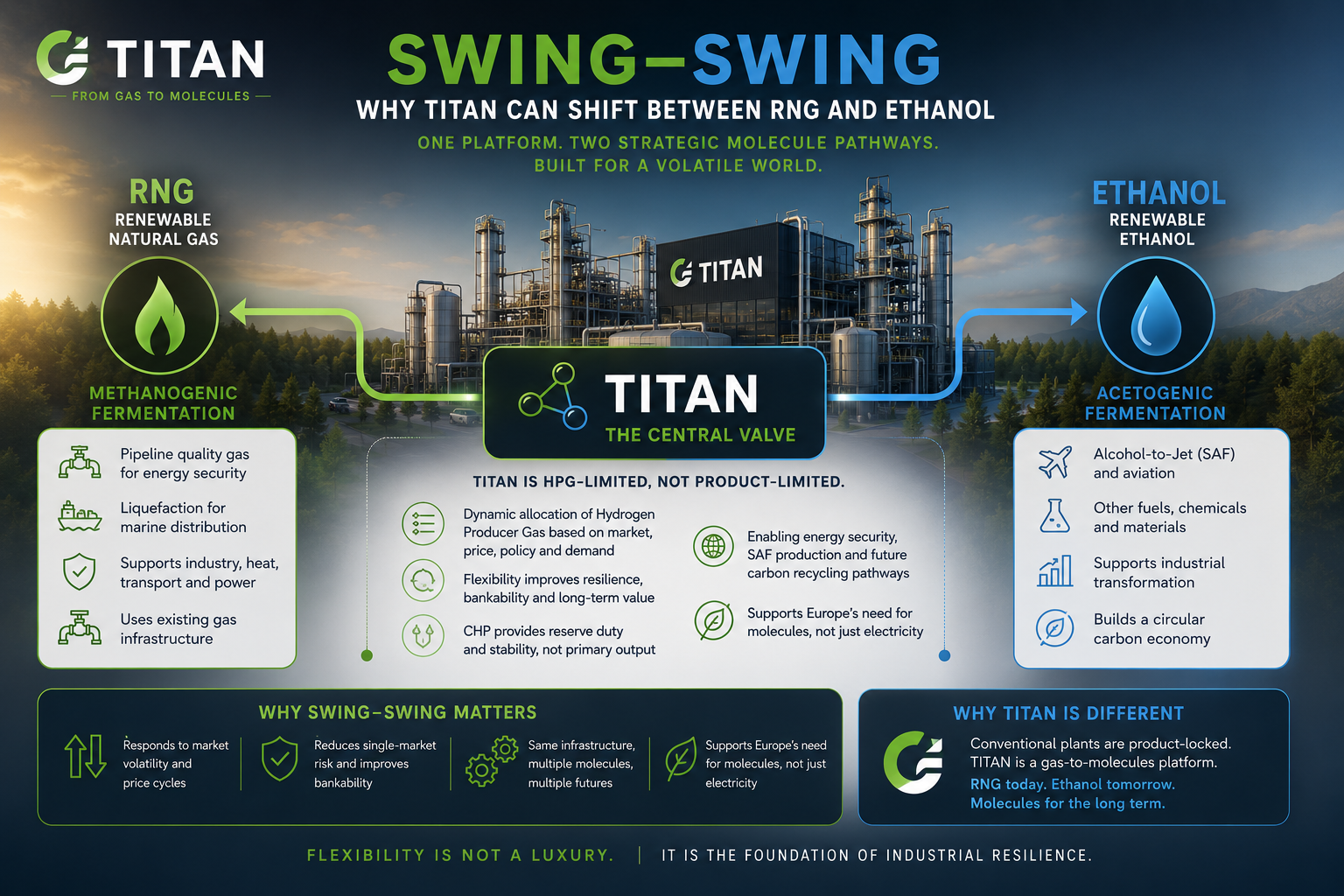
Why TITAN Can Shift Between RNG and Ethanol

Publish date: 7 May 2026

TITAN is designed around a simple industrial principle: do not lock a valuable feedstock into only one product.

At the centre of TITAN is Hydrogen Producer Gas. This gas is produced from forest residues and other renewable carbon resources. It contains the carbon and hydrogen needed to make useful molecules. Once this gas has been created, TITAN does not have to follow only one route.

It can shift.

This is what we call Swing–Swing.

In one operating mode, TITAN can direct more Hydrogen Producer Gas toward methanogenic fermentation to produce Renewable Natural Gas. RNG can be compressed, liquefied and distributed through existing gas and LNG logistics. It supports energy security, industrial heat, transport fuel and replacement of fossil natural gas.

In another operating mode, TITAN can direct more Hydrogen Producer Gas toward acetogenic fermentation to produce ethanol. This ethanol can support the Alcohol-to-Jet pathway for Sustainable Aviation Fuel, as well as other fuels, chemicals and materials.

The same platform can therefore support two strategic molecule markets: renewable methane and renewable ethanol.

This matters because energy markets are volatile. Gas prices move. Ethanol markets move. Aviation fuel policy develops over time. Industrial demand changes. A rigid plant is exposed to these changes. A flexible plant can respond to them.

TITAN is not product-limited. It is Hydrogen Producer Gas-limited.

That means the platform is built around the controlled production and allocation of gas. The value is not only in the final product. The value is in the ability to decide where the gas should go, based on demand, price, regulation and strategic need.

This is very different from a conventional biomethane project. A typical biomethane plant is built to make biomethane. That is its product. If market conditions change, the plant has limited options.

TITAN is different.

It is a gas-to-molecules platform. Methane is one output. Ethanol is another. Future pathways can include chemicals, proteins, materials and other fermentation products. The system is not designed as a single-output facility. It is designed as production infrastructure.

Swing–Swing also improves bankability.

Banks and investors do not like dependency on one market. They prefer assets that can survive different price cycles. A plant that can produce RNG when gas demand is strong, and ethanol when SAF demand grows, has stronger commercial resilience than a plant dependent on only one commodity.

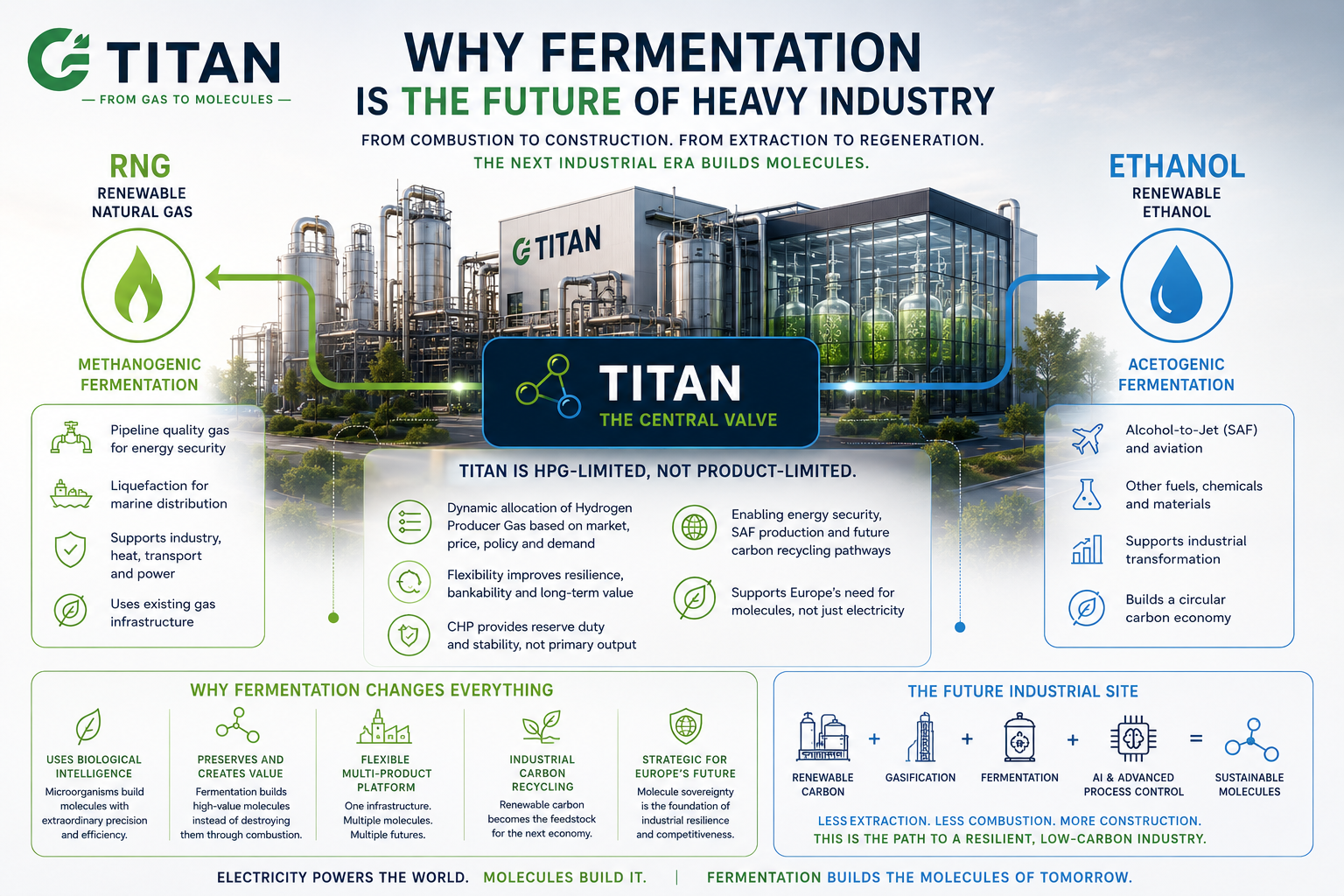
Why Fermentation Is the Future of Heavy Industry

Warsaw 06:05:2026 10.44 AM Steve Walker

For more than a century, heavy industry has been built around combustion.

We burn carbon to create heat. We use heat to create motion, electricity, pressure and industrial chemistry. This model shaped the modern world. Steel, cement, chemicals, refining, transport and power generation all grew from the age of combustion.

But combustion has limits.

Combustion is efficient at releasing energy, but inefficient at preserving molecular value. Once carbon is burned, most of its industrial usefulness disappears into the atmosphere as carbon dioxide, low-grade heat and emissions.

The next industrial era will increasingly focus on something different.

Not burning molecules.

Building them.

This is where fermentation becomes important.

Fermentation is often misunderstood because most people associate it with beer, wine or food production. In reality, fermentation is one of the most powerful industrial manufacturing systems ever developed. Modern fermentation can produce fuels, chemicals, proteins, pharmaceuticals, materials and industrial gases at enormous scale.

Microorganisms are not primitive chemistry.

They are molecular factories.

Inside every fermentation system, biology performs highly selective chemical conversion using carbon, hydrogen and energy. Instead of forcing reactions through extremely high temperatures and pressures, fermentation allows living systems to assemble molecules with extraordinary precision.

This changes industrial logic completely.

Traditional heavy industry relies on thermal force. Fermentation relies on biological intelligence developed through evolution over billions of years.

The future of heavy industry will increasingly combine both systems.

Thermal systems will continue to play an important role in areas such as gasification, metals, ceramics and high-temperature process industries. But fermentation will increasingly take over the role of precision molecule manufacturing.

This transition has already begun.

Around the world, industrial fermentation is moving beyond food and pharmaceuticals into energy, aviation fuel, chemicals, plastics and advanced materials. The growth of Sustainable Aviation Fuel alone is accelerating investment into fermentation technologies capable of converting renewable carbon into ethanol and other intermediates.

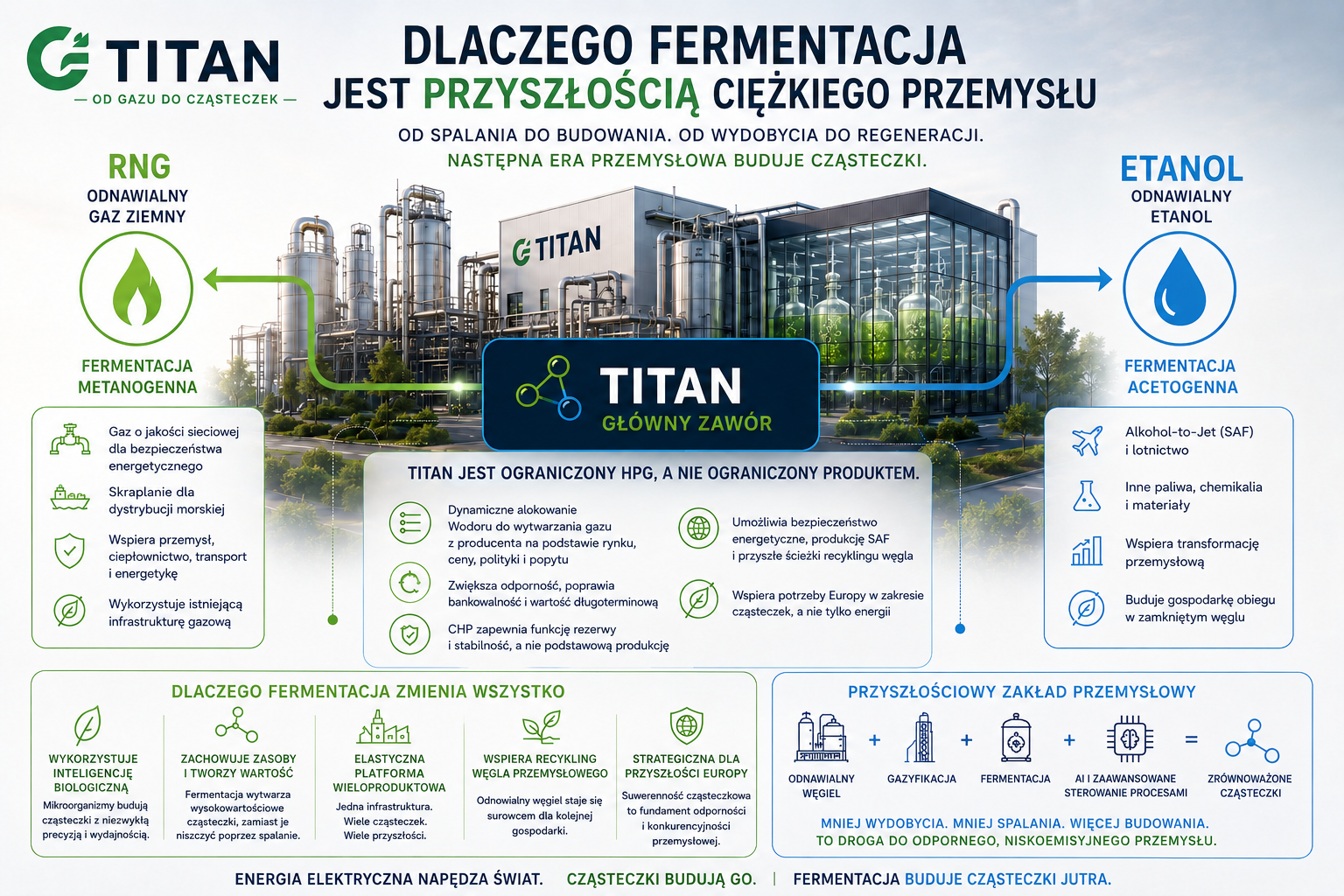
Dlaczego fermentacja jest przyszłością przemysłu ciężkiego

Warsaw 06:05:2026 10.40 AM Steve Walker

Przez ponad sto lat przemysł ciężki był oparty na spalaniu.

Spalamy węgiel, aby wytworzyć ciepło. Ciepło wykorzystujemy do produkcji ruchu, energii elektrycznej, ciśnienia i chemii przemysłowej. Ten model ukształtował współczesny świat. Hutnictwo, cementownie, przemysł chemiczny, rafinerie, transport i energetyka rozwijały się w epoce spalania.

Jednak spalanie ma swoje ograniczenia.

Spalanie skutecznie uwalnia energię, ale bardzo słabo zachowuje wartość molekularną. Gdy węgiel zostaje spalony, większość jego wartości przemysłowej znika do atmosfery w postaci dwutlenku węgla, niskotemperaturowego ciepła i emisji.

Kolejna epoka przemysłowa będzie coraz bardziej koncentrować się na czymś innym.

Nie na spalaniu molekuł.

Lecz na ich budowie.

W tym miejscu fermentacja staje się niezwykle ważna.

Fermentacja jest często źle rozumiana, ponieważ większość ludzi kojarzy ją z piwem, winem lub produkcją żywności. W rzeczywistości fermentacja jest jednym z najpotężniejszych systemów produkcyjnych, jakie kiedykolwiek opracowano. Współczesna fermentacja może produkować paliwa, chemikalia, białka, farmaceutyki, materiały i gazy przemysłowe na ogromną skalę.

Mikroorganizmy nie są prymitywną chemią.

Są fabrykami molekuł.

W każdym systemie fermentacyjnym biologia wykonuje niezwykle precyzyjne przemiany chemiczne z wykorzystaniem węgla, wodoru i energii. Zamiast wymuszać reakcje przy ekstremalnych temperaturach i ciśnieniach, fermentacja pozwala żywym organizmom budować molekuły z wyjątkową dokładnością.

To całkowicie zmienia logikę przemysłu.

Tradycyjny przemysł ciężki opiera się na sile termicznej. Fermentacja opiera się na biologicznej inteligencji rozwijanej przez miliardy lat ewolucji.

Przyszłość przemysłu będzie coraz częściej łączyć oba systemy.

Systemy termiczne nadal pozostaną ważne w takich obszarach jak zgazowanie, hutnictwo, ceramika i procesy wysokotemperaturowe. Jednak fermentacja będzie coraz częściej przejmować rolę precyzyjnej produkcji molekuł.

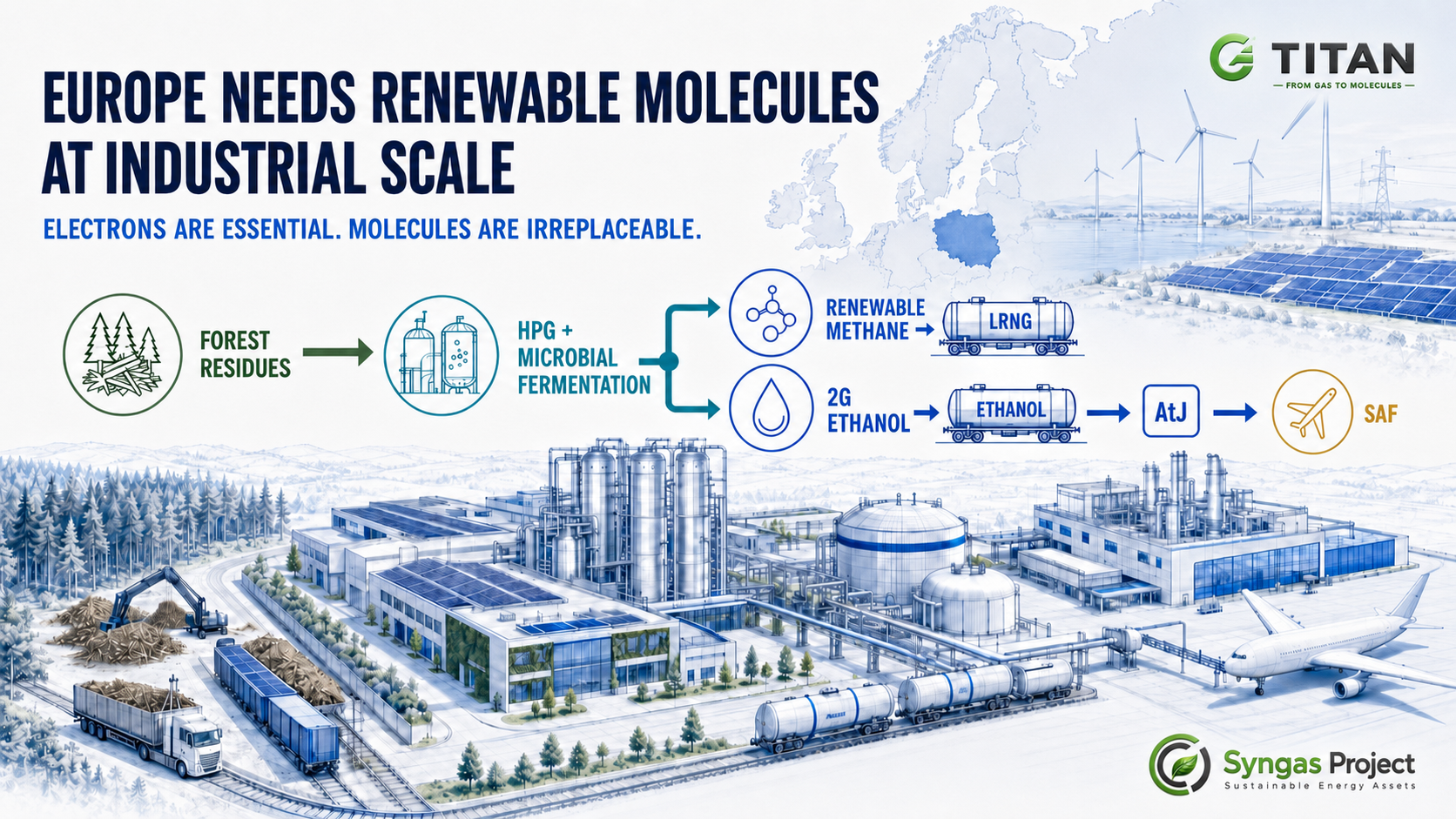
Europe Needs Renewable Molecules at Industrial Scale

Europe has made real progress in renewable electricity, but the molecule system remains exposed. Gas, liquid fuels, chemical feedstocks and future materials still rely heavily on fossil supply chains. These molecules cannot be replaced by electrons alone. They must be manufactured again, differently.

This is where TITAN changes the scale of the conversation.

A typical anaerobic digestion plant may produce around 2 million cubic metres of renewable gas per year. That is useful, but it does not move national energy security. TITAN is designed for a different class of output. In Phase One Swing–Swing mode, producing renewable methane and ethanol side by side, a TITAN site can produce around 22 million cubic metres of RNG equivalent per year. With the first 50 MW of a future 100 MW RNG capability installed in Phase One, the same site has the installed pathway to move beyond this level toward 44 million cubic metres of RNG, with one of ten planned full TITAN sites capable of more than 80 million cubic metres of RNG equivalent per year.

This is not a marginal improvement. It is a step-change in renewable molecule infrastructure.

TITAN achieves this scale by combining Hydrogen Producer Gas with industrialised biotechnology. Hydrogen Producer Gas creates the controllable carbon feedstock. Methanogenic fermentation converts that feedstock into renewable methane. Acetogenic fermentation converts it into 2G ethanol for SAF intermediates. These outputs are not competing products. They operate side by side in Swing–Swing mode, where shared gas supply, heat integration, utilities, operational flexibility and market optionality allow each pathway to support the other.

The result is not simply renewable gas production and not simply ethanol production. It is an integrated carbon-to-molecule platform.

This matters because Europe needs both gas and liquid fuels. Renewable methane can replace fossil LNG in existing gas logistics, virtual pipeline systems and industrial demand centres. 2G ethanol can support the alcohol-to-jet pathway for sustainable aviation fuel. Together, they create a stronger platform than either output alone.

Syngas Project’s first base is Poland. The long-term objective is to establish the platform capacity required to support a Polish SAF refinery capable of producing 1 million litres per day by 2035, while also building the renewable gas infrastructure needed to deliver approximately 1 GW of RNG-equivalent capacity through Swing–Swing deployment.

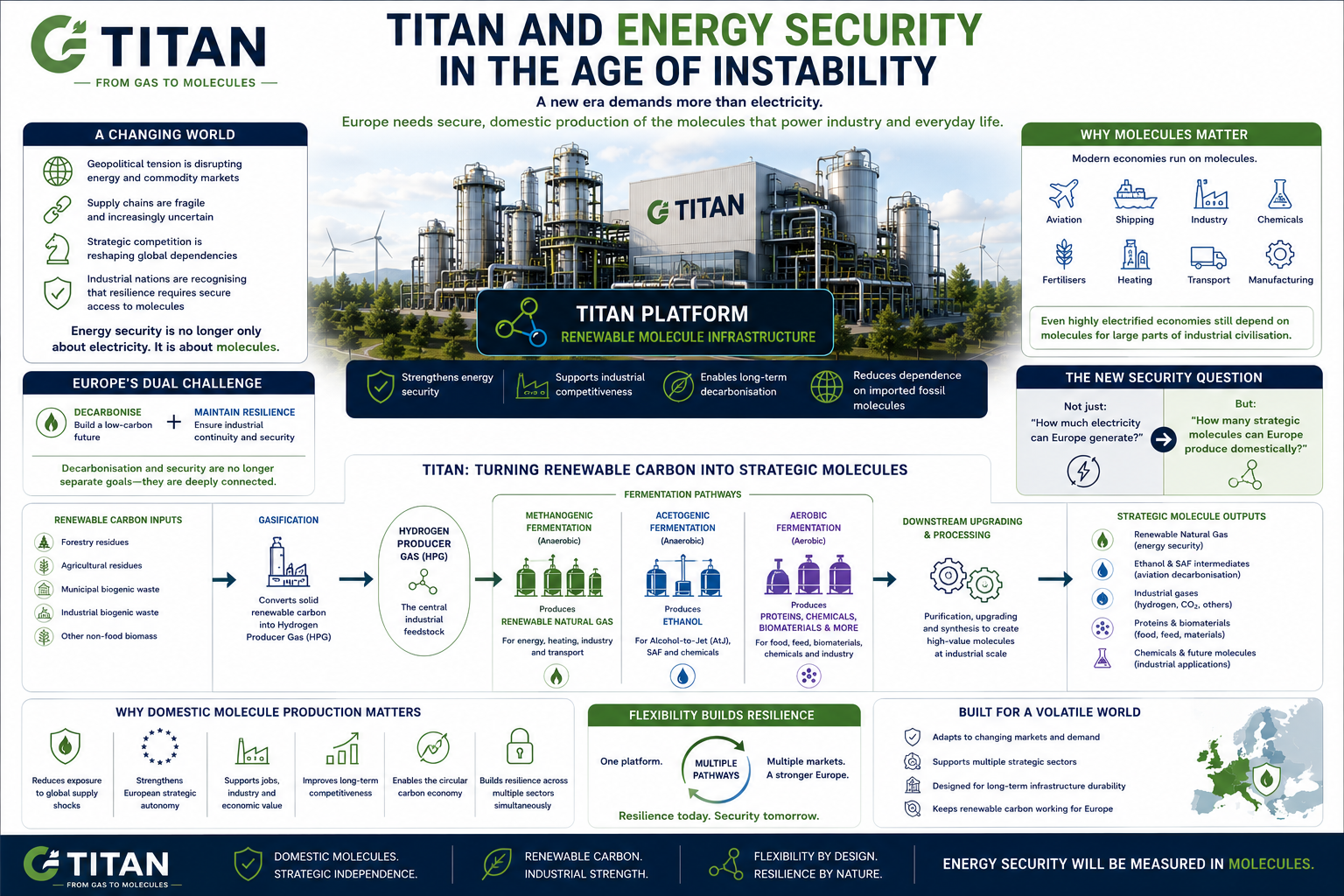
TITAN and Energy Security in the Age of Instability

Publish date: 2 May 2026

Europe is entering a more unstable world.

For decades, much of Europe’s industrial model depended on the assumption that energy, fuels and industrial feedstocks would remain globally available, relatively affordable and politically accessible. Large international supply chains made it possible to import molecules from distant regions while focusing domestic policy primarily on consumption and efficiency.

That world is changing.

Geopolitical tension has returned to energy markets. Supply chains have become more fragile. Strategic competition is increasing. Industrial nations are beginning to recognise that long-term resilience depends not only on electricity generation, but also on secure access to molecules.

This distinction matters.

Modern economies do not run on electricity alone.

Heavy industry, aviation, shipping, chemicals, fertilisers, district heating and industrial transport all require molecular products: gas, liquid fuels, carbon feedstocks and industrial gases. Even highly electrified economies still depend on molecules for large parts of industrial civilisation.

Europe therefore faces a dual challenge.

It must decarbonise.

But it must also maintain industrial continuity and strategic resilience.

These objectives are often treated separately. In reality, they are becoming increasingly connected.

The transition away from fossil carbon is not simply an environmental transition. It is also an industrial and geopolitical transition.

Countries capable of producing strategic molecules domestically will likely possess stronger long-term resilience than countries dependent on imported carbon systems.

This is where renewable molecule infrastructure becomes important.

TITAN was designed for this emerging industrial environment.

The platform converts renewable carbon into Hydrogen Producer Gas and then upgrades that gas into valuable industrial molecules through fermentation and downstream processing pathways. The objective is not only renewable energy generation. The objective is domestic molecule production at industrial scale.

This changes the role of infrastructure.

Traditional renewable systems often focus primarily on electricity generation. TITAN focuses on renewable molecules: Renewable Natural Gas, ethanol, future SAF intermediates, industrial gases, proteins, chemicals and future carbon-derived materials.

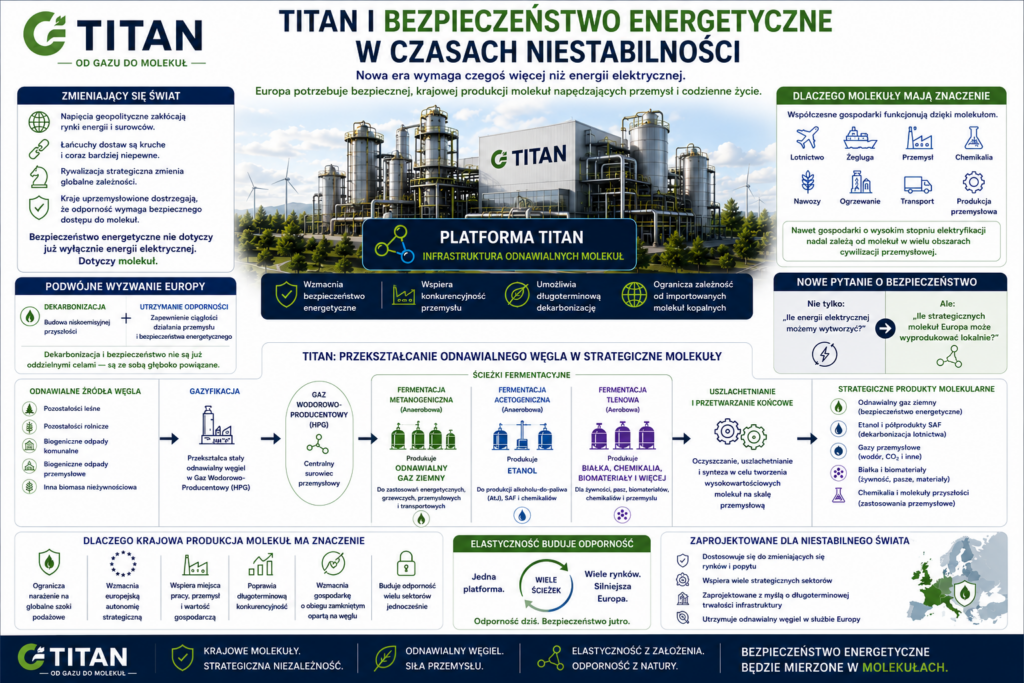
TITAN i bezpieczeństwo energetyczne w epoce niestabilności

Europa wchodzi w coraz bardziej niestabilny świat.

Przez dekady znaczna część europejskiego modelu przemysłowego opierała się na założeniu, że energia, paliwa i surowce przemysłowe pozostaną globalnie dostępne, względnie tanie i politycznie osiągalne. Rozbudowane międzynarodowe łańcuchy dostaw umożliwiały import molekuł z odległych regionów, podczas gdy polityka wewnętrzna koncentrowała się głównie na konsumpcji i efektywności.

Ten świat się zmienia.

Napięcia geopolityczne powróciły na rynki energii. Łańcuchy dostaw stały się bardziej kruche. Rośnie strategiczna konkurencja między państwami. Kraje przemysłowe zaczynają dostrzegać, że długoterminowa odporność zależy nie tylko od produkcji energii elektrycznej, ale również od bezpiecznego dostępu do molekuł.

To rozróżnienie ma ogromne znaczenie.

Nowoczesne gospodarki nie funkcjonują wyłącznie dzięki energii elektrycznej.

Przemysł ciężki, lotnictwo, żegluga, chemia, nawozy, ciepłownictwo i transport przemysłowy nadal wymagają produktów molekularnych: gazu, paliw ciekłych, surowców węglowych i gazów przemysłowych. Nawet silnie zelektryfikowane gospodarki pozostają zależne od molekuł w wielu obszarach współczesnej cywilizacji przemysłowej.

Europa stoi więc przed podwójnym wyzwaniem.

Musi przeprowadzić dekarbonizację.

Ale jednocześnie musi utrzymać ciągłość przemysłową i strategiczną odporność.

Cele te często traktowane są oddzielnie. W rzeczywistości stają się coraz bardziej ze sobą powiązane.

Odchodzenie od kopalnego węgla nie jest wyłącznie transformacją środowiskową. Jest również transformacją przemysłową i geopolityczną.

Państwa zdolne do krajowej produkcji strategicznych molekuł będą prawdopodobnie posiadały większą odporność długoterminową niż państwa zależne od importowanych systemów opartych na węglu kopalnym.

I właśnie tutaj infrastruktura odnawialnych molekuł staje się ważna.

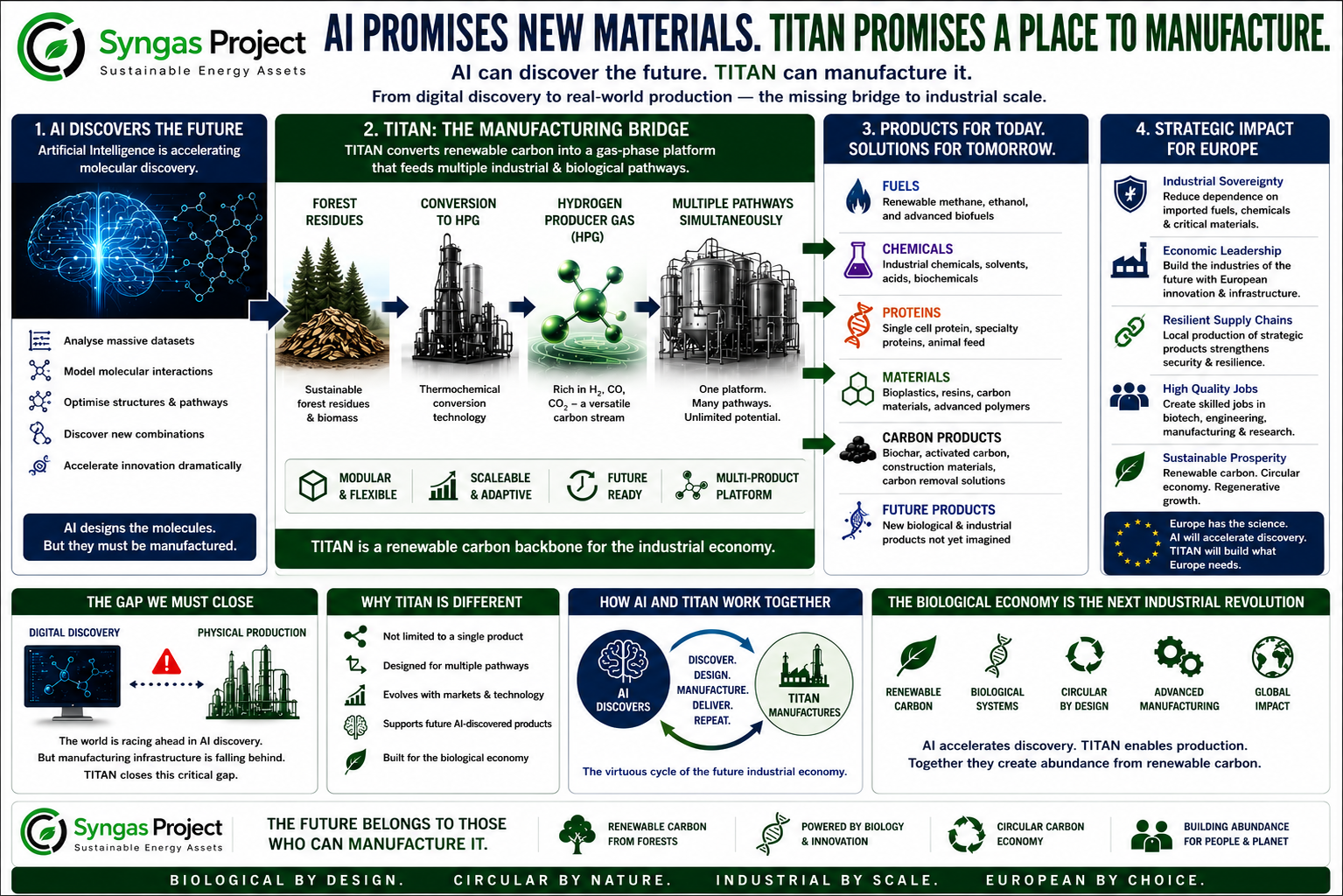
AI Promises New Materials. TITAN Promises a Place to Manufacture Them

Artificial intelligence is beginning to change chemistry faster than most people realise.

For decades, discovering new materials, biological pathways and industrial compounds was slow, expensive and uncertain. Research teams could spend years testing molecules, enzymes and formulations with limited success.

That is changing rapidly.

Artificial intelligence can now analyse enormous quantities of chemical, biological and material data simultaneously. It can model interactions, optimise molecular structures and identify entirely new combinations far faster than traditional research methods.

The implications are enormous.

AI may help discover:

New fuels.
New plastics.
New proteins.
New medicines.
New industrial chemicals.
New biological materials.
New agricultural systems.
New carbon products.

Governments and technology companies are investing billions into this transition because whoever controls the next generation of materials and molecules may help define the next industrial economy.

But there is a problem.

Discovery alone does not create industry.

A molecule discovered by artificial intelligence still needs to be manufactured physically, economically and at scale.

This is where the conversation becomes industrial rather than digital.

The world is rapidly building artificial intelligence systems capable of designing future products. But the physical infrastructure capable of manufacturing those products is developing far more slowly.

This creates a growing gap between digital discovery and real-world production.

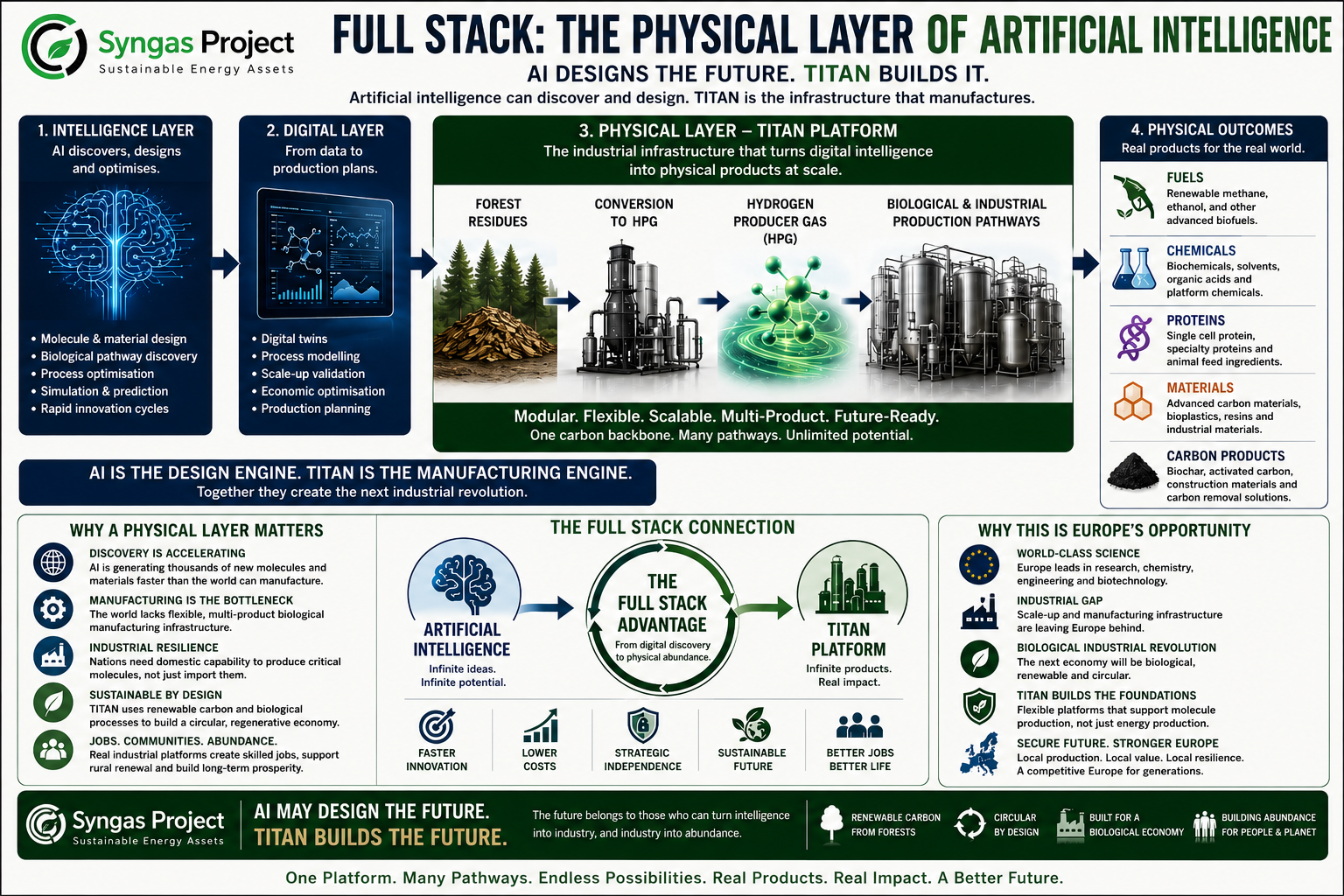
Full Stack: The Physical Layer of Artificial Intelligence

Artificial intelligence is rapidly becoming the defining technology race of the 21st century.

Every week brings announcements about larger models, faster processors, more capable software agents and increasingly advanced machine reasoning systems. Governments are investing billions. Technology companies are competing for dominance. Data centres are expanding across the world at extraordinary speed.

Most discussion focuses on computation.

But very little discussion focuses on what artificial intelligence ultimately needs in the physical world.

Because intelligence alone does not manufacture anything.

Artificial intelligence can design molecules.
It can optimise biological pathways.
It can simulate new materials.
It can improve industrial systems.
It can accelerate chemistry and biotechnology research.

But eventually, something physical must manufacture the result.

This is where the next industrial bottleneck may emerge.

The future may not belong only to countries that control computation.

It may also belong to countries that control biological manufacturing platforms capable of turning digital intelligence into physical products.

That distinction is becoming increasingly important.

Artificial intelligence is already beginning to transform chemistry, material science, pharmaceutical research, biological engineering and industrial process optimisation. The speed of discovery is accelerating dramatically. New materials, proteins, enzymes, carbon structures and biological production pathways are being identified faster than traditional industrial systems can adapt.

But discovery is only one half of the equation.

Manufacturing remains the other half.