
Publish date: 8 May 2026
Warsaw 08:05:2026 4:05 PM Steve Walker
Not all renewable gas is the same.
This is one of the most important realities often overlooked in public discussions surrounding biomethane, renewable gas and future decarbonisation systems.
Producing renewable molecules is only part of the challenge.
The second challenge is quality.
Industrial systems do not operate on slogans. They operate on specifications.
Pipelines require specification compliance.
Industrial burners require consistency.
Marine engines require fuel stability.
Cryogenic systems require purity.
Storage systems require predictable composition.
Large-scale logistics systems require standardisation.
Without these characteristics, renewable gas remains limited to small regional applications rather than becoming part of strategic national infrastructure.
This is one of the reasons TITAN was designed differently from the beginning.
The platform was not designed simply to produce “green gas.”
It was designed to produce infrastructure-grade renewable molecules capable of integration into real industrial systems.
This distinction matters enormously.
Many first-generation renewable gas systems were developed around local agricultural digestion projects where gas quality variability could often be tolerated within relatively small operating environments.
TITAN operates at a different industrial scale and under a different infrastructure philosophy.
The objective is not merely local energy recovery.
The objective is national-scale renewable molecule distribution through existing logistics and industrial infrastructure.
This requires molecule quality to become a central engineering priority.
TITAN therefore focuses heavily on gas conditioning and polishing.
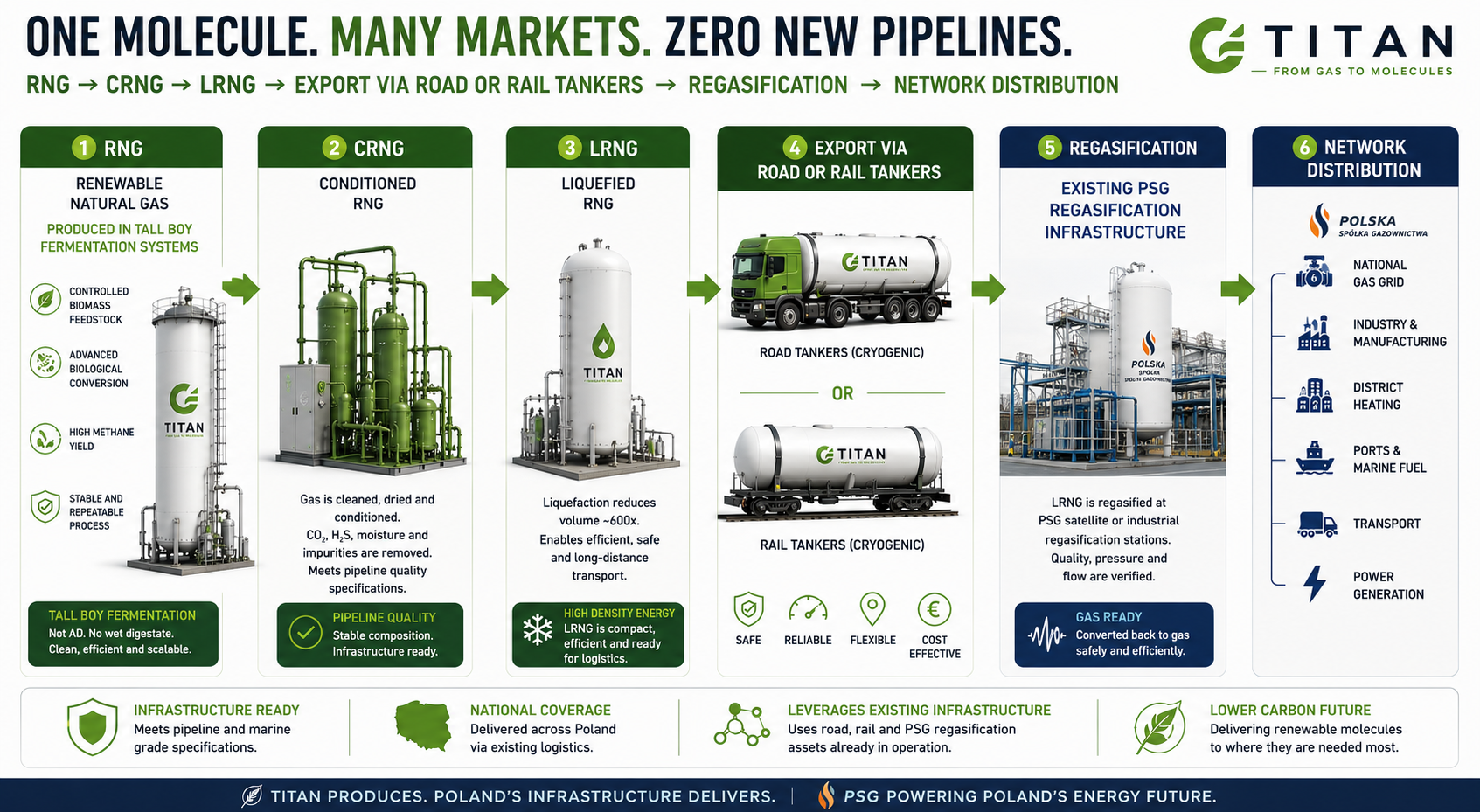
The Hydrogen Producer Gas platform creates a controlled gas-phase feedstock which is then biologically converted into Renewable Natural Gas through advanced methanogenic systems.
From there, the molecule undergoes additional upgrading and conditioning processes designed to produce stable, high-purity Renewable Natural Gas suitable for industrial use, liquefaction and infrastructure integration.
This is where pipeline-grade and marine-grade specifications become important.
Pipeline-grade gas means the molecule is compatible with national gas infrastructure requirements and industrial applications requiring stable composition and reliable performance.
Marine-grade gas means the molecule is suitable for future LNG-compatible marine fuel infrastructure, bunkering systems and heavy transport applications where consistency, cleanliness and energy density are critical.
These standards are not marketing terminology.
They are infrastructure requirements.