Why TITAN Produces Pipeline and Marine Grade Gas

Publish date: 8 May 2026
(Przewiń w dół, aby zobaczyć wersję polską.)

Not all renewable gas is the same.

This is one of the most important realities often overlooked in public discussions surrounding biomethane, renewable gas and future decarbonisation systems.

Producing renewable molecules is only part of the challenge.

The second challenge is quality.

Industrial systems do not operate on slogans. They operate on specifications.

Pipelines require specification compliance.

Industrial burners require consistency.

Marine engines require fuel stability.

Cryogenic systems require purity.

Storage systems require predictable composition.

Large-scale logistics systems require standardisation.

Without these characteristics, renewable gas remains limited to small regional applications rather than becoming part of strategic national infrastructure.

This is one of the reasons TITAN was designed differently from the beginning.

The platform was not designed simply to produce “green gas.”

It was designed to produce infrastructure-grade renewable molecules capable of integration into real industrial systems.

This distinction matters enormously.

Many first-generation renewable gas systems were developed around local agricultural digestion projects where gas quality variability could often be tolerated within relatively small operating environments.

TITAN operates at a different industrial scale and under a different infrastructure philosophy.

The objective is not merely local energy recovery.

The objective is national-scale renewable molecule distribution through existing logistics and industrial infrastructure.

This requires molecule quality to become a central engineering priority.

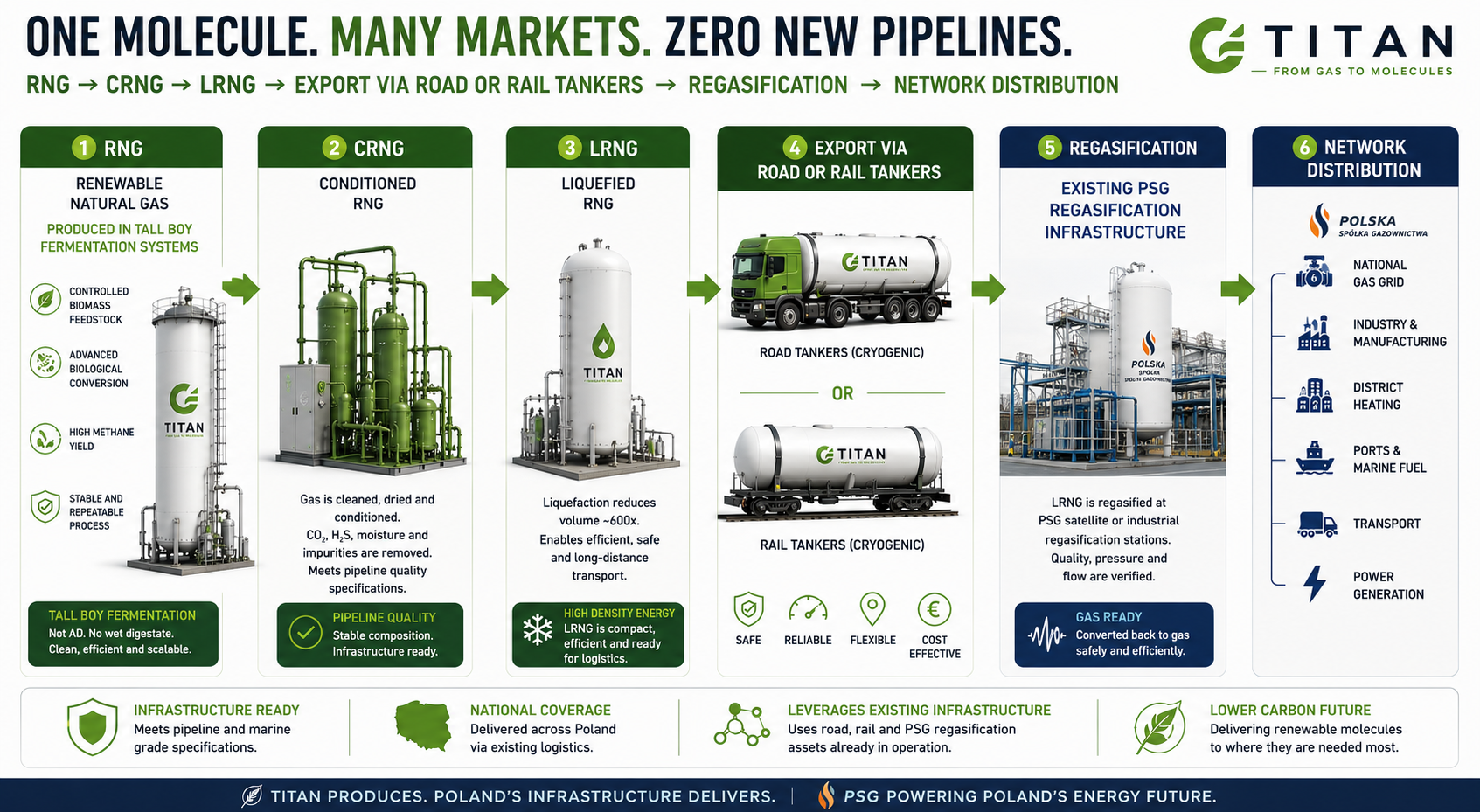
TITAN therefore focuses heavily on gas conditioning and polishing.

The Hydrogen Producer Gas platform creates a controlled gas-phase feedstock which is then biologically converted into Renewable Natural Gas through advanced methanogenic systems.

From there, the molecule undergoes additional upgrading and conditioning processes designed to produce stable, high-purity Renewable Natural Gas suitable for industrial use, liquefaction and infrastructure integration.

This is where pipeline-grade and marine-grade specifications become important.

Pipeline-grade gas means the molecule is compatible with national gas infrastructure requirements and industrial applications requiring stable composition and reliable performance.

Marine-grade gas means the molecule is suitable for future LNG-compatible marine fuel infrastructure, bunkering systems and heavy transport applications where consistency, cleanliness and energy density are critical.

These standards are not marketing terminology.

They are infrastructure requirements.
Why TITAN Can Shift Between RNG and Ethanol

Publish date: 7 May 2026

(Przewiń w dół, aby zobaczyć wersję polską.)

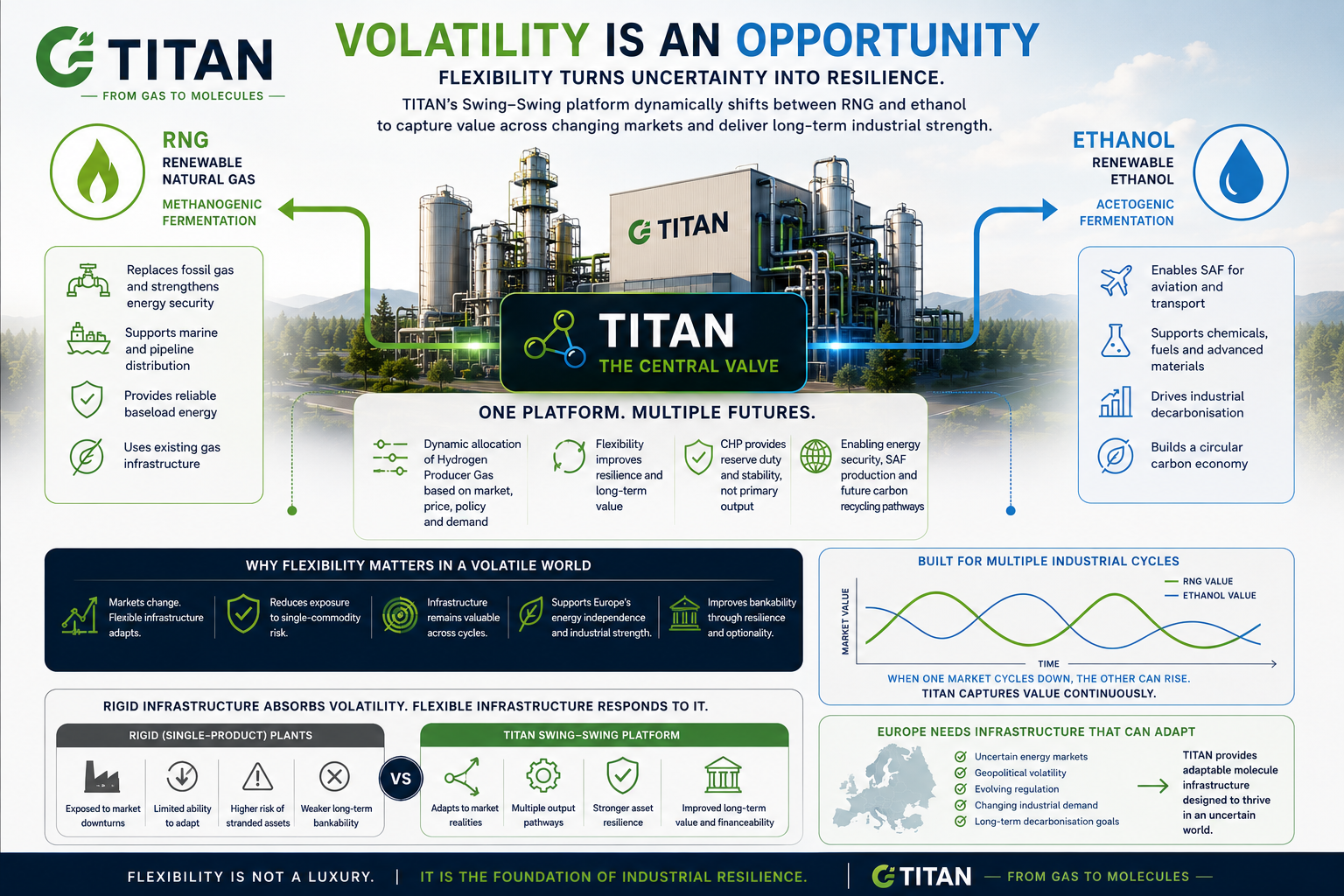
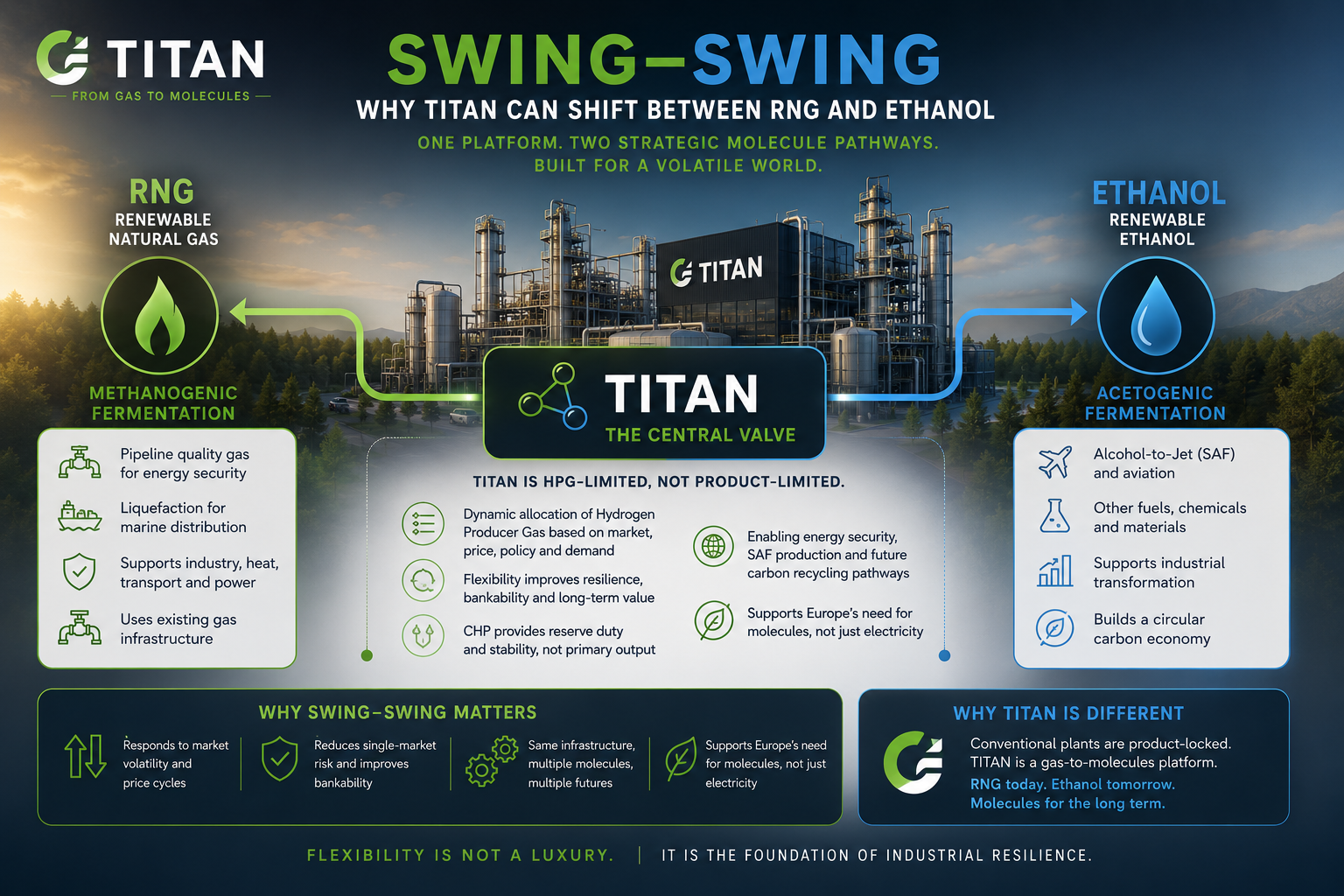
TITAN is designed around a simple industrial principle: do not lock a valuable feedstock into only one product.

At the centre of TITAN is Hydrogen Producer Gas. This gas is produced from forest residues and other renewable carbon resources. It contains the carbon and hydrogen needed to make useful molecules. Once this gas has been created, TITAN does not have to follow only one route.

It can shift.

This is what we call Swing–Swing.

In one operating mode, TITAN can direct more Hydrogen Producer Gas toward methanogenic fermentation to produce Renewable Natural Gas. RNG can be compressed, liquefied and distributed through existing gas and LNG logistics. It supports energy security, industrial heat, transport fuel and replacement of fossil natural gas.

In another operating mode, TITAN can direct more Hydrogen Producer Gas toward acetogenic fermentation to produce ethanol. This ethanol can support the Alcohol-to-Jet pathway for Sustainable Aviation Fuel, as well as other fuels, chemicals and materials.

The same platform can therefore support two strategic molecule markets: renewable methane and renewable ethanol.

This matters because energy markets are volatile. Gas prices move. Ethanol markets move. Aviation fuel policy develops over time. Industrial demand changes. A rigid plant is exposed to these changes. A flexible plant can respond to them.

TITAN is not product-limited. It is Hydrogen Producer Gas-limited.

That means the platform is built around the controlled production and allocation of gas. The value is not only in the final product. The value is in the ability to decide where the gas should go, based on demand, price, regulation and strategic need.

This is very different from a conventional biomethane project. A typical biomethane plant is built to make biomethane. That is its product. If market conditions change, the plant has limited options.

TITAN is different.

It is a gas-to-molecules platform. Methane is one output. Ethanol is another. Future pathways can include chemicals, proteins, materials and other fermentation products. The system is not designed as a single-output facility. It is designed as production infrastructure.

Swing–Swing also improves bankability.

Banks and investors do not like dependency on one market. They prefer assets that can survive different price cycles. A plant that can produce RNG when gas demand is strong, and ethanol when SAF demand grows, has stronger commercial resilience than a plant dependent on only one commodity.

Volatility Is an Industrial Opportunity

Publish date: 5 May 2026

(Przewiń w dół, aby zobaczyć wersję polską.)

For much of the industrial world, volatility is viewed as a threat.

Energy prices rise and fall. Commodity markets move unexpectedly. Regulation changes. Geopolitical tensions disrupt supply chains. Technologies evolve faster than expected. Entire sectors can become exposed to sudden shifts in economics or policy.

Traditional industrial infrastructure struggles in this environment.

Most industrial plants are designed around one core assumption: stability.

A refinery is optimised for a specific feedstock. A power plant is designed for a fixed operational profile. A conventional biomethane installation is built to produce biomethane. A chemical plant is often designed around a narrow process pathway.

This model worked well during periods of predictable markets and long industrial cycles.

But the world is changing.

Energy markets are becoming more dynamic. Carbon regulation is increasing. Molecule demand is evolving. Europe is attempting to reduce strategic dependence on imported fuels and industrial feedstocks while simultaneously decarbonising its economy.

In this environment, flexibility becomes increasingly valuable.

This is one of the reasons TITAN was designed differently.

TITAN is not built around a single product. It is built around controlled Hydrogen Producer Gas production and flexible molecule conversion pathways.

This distinction is important.

Traditional infrastructure often becomes vulnerable when its primary output loses competitiveness. A rigid system can only respond in limited ways to changing markets. If prices fall or regulation changes, the infrastructure itself may lose strategic value.

TITAN approaches this problem differently.

The platform is designed around optionality.

Hydrogen Producer Gas can be directed toward multiple downstream pathways depending on market conditions, regulation, demand and strategic priorities. In one operating environment, renewable methane may provide the strongest value proposition. In another, ethanol for Sustainable Aviation Fuel may become more attractive.

The same infrastructure remains relevant across multiple industrial cycles.

This changes the risk profile of the platform.

Volatility becomes less of a threat when infrastructure can adapt to it.

This does not eliminate risk entirely. All industrial systems face operational, regulatory and market challenges. But flexibility changes how those risks are managed.

A rigid system absorbs volatility.

A flexible system can respond to it.

This principle already exists in other forms of infrastructure. Modern logistics networks, data systems and manufacturing platforms increasingly rely on adaptability rather than fixed operational assumptions. The same logic is now beginning to emerge in industrial molecule production.

The future industrial economy will likely reward systems capable of continuous adjustment.

Europe’s SAF Challenge Cannot Be Solved with Cooking Oil Alone

Publish date: 4 May 2026

(Przewiń w dół, aby zobaczyć wersję polską.)

Europe is entering a new phase of aviation decarbonisation.

For decades, aviation depended almost entirely on fossil kerosene. The sector became one of the hardest parts of the economy to decarbonise because aircraft require extremely energy-dense liquid fuels that are safe, stable and globally compatible.

Unlike passenger vehicles, aviation cannot easily electrify at large scale.

Aircraft need molecules.

This is why Sustainable Aviation Fuel has become strategically important.

SAF allows the aviation sector to reduce lifecycle emissions while continuing to use existing aircraft, airports, pipelines and fuel logistics infrastructure. Instead of replacing the aviation system entirely, SAF enables gradual transition using compatible renewable fuels.

This approach is practical.

But it also creates a major challenge.

The scale of aviation fuel demand is enormous.

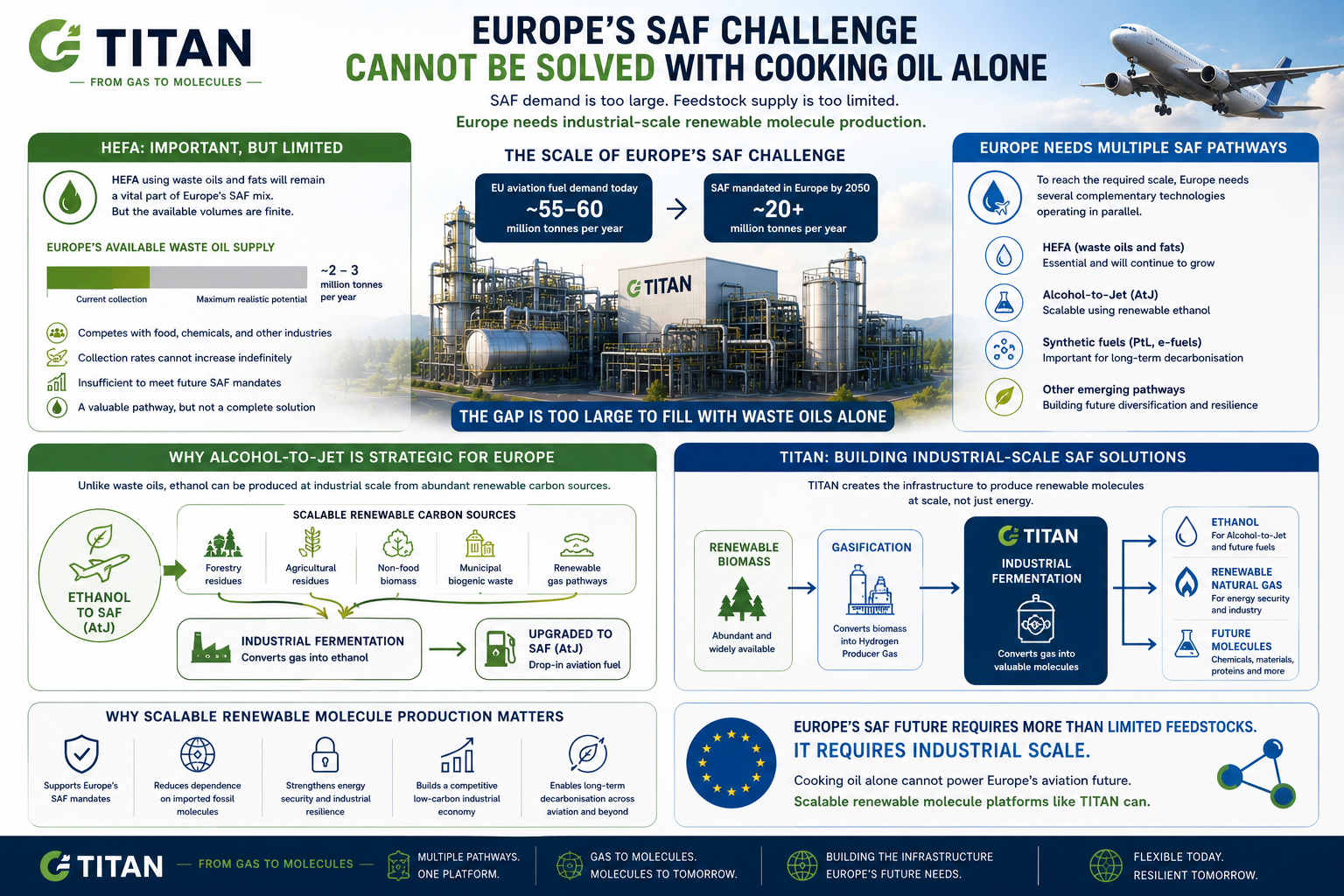
Europe consumes tens of millions of tonnes of aviation fuel every year. As SAF mandates increase over time, the volume of renewable fuel required will become extremely large. This creates pressure on feedstock supply chains across the entire energy and industrial system.

At present, much of the SAF discussion focuses on lipid-based pathways such as used cooking oil, waste fats and vegetable oils. These pathways are important and will continue to play a valuable role in SAF development.

But there is a structural limitation.

The volume of waste oils available is finite.

Europe cannot build a long-term SAF strategy around feedstocks that exist only in limited quantities. Even with aggressive collection systems, the available supply of used cooking oil and waste fats remains relatively small compared with total aviation fuel demand.

This is not a criticism of HEFA or lipid pathways.

It is simply a question of scale.

As aviation decarbonisation accelerates, Europe will require additional SAF pathways capable of operating at industrial volume using broader renewable carbon resources.

Why Carbon Recycling Will Replace Carbon Extraction

Publish date: 1 May 2026

(Przewiń w dół, aby zobaczyć wersję polską.)

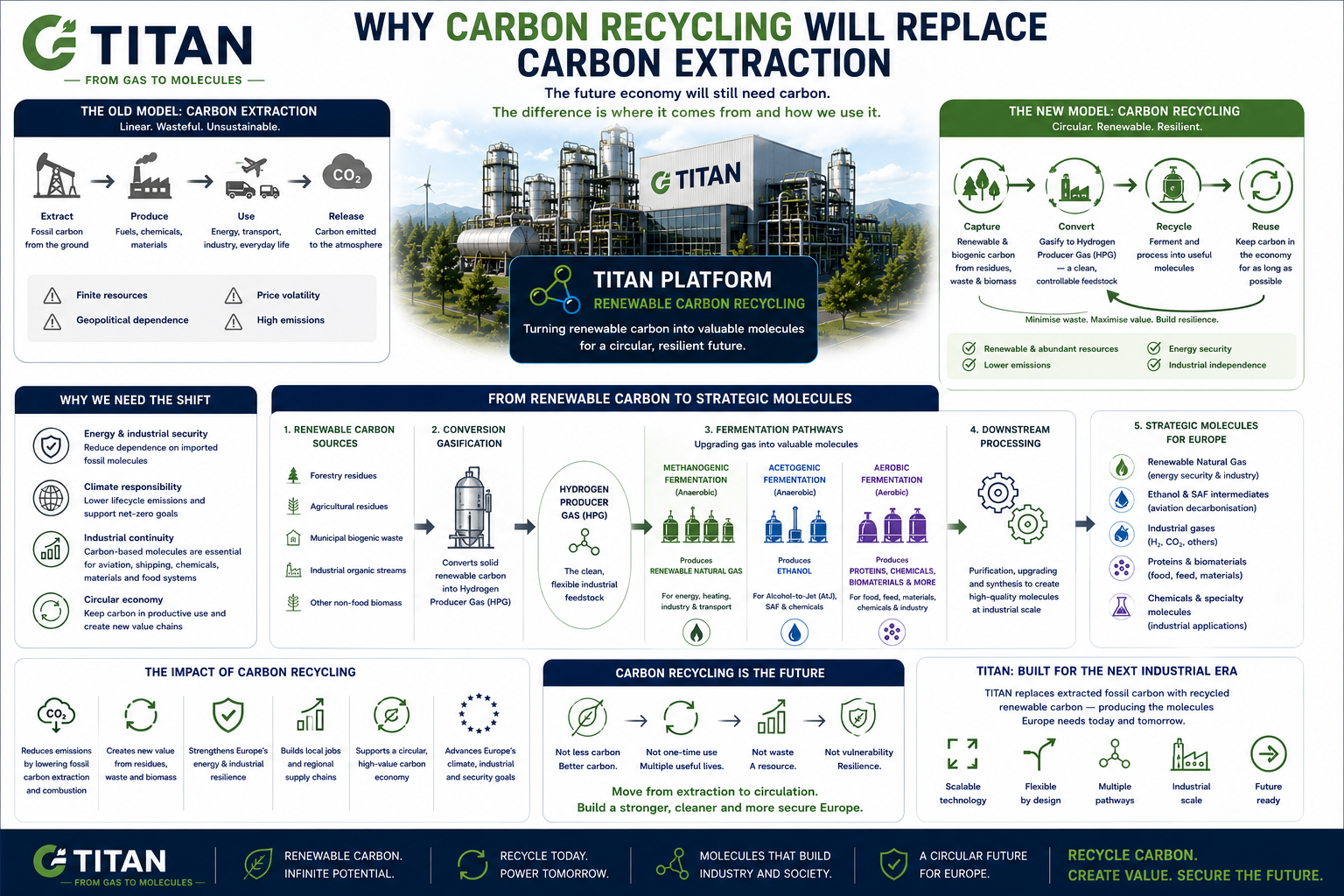
For more than a century, industrial growth has depended on carbon extraction.

Coal, oil and natural gas were taken from the ground, refined, transported and converted into energy, fuels, chemicals and materials. This model powered the modern economy. It created mobility, manufacturing, aviation, plastics, fertilisers and global trade.

But it also created a structural problem.

The industrial economy became dependent on fossil carbon.

Carbon was extracted once, used briefly, and then released into the atmosphere. This linear model was efficient during the age of cheap fossil resources, but it is no longer compatible with Europe’s long-term climate, industrial and security objectives.

The next industrial era will require a different model.

Carbon cannot simply be treated as something to extract, burn and discard.

It must be treated as something to recover, recycle and reuse.

This is the logic of carbon recycling.

Carbon recycling does not mean stopping the use of carbon. That would be impossible for many parts of the economy. Aviation, shipping, chemicals, materials, agriculture, food systems and industrial manufacturing all depend on carbon-based molecules.

The real question is not whether society will use carbon.

The question is where that carbon comes from.

In the old model, carbon came from fossil extraction.

TITAN next generation ethanol and the decarbonisation of our skies

Revised: Steve Walker 20.04.2025

TITAN: Next-Generation Ethanol and the Decarbonisation of Our Skies

As aviation and transport fuel regulations tighten across Europe, second-generation ethanol (2G EtOH) has emerged as a cornerstone in the EU’s clean fuel strategy. At the heart of this transition is TITAN, a bio-engineering platform that transforms forest waste into renewable fuel, replacing petroleum-based inputs with high-value, low-emission alternatives.

TITAN is not just a plant — it is a statement of intent. It reflects a deep commitment to energy sovereignty, local feedstock utilisation, and a truly circular economy. It also represents a strategic leap forward for Poland’s aviation sector, offering a domestic solution to one of Europe’s most urgent climate compliance challenges.

2G Ethanol: The Core of TITAN’s Mission

TITAN’s primary objective is the production of advanced, non-food-based 2G EtOH, sourced entirely from waste forest biomass. This includes residues left on the forest floor, non-virgin woody biomass, and materials historically destined for landfilling or low-grade combustion.

Using a proprietary Hydrogen Producer Gas (HPG) to Targeted Microbial Fermentation (TMF) process, TITAN extracts renewable carbon and hydrogen from biomass, converting it into 2G EtOH with near-zero refinery emissions and no fossil fuel input. The platform’s dual HPG island architecture ensures continuous and decentralised gas supply for both electricity/heat and fermentation feedstock.

This modular structure allows TITAN to function as a standalone, grid-independent, smoke-free, zero-coal facility, setting a new benchmark for carbon-negative industrial energy systems.

SAF Rollout and the Alcohol-to-Jet Pathway

The second phase of TITAN’s rollout will focus on producing Sustainable Aviation Fuel (SAF) through the Alcohol-to-Jet (AtJ) pathway. The AtJ process refines TITAN’s 2G ethanol into Jet-A1 compliant, drop-in aviation fuel, ready to blend at refuelling depots across Europe. The first ten TITAN installations produce enough 2G EtOH to supply an AtJ refinery producing Jet-A1 and Biodeisel

This development is perfectly aligned with the ReFuelEU Aviation Regulation, which mandates all EU airports begin blending sustainable aviation fuels starting at 2% in 2025, rising to 6% in 2030, 20% by 2035, and 28% by 2050. Airlines that do not comply must pay penalties.

TITAN’s SAF production will therefore not only enable Polish airlines to comply — it will allow them to lead. By producing SAF locally, Poland can secure its own fuel supply, reduce its carbon intensity per flight, and offer intercontinental connections from a net-zero baseline.

From Waste to Sovereignty Alternatives – Chinese Hamster Ovary (CHO) Cells

From Waste to Sovereignty: How TITAN and ASMARA Build Europe’s New Biomanufacturing Landscape

TITAN and ASMARA are not just platforms for converting waste into energy. They are flexible, modular bio-manufacturing hubs designed to anchor a new industrial landscape—one built on sovereignty, sustainability, and regional regeneration.

At their core is a powerful integration of Hydrogen Producer Gas (HPG) and Targeted Microbial Fermentation (TMF)—a pairing that unlocks the ability to produce a vast spectrum of high-value outputs: fuels, bioplastics, chemicals, proteins, and even advanced medical bioproducts like CHO (Chinese Hamster Ovary) cells.

But more importantly, these platforms offer a way to reindustrialise rural Europe, create high-quality employment in overlooked regions, and reduce the continent’s dependence on imported fuels, chemicals, and biopharmaceutical precursors.

Syngas Project Pioneering Solutions for a Healthier Future

 Mr Hyde

Reclaiming Insulin Sovereignty: TITAN and ASMARA Platforms for Mass Biomanufacturing in Europe

Breaking the Cartel: Insulin, Inequality, and the Opportunity for European Leadership

At the heart of the global diabetes crisis lies a quiet but devastating monopoly: a life-saving medicine held hostage by a handful of manufacturers. Despite insulin being off-patent for decades, just three global pharmaceutical giants dominate the market—dictating pricing, supply, and access. This concentration of control has limited the availability of affordable insulin, especially in regions already under economic pressure.

In the United States, insulin prices have soared beyond reason. Europe, including Poland and other Central and Eastern European nations, now faces similar systemic risks: rising diabetes rates, increasing healthcare costs, and inadequate local production capacity. But amid this crisis lies a chance to rewrite the pharmaceutical supply chain—through a bold, sovereign European solution: the TITAN and ASMARA platforms.

The Insulin Crisis: A Manufactured Scarcity

Insulin is not a rare or exotic molecule. It has been biosynthesised for over 40 years using recombinant DNA technology. The science is well-understood. The demand is clear. And yet, millions of people globally still struggle to access it due to pricing structures, regulatory lock-ins, and lack of local production.

  • Patients ration insulin to make it last—resulting in amputations, blindness, kidney failure, and death.
  • Governments overspend on cartel-priced imports—diverting budgets from prevention and education.
  • Local biomanufacturing is nearly nonexistent—especially in rural or post-industrial regions where new health infrastructure is most needed.

Europe’s current strategy, relying on imports and foreign-owned production, offers no resilience, no price control, and no autonomy.

TITAN and ASMARA: A Platform for Pharmaceutical Sovereignty

The TITAN (rural) and ASMARA (urban) platforms are not pharma factories in the traditional sense. They are modular, circular, multi-output bio-industrial systems. Originally designed to transform biomass and waste into hydrogen producer gas (HPG) and ethanol, these platforms now represent the future of distributed biomanufacturing—including insulin.

Each platform features:

  • Renewable, 24-hour power and heat, generated from local waste streams
  • Targeted Microbial Fermentation (TMF) stations, already capable of industrial protein synthesis
  • CO₂-ready infrastructure for enhanced fermentation using waste or captured carbon
  • A scalable, cookie-cutter design that enables low-cost replication across the EU

By adding a dedicated pharmaceutical-grade fermentation unit, any TITAN or ASMARA site can pivot to produce biosynthetic insulin using engineered microbial strains like E. coli or yeast—in clean, stable, sovereign-controlled conditions.

This isn’t hypothetical. TITAN’s ethanol lines already handle 50,000 litres per day. The same bioreactors and feedstock management protocols can be adapted to pharmaceutical production with minimal redesign.

How Dark Hydrogen became the New Green

The “new green hydrogen” is “dark bio-hydrogen”, so called after the dark fermentation bio-manufacturing process which creates it green because its manufacture and existence are entirely organic, renewable and waterless. 

We choose to go to the moon JFK 1962 Moonshot Speech
60 years on from JFK moonshot speech

One small step ahead of carbon capture and storage CCS replacing it instead with capture and transformation CCT, thus taking the capture and recycling of waste carbon to the next level is a giant leap for mankind. 60 years on from JFK’s moonshot speech and on its anniversary Joe Biden announced the cure for cancer is the new moonshot and its through bio-technology transformation that will get us there.

TITAN and ASMARA incorporate two technologies on one platform, waste to hydrogen producer gas + microbial fermentation to manufacture fuel, chemical and material products. CCT is a well-proven process for recycling both the carbon at the smoke stack, in the waste we produce and in the waste we throw away as it is for the carbon we have already produced. We are presented with a truly value-added proposition because recycling the carbon we already have obviates the need to dig up more carbon. Through converting solid waste into producer’s gas and CCT emission technology to recycle carbon in the producer’s gas through, microbial fermentation, we can reproduce all of the products we currently manufacture from oil and gas, where the likes of transport fuels, plastics and fertilisers are produced with far less environmental impact. In manufacturing, this great array of products as an added bonus, large quantities of waterless green hydrogen is recovered as a byproduct.        

Dark bio-hydrogen presents a disruptive edge to the idea of hydrogen as an energy carrier because it does not burden our ever-depleting water supply, instead, hydrogen is recovered from changing the state of organic feedstock through a proprietary, bio-manufacturing process where carbon-rich waste biomass or bio-waste is transformed from solid state to a gaseous state and as a feedstock for fermentation.  


ASMARA Hydrogen Producers Gas to Microbial Fermentation the key to upcycling thermoplastics

Warsaw 7 July 2022

The SOLIDEA Groups ASMARA platform converts all waste plastics [except PVC] into new biodegradable plastics. So-called PHA-derived plastics have the same characteristics as oil-derived thermo-plastics however as well as being 100% biodegradable PHA’s are biocompatible. To date, these plastics have been critical in the development of many medical procedures though traditionally expensive to produce.

The ASMARA platform marries two technologies a waste-to-energy plant and a bio-refinery at scale into one cookie-cutter project. The technology at the front of the process is Microbial Fermentation where a carbon-rich Hydrogen Producer Gas is forced into a tank of billions of microbes. This Microbial Fermentation process multiplies, fattens and then terminates the life of the microbes so they can be harvested to recreate a range of chemicals, fuels and materials that we use every day.

The waste-to-energy technology at the back end of the process converts solid waste streams into a Hydrogen producer’s Gas. A well demonstrated tried and tested thermo-chemical process which turns solids into gas in the absence of oxygen. There is no smoke because no burning occurs [because there is no oxygen] which is just as well because there is no smokestack or chimney for such emissions.

Hydrogen Producers Gas is created in a slightly negative pressure environment it is rich in hydrogen [H2] and carbon monoxide [CO] and these elements are suspended in nitrogen [N] together with lesser amounts of carbon dioxide [CO2] and a little methane [CH4].

The ASMARA Hydrogen Producers Gas to PHA process 

ASMARA like its cousin TITAN are platforms on which to convert abundant and or problematic organic waste into Hydrogen Producer Gas. Since we are converting waste into new materials the process is recycling however since we are producing far superior added-value materials we believe we are upcycling.

ASMARA converts problematic sorted Municipal Solid Waste [MSW] such as plastic together with household waste whilst TITAN convert abundant forest floor residues. Both platforms support different outcomes including [i] Combined Heat and Power [CHP] [ii] Gas to Liquid [GTL] tanking fuels via the fermentation of Polyhydroxyalkanoates [PHA] which produce ethanol or [iii] Bioplastics “nature-like” polymers which can be rolled to make films, extruded to make bottles and profiles or moulded to make components just like typical fossil fuel sourced thermo-plastics.