Why TITAN Produces Pipeline and Marine Grade Gas

Publish date: 8 May 2026
(Przewiń w dół, aby zobaczyć wersję polską.)

Not all renewable gas is the same.

This is one of the most important realities often overlooked in public discussions surrounding biomethane, renewable gas and future decarbonisation systems.

Producing renewable molecules is only part of the challenge.

The second challenge is quality.

Industrial systems do not operate on slogans. They operate on specifications.

Pipelines require specification compliance.

Industrial burners require consistency.

Marine engines require fuel stability.

Cryogenic systems require purity.

Storage systems require predictable composition.

Large-scale logistics systems require standardisation.

Without these characteristics, renewable gas remains limited to small regional applications rather than becoming part of strategic national infrastructure.

This is one of the reasons TITAN was designed differently from the beginning.

The platform was not designed simply to produce “green gas.”

It was designed to produce infrastructure-grade renewable molecules capable of integration into real industrial systems.

This distinction matters enormously.

Many first-generation renewable gas systems were developed around local agricultural digestion projects where gas quality variability could often be tolerated within relatively small operating environments.

TITAN operates at a different industrial scale and under a different infrastructure philosophy.

The objective is not merely local energy recovery.

The objective is national-scale renewable molecule distribution through existing logistics and industrial infrastructure.

This requires molecule quality to become a central engineering priority.

TITAN therefore focuses heavily on gas conditioning and polishing.

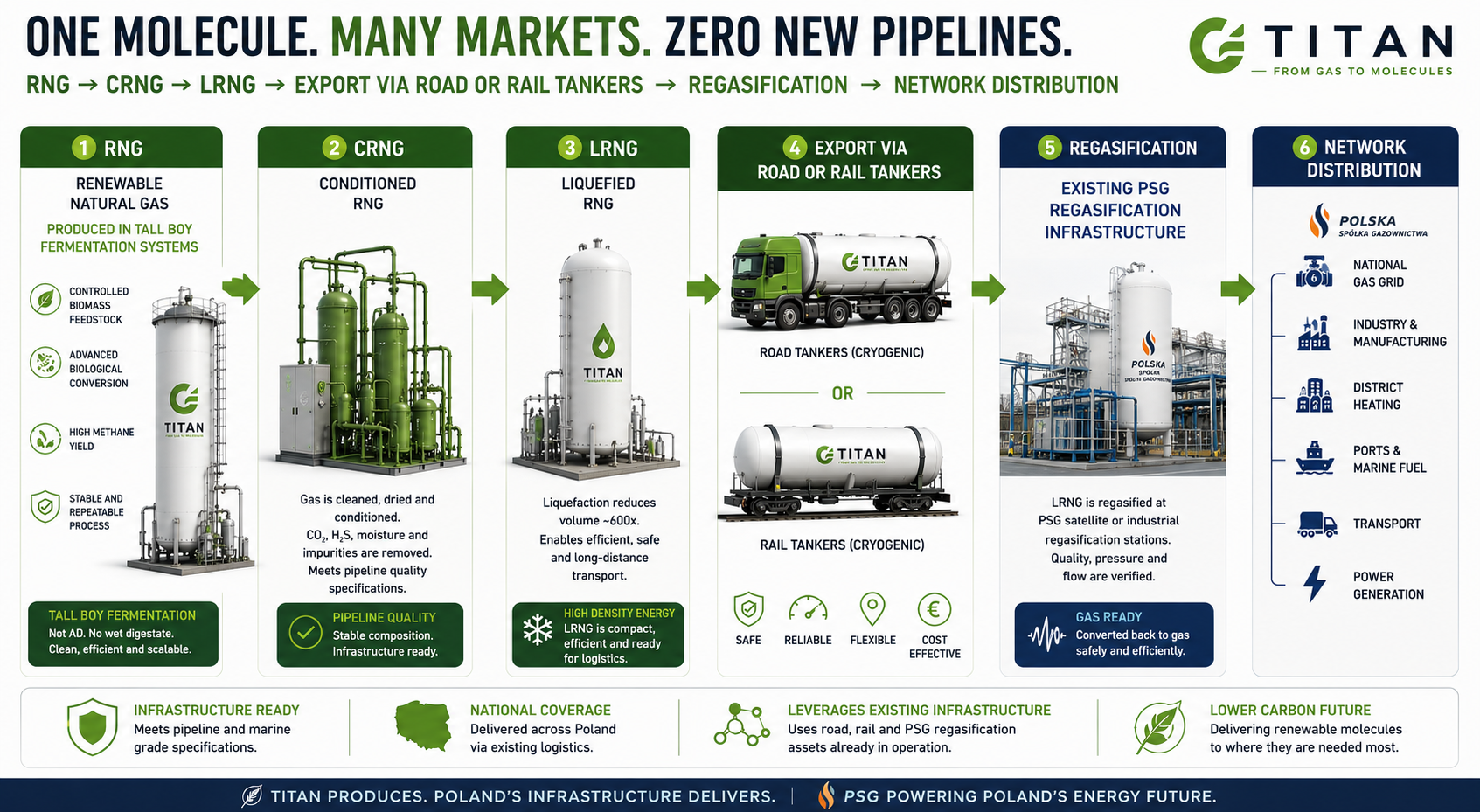
The Hydrogen Producer Gas platform creates a controlled gas-phase feedstock which is then biologically converted into Renewable Natural Gas through advanced methanogenic systems.

From there, the molecule undergoes additional upgrading and conditioning processes designed to produce stable, high-purity Renewable Natural Gas suitable for industrial use, liquefaction and infrastructure integration.

This is where pipeline-grade and marine-grade specifications become important.

Pipeline-grade gas means the molecule is compatible with national gas infrastructure requirements and industrial applications requiring stable composition and reliable performance.

Marine-grade gas means the molecule is suitable for future LNG-compatible marine fuel infrastructure, bunkering systems and heavy transport applications where consistency, cleanliness and energy density are critical.

These standards are not marketing terminology.

They are infrastructure requirements.
Why TITAN Can Shift Between RNG and Ethanol

Publish date: 7 May 2026

(Przewiń w dół, aby zobaczyć wersję polską.)

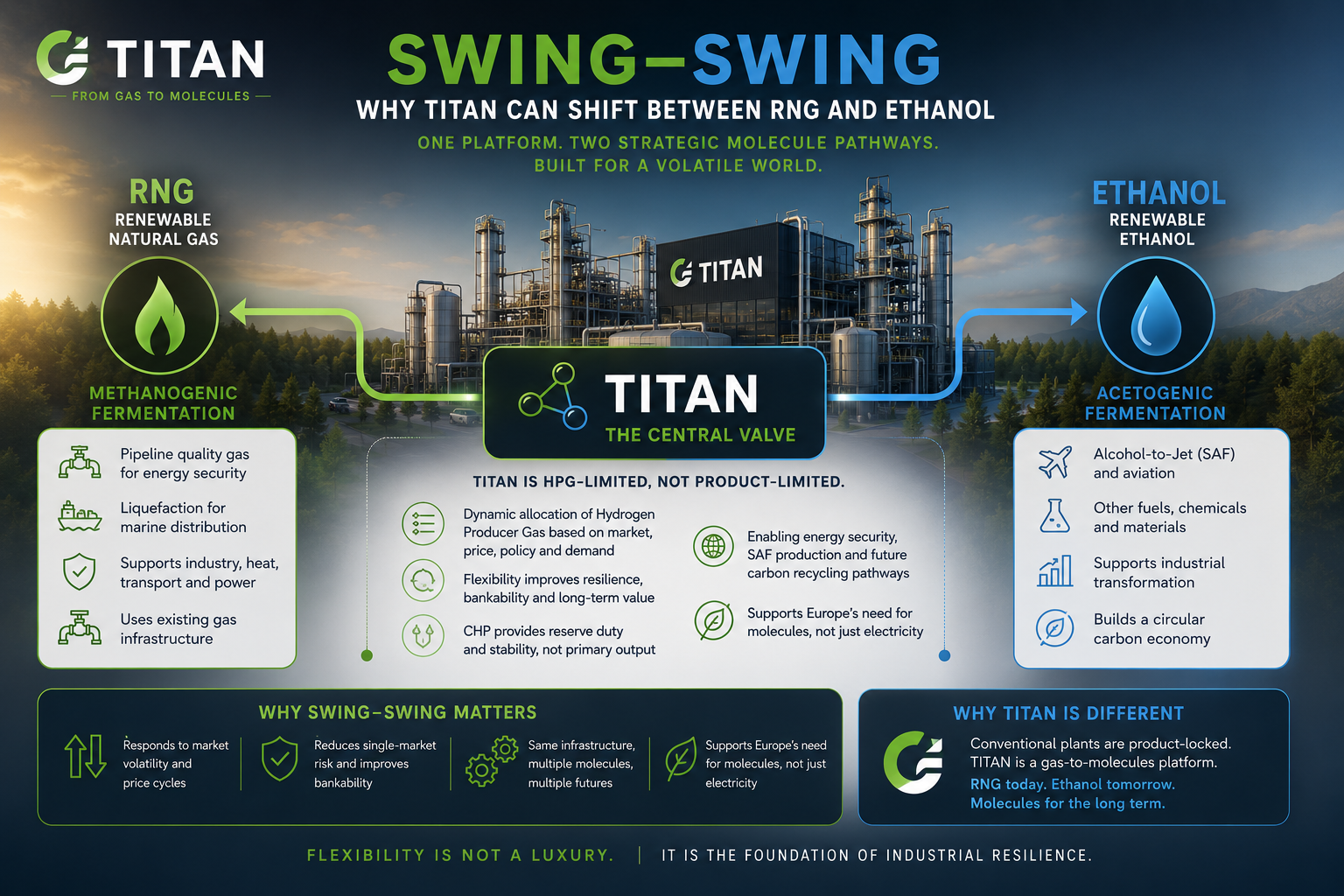
TITAN is designed around a simple industrial principle: do not lock a valuable feedstock into only one product.

At the centre of TITAN is Hydrogen Producer Gas. This gas is produced from forest residues and other renewable carbon resources. It contains the carbon and hydrogen needed to make useful molecules. Once this gas has been created, TITAN does not have to follow only one route.

It can shift.

This is what we call Swing–Swing.

In one operating mode, TITAN can direct more Hydrogen Producer Gas toward methanogenic fermentation to produce Renewable Natural Gas. RNG can be compressed, liquefied and distributed through existing gas and LNG logistics. It supports energy security, industrial heat, transport fuel and replacement of fossil natural gas.

In another operating mode, TITAN can direct more Hydrogen Producer Gas toward acetogenic fermentation to produce ethanol. This ethanol can support the Alcohol-to-Jet pathway for Sustainable Aviation Fuel, as well as other fuels, chemicals and materials.

The same platform can therefore support two strategic molecule markets: renewable methane and renewable ethanol.

This matters because energy markets are volatile. Gas prices move. Ethanol markets move. Aviation fuel policy develops over time. Industrial demand changes. A rigid plant is exposed to these changes. A flexible plant can respond to them.

TITAN is not product-limited. It is Hydrogen Producer Gas-limited.

That means the platform is built around the controlled production and allocation of gas. The value is not only in the final product. The value is in the ability to decide where the gas should go, based on demand, price, regulation and strategic need.

This is very different from a conventional biomethane project. A typical biomethane plant is built to make biomethane. That is its product. If market conditions change, the plant has limited options.

TITAN is different.

It is a gas-to-molecules platform. Methane is one output. Ethanol is another. Future pathways can include chemicals, proteins, materials and other fermentation products. The system is not designed as a single-output facility. It is designed as production infrastructure.

Swing–Swing also improves bankability.

Banks and investors do not like dependency on one market. They prefer assets that can survive different price cycles. A plant that can produce RNG when gas demand is strong, and ethanol when SAF demand grows, has stronger commercial resilience than a plant dependent on only one commodity.

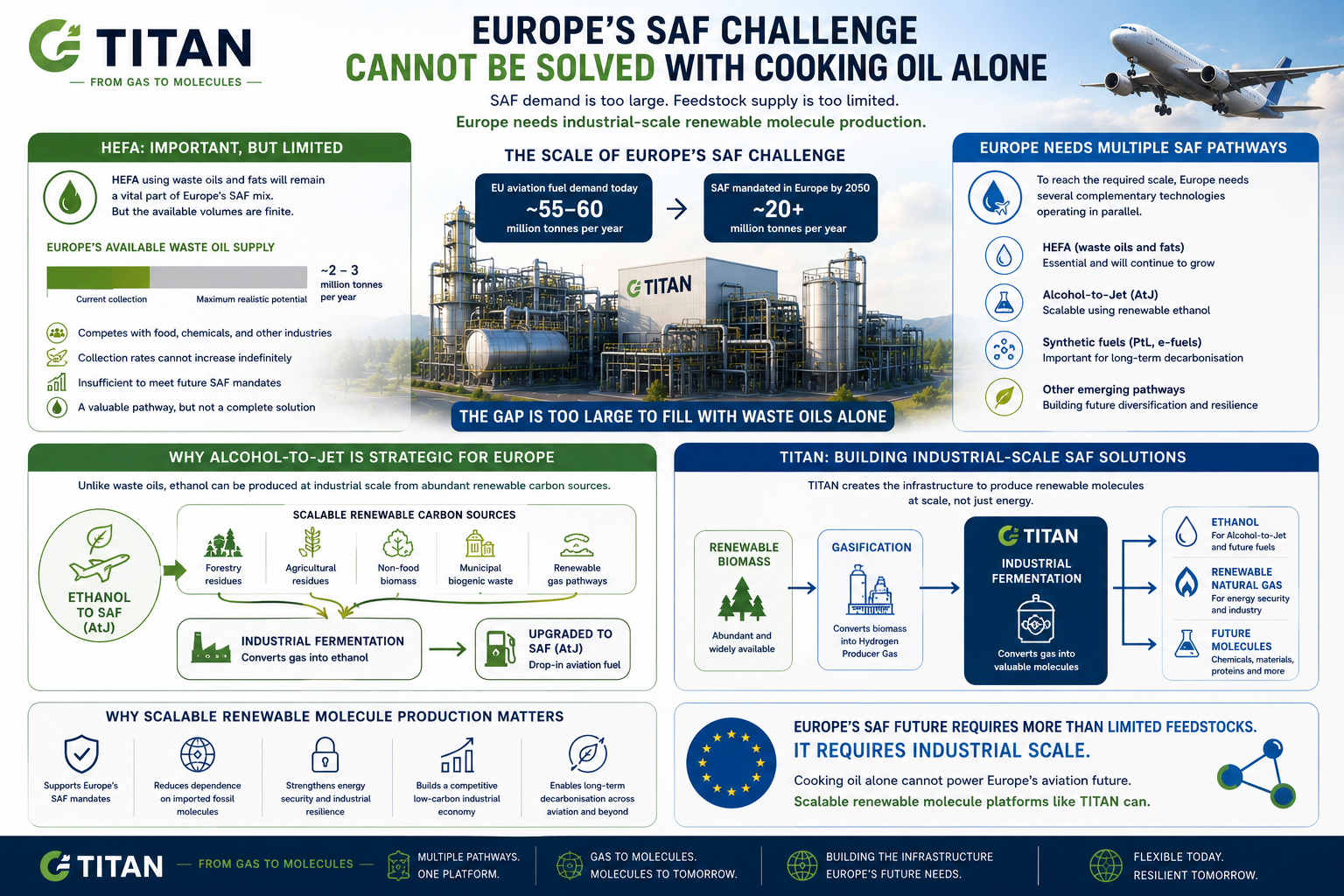
Europe’s SAF Challenge Cannot Be Solved with Cooking Oil Alone

Publish date: 4 May 2026

(Przewiń w dół, aby zobaczyć wersję polską.)

Europe is entering a new phase of aviation decarbonisation.

For decades, aviation depended almost entirely on fossil kerosene. The sector became one of the hardest parts of the economy to decarbonise because aircraft require extremely energy-dense liquid fuels that are safe, stable and globally compatible.

Unlike passenger vehicles, aviation cannot easily electrify at large scale.

Aircraft need molecules.

This is why Sustainable Aviation Fuel has become strategically important.

SAF allows the aviation sector to reduce lifecycle emissions while continuing to use existing aircraft, airports, pipelines and fuel logistics infrastructure. Instead of replacing the aviation system entirely, SAF enables gradual transition using compatible renewable fuels.

This approach is practical.

But it also creates a major challenge.

The scale of aviation fuel demand is enormous.

Europe consumes tens of millions of tonnes of aviation fuel every year. As SAF mandates increase over time, the volume of renewable fuel required will become extremely large. This creates pressure on feedstock supply chains across the entire energy and industrial system.

At present, much of the SAF discussion focuses on lipid-based pathways such as used cooking oil, waste fats and vegetable oils. These pathways are important and will continue to play a valuable role in SAF development.

But there is a structural limitation.

The volume of waste oils available is finite.

Europe cannot build a long-term SAF strategy around feedstocks that exist only in limited quantities. Even with aggressive collection systems, the available supply of used cooking oil and waste fats remains relatively small compared with total aviation fuel demand.

This is not a criticism of HEFA or lipid pathways.

It is simply a question of scale.

As aviation decarbonisation accelerates, Europe will require additional SAF pathways capable of operating at industrial volume using broader renewable carbon resources.

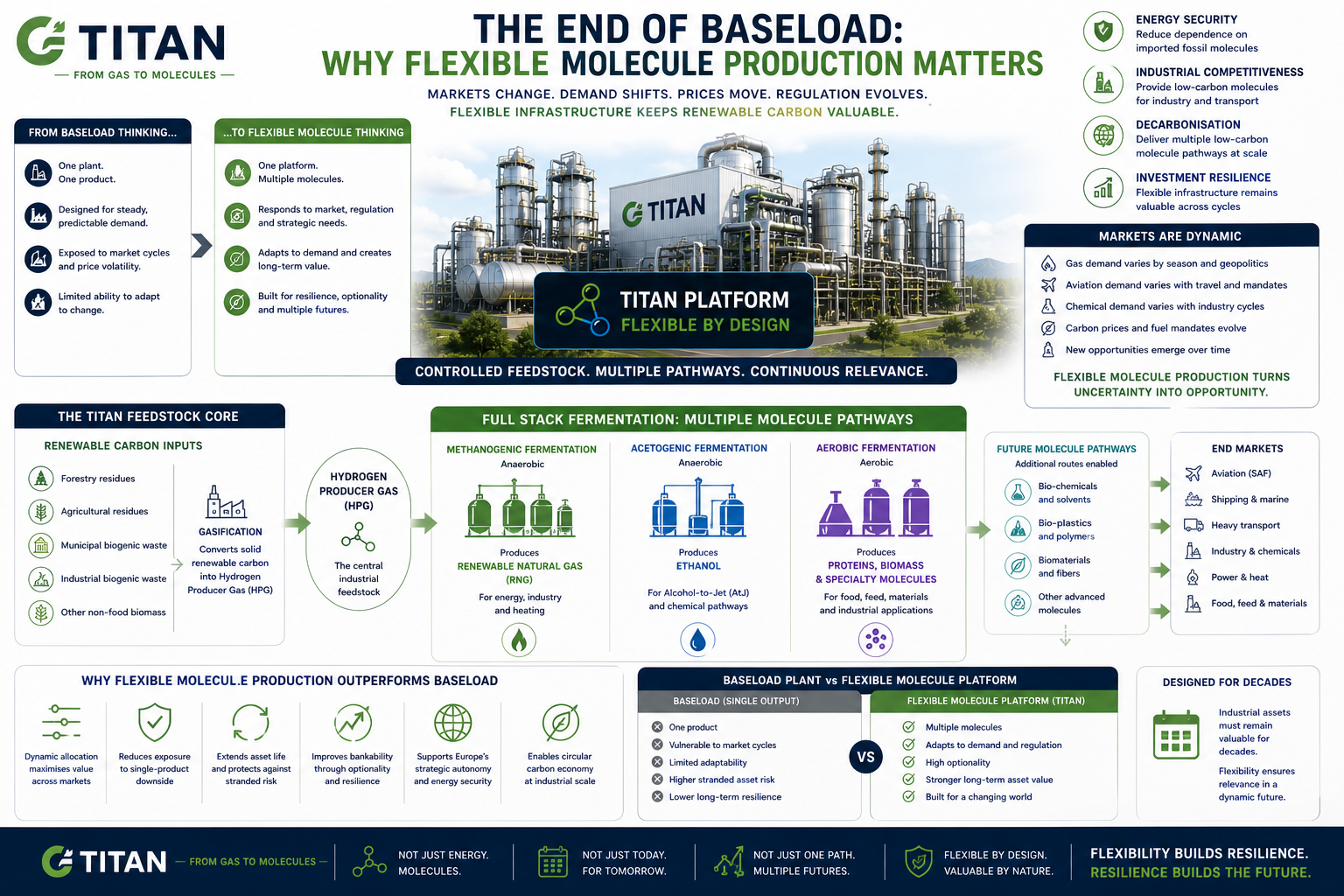
The End of Baseload: Why Flexible Molecule Production Matters

Publish date: 3 May 2026

(Przewiń w dół, aby zobaczyć wersję polską.)

For most of the twentieth century, industrial energy systems were built around baseload.

Large plants operated continuously. Power stations produced electricity day and night. Refineries processed fuels at steady volume. Industrial systems were designed for predictability, fixed flows and long operating cycles.

That model shaped the modern economy.

But the energy system is changing.

Renewable electricity is growing. Demand is becoming more variable. Energy prices move more quickly. Industrial customers need lower-carbon fuels, gases and feedstocks. Supply chains are exposed to geopolitical pressure. Markets are no longer as stable as they once appeared.

In this new environment, baseload alone is no longer enough.

The future belongs to infrastructure that can adapt.

This is especially true for molecules.

Electricity is only one part of the transition. Europe also needs gas, fuels, chemicals and industrial feedstocks. These are not simply energy products. They are molecular products. They support aviation, shipping, heavy transport, heating, industry and manufacturing.

The challenge is that molecule demand is not static.

Gas demand changes by season. Aviation fuel demand changes with travel and regulation. Chemical demand changes with industry. Carbon prices, fuel mandates and geopolitical conditions all affect which molecules are most valuable at any given time.

A single-output plant struggles in this environment.

If an installation is designed to make only one product, it is exposed to that product’s market cycle. When demand is strong, the plant performs well. When demand weakens, the plant has limited choices.

Flexible molecule production changes this logic.

Instead of locking infrastructure into one output, flexible platforms can direct a controlled feedstock into different production pathways.

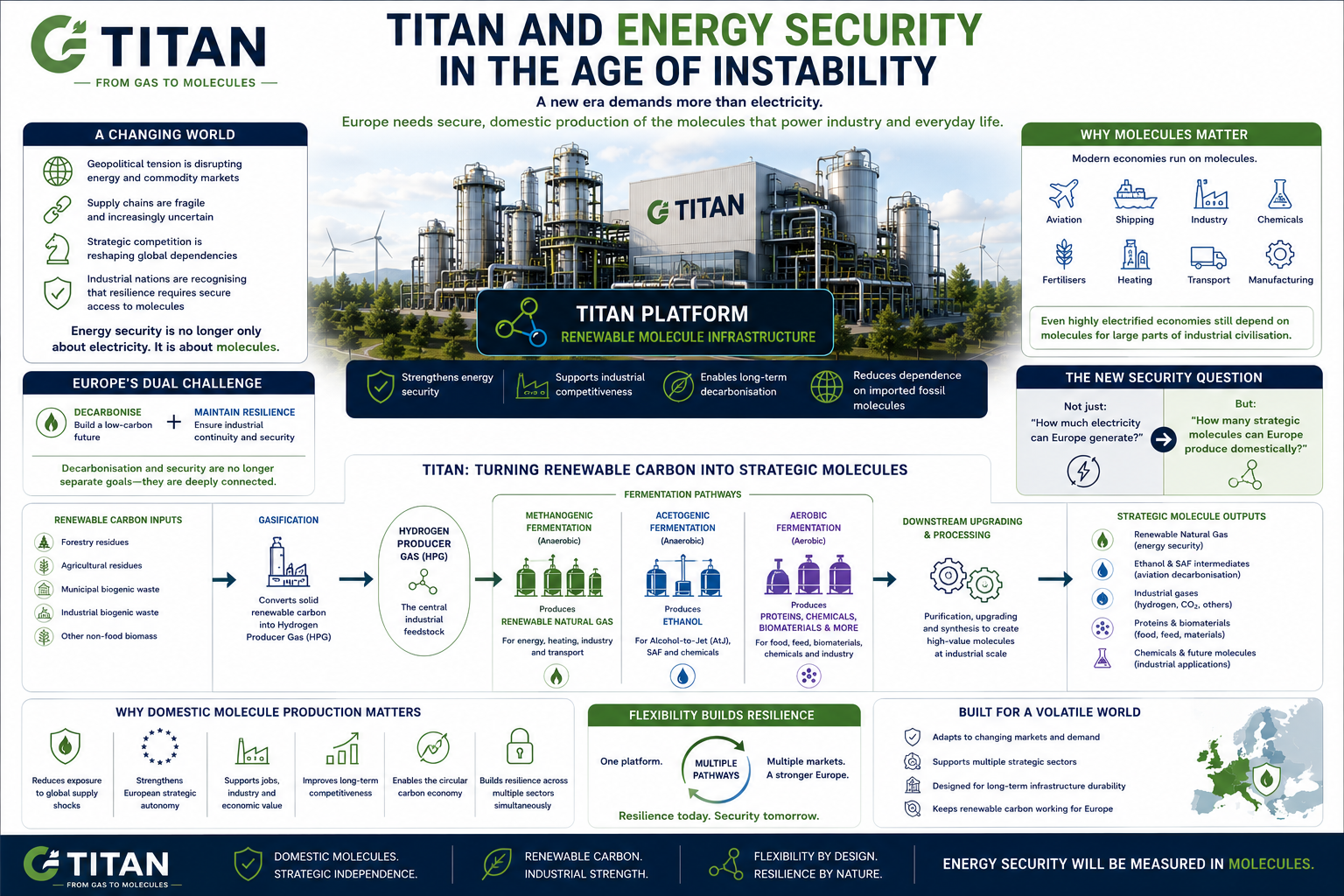
TITAN and Energy Security in the Age of Instability

Publish date: 2 May 2026

(Przewiń w dół, aby zobaczyć wersję polską.)

Europe is entering a more unstable world.

For decades, much of Europe’s industrial model depended on the assumption that energy, fuels and industrial feedstocks would remain globally available, relatively affordable and politically accessible. Large international supply chains made it possible to import molecules from distant regions while focusing domestic policy primarily on consumption and efficiency.

That world is changing.

Geopolitical tension has returned to energy markets. Supply chains have become more fragile. Strategic competition is increasing. Industrial nations are beginning to recognise that long-term resilience depends not only on electricity generation, but also on secure access to molecules.

This distinction matters.

Modern economies do not run on electricity alone.

Heavy industry, aviation, shipping, chemicals, fertilisers, district heating and industrial transport all require molecular products: gas, liquid fuels, carbon feedstocks and industrial gases. Even highly electrified economies still depend on molecules for large parts of industrial civilisation.

Europe therefore faces a dual challenge.

It must decarbonise.

But it must also maintain industrial continuity and strategic resilience.

These objectives are often treated separately. In reality, they are becoming increasingly connected.

The transition away from fossil carbon is not simply an environmental transition. It is also an industrial and geopolitical transition.

Countries capable of producing strategic molecules domestically will likely possess stronger long-term resilience than countries dependent on imported carbon systems.

This is where renewable molecule infrastructure becomes important.

TITAN was designed for this emerging industrial environment.

The platform converts renewable carbon into Hydrogen Producer Gas and then upgrades that gas into valuable industrial molecules through fermentation and downstream processing pathways. The objective is not only renewable energy generation. The objective is domestic molecule production at industrial scale.

This changes the role of infrastructure.

Traditional renewable systems often focus primarily on electricity generation. TITAN focuses on renewable molecules: Renewable Natural Gas, ethanol, future SAF intermediates, industrial gases, proteins, chemicals and future carbon-derived materials.

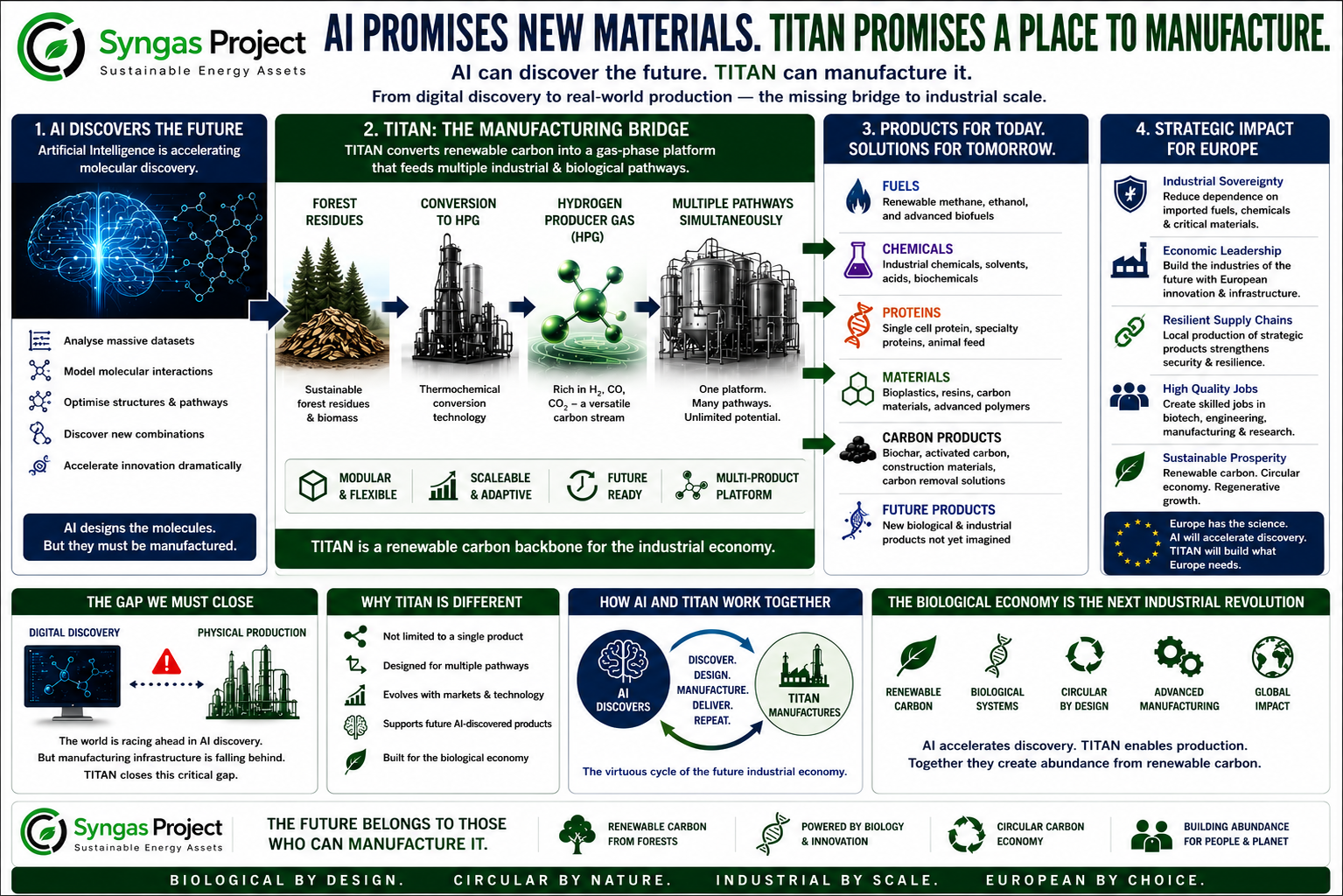
AI Promises New Materials. TITAN Promises a Place to Manufacture Them

Publish Date: 2 May 2026

(Przewiń w dół, aby zobaczyć wersję polską.)

Artificial intelligence is beginning to change chemistry faster than most people realise.

For decades, discovering new materials, biological pathways and industrial compounds was slow, expensive and uncertain. Research teams could spend years testing molecules, enzymes and formulations with limited success.

That is changing rapidly.

Artificial intelligence can now analyse enormous quantities of chemical, biological and material data simultaneously. It can model interactions, optimise molecular structures and identify entirely new combinations far faster than traditional research methods.

The implications are enormous.

AI may help discover:

New fuels.
New plastics.
New proteins.
New medicines.
New industrial chemicals.
New biological materials.
New agricultural systems.
New carbon products.

Governments and technology companies are investing billions into this transition because whoever controls the next generation of materials and molecules may help define the next industrial economy.

But there is a problem.

Discovery alone does not create industry.

A molecule discovered by artificial intelligence still needs to be manufactured physically, economically and at scale.

This is where the conversation becomes industrial rather than digital.

The world is rapidly building artificial intelligence systems capable of designing future products. But the physical infrastructure capable of manufacturing those products is developing far more slowly.

This creates a growing gap between digital discovery and real-world production.

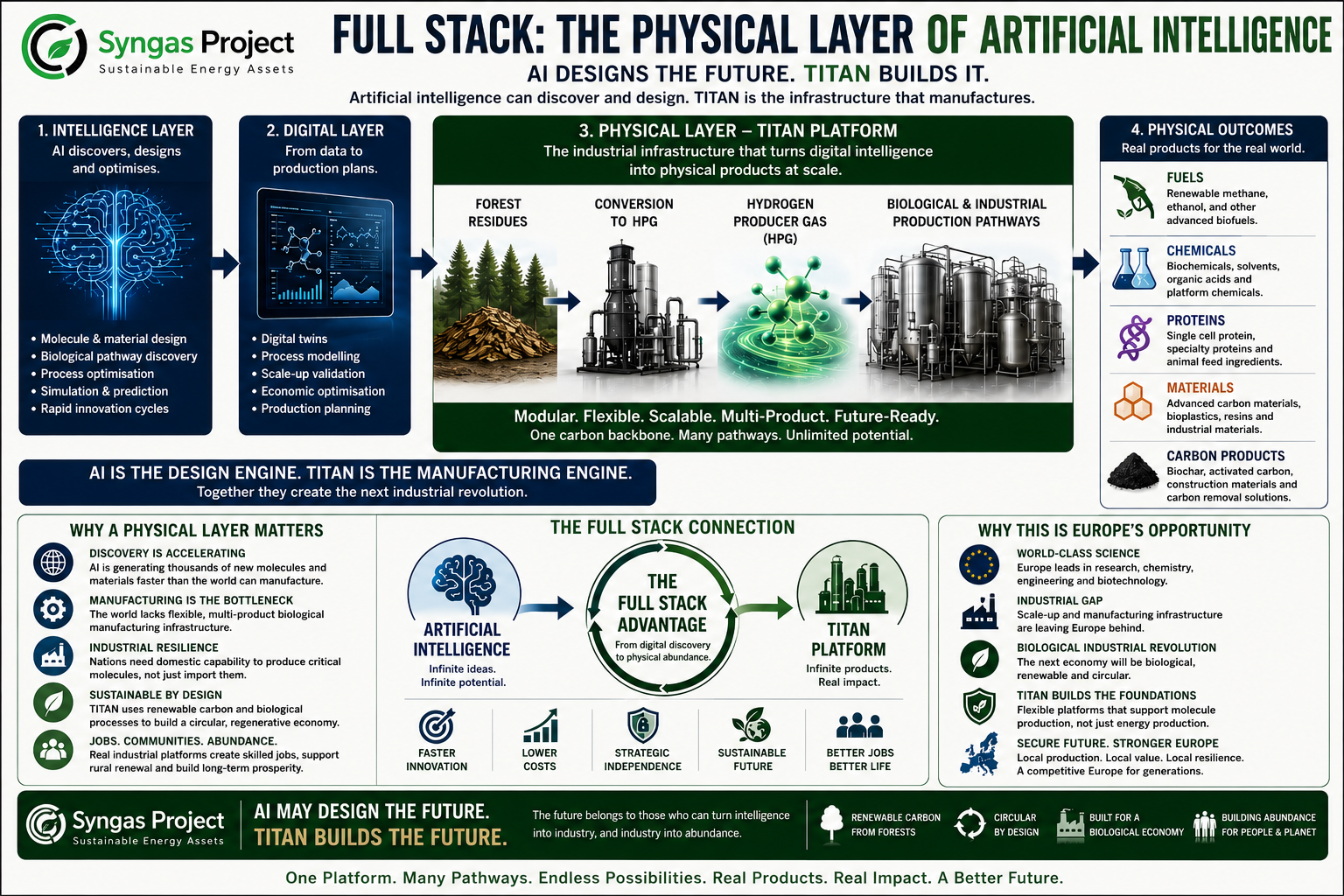
Full Stack: The Physical Layer of Artificial Intelligence

Publish Date: 2 May 2026

(Przewiń w dół, aby zobaczyć wersję polską.)

Artificial intelligence is rapidly becoming the defining technology race of the 21st century.

Every week brings announcements about larger models, faster processors, more capable software agents and increasingly advanced machine reasoning systems. Governments are investing billions. Technology companies are competing for dominance. Data centres are expanding across the world at extraordinary speed.

Most discussion focuses on computation.

But very little discussion focuses on what artificial intelligence ultimately needs in the physical world.

Because intelligence alone does not manufacture anything.

Artificial intelligence can design molecules.
It can optimise biological pathways.
It can simulate new materials.
It can improve industrial systems.
It can accelerate chemistry and biotechnology research.

But eventually, something physical must manufacture the result.

This is where the next industrial bottleneck may emerge.

The future may not belong only to countries that control computation.

It may also belong to countries that control biological manufacturing platforms capable of turning digital intelligence into physical products.

That distinction is becoming increasingly important.

Artificial intelligence is already beginning to transform chemistry, material science, pharmaceutical research, biological engineering and industrial process optimisation. The speed of discovery is accelerating dramatically. New materials, proteins, enzymes, carbon structures and biological production pathways are being identified faster than traditional industrial systems can adapt.

But discovery is only one half of the equation.

Manufacturing remains the other half.

Why Carbon Recycling Will Replace Carbon Extraction

Publish date: 1 May 2026

(Przewiń w dół, aby zobaczyć wersję polską.)

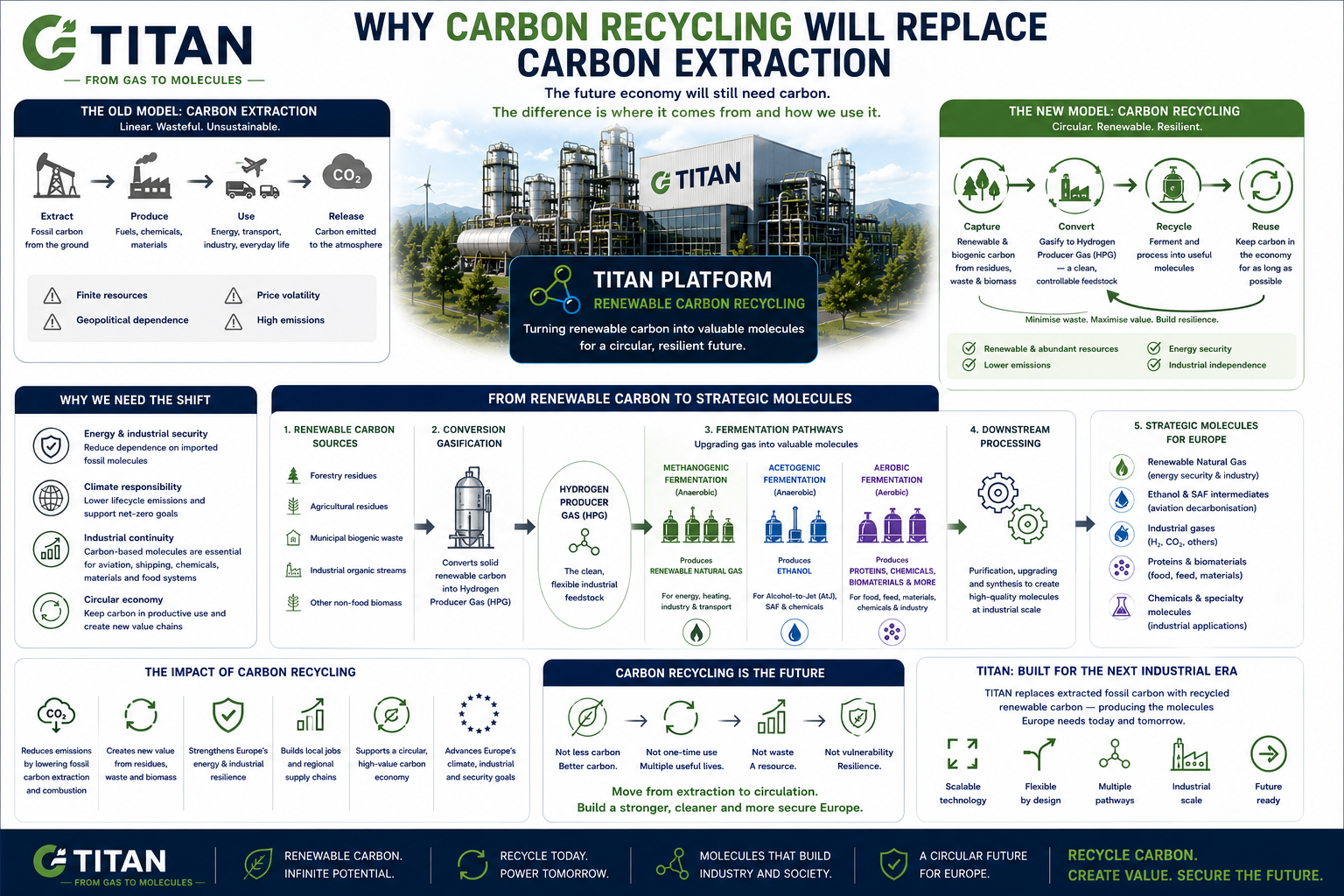
For more than a century, industrial growth has depended on carbon extraction.

Coal, oil and natural gas were taken from the ground, refined, transported and converted into energy, fuels, chemicals and materials. This model powered the modern economy. It created mobility, manufacturing, aviation, plastics, fertilisers and global trade.

But it also created a structural problem.

The industrial economy became dependent on fossil carbon.

Carbon was extracted once, used briefly, and then released into the atmosphere. This linear model was efficient during the age of cheap fossil resources, but it is no longer compatible with Europe’s long-term climate, industrial and security objectives.

The next industrial era will require a different model.

Carbon cannot simply be treated as something to extract, burn and discard.

It must be treated as something to recover, recycle and reuse.

This is the logic of carbon recycling.

Carbon recycling does not mean stopping the use of carbon. That would be impossible for many parts of the economy. Aviation, shipping, chemicals, materials, agriculture, food systems and industrial manufacturing all depend on carbon-based molecules.

The real question is not whether society will use carbon.

The question is where that carbon comes from.

In the old model, carbon came from fossil extraction.

Renewable Methane at Scale: LRNG and the Return of Local Gas

(Przewiń w dół, aby zobaczyć wersję polską.)

Publish April 30 2026

Europe does not have a gas problem. It has a gas origin problem.

Methane remains essential. It fuels industry, supports energy resilience, underpins logistics and provides the backbone for large parts of the economy that cannot simply electrify. The system that distributes methane is already built. What is changing is not the need for gas, but where that gas comes from.

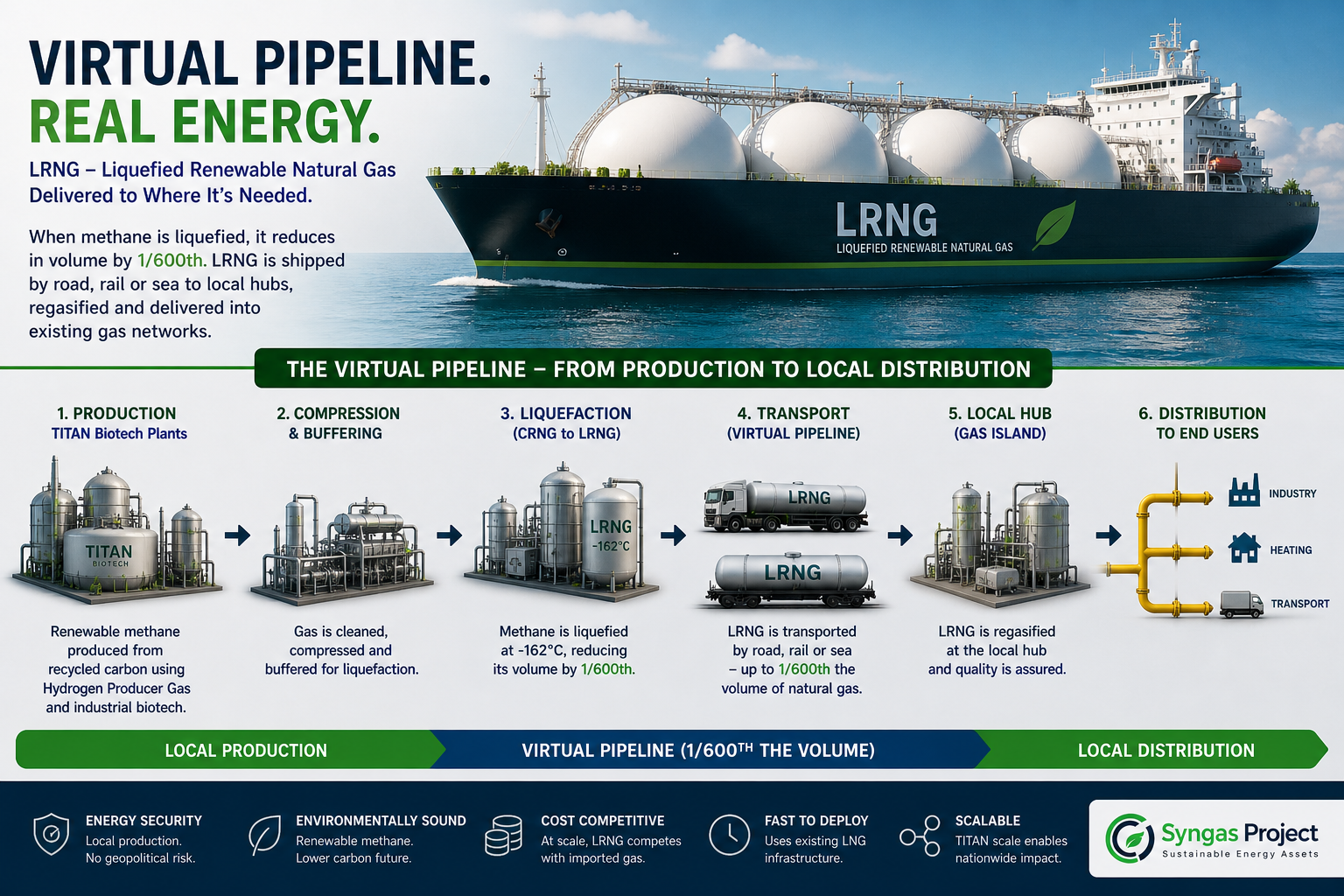
Today, gas is distributed increasingly in liquefied form. LNG has already proven the model. Methane is cooled, liquefied and reduced to around 1/600th of its original volume. It is then transported efficiently by ship, rail or road tanker, delivered to a local hub, regasified and supplied into the network.

This is not a workaround. It is the system.

Many still think LNG distribution is an excuse for not having pipelines. That is wrong. LNG is a more targeted delivery system. The local hub receives the gas it ordered, not a blended molecule that entered a pipeline thousands of kilometres away. The control point moves from the pipeline to the destination.

The real legacy of the gas system is not the intercontinental pipeline.

It is the local gas network.

Historically, gas was produced locally and distributed locally. Towns and industrial centres had their own gas production linked directly to local demand. Long-distance pipelines came much later. They replaced local producers and centralised supply, often for convenience and scale. For a period, that worked.

Today, that model is under pressure.

Russia to the east is no longer a reliable source. Conflict in the Middle East continues to destabilise global energy flows. The United States is becoming less dependable as a long-term strategic partner. Norway carried Europe through the immediate crisis, but it is past peak. It delivered when needed, but production will not keep expanding. The longer global instability continues, the more pressure is placed on a limited northern supply base.

Europe is still climbing an import ladder that is no longer secure.

At some point, that ladder has to be left behind.

Poland has an alternative.

Poland already operates a distributed gas system. The LNG terminal near Szczecin has been built out from approximately 6 billion cubic metres toward 8 billion cubic metres of capacity. More importantly, more than 100 LNG regasification gas islands developed by PSG already form a decentralised distribution network across the country.

These are not temporary assets. They are long-life infrastructure.

Reach & Cache: Rebuilding Regional Biomass Logistics

Publish date: 30 April 2026

(Przewiń w dół, aby zobaczyć wersję polską.)

One of the biggest challenges in the renewable molecule economy is not chemistry.

It is logistics.

Europe possesses large volumes of renewable carbon in the form of forestry residues, agricultural residues and other biogenic resources. Much of this material already exists across regional landscapes in fragmented and low-density form.

The problem is not whether the carbon exists.

The problem is how to collect it efficiently.

For decades, industrial systems were designed around highly concentrated fossil resources. Coal, oil and gas could be extracted at large scale from centralised locations and transported through mature infrastructure networks. Renewable carbon does not behave the same way.

Biomass is distributed.

It is seasonal. It varies in moisture content, density and handling characteristics. Transport distances matter. Weather matters. Storage matters. Fuel preparation matters.

This means the future renewable molecule economy will require a new generation of regional logistics infrastructure.

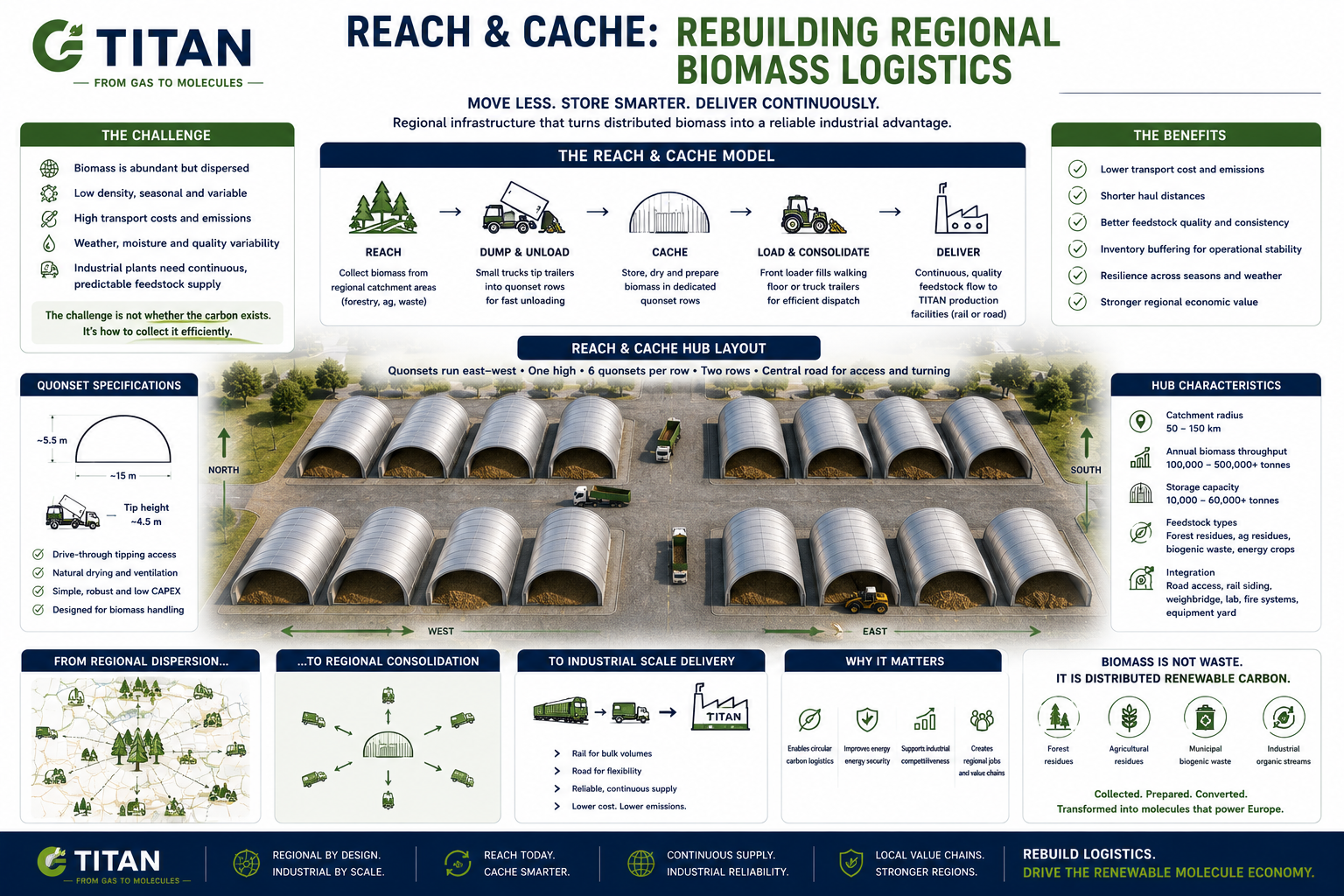
This is where Reach & Cache becomes important.

Reach & Cache is the logistical philosophy behind TITAN’s biomass supply model.

Instead of relying entirely on long-distance trucking or fragmented supply chains, the system creates regional collection, preparation and consolidation hubs designed specifically for renewable carbon logistics.

The objective is simple:

Reduce transport inefficiency while increasing regional feedstock resilience.

Under the Reach & Cache model, biomass is collected from regional catchment areas and moved into dedicated aggregation sites. At these locations, material can be stored, dried, processed, chipped and prepared for onward transport into TITAN production facilities.