
Publish date: 7 May 2026
Warsaw 07:05:10:32 AM Steve Walker
TITAN is designed around a simple industrial principle: do not lock a valuable feedstock into only one product.
At the centre of TITAN is Hydrogen Producer Gas. This gas is produced from forest residues and other renewable carbon resources. It contains the carbon and hydrogen needed to make useful molecules. Once this gas has been created, TITAN does not have to follow only one route.
It can shift.
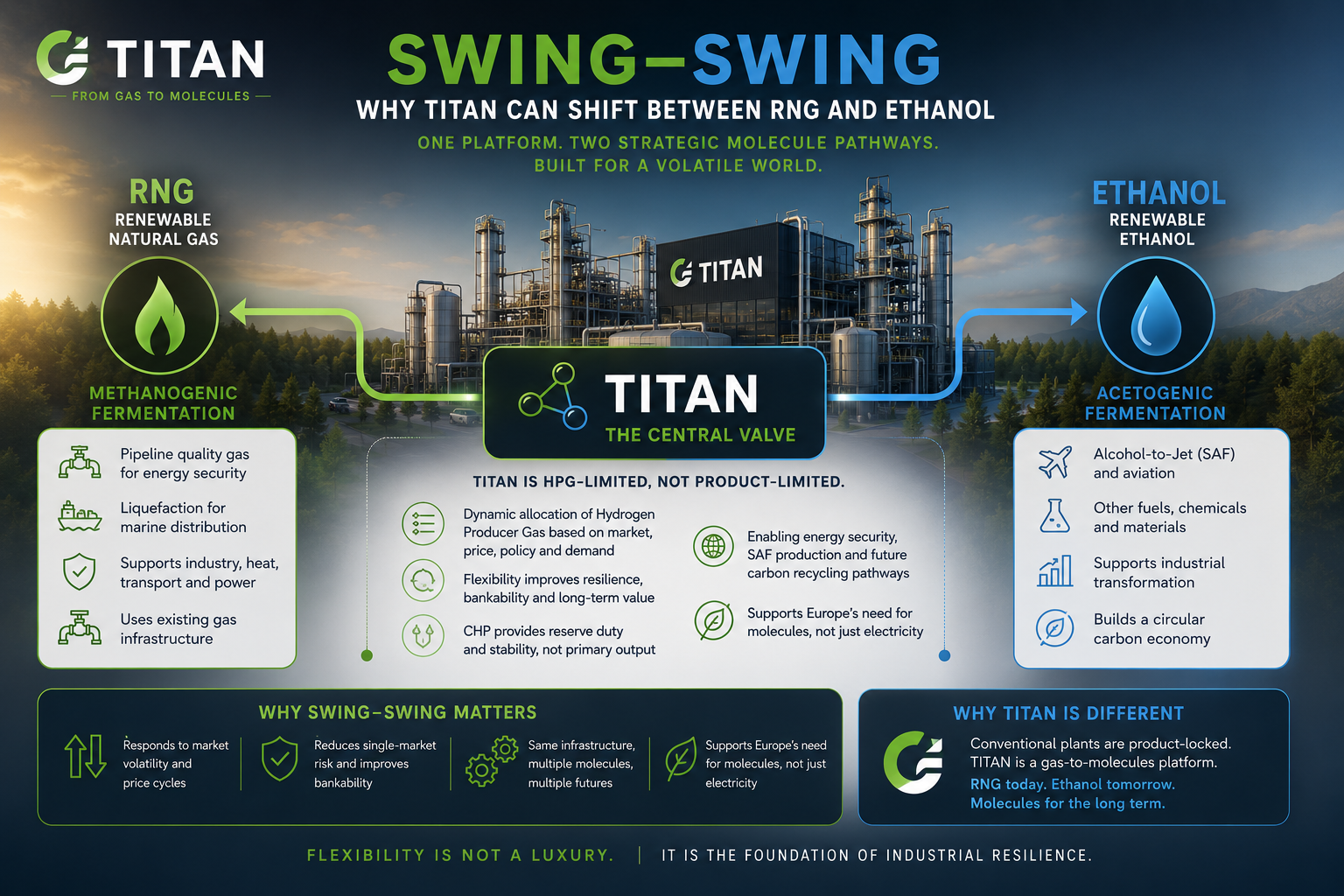
This is what we call Swing–Swing.
In one operating mode, TITAN can direct more Hydrogen Producer Gas toward methanogenic fermentation to produce Renewable Natural Gas. RNG can be compressed, liquefied and distributed through existing gas and LNG logistics. It supports energy security, industrial heat, transport fuel and replacement of fossil natural gas.
In another operating mode, TITAN can direct more Hydrogen Producer Gas toward acetogenic fermentation to produce ethanol. This ethanol can support the Alcohol-to-Jet pathway for Sustainable Aviation Fuel, as well as other fuels, chemicals and materials.
The same platform can therefore support two strategic molecule markets: renewable methane and renewable ethanol.
This matters because energy markets are volatile. Gas prices move. Ethanol markets move. Aviation fuel policy develops over time. Industrial demand changes. A rigid plant is exposed to these changes. A flexible plant can respond to them.
TITAN is not product-limited. It is Hydrogen Producer Gas-limited.
That means the platform is built around the controlled production and allocation of gas. The value is not only in the final product. The value is in the ability to decide where the gas should go, based on demand, price, regulation and strategic need.
This is very different from a conventional biomethane project. A typical biomethane plant is built to make biomethane. That is its product. If market conditions change, the plant has limited options.
TITAN is different.
It is a gas-to-molecules platform. Methane is one output. Ethanol is another. Future pathways can include chemicals, proteins, materials and other fermentation products. The system is not designed as a single-output facility. It is designed as production infrastructure.
Swing–Swing also improves bankability.
Banks and investors do not like dependency on one market. They prefer assets that can survive different price cycles. A plant that can produce RNG when gas demand is strong, and ethanol when SAF demand grows, has stronger commercial resilience than a plant dependent on only one commodity.