
Warsaw 04:05:2026 11.39 AM Steve Walker
Europe is entering a new phase of aviation decarbonisation.
For decades, aviation depended almost entirely on fossil kerosene. The sector became one of the hardest parts of the economy to decarbonise because aircraft require extremely energy-dense liquid fuels that are safe, stable and globally compatible.
Unlike passenger vehicles, aviation cannot easily electrify at large scale.
Aircraft need molecules.
This is why Sustainable Aviation Fuel has become strategically important.
SAF allows the aviation sector to reduce lifecycle emissions while continuing to use existing aircraft, airports, pipelines and fuel logistics infrastructure. Instead of replacing the aviation system entirely, SAF enables gradual transition using compatible renewable fuels.
This approach is practical.
But it also creates a major challenge.
The scale of aviation fuel demand is enormous.
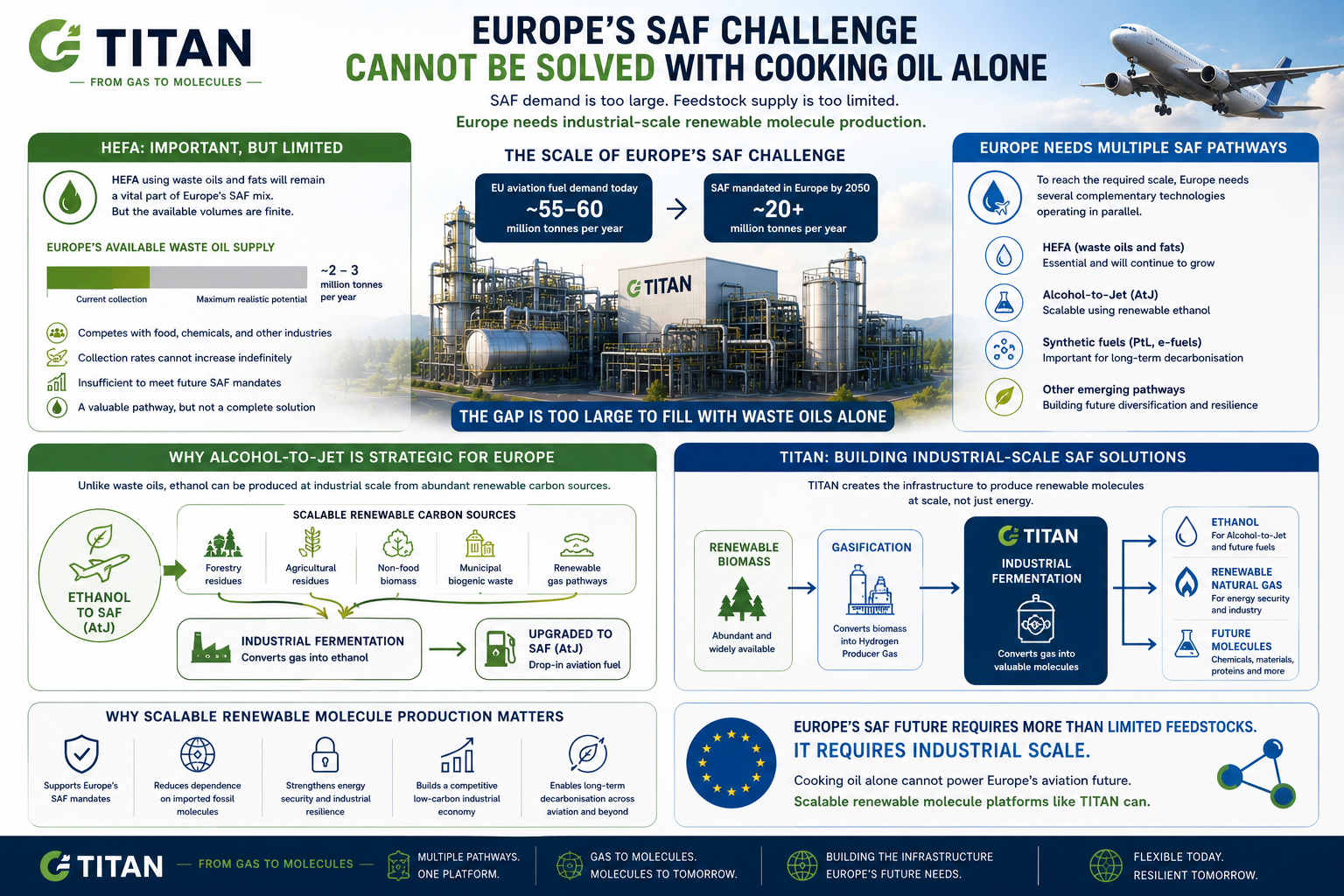
Europe consumes tens of millions of tonnes of aviation fuel every year. As SAF mandates increase over time, the volume of renewable fuel required will become extremely large. This creates pressure on feedstock supply chains across the entire energy and industrial system.
At present, much of the SAF discussion focuses on lipid-based pathways such as used cooking oil, waste fats and vegetable oils. These pathways are important and will continue to play a valuable role in SAF development.
But there is a structural limitation.
The volume of waste oils available is finite.
Europe cannot build a long-term SAF strategy around feedstocks that exist only in limited quantities. Even with aggressive collection systems, the available supply of used cooking oil and waste fats remains relatively small compared with total aviation fuel demand.
This is not a criticism of HEFA or lipid pathways.
It is simply a question of scale.
As aviation decarbonisation accelerates, Europe will require additional SAF pathways capable of operating at industrial volume using broader renewable carbon resources.