Przewiń w dół, aby zobaczyć wersję w języku polskim.
TITAN does not begin with fermentation.
It begins with control.
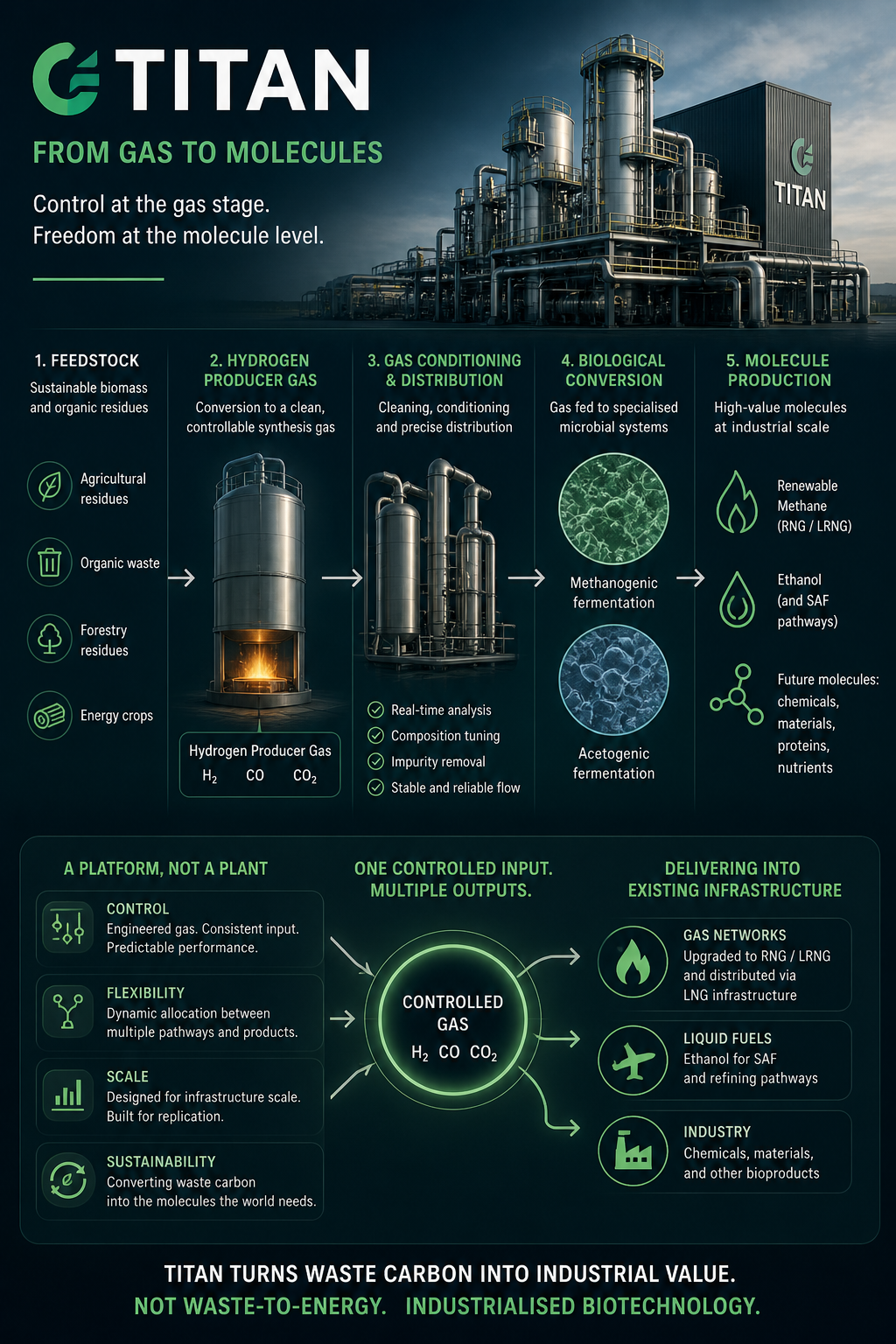
At the heart of the platform is a simple but critical step: converting solid carbon into a stable, controllable gas. This is achieved through Hydrogen Producer Gas, where biomass is transformed into a defined mixture of hydrogen, carbon monoxide and carbon dioxide.
This step determines everything that follows.
Most carbon conversion systems struggle because they attempt to process variability. Mixed inputs lead to unstable outputs. Biological systems, in particular, are sensitive to inconsistency. When feedstock fluctuates, performance drops, yields fall, and scale becomes difficult.
TITAN removes this problem at the source.
By converting solids into gas first, it separates variability from production. The gas phase becomes a controlled interface between raw material and biology. Instead of managing unpredictable solids, the system manages a measurable, adjustable flow.
Gas can be analysed in real time.
Composition can be tuned. Ratios of hydrogen to carbon monoxide can be adjusted depending on the target pathway. Flow can be stabilised. Impurities can be reduced through conditioning and polishing. What enters the fermentation system is no longer variable waste. It is engineered input.
This is the difference between adaptation and design.
In conventional systems, biology is forced to adapt to the feedstock. In TITAN, the feedstock is engineered to suit the biology. This allows microbial systems to operate under optimal conditions rather than survival conditions.
The result is stability.
Methanogenic and acetogenic pathways require consistency to perform at industrial scale. Methanogens convert hydrogen and carbon dioxide into methane. Acetogens convert carbon monoxide and hydrogen into ethanol and other molecules. Both processes are highly sensitive to gas composition, pressure and flow.