

Published: 16 April 2026
(Przewiń w dół, aby zobaczyć wersję polską.)
For decades, forest residue has been viewed in two simplistic ways.
Either it is treated as waste that should be removed completely from the forest floor, or it is treated as untouchable material that must remain exactly where it falls.
Reality is more nuanced.
A healthy forest is not built by abandoning unmanaged residue indefinitely. Nor is it built by stripping the forest clean. Sustainable forestry requires balance between recovery, regeneration, biodiversity, fire management, soil protection and long-term carbon stability.
This is where TITAN’s Gather–Chip–Ship (GCS) model becomes important.
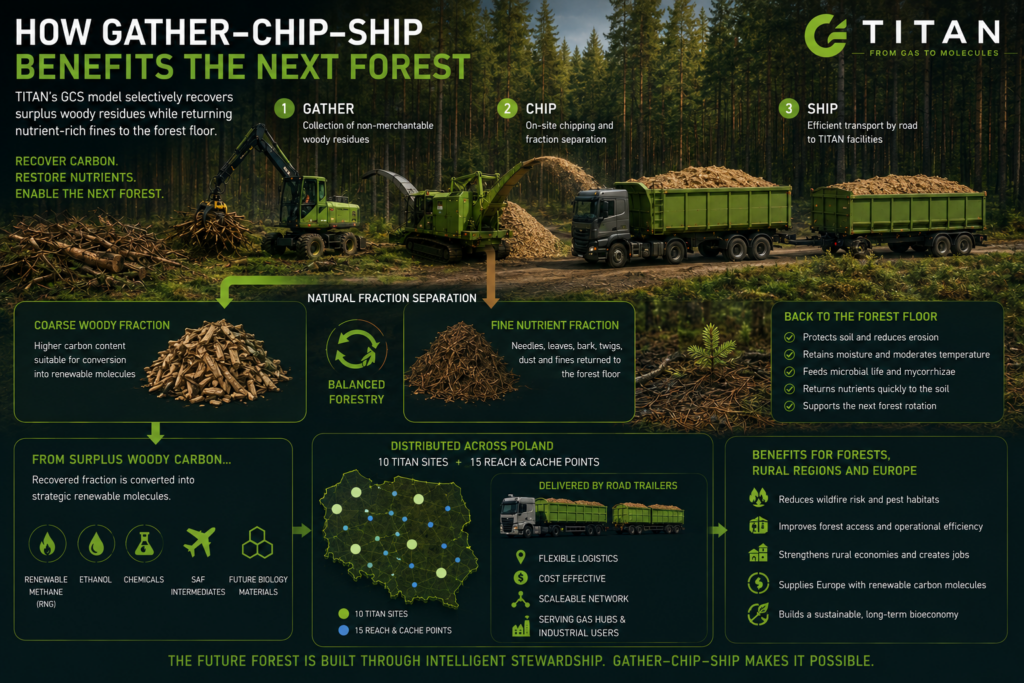
GCS is not designed to “mine” the forest. It is designed to selectively recover surplus woody residues while deliberately retaining the biologically active nutrient fraction where it belongs: on the forest floor.
This distinction matters enormously.
When forest residues are chipped and processed in the field, the material naturally separates into fractions. Larger woody fractions contain most of the recoverable carbon value suitable for conversion into renewable molecules such as renewable methane, ethanol, chemicals and sustainable aviation fuel intermediates.
The finer material behaves differently.
Needles, leaves, bark particles, small twigs, dust, fragmented organics and chipped fines contain much of the rapidly recyclable nutrient content required for healthy soil ecosystems. These materials decompose quickly, retain moisture, protect the soil surface, support fungal networks and microbial life, and help feed the next forest rotation.
In practical terms, the forest floor receives a pre-mulched biological layer.
This acts almost like a natural compost blanket.
It reduces erosion. It slows water loss. It moderates temperature fluctuations at soil level. It supports mycorrhizal activity. It returns nutrients back into the biological cycle far faster than large woody residues that may otherwise remain exposed for years.
This is one of the reasons why modern sustainable forestry increasingly focuses on selective recovery rather than total extraction.