Volatility Is an Industrial Opportunity

For much of the industrial world, volatility is viewed as a threat.

Energy prices rise and fall. Commodity markets move unexpectedly. Regulation changes. Geopolitical tensions disrupt supply chains. Technologies evolve faster than expected. Entire sectors can become exposed to sudden shifts in economics or policy.

Traditional industrial infrastructure struggles in this environment.

Most industrial plants are designed around one core assumption: stability.

A refinery is optimised for a specific feedstock. A power plant is designed for a fixed operational profile. A conventional biomethane installation is built to produce biomethane. A chemical plant is often designed around a narrow process pathway.

This model worked well during periods of predictable markets and long industrial cycles.

But the world is changing.

Energy markets are becoming more dynamic. Carbon regulation is increasing. Molecule demand is evolving. Europe is attempting to reduce strategic dependence on imported fuels and industrial feedstocks while simultaneously decarbonising its economy.

In this environment, flexibility becomes increasingly valuable.

This is one of the reasons TITAN was designed differently.

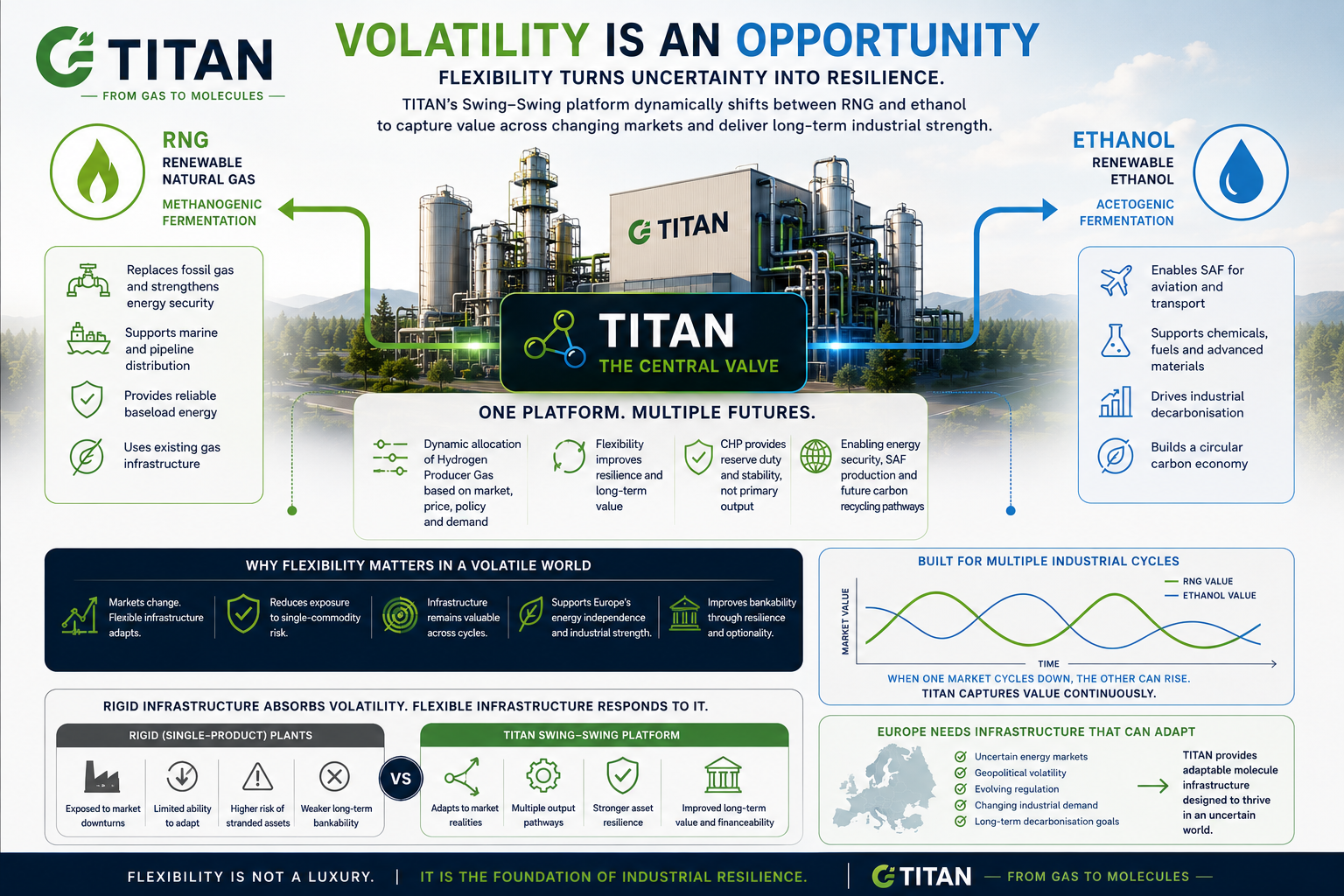
TITAN is not built around a single product. It is built around controlled Hydrogen Producer Gas production and flexible molecule conversion pathways.

This distinction is important.

Traditional infrastructure often becomes vulnerable when its primary output loses competitiveness. A rigid system can only respond in limited ways to changing markets. If prices fall or regulation changes, the infrastructure itself may lose strategic value.

TITAN approaches this problem differently.

The platform is designed around optionality.

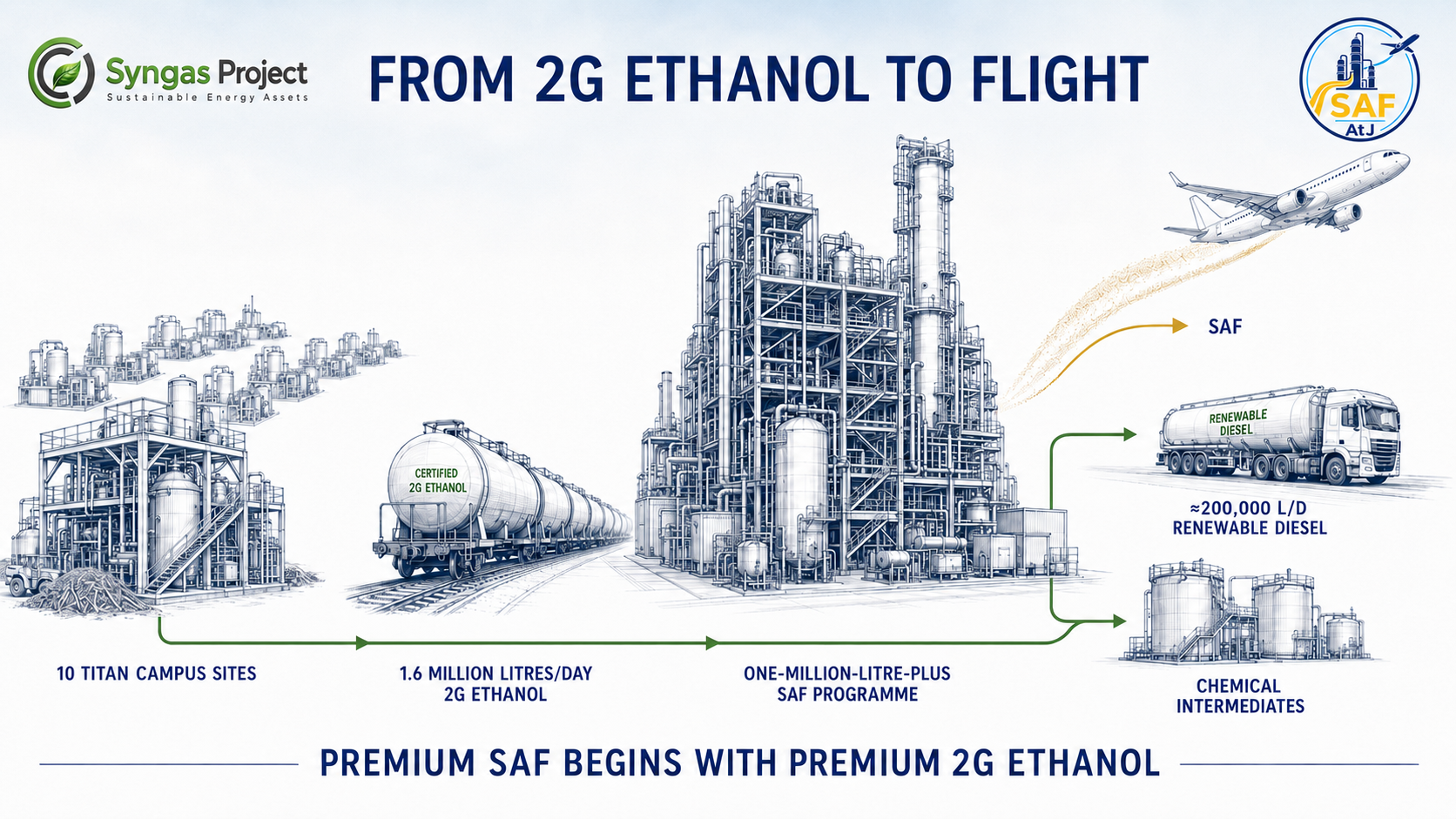
Hydrogen Producer Gas can be directed toward multiple downstream pathways depending on market conditions, regulation, demand and strategic priorities. In one operating environment, renewable methane may provide the strongest value proposition. In another, ethanol for Sustainable Aviation Fuel may become more attractive.

The same infrastructure remains relevant across multiple industrial cycles.

This changes the risk profile of the platform.

Volatility becomes less of a threat when infrastructure can adapt to it.

This does not eliminate risk entirely. All industrial systems face operational, regulatory and market challenges. But flexibility changes how those risks are managed.

A rigid system absorbs volatility.

A flexible system can respond to it.

This principle already exists in other forms of infrastructure. Modern logistics networks, data systems and manufacturing platforms increasingly rely on adaptability rather than fixed operational assumptions. The same logic is now beginning to emerge in industrial molecule production.

The future industrial economy will likely reward systems capable of continuous adjustment.
Full Stack: The Physical Layer of Artificial Intelligence

Artificial intelligence is rapidly becoming the defining technology race of the 21st century.

Every week brings announcements about larger models, faster processors, more capable software agents and increasingly advanced machine reasoning systems. Governments are investing billions. Technology companies are competing for dominance. Data centres are expanding across the world at extraordinary speed.

Most discussion focuses on computation.

But very little discussion focuses on what artificial intelligence ultimately needs in the physical world.

Because intelligence alone does not manufacture anything.

Artificial intelligence can design molecules.
It can optimise biological pathways.
It can simulate new materials.
It can improve industrial systems.
It can accelerate chemistry and biotechnology research.

But eventually, something physical must manufacture the result.

This is where the next industrial bottleneck may emerge.

The future may not belong only to countries that control computation.

It may also belong to countries that control biological manufacturing platforms capable of turning digital intelligence into physical products.

That distinction is becoming increasingly important.

Artificial intelligence is already beginning to transform chemistry, material science, pharmaceutical research, biological engineering and industrial process optimisation. The speed of discovery is accelerating dramatically. New materials, proteins, enzymes, carbon structures and biological production pathways are being identified faster than traditional industrial systems can adapt.

But discovery is only one half of the equation.

Manufacturing remains the other half.

Why Carbon Recycling Will Replace Carbon Extraction

Publish date: 1 May 2026

(Przewiń w dół, aby zobaczyć wersję polską.)

For more than a century, industrial growth has depended on carbon extraction.

Coal, oil and natural gas were taken from the ground, refined, transported and converted into energy, fuels, chemicals and materials. This model powered the modern economy. It created mobility, manufacturing, aviation, plastics, fertilisers and global trade.

But it also created a structural problem.

The industrial economy became dependent on fossil carbon.

Carbon was extracted once, used briefly, and then released into the atmosphere. This linear model was efficient during the age of cheap fossil resources, but it is no longer compatible with Europe’s long-term climate, industrial and security objectives.

The next industrial era will require a different model.

Carbon cannot simply be treated as something to extract, burn and discard.

It must be treated as something to recover, recycle and reuse.

This is the logic of carbon recycling.

Carbon recycling does not mean stopping the use of carbon. That would be impossible for many parts of the economy. Aviation, shipping, chemicals, materials, agriculture, food systems and industrial manufacturing all depend on carbon-based molecules.

The real question is not whether society will use carbon.

The question is where that carbon comes from.

In the old model, carbon came from fossil extraction.

Why Rail Logistics Matter for Renewable Molecules

Publish date 29 April 2026

(Przewiń w dół, aby zobaczyć wersję polską.)

The renewable molecule economy will not succeed on chemistry alone.

It will succeed on logistics.

One of the largest mistakes in modern energy planning is the assumption that low-carbon systems can simply replace fossil systems without rebuilding the underlying industrial transport infrastructure. In reality, renewable molecules require an entirely different logistical approach.

This is especially true at industrial scale.

Renewable carbon is more distributed than fossil carbon. Biomass is regional. Residues are seasonal. Industrial fermentation requires continuous feedstock flow. Renewable gases and fuels must move efficiently between production, storage and end markets.

That means logistics become strategic infrastructure.

This is one of the reasons TITAN was designed around rail.

Rail is not simply a transport option.

It is one of the core foundations of industrial-scale renewable molecule production.

TITAN: A Cookie-Cutter Roll-Out Platform

Publish date: 28 April 2026

(Przewiń w dół, aby zobaczyć wersję polską.)

One of the biggest challenges in industrial decarbonisation is not technology.

It is replication.

Many energy and industrial projects work only under highly specific local conditions. They rely on unusual feedstocks, unique permitting structures, customised engineering or isolated infrastructure advantages. This makes scaling difficult, expensive and slow.

Europe does not only need successful demonstration projects.

Europe needs repeatable industrial platforms.

This is one of the core principles behind TITAN.

TITAN was not designed as a one-off installation.

It was designed as a cookie-cutter roll-out platform.

The objective is simple:

Standardise as much of the industrial system as possible while allowing limited adaptation to local site conditions.

This approach changes the economics and deployment logic of renewable molecule infrastructure.

In traditional industrial development, every project often starts from the beginning. Engineering teams redesign systems repeatedly. Procurement chains change. Operational training changes. Construction sequencing changes. Financing becomes more difficult because each installation appears unique.

TITAN approaches this differently.

The platform is modular, repeatable and structurally standardised.

Core systems remain consistent across deployments: gasification architecture, Hydrogen Producer Gas production, fermentation pathways, logistics logic, control philosophy and industrial workflow. This allows engineering knowledge, operational experience and supply-chain learning to accumulate over time rather than restarting for every site.

This is how industrial scaling historically succeeds.

The automotive industry did not scale through handcrafted prototypes.

Container shipping did not scale through unique containers.

Rail systems did not scale through custom track gauges for every city.

Industrial systems become powerful when they become repeatable.

TITAN applies the same principle to renewable molecule infrastructure.

Each TITAN deployment is designed around a familiar industrial structure: renewable carbon intake, gasification, controlled Hydrogen Producer Gas production, fermentation pathways, molecule upgrading, logistics integration and dispatch.

Europe’s Next Industrial Revolution Will Be Biological

Publish Date 27 April 2026

(Przewiń w dół, aby zobaczyć wersję polską.)

Europe was built on industrial revolutions.

The first industrial age was powered by coal, steam and mechanisation. The second was built around oil, gas, chemicals and mass electrification. The digital era transformed communications, finance and information systems.

The next industrial revolution may be biological.

Not in the science-fiction sense.

In the industrial sense.

The global economy is beginning to move away from extracting fossil carbon from underground and toward managing renewable carbon flows above ground. This transition will affect far more than energy production. It will reshape fuels, chemicals, agriculture, food systems, materials, manufacturing and industrial supply chains.

This matters because modern economies do not run on electricity alone.

They also run on molecules.

Fuels.
Chemicals.
Plastics.
Solvents.
Proteins.
Materials.
Industrial gases.
Carbon products.

For more than a century, most of these products originated from oil, coal and gas extraction. The fossil economy did not only produce energy. It produced the molecular foundation of industrial civilisation.

That foundation is now beginning to change.

Europe faces a strategic challenge.

The continent has world-class science, engineering and biotechnology capability. But it imports large quantities of critical molecules and remains structurally dependent on external energy and feedstock systems. Geopolitical instability, supply chain disruption and rising resource competition are exposing the risks of this dependence.

The solution may not simply be replacing fossil electricity generation.

The solution may be rebuilding Europe’s molecule economy around renewable carbon systems.

This is where biological manufacturing becomes important.

Biological systems are extraordinarily efficient molecular factories. Microbes, enzymes and fermentation systems can already produce fuels, proteins, chemicals and specialist compounds. Artificial intelligence is now accelerating the discovery of entirely new biological pathways and material possibilities.

But these systems require industrial platforms capable of operating at scale.

That is where TITAN positions itself.

TITAN and ASMARA: Two Carbon Platforms, Two Different Duties

Publish date: 27 April 2026

(Przewiń w dół, aby zobaczyć wersję polską.)

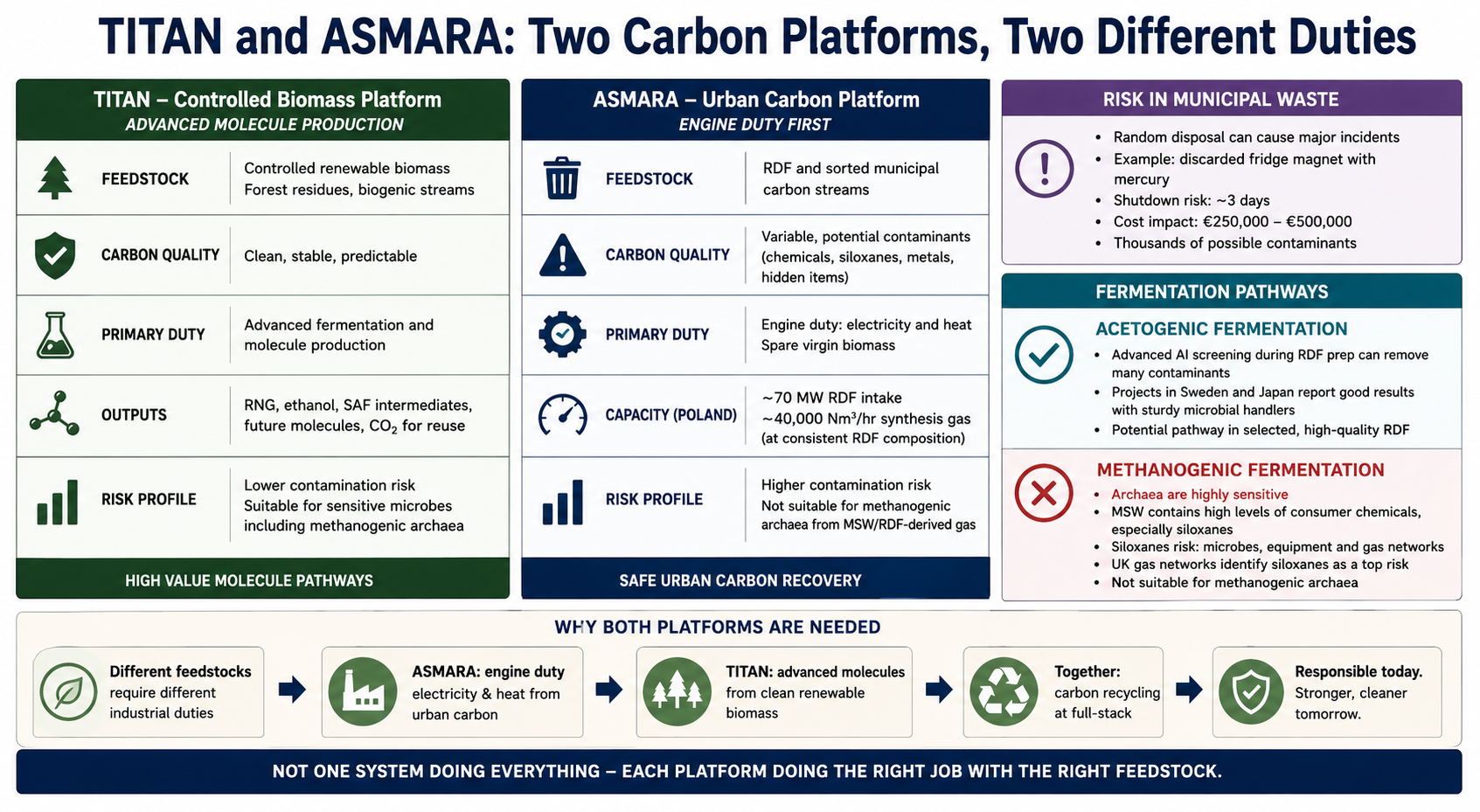
TITAN and ASMARA are sister platforms, but they do not perform the same industrial duty.

This distinction is extremely important.

Both systems are built around Hydrogen Producer Gas and carbon recycling. Both convert difficult carbon streams into useful industrial outputs. Both are designed to support Europe’s transition away from fossil carbon extraction.

But the feedstocks are fundamentally different.

And that changes everything.

TITAN is designed primarily around controlled renewable biomass, especially forest residues and other biogenic carbon streams. The feedstock is cleaner, more stable and more predictable. This allows TITAN to support advanced fermentation pathways including Renewable Natural Gas, ethanol, future SAF intermediates and wider industrial molecule production.

ASMARA is different.

ASMARA is designed around RDF and sorted municipal carbon streams.

That creates opportunity.

But it also creates risk.

Modern cities contain enormous quantities of recoverable carbon. Even after conventional recycling, large amounts of carbon-rich material remain inside municipal waste streams. If these streams can be processed safely, they represent an important industrial resource.

ASMARA is designed to recover value from this urban carbon.

At industrial scale, ASMARA can process approximately 70 MW of RDF feedstock to produce around 40,000 Nm³/hr of synthesis gas when RDF composition remains sufficiently consistent.

That is a very significant urban carbon recovery platform.

However, municipal carbon is not the same as controlled biomass.

Municipal waste streams contain uncertainty.

Even in highly disciplined waste economies such as Sweden and Japan, random disposal events still occur. Consumer products, household chemicals, solvents, oils, silicones, heavy metals and hidden contaminants can enter the waste stream unexpectedly.

How Gather–Chip–Ship Benefits the Next Forest

Published: 16 April 2026

(Przewiń w dół, aby zobaczyć wersję polską.)

For decades, forest residue has been viewed in two simplistic ways.

Either it is treated as waste that should be removed completely from the forest floor, or it is treated as untouchable material that must remain exactly where it falls.

Reality is more nuanced.

A healthy forest is not built by abandoning unmanaged residue indefinitely. Nor is it built by stripping the forest clean. Sustainable forestry requires balance between recovery, regeneration, biodiversity, fire management, soil protection and long-term carbon stability.

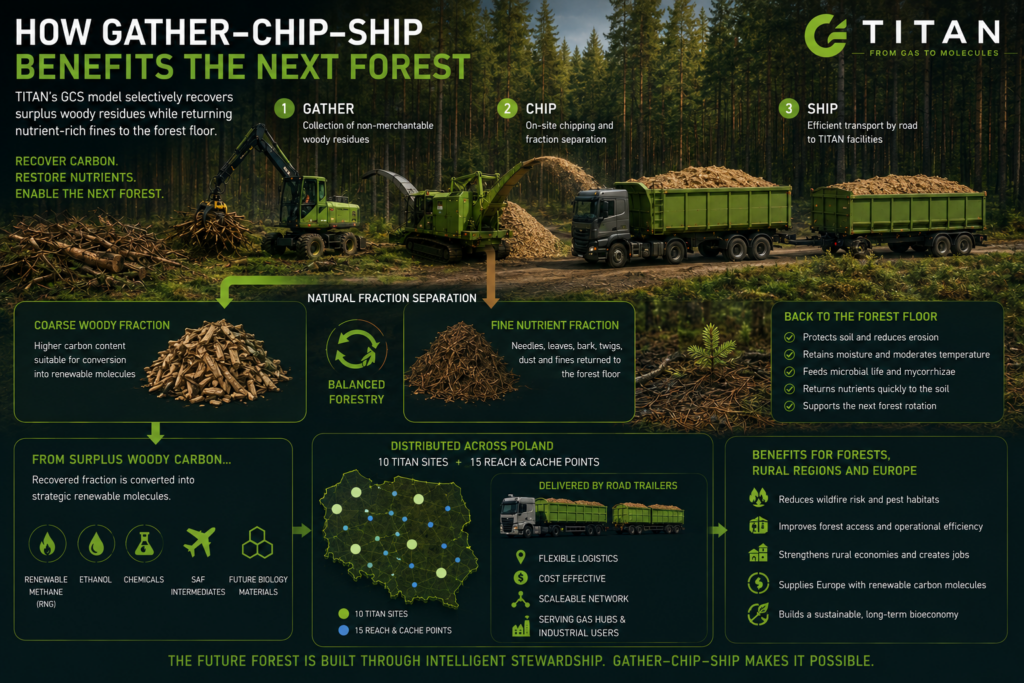
This is where TITAN’s Gather–Chip–Ship (GCS) model becomes important.

GCS is not designed to “mine” the forest. It is designed to selectively recover surplus woody residues while deliberately retaining the biologically active nutrient fraction where it belongs: on the forest floor.

This distinction matters enormously.

When forest residues are chipped and processed in the field, the material naturally separates into fractions. Larger woody fractions contain most of the recoverable carbon value suitable for conversion into renewable molecules such as renewable methane, ethanol, chemicals and sustainable aviation fuel intermediates.

The finer material behaves differently.

Needles, leaves, bark particles, small twigs, dust, fragmented organics and chipped fines contain much of the rapidly recyclable nutrient content required for healthy soil ecosystems. These materials decompose quickly, retain moisture, protect the soil surface, support fungal networks and microbial life, and help feed the next forest rotation.

In practical terms, the forest floor receives a pre-mulched biological layer.

This acts almost like a natural compost blanket.

It reduces erosion. It slows water loss. It moderates temperature fluctuations at soil level. It supports mycorrhizal activity. It returns nutrients back into the biological cycle far faster than large woody residues that may otherwise remain exposed for years.

This is one of the reasons why modern sustainable forestry increasingly focuses on selective recovery rather than total extraction.

Swing–Swing: fermentacja metanogenna i acetogenna na jednej platformie

TITAN nie wybiera pomiędzy metanem odnawialnym a etanolem.

Produkuje oba produkty na tej samej platformie, z tego samego strumienia węgla.

To jest podstawa trybu Swing–Swing.

W centrum platformy TITAN znajduje się Hydrogen Producer Gas. Nie jest to gaz odpadowy. Jest to kontrolowany surowiec węglowy, zaprojektowany tak, aby dostarczać stabilną mieszaninę wodoru, tlenku węgla i dwutlenku węgla. Ten gaz staje się interfejsem pomiędzy konwersją termochemiczną a biotechnologią.

Z jednego strumienia gazu równolegle działają dwie ścieżki biologiczne.

Fermentacja metanogenna przekształca gaz w metan odnawialny.

Fermentacja acetogenna przekształca ten sam gaz w etanol.

To nie są procesy konkurencyjne. Są komplementarne.

Tradycyjne systemy wymuszają wybór. Gaz jest spalany, uszlachetniany albo kierowany do jednej ścieżki downstream. Ogranicza to elastyczność i zmniejsza wartość. TITAN został zaprojektowany inaczej. Gaz jest kondycjonowany i dystrybuowany w ramach platformy, która może kierować węgiel tam, gdzie w danym momencie tworzy największą wartość.

To nie jest przewaga teoretyczna. To zdolność na poziomie systemu.

Organizmy metanogenne preferują warunki bogate w wodór. Efektywnie i niezawodnie przekształcają wodór i dwutlenek węgla w metan. Ta ścieżka produkuje odnawialny gaz ziemny, który może być sprężany, skraplany i dystrybuowany jako LRNG przez istniejącą infrastrukturę.

Organizmy acetogenne działają inaczej. Zużywają tlenek węgla i dwutlenek węgla, przekształcając je w etanol i inne półprodukty. Ta ścieżka wspiera produkcję etanolu 2G, który może być następnie wykorzystany w ścieżce Alcohol-to-Jet do produkcji zrównoważonego paliwa lotniczego.

Obie ścieżki zależą od jakości gazu, ciśnienia, temperatury i składu. W TITAN te zmienne są kontrolowane. Gaz nie jest po prostu produkowany i wysyłany dalej. Jest zarządzany, kondycjonowany i kierowany.