

Warsaw 05:05:2026 11:08 AM Steve Walker
For much of the industrial world, volatility is viewed as a threat.
Energy prices rise and fall. Commodity markets move unexpectedly. Regulation changes. Geopolitical tensions disrupt supply chains. Technologies evolve faster than expected. Entire sectors can become exposed to sudden shifts in economics or policy.
Traditional industrial infrastructure struggles in this environment.
Most industrial plants are designed around one core assumption: stability.
A refinery is optimised for a specific feedstock. A power plant is designed for a fixed operational profile. A conventional biomethane installation is built to produce biomethane. A chemical plant is often designed around a narrow process pathway.
This model worked well during periods of predictable markets and long industrial cycles.
But the world is changing.
Energy markets are becoming more dynamic. Carbon regulation is increasing. Molecule demand is evolving. Europe is attempting to reduce strategic dependence on imported fuels and industrial feedstocks while simultaneously decarbonising its economy.
In this environment, flexibility becomes increasingly valuable.
This is one of the reasons TITAN was designed differently.
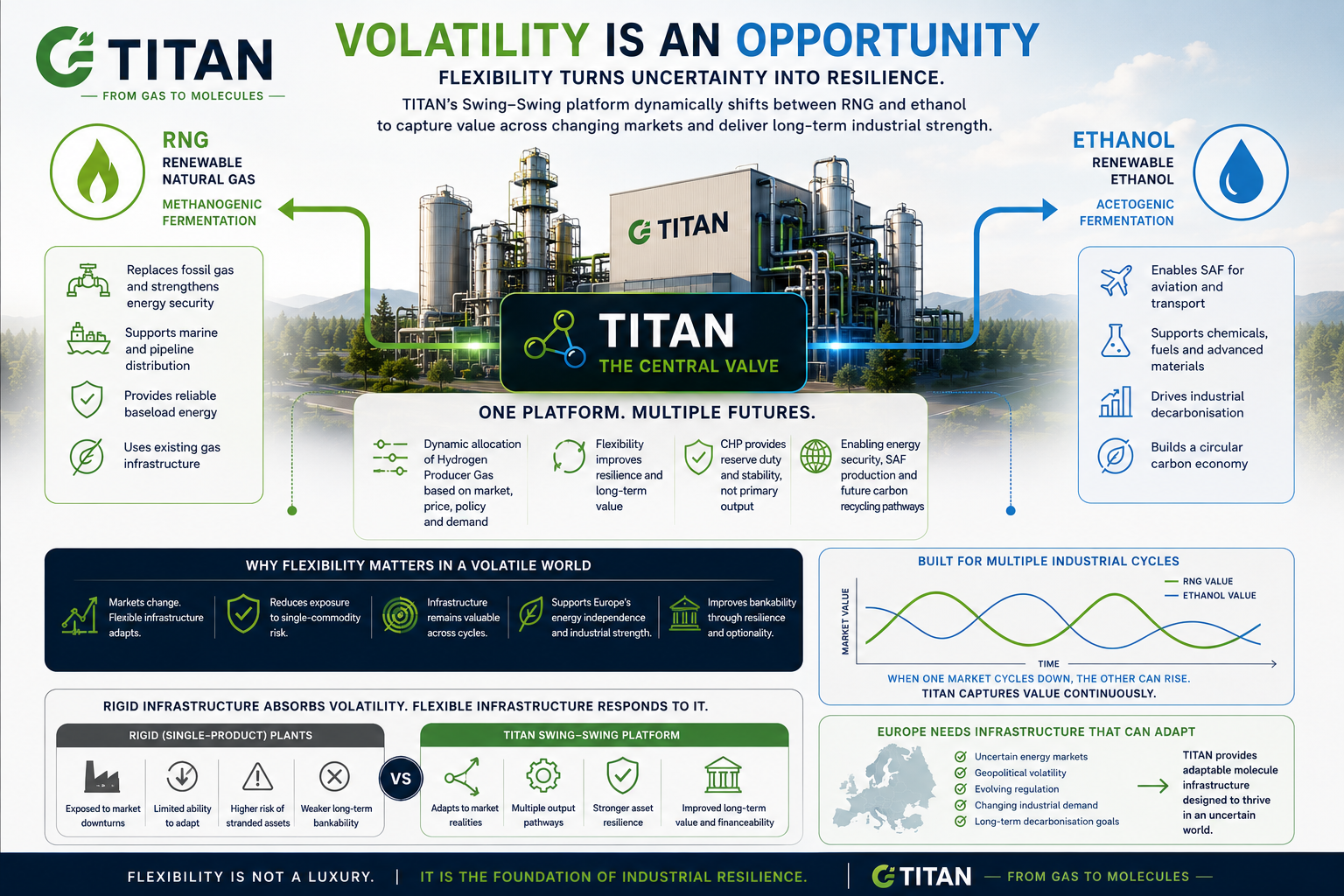
TITAN is not built around a single product. It is built around controlled Hydrogen Producer Gas production and flexible molecule conversion pathways.
This distinction is important.
Traditional infrastructure often becomes vulnerable when its primary output loses competitiveness. A rigid system can only respond in limited ways to changing markets. If prices fall or regulation changes, the infrastructure itself may lose strategic value.
TITAN approaches this problem differently.
The platform is designed around optionality.
Hydrogen Producer Gas can be directed toward multiple downstream pathways depending on market conditions, regulation, demand and strategic priorities. In one operating environment, renewable methane may provide the strongest value proposition. In another, ethanol for Sustainable Aviation Fuel may become more attractive.
The same infrastructure remains relevant across multiple industrial cycles.
This changes the risk profile of the platform.
Volatility becomes less of a threat when infrastructure can adapt to it.
This does not eliminate risk entirely. All industrial systems face operational, regulatory and market challenges. But flexibility changes how those risks are managed.
A rigid system absorbs volatility.
A flexible system can respond to it.
This principle already exists in other forms of infrastructure. Modern logistics networks, data systems and manufacturing platforms increasingly rely on adaptability rather than fixed operational assumptions. The same logic is now beginning to emerge in industrial molecule production.
The future industrial economy will likely reward systems capable of continuous adjustment.