Warsaw 04:06:2006 7:00 Steve Walker
For almost 150 years, industrial civilisation has been built around one dominant idea:
If carbon contains energy, burn it.
Coal powered the industrial revolution. Oil powered transport. Gas powered modern electricity systems. Entire cities, industries and economies were designed around combustion because combustion released energy quickly and at enormous scale.
But combustion also destroys something.
The moment carbon burns, its molecular structure disappears. Heat is released once, then the carbon leaves the system as exhaust, ash or emissions. For generations this looked perfectly rational because energy itself was the prize. Nobody seriously asked whether carbon might hold more value before it entered the furnace.
That assumption is beginning to break.
The modern industrial economy increasingly depends not only on energy, but on molecules. Fuels matter, but so do solvents, gases, polymers, chemicals, materials and biological feedstocks. A tonne of carbon-rich material may now hold greater value as industrial feedstock than as immediate heat.
This changes the industrial question completely.
The old economy asked:
How much energy can we release from carbon?
The emerging economy asks:
What is the highest possible value this carbon can become before we burn it?
That is where TITAN diverges from the traditional furnace economy.
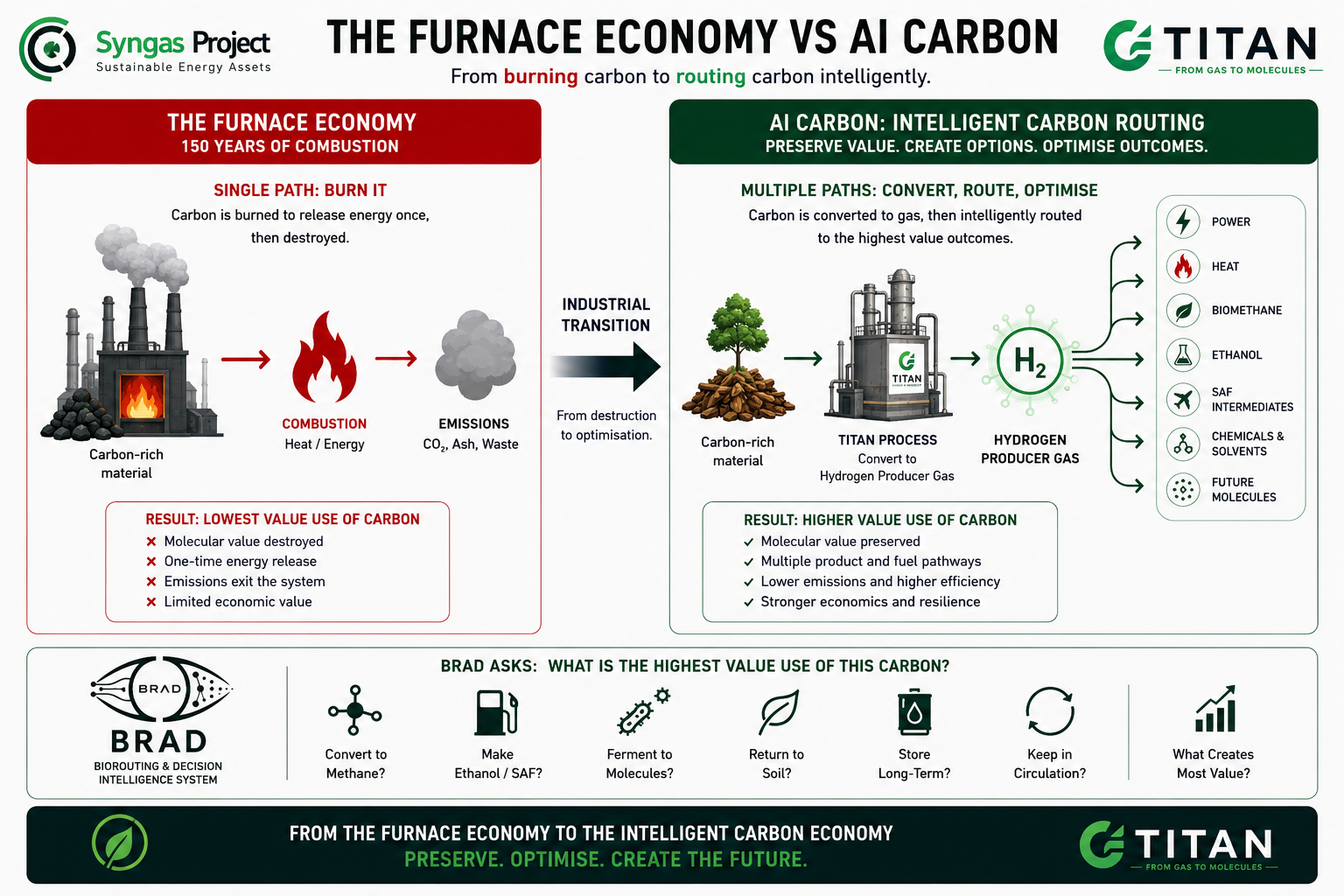
TITAN does not simply burn carbon. It first converts carbon into hydrogen producer gas. Once carbon becomes gas, something important happens. The carbon is no longer trapped inside solid biomass. It becomes routeable.
That routing changes everything.
The same carbon stream may become electricity today, biomethane tomorrow, ethanol next week, or eventually SAF intermediates, solvents, ketones, acids or other industrial molecules. Instead of destroying molecular value immediately through combustion, TITAN attempts to preserve optionality for as long as possible.
This is the beginning of a very different industrial philosophy.
The furnace economy treats carbon as something to consume.
AI Carbon treats carbon as something to optimise.
That distinction may define the next industrial era.
Historically, combustion won because it was simple and cheap. Oil and gas became abundant. Giant centralised refineries and power systems dominated the world. Biological pathways, fermentation routes and alternative carbon systems were pushed aside because the economics of hydrocarbons overwhelmed almost everything else.