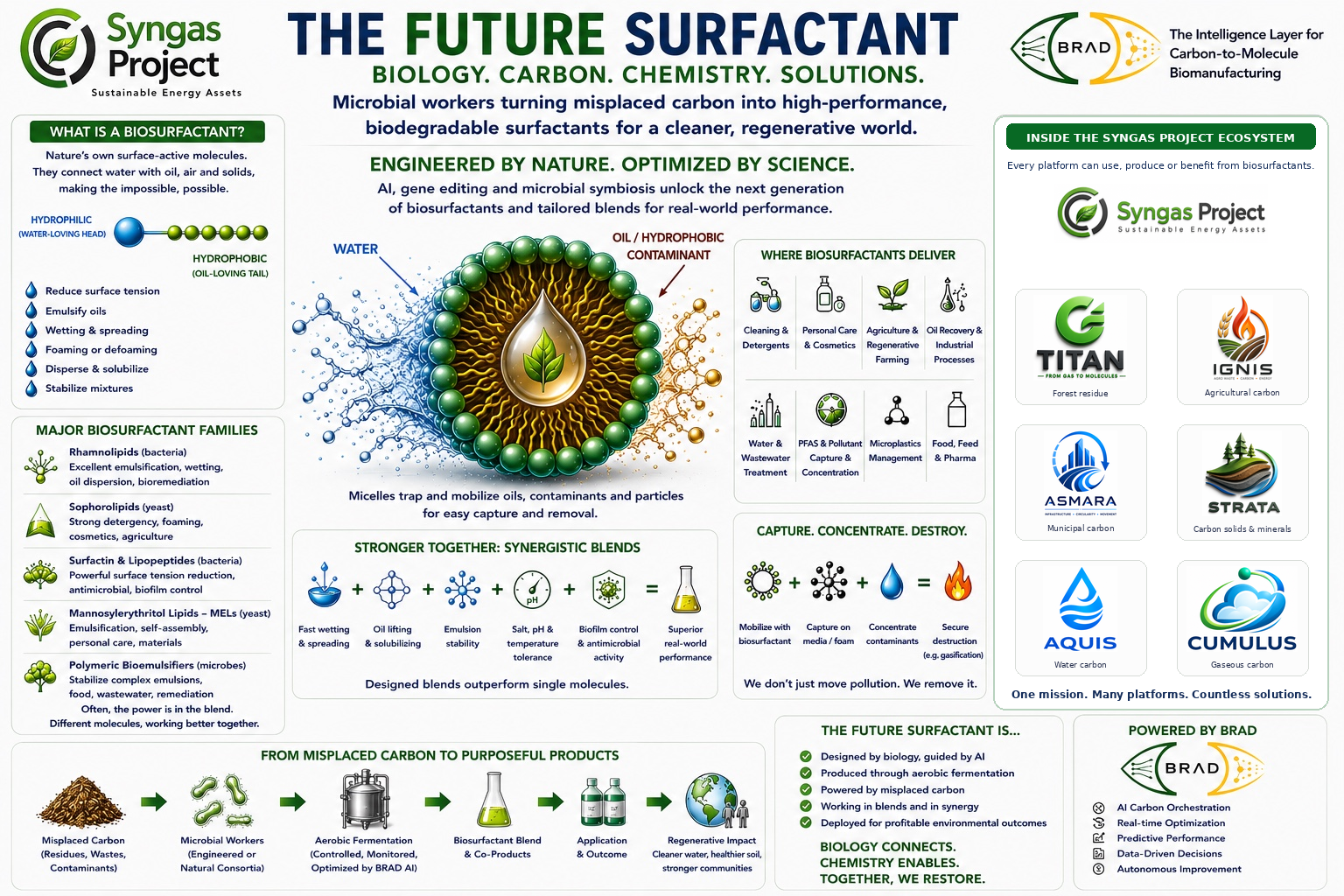
The Future Surfactant

Warsaw 05:08:2026 Steve Walker


The Future Surfactant

How microbial workers could turn misplaced carbon into a new generation of useful molecules

Syngas Project develops platforms that bring misplaced carbon together with carefully selected microbial workers to create profitable products and measurable environmental outcomes.

Much of the basic science is already understood. We know that different microorganisms consume different carbon diets. We know that they use metabolic pathways to transform carbon into fuels, chemicals, proteins, polymers and other useful materials. The performance of many industrial microbes has been studied and documented for decades.

What is changing is our ability to see, predict and improve what these microbial workers can do.

Artificial intelligence, machine learning, gene editing, high-throughput screening and advanced metabolic modelling are accelerating the search for better industrial strains. Researchers can increasingly compare large biological datasets, predict useful metabolic pathways, identify promising enzymes and test possible genetic changes before committing to lengthy laboratory programmes. These tools do not remove the need for laboratory validation, but they can significantly improve the speed and direction of microbial development. (ACS Publications⁠)

Aerobic Microbes

Aerobic Microbes — The Bridge

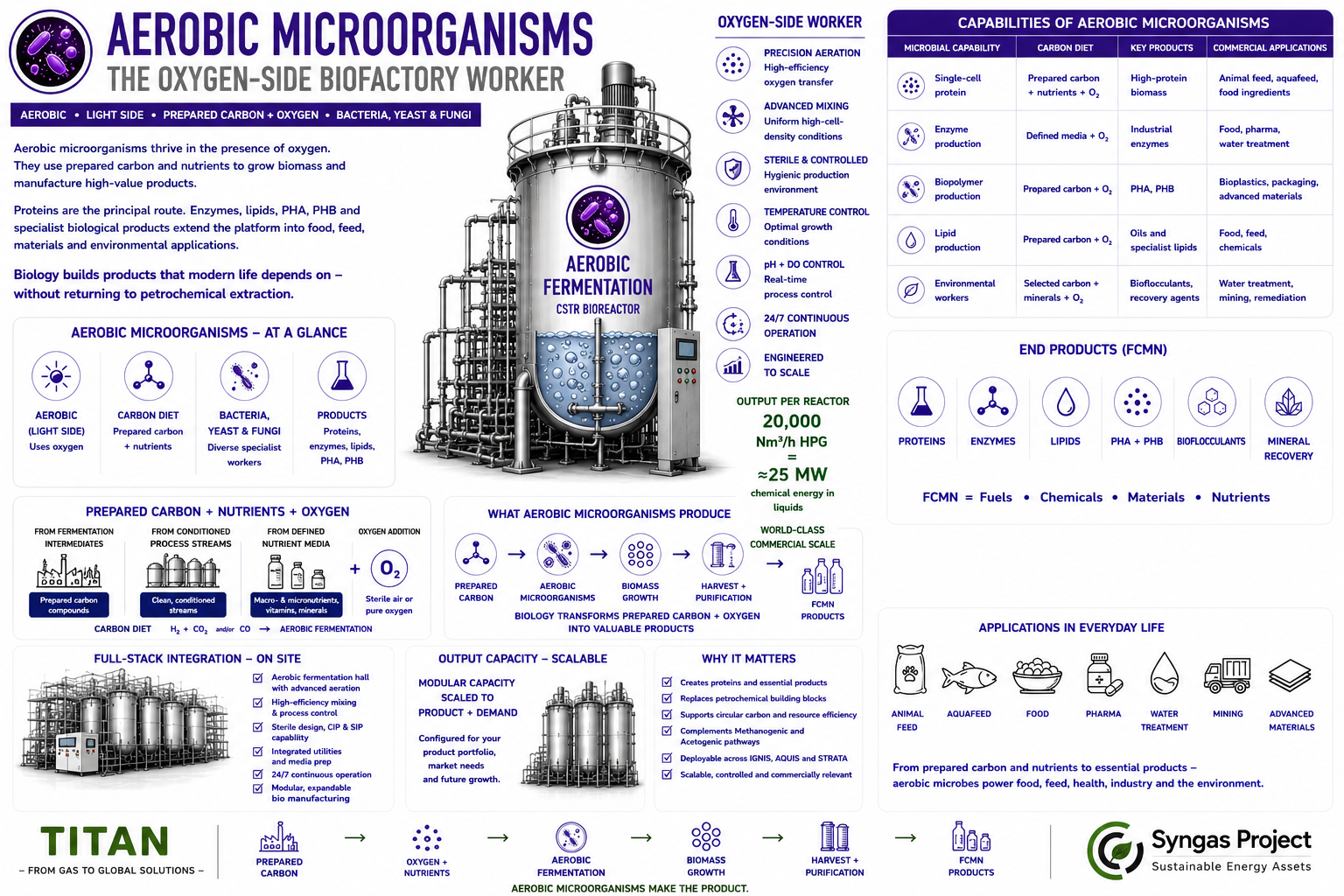
Aerobic fermentation is installed during TITAN Phase 2 in Sector 5a.

We call it The Bridge because it connects TITAN with the wider SOLIDEA platform family: ASMARA, AQUIS, STRATA and IGNIS.

Methanogenic fermentation gives TITAN its renewable methane pathway.

Acetogenic fermentation gives TITAN its ethanol, chemicals and materials pathway.

Aerobic fermentation completes the full fermentation stack.

It creates products within the Fermentation CAMPUS, prepares specialist microbial workers for deployment beyond the CAMPUS and connects prepared carbon with a much wider range of biological outcomes.

The Light Side

Aerobic Microbes work in the presence of oxygen.

They use controlled carbon, nutrients and oxygen to grow rapidly and produce substantial microbial biomass.

This distinguishes them from the Methanogenic and Acetogenic families (the Dark Side).

Methanogenic Microbes primarily produce methane.

Acetogenic Microbes primarily produce alcohols, acids and chemical intermediates.

With Aerobic Microbes, the microbial biomass itself may become the commercial product or perform the required biological task.

This is why Aerobic fermentation produces the heavy-biomass outcomes within the full fermentation stack.

The biomass can be harvested, separated, washed, dried and formulated into useful products.

It can also be maintained as a living Microbial Capability and deployed into treatment, recovery, extraction and remediation systems.

Fermentacja Tlenowa

Mikroorganizmy Tlenowe — Most

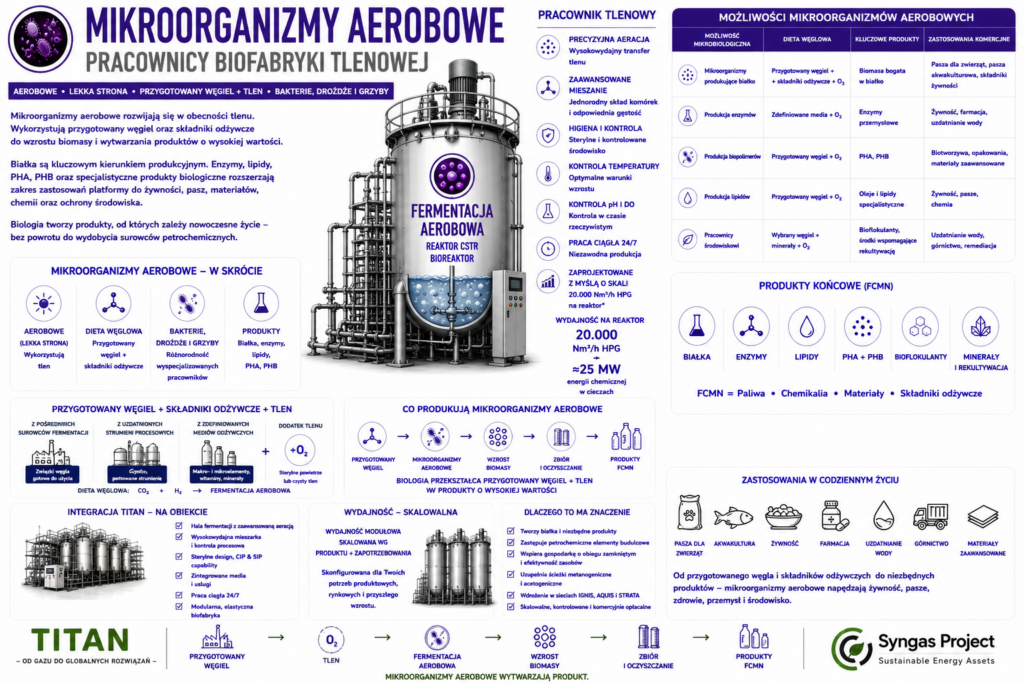
Fermentacja tlenowa zostaje wdrożona podczas Fazy 2 TITAN, w Sektorze 5a.

Nazywamy ją Mostem, ponieważ łączy TITAN z szerszą rodziną platform SOLIDEAASMARA, AQUIS, STRATA oraz IGNIS.

Fermentacja metanogenna zapewnia TITAN ścieżkę produkcji odnawialnego metanu.

Fermentacja acetogeniczna zapewnia TITAN ścieżkę produkcji bioetanolu, chemikaliów i materiałów.

Fermentacja tlenowa dopełnia cały stos technologii fermentacyjnych.

Wytwarza produkty w obrębie CAMPUSU Fermentacyjnego, przygotowuje wyspecjalizowanych Pracowników Mikrobiologicznych do wdrożenia poza CAMPUSEM oraz łączy przygotowany węgiel z znacznie szerszym zakresem zastosowań biologicznych.

Strona Tlenowa

Mikroorganizmy tlenowe pracują w obecności tlenu.

Wykorzystują kontrolowane źródło węgla, składniki odżywcze oraz tlen, aby szybko się namnażać i wytwarzać znaczną ilość biomasy mikrobiologicznej.

To właśnie odróżnia je od rodzin mikroorganizmów metanogennych i acetogenicznych.

Mikroorganizmy metanogenne produkują przede wszystkim metan.

Mikroorganizmy acetogeniczne produkują przede wszystkim alkohole, kwasy oraz chemiczne związki pośrednie.

W przypadku mikroorganizmów tlenowych sama biomasa mikrobiologiczna może stać się produktem handlowym lub wykonywać określone zadanie biologiczne.

Dlatego fermentacja tlenowa odpowiada za produkcję wysokobiomasowych produktów w ramach pełnego stosu technologii fermentacyjnych.

Biomasa może zostać odzyskana, oddzielona, przepłukana, wysuszona i przygotowana jako gotowy produkt.

Może również pozostać żywą Zdolnością Mikrobiologiczną, gotową do wdrożenia w systemach oczyszczania, odzysku surowców, ekstrakcji oraz remediacji środowiska.