
Warsaw 02:06:2026 Steve Walker
Why Fermentation Capacity Is Strategic Resilience
Europe is beginning to rediscover a hard industrial truth.
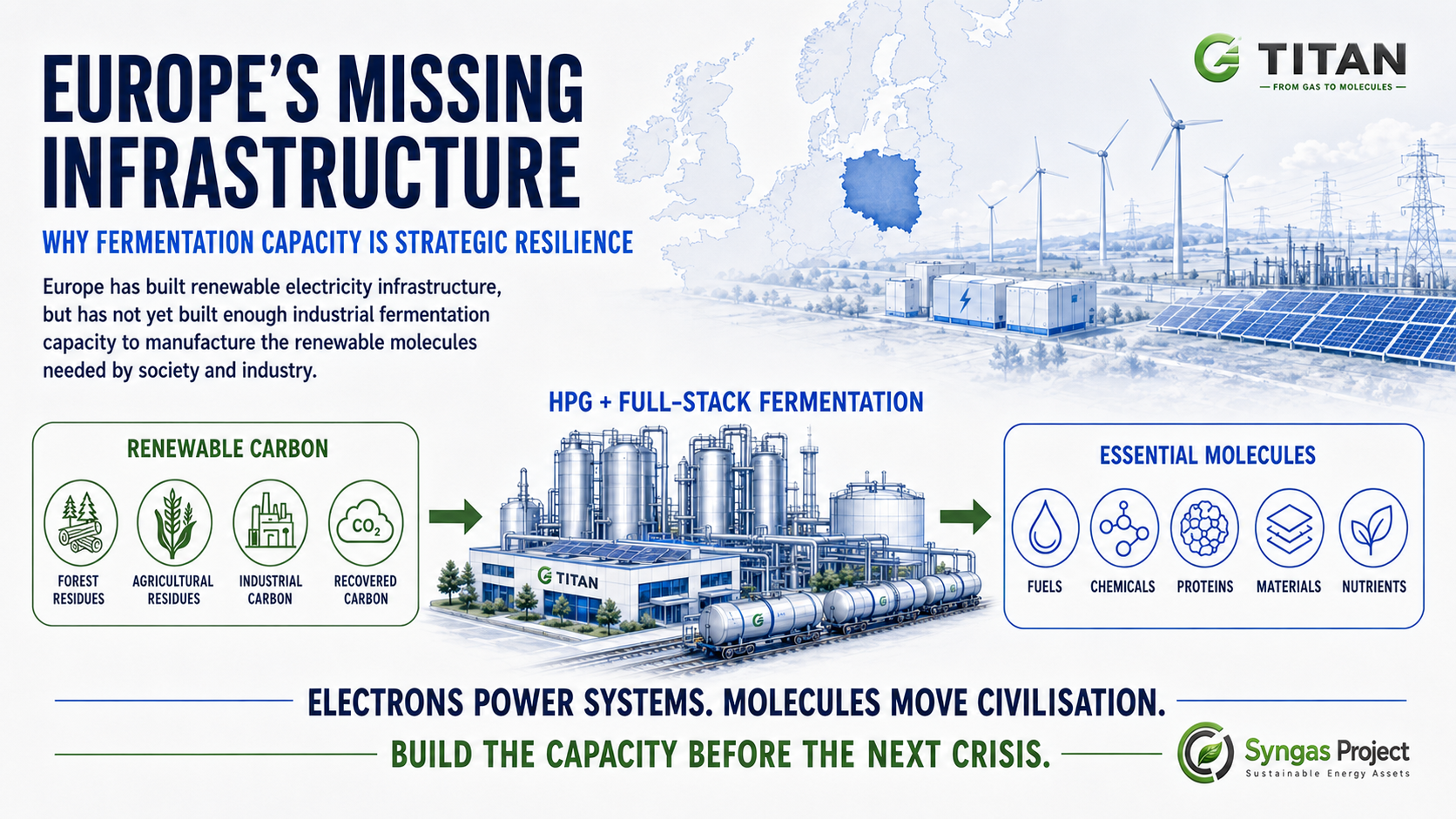
Electricity and storage are essential, but they do not provide full resilience. They keep systems powered. They do not, by themselves, produce the molecules that keep society alive, industry operating, hospitals supplied, aircraft flying or logistics moving when the world becomes unstable.
Civilisation runs on molecules: Jet A1, diesel, methane, ethanol, butanol, acetone, solvents, proteins, enzymes, organic acids, polymers, plastics, chemical intermediates, fertiliser inputs, specialist materials and industrial feedstocks — all of which can be fermented, supported or replaced through fermentation and local carbon conversion.
That is the infrastructure Europe has not yet built at sufficient scale.
For the last decade, Europe has invested heavily in electrons. Wind turbines expanded. Solar farms multiplied. Battery systems accelerated. Grid investment became central to the energy transition. These investments are useful and necessary, but they are not sufficient.
A solar farm does not produce Jet A1.
A wind turbine does not produce diesel.
A battery park does not produce ethanol, acetone, butanol, proteins, enzymes, solvents, plastics or specialist industrial materials.
Europe built capacity in electricity while neglecting capacity in molecules.
That is the strategic gap.
In normal times, the gap is hidden. Global supply chains deliver what is needed. Fuels arrive. Chemicals arrive. Industrial inputs arrive. Food-system materials arrive. The system looks efficient because the world is calm enough for efficiency to dominate.