Denmark’s EU registry baseline contradicts the Danish Energy Agency’s position
The critical Denmark correction is:
| Basis | AD plants | Plants/million | AQUIS Islands | 10% clients |
| EU/ETS register baseline | 250 | 41.7 | 11.8 | 25 |
| Current Danish Energy Agency position | ~150 | ~25.0 | ~7.1 | 15 |
We should retain 250 in the register until the database is formally revised, but use approximately 150 for the current commercial DD.
Denmark Anaerobic Digestion Market Due Diligence
Syngas Project — AQUIS, CUMULUS and CAMPUS Commercial Review
Assessment date: July 2026
Syngas Project Priority: 4.5/5 — High Priority
AQUIS Denmark Opportunity
| Opportunity measure | National market | 10% AQUIS target | Calculation and interpretation |
| Current operating AD/biogas plants | ~150 | 15 clients | Current Danish Energy Agency position |
| EU/ETS register baseline | 250 | 25 clients | Retained as the historical planning baseline |
| Population | ~6.0 million | — | Rounded planning population |
| Current plants per million people | ~25.0 | — | 150 ÷ 6.0 million |
| EU/ETS register density | 41.7 | — | 250 ÷ 6.0 million |
| German reference density | 125.1 | — | Syngas Project comparison benchmark |
| Current density relative to Germany | ~20.0% | — | 25.0 ÷ 125.1 |
| Register density relative to Germany | ~33.3% | — | 41.7 ÷ 125.1 |
| Current national AQUIS Islands | ~7.11 | ~0.71 Island | 21.1 AD plants per AQUIS Island |
| Current national Island clusters | ~2.37 clusters | ~0.24 cluster | Three Islands per cluster |
| Initial CAMPUS opportunity | Conditional | No standalone cluster at strict 10% | One Danish hub requires aggregated clients or strategic offtake |
| LRNG methane opportunity | ~177.7 MW | ~17.8 MW | 25 MW continuous per Island |
| Ethanol-equivalent opportunity | ~569,000 L/day | ~56,900 L/day | Planning equivalence of 80,000 litres/day per Island |
| AQUIS Services clients | — | 3 | 20% of the 15-client target |
| AQUIS EPS clients | — | 12 | 80% of the 15-client target |
| CUMULUS gas-treatment systems | ~7.11 national | ~0.71 target | Practical first deployment: one anchor system |
| Priority | — | 4.5/5 | Mature, concentrated and technically sophisticated market |
Register-basis commercial comparison
If Syngas Project continues using the existing 250-plant EU/ETS register until the complete database revision, the equivalent 10% opportunity is:
| Register-basis measure | Result |
| Target clients | 25 |
| AQUIS Services clients | 5 |
| AQUIS EPS clients | 20 |
| Target AQUIS Islands | ~1.18 |
| Target Island clusters | ~0.39 |
| LRNG methane opportunity | ~29.6 MW |
| Ethanol-equivalent opportunity | ~94,800 litres/day |
| CUMULUS planning requirement | ~1.18 systems |
| Practical opening position | One AQUIS Island and one CUMULUS installation |
Executive Summary
Denmark is one of Europe’s most mature anaerobic-digestion and biomethane markets. It combines intensive livestock agriculture, established centralised co-digestion plants, an extensive gas network, experienced operators and a national policy expectation that Danish gas consumption can become entirely green.
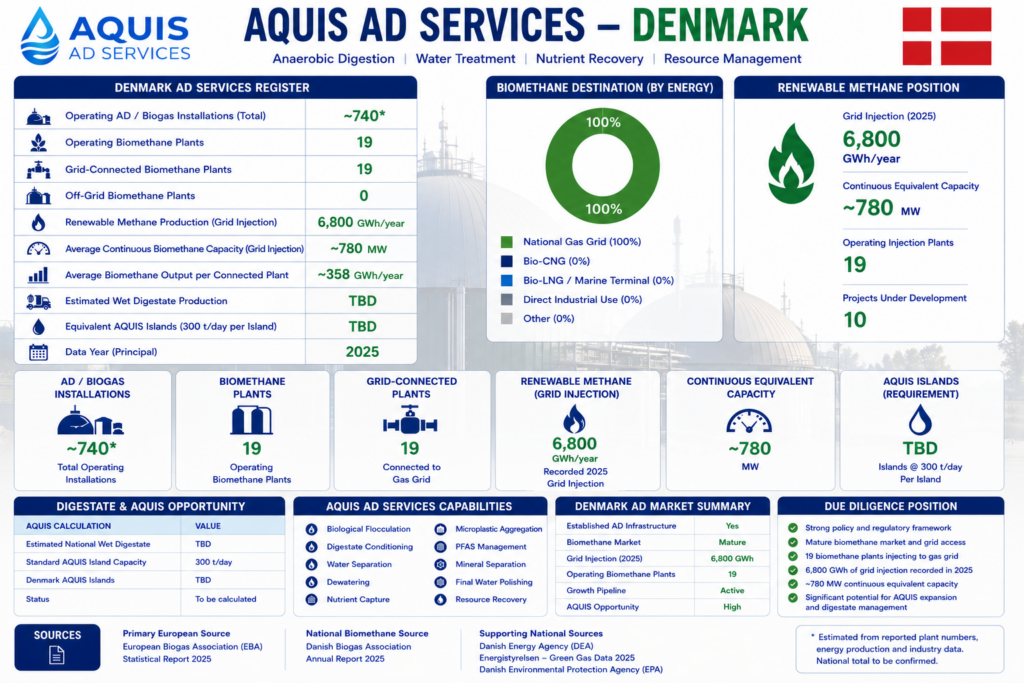
The Danish Energy Agency currently reports approximately 150 biogas plants. This is materially below the 250 installations recorded in the Syngas Project EU/ETS register. The difference is likely to reflect differing definitions, reference years and the inclusion or exclusion of small agricultural, wastewater, landfill and non-operational installations. Both figures should therefore remain visible until plant-level reconciliation is completed.
Using the current official figure, Denmark has approximately 25 operating plants per million people—around 20% of Germany’s 125.1 plants per million. Using the existing register, Denmark reaches 41.7 plants per million, equivalent to 33.3% of German density. In either case, Denmark is substantially more developed than many Central and Eastern European markets.
The Danish opportunity is consequently not based primarily on constructing basic AD capacity. It is a technology-upgrade, digestate-management, contaminant-control, gas-polishing and renewable-molecule opportunity.
A strict 10% market share based on the current official count represents approximately 15 clients: three AQUIS Services relationships and 12 AQUIS EPS clients. This supports approximately 0.71 of an AQUIS Island, or 17.8 MW of continuous LRNG methane opportunity. It does not independently justify a complete three-Island CAMPUS cluster. A Danish CAMPUS should therefore be conditioned on aggregated national contracts, marine or industrial fuel offtake, or integration with neighbouring Nordic markets.
Denmark AD Market Position
The Danish Energy Agency reports that:
- Denmark has approximately 150 operating biogas plants.
- Livestock manure is the principal input material.
- Approximately 80% of Danish biogas is now upgraded and injected into the gas grid.
- Biomethane supplied almost 40% of the Danish gas system in 2023.
- Danish gas consumption is expected to become 100% green by 2030.
This makes Denmark fundamentally different from markets dominated by electricity-only CHP plants. The principal Danish commercial route is already upgraded biomethane, supported by an established gas grid and increasingly sophisticated carbon-management infrastructure. Danish Energy Agency
The European Biogas Association recorded 58 Danish biomethane-producing installations in 2024, confirming that Denmark has one of Europe’s most developed upgrading markets. EBA Statistical Report 2025
Comparison with Germany
| Measure | Denmark—current basis | Denmark—register basis | Germany |
| Operating plants | ~150 | 250 | 10,455 |
| Population | ~6.0m | ~6.0m | 83.6m |
| Plants per million | ~25.0 | 41.7 | 125.1 |
| Relative plant density | ~20.0% | ~33.3% | 100% |
| Absolute plant count | ~1.4% | ~2.4% | 100% |
Denmark has a much smaller absolute market than Germany, but it has unusually high technical maturity. Danish operators are more likely to understand gas upgrading, digestate logistics, methane-loss control and carbon accounting. The sales proposition must therefore be based on measurable performance improvements rather than elementary AD education.
Gas Destinations
Grid injection
Grid injection is Denmark’s primary growth route. Approximately 80% of Danish biogas is upgraded before entering the gas system. AQUIS and CUMULUS should therefore be presented as complementary treatment platforms that improve feedstock control, digestate management, gas quality and contaminant assurance.
CHP, electricity and district heating
Older and smaller facilities continue to use biogas in engines, process heating and district-heating systems. This remains an AQUIS Services opportunity, particularly where existing plants require improvements in biological stability, filtration, water separation, hydrogen-sulphide management and methane-loss reduction.
However, Denmark’s market direction has moved decisively away from CHP-only development and towards upgraded renewable methane.
Industrial gas supply
Grid-injected biomethane can displace fossil natural gas in industrial heat and manufacturing. Industrial offtakers offer stronger contractual structures than merchant electricity alone and may support longer-term finance for AQUIS and CUMULUS installations.
Public and heavy transport
Compressed renewable natural gas can serve municipal vehicles, refuse fleets and heavy road transport. Denmark’s rapid electrification means Bio-CNG should be targeted where battery operation is difficult rather than presented as a universal road-transport solution.
LRNG and marine fuel
Denmark has a particularly strong strategic position for liquefied renewable natural gas because of its ports, shipping industry and proximity to Baltic and North Sea marine corridors.
The Hjørring liquefaction installation converts manure-derived biogas into Bio-LNG and has been reported as providing approximately 41,000 tonnes per year of avoided carbon emissions when replacing fossil natural gas. Hjørring Bio-LNG project
Maersk identifies liquefied biomethane as a viable transitional marine-fuel pathway, although sustainable supply and ultimate scalability remain important constraints. Maersk marine-fuel position
This creates a credible market for AQUIS take-off, methane conditioning, LRNG production and CUMULUS gas treatment.
Feedstock and Digestate Position
Danish biogas production is based predominantly on livestock manure, agricultural residues and controlled organic wastes. Danish technical studies estimate that agricultural residues and slurry account for approximately 75% of production.
Digestate is commonly returned directly to agricultural land as fertiliser. This recycles nitrogen, phosphorus, potassium and organic matter but also creates a significant assurance requirement. The commercial issue is not whether Danish digestate is automatically contaminated; it is whether each feedstock and digestate stream can demonstrate controlled quality.
The Danish Environmental Protection Agency’s 2025 screening detected few PFAS findings—and generally low concentrations—in samples from eight biogas plants. This is encouraging but does not establish that every Danish feedstock or digestate stream is PFAS-free. The report supports a risk-based testing programme rather than either complacency or an assumption of universal contamination. Danish PFAS fertiliser-products study
AQUIS should offer:
- Feedstock acceptance and contamination protocols.
- PFAS analytical testing.
- Microplastic and nanoplastic sampling programmes.
- Biological flocculation and particle aggregation.
- Digestate conditioning and water separation.
- Nutrient capture and mineral recovery.
- Dewatering and final-water polishing.
- Traceable management of concentrated residual material.
Key Installations and Operators
Nature Energy Korskro
Korskro processes approximately 710,000 tonnes of biomass annually, including livestock manure, bedding, food waste and industrial organic residues. Its initial reported biomethane production capacity was approximately 22 million Nm³ per year, injected into the gas network. Korskro project profile
Korskro demonstrates Denmark’s movement towards large, multi-source plants. Such facilities offer significant AQUIS service and treatment opportunities but require more extensive feedstock, plastics, PFAS and digestate-quality due diligence than a controlled single-source agricultural plant.
Nature Energy Holsted
Holsted is an established Danish reference installation processing approximately 400,000 tonnes of material annually and producing around 13 million m³ of upgraded biogas. It illustrates Denmark’s standard commercial model of large agricultural co-digestion followed by grid injection. Danish Energy Agency technology data
Hærup Biogas
Hærup produces approximately 40 GWh of biogas annually for local heat and process use. Gasum announced plans to add upgrading and grid connection, demonstrating the continuing conversion of Danish CHP-oriented assets into biomethane suppliers. Gasum acquisition report
AQUIS Commercial Opportunity
AQUIS Services
The initial service target is three current-market clients—or five clients if the 250-plant register is retained as the commercial baseline.
Services should concentrate on:
- Feedstock and process due diligence.
- Biological-performance optimisation.
- Digestate and separated-water characterisation.
- PFAS and microplastic testing programmes.
- Methane-loss and gas-quality review.
- Nutrient recovery studies.
- AQUIS Island feasibility and engineering.
AQUIS EPS
The initial equipment, process and service target is 12 current-market clients—or 20 clients under the register basis.
Priority EPS applications include:
- Biological flocculation equipment.
- Microplastic aggregation.
- Water and solids separation.
- Digestate dewatering.
- Nutrient and mineral capture.
- Final-water polishing.
- Replaceable CUMULUS gas filters.
- Gas-cleaning and contaminant-monitoring packages.
CUMULUS
The strict 10% calculation produces a requirement of approximately 0.71 CUMULUS systems on the current basis, or 1.18 systems using the register.
The practical entry programme is therefore one anchor CUMULUS installation, preferably associated with:
- A multi-source centralised plant.
- A plant adding biomethane upgrading.
- A Bio-LNG or marine-fuel project.
- A plant integrating biogenic CO₂ recovery.
- An operator requiring enhanced contaminant assurance.
AQUIS Island and CAMPUS
The strict current-market target represents approximately 0.71 of an AQUIS Island. One physical Island may still be commercially justified if it is anchored by sufficient contracted throughput.
A complete three-Island CAMPUS is not supported by the strict 10% calculation alone. It becomes credible if the facility also serves:
- A portfolio of Danish plants.
- Nordic cross-border clients.
- Marine-fuel production.
- Industrial renewable-gas customers.
- Centralised filter and residual-material treatment.
- Biogenic CO₂ conditioning and utilisation.
Market Expansion
Denmark’s AD expansion is expected to be driven less by the number of digesters and more by changes in the value obtained from existing gas and digestate:
- Continued conversion from CHP to grid-injected biomethane.
- Expansion of Bio-CNG and Bio-LNG for difficult-to-electrify transport.
- Marine renewable-fuel demand under European shipping regulations.
- Biogenic CO₂ capture, use and permanent storage.
- Methane-loss reduction.
- Improved nutrient recovery and digestate assurance.
- Greater scrutiny of PFAS, plastics and emerging contaminants.
- Consolidation of smaller plants into larger operating portfolios.
CUMULUS Gas-Treatment Opportunity
Danish technical guidance identifies hydrogen sulphide, methane leakage and odour as material operational issues. Raw gas produced predominantly from animal slurry may contain approximately 3,000–10,000 mg/m³ of hydrogen sulphide before treatment.
CUMULUS should be positioned as a controlled gas-treatment and replaceable-filter platform addressing:
- Hydrogen sulphide.
- Siloxanes where relevant.
- Volatile organic contaminants.
- Moisture and entrained aerosols.
- Methane-quality protection.
- Final polishing before upgrading or liquefaction.
- Controlled treatment and retirement of spent filter media.
Any claim concerning PFAS destruction must be supported by inlet, intermediate and outlet analytical testing. The due-diligence position should be “measured destruction and controlled residual management,” not an unverified universal destruction claim.
Principal Risks
| Risk | DD position |
| Plant-count discrepancy | Reconcile the 250-register figure against the current official figure of approximately 150 |
| Mature incumbent market | AQUIS must demonstrate measurable advantages over established Danish suppliers |
| Subsidy transition | The former fixed-support system is closed to new applicants; future capacity depends increasingly on tenders and commercial offtake |
| Feedstock competition | Secure long-term manure and organic-residue contracts before investment |
| Digestate contamination | Apply source-dependent PFAS, plastics, metals and pathogen testing |
| Methane leakage | Include quantified inlet-to-outlet methane accounting |
| Technology-performance risk | Require guarantees, monitoring and independently verifiable results |
| CAMPUS underutilisation | Do not construct a full cluster without aggregated throughput commitments |
| Bio-LNG competition | Confirm price, certification, liquefaction and transport economics |
| Regulatory change | Track Danish and EU fertiliser, PFAS, methane and renewable-fuel requirements |
Weighted Priority Assessment
| Assessment category | Score |
| Market maturity and operating capability | 0.95/1.00 |
| Accessible commercial scale | 0.75/1.00 |
| Feedstock and digestate opportunity | 0.95/1.00 |
| AQUIS and CUMULUS strategic fit | 0.95/1.00 |
| Policy, grid and fuel-offtake environment | 0.90/1.00 |
| Total priority | 4.50/5.00 |
Final Due-Diligence Decision
Market entry: Yes
Priority: High—4.5/5
Initial target: 15 current-basis clients
AQUIS Services: 3 clients
AQUIS EPS: 12 clients
Initial CUMULUS deployment: One anchor installation
Initial AQUIS take-off: Up to one Island, subject to contracted throughput
Standalone Danish CAMPUS: Not justified by the strict 10% calculation
Conditional CAMPUS: Yes, with aggregated Danish/Nordic clients or marine and industrial fuel offtake
Conclusion
Denmark is a high-priority AQUIS market because it has already completed much of the transition from small CHP-based digestion to large agricultural co-digestion and grid-injected biomethane.
The opportunity is not simply to add more digesters. It is to improve the environmental and commercial value of the existing system through digestate conditioning, contaminant assurance, nutrient recovery, water treatment, gas polishing, LRNG production and controlled management of spent filtration materials.
The recommended first step is one Danish anchor project combining AQUIS Services, AQUIS EPS and CUMULUS. A complete CAMPUS should follow only when sufficient plant throughput, marine-fuel demand or regional Nordic service contracts have been secured.