

Syngas Project Due Diligence — Slovakia
Assessment date: 27 July 2026
Syngas Project priority: 3.6 / 5 — Targeted regional-development market
AQUIS opportunity summary
| AQUIS opportunity | National market | Syngas Project target: 10% | Practical interpretation |
| Operating significant AD/biogas plants | ~100 | 10 clients | Confirm individually before commercial qualification |
| Population | 5.409 million | — | Official year-end 2025 population |
| Plants per million population | 18.5 | — | Moderate-low installed density |
| Capability versus Germany | 14.8% | — | Germany = 125.1 plants per million |
| Absolute plant base versus Germany | 0.96% | — | 100 versus 10,455 plants |
| AQUIS island equivalent | 4.74 islands | 0.47 island | Based on 21.1 plants per island |
| AQUIS clusters | 1.58 clusters | 0.16 cluster | One cluster comprises three islands |
| Standalone CAMPUS opportunities | Potentially 1 nationally | 0 initially at strict 10% | Regional coverage is preferable initially |
| Continuous LRNG methane opportunity | 118.5 MW | 11.8 MW | Alternative take-off route |
| 2G ethanol equivalent | 379,000 L/day | 37,900 L/day | Alternative to LRNG, not additional |
| AQUIS Services clients | — | 2 | Initial 20% planning allocation |
| AQUIS EPS clients | — | Up to 8 | Initial 80% planning allocation |
| CUMULUS gas-train requirement | 4.74 train-equivalents | 0.47 equivalent | First physical installation would be one train |
| Priority | — | 3.6 / 5 | Regional service and conversion opportunity |
Executive summary
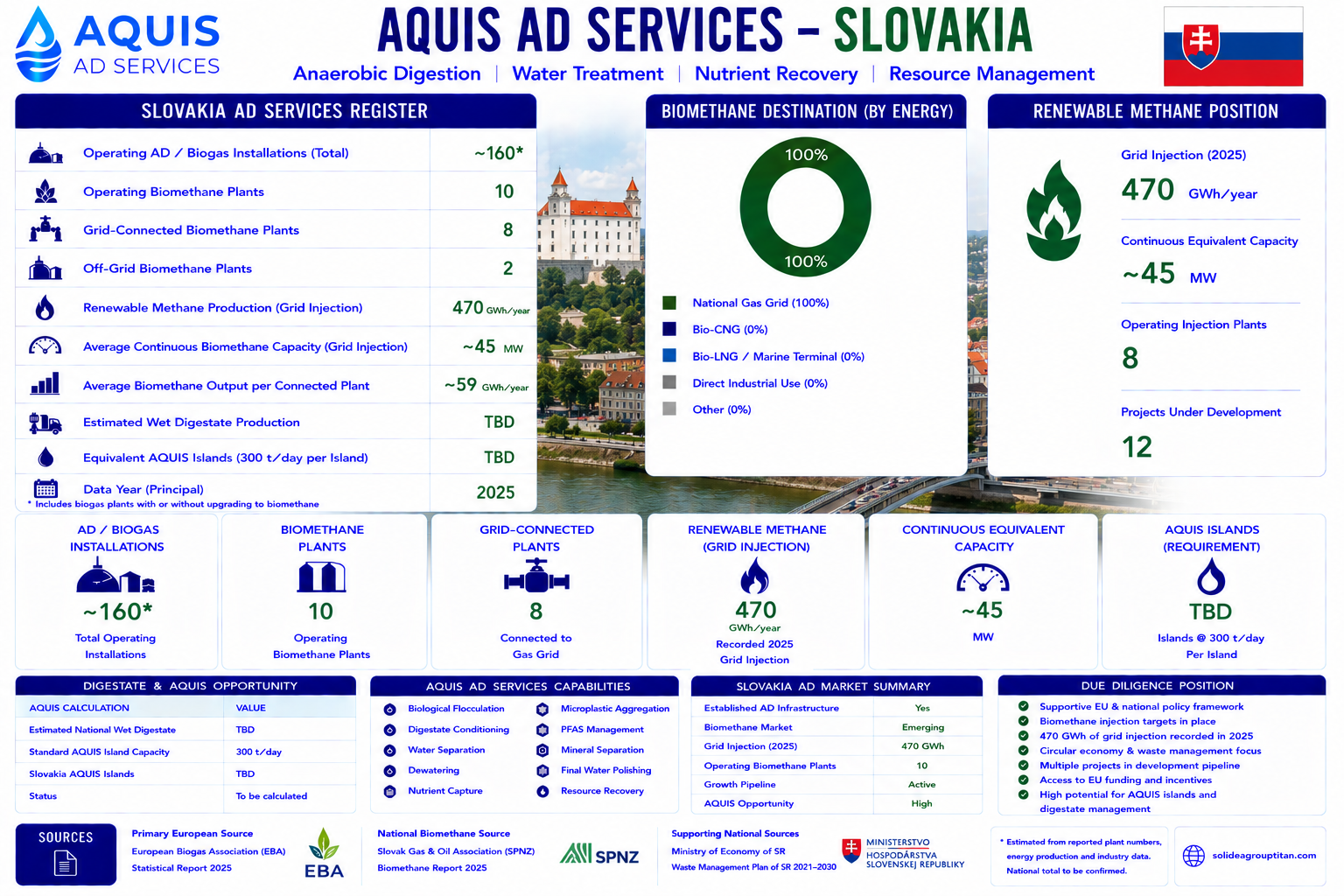
Slovakia is a comparatively small but increasingly active biogas-to-biomethane conversion market. Its updated national plan reports approximately 100 biogas stations, 103 MW of capacity and an electricity-production potential of 810 GWh/year. Most plants were developed around maize silage and CHP, and more than 70 are approximately 1 MW installations. Slovakia’s updated National Energy and Climate Plan
The market has only 14.8% of Germany’s plant density, demonstrating considerable theoretical headroom. However, Slovakia’s absolute plant population is less than 1% of Germany’s. It should therefore be treated as a specialised regional market, not as a standalone deployment programme comparable with Poland or Czechia.
At the 10% market-share objective, Syngas Project would target approximately:
- 10 AD operators;
- two direct AQUIS Services clients;
- up to eight AQUIS EPS clients;
- 0.47 AQUIS island equivalent;
- 11.8 MW of continuous LRNG capacity; or
- approximately 37,900 litres/day of equivalent 2G ethanol capacity.
This target does not yet justify one complete Slovak CAMPUS containing a three-island cluster. The better initial model is to serve Slovakia from a Czechia–Slovakia or Poland–Slovakia regional cluster while establishing one Slovak service, demonstration or take-off installation.
Market position against Germany
| Measure | Slovakia | Germany | Slovakia as percentage of Germany |
| Significant AD plants | ~100 | 10,455 | 0.96% |
| Population | 5.409m | 83.60m | 6.47% |
| Plants per million | 18.5 | 125.1 | 14.8% |
Slovakia therefore has roughly one AD plant per 54,100 residents, compared with approximately one per 8,000 residents in Germany.
This gap represents development potential, but it does not mean Slovakia will replicate Germany’s historical maize-fed CHP market. Growth is more likely to arise through:
- conversion of existing CHP plants to biomethane;
- food-industry and biodegradable-waste feedstocks;
- manure and agricultural-residue digestion;
- connection to the gas distribution network;
- digestate conditioning and contaminant management; and
- restructuring plants whose original electricity support is ending.
Market expansion and financing drivers
Slovakia’s original fleet was predominantly constructed to produce supported electricity and heat. Older support arrangements are reaching expiry, creating both distress risk and a conversion opportunity.
The strongest expansion evidence is the identified potential to convert approximately 34 existing biogas plants to biomethane. SPP–distribúcia also reports that almost 400 million Nm³/year of biomethane could ultimately be produced from biodegradable municipal waste, catering waste and livestock residues. Its network exceeds 33,000 km and distributes approximately 98% of Slovakia’s gas, providing an unusually strong physical route to market. SPP–distribúcia annual report, 2026 Slovak renewable-gas domain protocol
The key lender concern is that conversion funding does not automatically solve:
- substrate-contract risk;
- declining maize economics;
- digestate disposal;
- grid-connection timing;
- methane-loss performance;
- contaminant liabilities;
- plant availability; or
- biomethane offtake pricing.
AQUIS should consequently be positioned as an asset-performance and residual-liability platform, not merely as additional process equipment.
Gas-destination assessment
| Gas destination | Present position | AQUIS relevance |
| CHP electricity | Historically dominant | Repowering, gas cleaning and digestate services |
| Useful heat | Variable and site-specific | Require verified year-round heat customer |
| Grid biomethane | Rapidly emerging | Primary near-term opportunity |
| Public transport | Technically possible but limited evidence of established bio-CNG demand | Target municipal fleets selectively |
| Road freight | Developing opportunity | CRNG/LRNG for captive logistics fleets |
| Marine fuel | Very limited domestic case | Slovakia is landlocked; Danube applications would be niche |
| Industrial gas | Strong potential | Grid delivery or direct industrial offtake |
| 2G ethanol | Syngas Project alternative | Consider where gas-grid economics are weak |
CHP remains relevant, but it should not be assumed that every megawatt of installed capacity has a bankable heat customer. For lender assessment, electricity output, useful heat sales and parasitic consumption must be separated.
Grid injection
Grid injection is now the strongest growth segment. Slovakia had one operating biomethane facility when the IEA completed its 2024 review, but the market subsequently accelerated. IEA Slovakia Energy Policy Review
By April 2026, a fourth biomethane station had been connected to the national grid. The Ožďany installation alone added almost 4 million Nm³/year of renewable-gas capacity. Slovakia’s fourth grid-connected biomethane station
Public transport and freight
Slovakia has gas infrastructure capable of supporting CRNG and LRNG, but a significant domestic biomethane transport market has not yet been demonstrated.
The initial transport proposition should therefore concentrate on:
- captive municipal vehicle fleets;
- refuse-collection vehicles;
- food and agricultural logistics;
- heavy vehicles operating fixed routes;
- depot-based CRNG supply; and
- LRNG for regional freight corridors.
Transport volumes should not be included in lender-base projections until fleet commitments, station access and fuel pricing are documented.
Marine fuel
Slovakia has no seagoing marine market. Potential applications are limited to the Danube and inland vessels. Marine LRNG should consequently be classified as optional upside, not a base-case offtake.
Key installations
| Installation | Reported position | Due-diligence significance |
| Jelšava | Slovakia’s first biomethane plant injecting into the distribution network | Reference for permitting, gas quality and grid interface |
| Bierovce | 449 Nm³/h biomethane upgrading facility; injecting since 2025 | Established conversion reference |
| Horovce | 3 MW electrical capacity; 1,553 Nm³/h raw biogas; up to 57 GWh/year biomethane | Major food-industry-waste and grid-injection reference |
| Ožďany | Fourth grid-connected Slovak facility; nearly 4 million Nm³/year | Evidence of accelerating rollout |
| Existing CHP fleet | Approximately 100 plants and 103 MW | Principal AQUIS EPS and conversion prospect pool |
Bierovce’s EnviThan installation is rated at 449 Nm³/h biomethane. EnviTec Bierovce commissioning
Horovce is now reported as the largest biomethane installation in Slovakia and Czechia, with annual potential of up to 57,000 MWh and a high-pressure pipeline connection approximately 650 metres from the plant. AB Group Horovce project
These projects show that the Slovak opportunity is moving from theoretical conversion studies into operating grid-injection assets.
AQUIS commercial opportunity
AQUIS Services
The strongest service opportunities are:
- biological flocculation;
- digestate conditioning;
- solid–liquid separation;
- dewatering;
- nutrient recovery;
- final-water polishing;
- microplastic aggregation;
- PFAS sampling and management;
- gas-quality assurance;
- filter-media management; and
- preparation of residual solids for controlled recovery.
The initial two direct service clients should preferably include:
- one grid-injection biomethane plant; and
- one wastewater, food-industry or multi-source AD installation.
This provides two contrasting feedstock and contaminant profiles.
AQUIS EPS
The eight initial EPS prospects should be prioritised among:
- plants losing historic electricity support;
- sites unable to demonstrate profitable heat use;
- operators evaluating biomethane conversion;
- food-industry plants with gate-fee and contamination exposure;
- multi-source digesters;
- sites with constrained digestate outlets; and
- plants close to suitable gas-grid connection points.
AQUIS take-off
At strict 10% market penetration, Slovakia generates only 0.47 island equivalent. A full three-island cluster would represent:
- 75 MW continuous LRNG capacity; or
- 240,000 litres/day of 2G ethanol equivalent; and
- approximately 63 significant-plant equivalents under the planning model.
This materially exceeds the present 10-client target. The recommended entry sequence is therefore:
- regional AQUIS Services and EPS coverage;
- one Slovak demonstration or anchor installation;
- contracted aggregation of feedstock, digestate or filtered residuals;
- confirmation of sufficient take-off volume; and
- only then a Slovak CAMPUS investment decision.
Digestate and contaminant position
A reliable, consolidated national figure for current Slovak wet digestate production was not located. It should remain marked NR — not reliably reported, rather than inferred from electrical capacity.
The existing fleet’s reliance on maize silage suggests a relatively predictable agricultural digestate at many sites. However, the market is moving toward food waste, biodegradable municipal waste, catering waste, manure and wastewater streams. That transition increases the potential variability of:
- plastics and packaging fragments;
- microplastics and nanoplastics;
- PFAS;
- heavy metals;
- pharmaceutical residues;
- cleaning chemicals;
- persistent organic contaminants;
- pathogens; and
- excess nitrogen and phosphorus.
No adequate national dataset was identified that proves Slovak digestate is free from PFAS or micro/nanoplastics. Absence of reported contamination must therefore not be interpreted as evidence of absence.
For lender-grade projects, the minimum evidence package should include:
- separately characterised feedstock streams;
- PFAS testing with declared analyte list and detection limits;
- microplastic sampling and polymer identification;
- metals and organic-contaminant analysis;
- digestate mass balance;
- landbank capacity and nutrient-loading assessment;
- contracts for separated solids and reject water;
- analysis of spent filters; and
- defined routes for material that fails agricultural specifications.
CUMULUS opportunity
CUMULUS should be offered where contaminants or residual compounds can transfer into the gas-cleaning train, especially at multi-source and industrial-food-waste installations.
At the 10% market target, the mathematical requirement is 0.47 gas-train equivalent. Because equipment cannot be installed fractionally, the initial commercial proposition is:
- one first CUMULUS train attached to an anchor biomethane or AQUIS take-off project;
- mobile or contract testing across the remaining target sites; and
- three CUMULUS trains only when a complete three-island cluster is contracted.
PFAS destruction must not be claimed solely from temperature or plasma exposure. The performance case should be supported by inlet/outlet mass balance, destruction and removal efficiency, short-chain transformation analysis, fluorine accounting and analysis of ash, condensate and spent filtration media.
Priority assessment
| Factor | Score / 5 | Assessment |
| Installed AD market | 3.0 | Around 100 plants and 103 MW |
| Market density | 2.0 | Only 14.8% of German plant intensity |
| Biomethane conversion momentum | 4.5 | Four grid connections and 34 identified candidates |
| Gas-grid suitability | 4.5 | Extensive distribution network and renewable-gas registry |
| AQUIS Services requirement | 3.8 | Ageing CHP fleet and changing feedstocks |
| CAMPUS scale at 10% | 2.0 | Insufficient for a standalone three-island cluster |
| Regional strategic fit | 4.5 | Strong fit with Czechia and Poland coverage |
| Data and contracting maturity | 3.0 | Plant-level qualification still required |
| Overall priority | 3.6 / 5 | Targeted regional-development market |
Principal lender risks
| Risk | Position | Required mitigation |
| Support-expiry risk | Material | Model post-support revenue before financing |
| Maize-silage dependency | Material | Transition plan toward residues and wastes |
| Feedstock competition | Medium | Audited supply contracts and catchment analysis |
| Grid connection | Site-specific | Binding connection study and cost allocation |
| Biomethane price | Material | Floor price or creditworthy offtake contract |
| Digestate landbank | Material | Nutrient balance and contracted outlets |
| PFAS/MNP liability | Unquantified | Baseline testing and residual-material controls |
| Heat utilisation | Frequently uncertain | Count only metered, contractually sold heat |
| Technology performance | Medium | Availability guarantees and methane-loss testing |
| CAMPUS over-sizing | High at 10% target | Begin with regional coverage and an anchor project |
Syngas Project decision
| Decision item | Recommendation |
| Enter Slovak market | Yes—selectively |
| Build an immediate standalone CAMPUS | No |
| Establish regional coverage | Yes—combine with Czechia/Poland |
| Initial commercial target | 10 AD clients |
| AQUIS Services target | 2 clients |
| AQUIS EPS target | Up to 8 clients |
| Initial CUMULUS deployment | One anchor installation |
| Preferred sector | Existing CHP-to-biomethane conversions |
| Secondary sector | Food-industry, wastewater and multi-source AD |
| Priority | 3.6 / 5 |
Conclusion: Slovakia is not large enough to warrant an immediate standalone three-island AQUIS cluster at the 10% target. Its value lies in the accelerating conversion of an established CHP fleet, excellent gas-grid access, approximately 34 biomethane-conversion candidates and close integration with the Czech and Polish markets. The correct strategy is a regional service-and-EPS entry, followed by a Slovak anchor take-off project once contracted volumes justify physical island deployment.