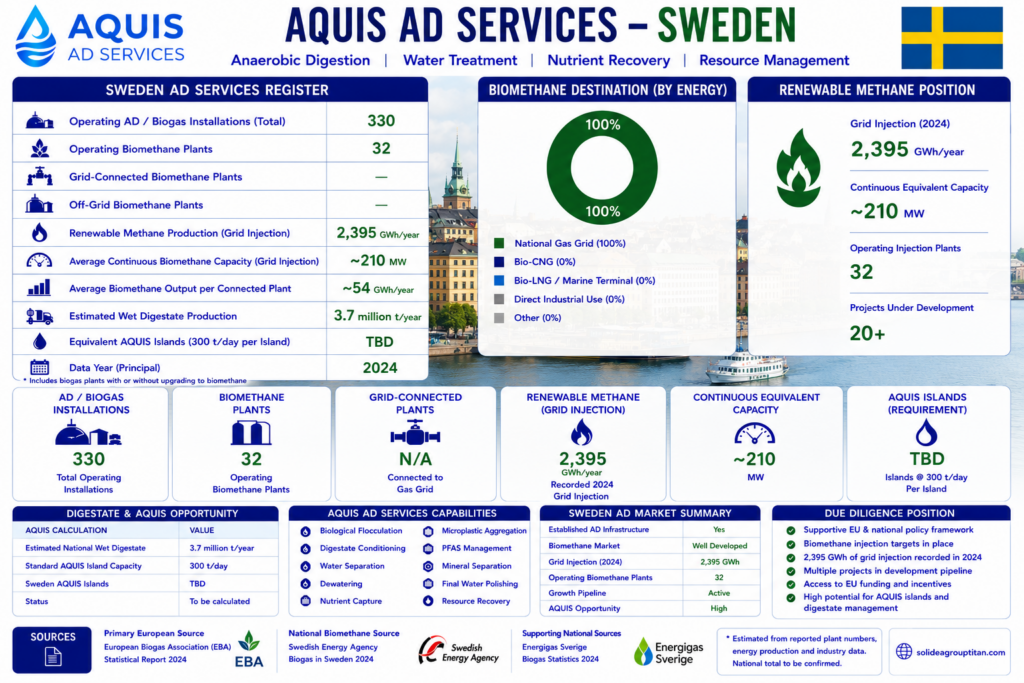
Sweden is a stronger and larger AQUIS opportunity than Denmark. Before publishing the DD, the existing infographic needs three corrections:
| Existing infographic | Correct 2024 figure |
| Biomethane plants: 6 | 71 upgrading units |
| Grid-connected plants: 4 | Replace with approximately 550 GWh/year grid injection |
| Grid injection: 253 GWh/year | 253 GWh/year LBG production from six liquefaction plant |
Sweden Anaerobic Digestion Market Due Diligence
Syngas Project — AQUIS, CUMULUS and CAMPUS Commercial Review
Assessment date: July 2026
Syngas Project Priority: 4.7/5 — High Priority
AQUIS Sweden Opportunity
| Opportunity measure | National market | 10% AQUIS target | Calculation and interpretation |
| Current operating AD/biogas plants | 330 | 33 clients | Swedish 2024 national statistics |
| Previous EU/ETS register baseline | 300 | 30 clients | Replace with the current 330 figure |
| Population | 10.59 million | — | Syngas Project planning population |
| Plants per million people | 31.2 | — | 330 ÷ 10.59 million |
| German reference density | 125.1 | — | Syngas Project European benchmark |
| Swedish density relative to Germany | 24.9% | — | 31.2 ÷ 125.1 |
| Absolute scale relative to Germany | 3.2% | — | 330 ÷ 10,455 |
| Plant-based AQUIS Islands | 15.64 | 1.56 Islands | 21.1 plants per planning Island |
| Plant-based Island clusters | 5.21 | 0.52 cluster | Three Islands per cluster |
| Estimated national wet digestate | ~3.7m tonnes/year | ~370,000 t/year | Existing Sweden planning estimate |
| Throughput-based AQUIS Islands | ~33.8 | ~3.38 Islands | 109,500 tonnes/year per Island |
| Throughput-based Island clusters | ~11.3 | ~1.13 clusters | Indicates one complete 10% cluster |
| LRNG opportunity—plant basis | ~391 MW | ~39.1 MW | 25 MW continuous per Island |
| LRNG opportunity—digestate basis | ~845 MW | ~84.5 MW | Subject to verification of treatable throughput |
| Ethanol equivalent—plant basis | ~1.25m L/day | ~125,000 L/day | Alternative use of Island capacity |
| Ethanol equivalent—digestate basis | ~2.70m L/day | ~270,000 L/day | Alternative, not additional to LRNG |
| AQUIS Services clients | — | 7 | Approximately 20% of the 33-client target |
| AQUIS EPS clients | — | 26 | Approximately 80% of the 33-client target |
| CUMULUS target | 15.64 national | 1.56 systems | Practical opening programme: two systems |
| CAMPUS opportunity | 3–4 national | 1 initial opportunity | One cluster per participating CAMPUS |
Executive Summary
Sweden is a mature and expanding renewable-gas market with 330 operating biogas installations. National production reached approximately 2.395 TWh in 2024, an increase of 6% from 2023.
Sweden has approximately 31.2 AD plants per million people. This is 24.9% of Germany’s reference density of 125.1 plants per million. Sweden therefore remains well below German plant density but has already developed an advanced biomethane, transport-gas and liquefied-biogas market.
The strongest Swedish AQUIS opportunity is not basic digester construction. It is the treatment of digestate, filtrate and process water generated by:
- Municipal wastewater-treatment plants.
- Food-waste co-digestion plants.
- Agricultural and manure-based installations.
- Industrial and slaughterhouse-waste plants.
- New large-scale liquefied-biogas facilities.
A strict 10% share represents 33 clients, divided for planning purposes into seven AQUIS Services clients and 26 AQUIS EPS clients.
The plant-count calculation supports approximately 1.56 AQUIS Islands. However, the estimated 3.7 million tonnes of national wet digestate would require approximately 33.8 Islands if all material were treated. A 10% digestate share therefore represents approximately 3.38 Islands—enough to support one complete three-Island AQUIS cluster and one Swedish CAMPUS opportunity.
The digestate-throughput figure must be confirmed before investment, but it demonstrates that plant count alone may substantially understate the Swedish market.
Sweden AD Market Register
| Market measure | 2024 position |
| Operating biogas plants | 330 |
| Total domestic biogas and biomethane production | 2,395 GWh/year |
| Production growth, 2023–2024 | 6% |
| Biomethane-upgrading units | 71 |
| Biomethane production | ~1,600 GWh/year |
| Share of biogas upgraded | 68% |
| Biomethane injected into gas networks | ~550 GWh/year |
| Liquefied-biogas plants | 6 |
| LBG production | 253 GWh/year |
| LBG production growth | 41% |
| Total Swedish biogas use, including net imports | ~4,100 GWh/year |
| Wastewater-treatment plants producing biogas | 131 |
| Co-digestion plants | 32 |
| Estimated wet digestate | ~3.7m tonnes/year—planning estimate |
Sweden produced approximately 2.4 TWh of biogas and biomethane in 2024 but consumed approximately 4.1 TWh after imports. This indicates a supply gap of around 1.7 TWh between domestic production and total use.
Approximately 68% of Swedish biogas was upgraded to biomethane. More than 90% of this upgraded gas was used in transport. Sweden is therefore one of Europe’s most established transport-oriented biomethane markets. Swedish Gas Association market review
Comparison with Germany
| Measure | Sweden | Germany | Swedish position |
| Operating AD plants | 330 | 10,455 | 3.2% |
| Population | 10.59m | 83.6m | 12.7% |
| Plants per million people | 31.2 | 125.1 | 24.9% |
| Plant-based AQUIS Islands | 15.64 | ~495.5 | 3.2% |
| 10% target clients | 33 | — | Commercial planning target |
Sweden has approximately one-quarter of German AD density. This indicates further theoretical expansion capacity, but the Swedish market should not be treated simply as an underdeveloped version of Germany.
Sweden has limited national gas-pipeline coverage and has developed a different commercial model based on local use, transported compressed biomethane and increasingly liquefied biogas. AQUIS and CUMULUS must therefore support both fixed grid-connected plants and distributed gas logistics.
Market Structure and Feedstocks
Sweden’s 330 plants include a large number of relatively small farm and wastewater installations. Production is more concentrated than the plant count suggests:
- Thirty-two co-digestion plants produce approximately 52% of national biogas.
- Some 131 wastewater-treatment plants produce approximately 30%.
- The remaining production comes from farm digesters, industrial installations, landfill-gas facilities and other plants.
Principal feedstocks include:
| Feedstock | AQUIS relevance |
| Sewage sludge | PFAS, microplastics, pharmaceuticals, metals and siloxanes |
| Source-separated food waste | Packaging fragments, plastics, glass and mixed contaminants |
| Manure | Nutrient concentration, pathogens, fibres and veterinary residues |
| Food-industry residues | Variable chemistry, cleaning chemicals, fats and salts |
| Slaughterhouse residues | Pathogens, fats, high organic loading and nitrogen |
| Agricultural residues | Fibres, soil, mineral matter and pesticide residues |
The large wastewater and co-digestion contribution makes Sweden particularly suitable for AQUIS. These installations collect material from many sources and therefore require stronger feedstock acceptance, testing and traceability than controlled single-source farm plants.
Gas Destinations
Transport fuel
Transport is the established Swedish biomethane market. More than 90% of upgraded Swedish biomethane is used in transport.
Compressed biomethane can supply buses, refuse-collection vehicles, municipal fleets and regional heavy transport. However, battery electrification is reducing the long-term opportunity in some urban bus and passenger-vehicle applications.
The strongest continuing Bio-CNG opportunity is likely to remain in heavy vehicles, municipal service fleets and applications where charging time, vehicle weight or operating range constrain electrification.
Liquefied renewable natural gas
Sweden is rapidly expanding liquefied-biogas production. Six plants produced 253 GWh in 2024, 41% more than in 2023.
LBG is particularly relevant for:
- Long-distance road freight.
- Marine fuel.
- Industrial heat.
- Remote customers outside the gas-grid area.
- Cross-border Nordic renewable-gas supply.
This is a strong fit for the Syngas Project LRNG model because Sweden already understands liquefaction, tanker distribution and transport-fuel certification.
Grid injection
Approximately 550 GWh of Swedish biomethane was injected into the south-western gas grid and Stockholm’s regional gas network in 2024.
Grid injection remains valuable but is geographically constrained. AQUIS planning cannot assume that every Swedish installation can obtain an economic gas-grid connection.
CHP, electricity and heat
Smaller farms, wastewater plants and installations distant from gas infrastructure continue to use biogas for local electricity and heat. These sites offer service, filtration, gas-cleaning and process-improvement opportunities but may not justify a complete AQUIS Island individually.
Marine fuel
Sweden’s Baltic and North Sea access creates a strategic marine-fuel market. LBG can be transported to ports without relying on a national pipeline network.
CUMULUS gas conditioning, AQUIS take-off and LRNG production should therefore be presented as an integrated route for supplying certified renewable marine fuel.
Key Installations and Expansion Pipeline
Gasum Götene
Gasum opened its Götene plant in 2025. The installation:
| Measure | Götene position |
| Investment | Approximately €58 million |
| Feedstock | Manure and agricultural residues |
| Annual feedstock intake | Approximately 400,000 tonnes |
| LBG production | 120 GWh/year |
| Principal markets | Heavy transport and industry |
| Digestate outcome | Recycled fertiliser returned to farms |
Götene is one of Sweden’s largest liquefied-biogas facilities and demonstrates the movement towards large agricultural plants serving transport and industrial markets. Gasum Götene project
Gasum Borlänge
The Borlänge project is designed to process approximately 270,000 tonnes per year of manure and source-separated household organic waste.
| Measure | Borlänge position |
| Investment | More than €62 million |
| Planned LBG production | 133 GWh/year |
| Feedstock intake | ~270,000 tonnes/year |
| Recycled fertiliser | ~250,000 tonnes/year |
| Planned production | From 2026 |
Borlänge is especially relevant to AQUIS because it combines agricultural material with household organic waste. This increases the requirement for plastics control, feedstock inspection, digestate testing and water treatment.
Digestate and AQUIS Opportunity
The existing Sweden country sheet estimates approximately 3.7 million tonnes per year of wet digestate.
At the standard AQUIS Island capacity of 300 tonnes per day:
3{,}700{,}000 \div 109{,}500 = 33.8\ AQUIS\ Islands
A 10% share equals:
370{,}000 \div 109{,}500 = 3.38\ AQUIS\ Islands
This produces two different commercial views:
| Calculation method | National Islands | 10% target | Commercial interpretation |
| Plant-count screening | 15.64 | 1.56 | Consistent with the European register |
| Digestate-throughput screening | 33.8 | 3.38 | Supports one complete three-Island cluster |
| Recommended DD position | Verify both | One cluster opportunity | Investment based on contracted tonnes |
The plant-count calculation should remain on the European comparison table. The digestate-throughput calculation should control the physical design and investment decision once plant-level tonnage has been verified.
AQUIS Services Opportunity
The initial target is seven AQUIS Services relationships.
Priority services are:
- Plant and feedstock due diligence.
- Digestate sampling and characterisation.
- PFAS analytical testing.
- Microplastic and nanoplastic testing.
- Process-water review.
- Biological flocculation trials.
- Nutrient-recovery studies.
- Dewatering and water-reuse engineering.
- AQUIS Island feasibility.
- Spent-filter collection and traceability.
Sweden’s large geography favours a service network with central laboratories, regional collection and parcel-based filter exchange for smaller installations.
AQUIS EPS Opportunity
The initial EPS target is 26 clients.
Priority equipment and biological service packages include:
- AQUIS EXTRACT for nutrient, mineral and phosphorus recovery.
- AQUIS FLOCC for microplastic and nanoplastic aggregation.
- AQUIS GUARD for process conditioning and siloxane control.
- AQUIS PFAS for capture support and controlled concentration.
- AQUIS POLISH for ammonia, nitrate and phosphate removal.
- AQUIS filter cartridges.
- Digestate dewatering.
- Separated-water polishing.
- Gas-cleaning filter packages.
- Controlled residual-material management.
PFAS and Microplastic Position
Sweden has extensive experience with PFAS contamination and has identified PFAS risks in drinking water, groundwater and sewage-treatment systems.
Sewage sludge, household organic waste and mixed industrial residues require particular attention because they can contain:
- PFAS and PFAS precursors.
- Microplastics and nanoplastics.
- Pharmaceuticals.
- Personal-care chemicals.
- Heavy metals.
- Siloxanes.
- Glass and packaging fragments.
- Pathogens and antimicrobial-resistant organisms.
The 131 wastewater-treatment plants and 32 high-output co-digestion plants should be prioritised for testing.
AQUIS should not state that all Swedish digestate is contaminated. The correct position is that contamination depends on feedstock origin, and that multi-source and sewage-sludge installations require stronger analytical assurance before digestate is returned to land.
CUMULUS Opportunity
The plant-based 10% calculation supports approximately 1.56 CUMULUS systems. The practical opening programme is therefore two anchor installations.
The strongest candidates are:
- A major co-digestion plant producing LBG.
- A wastewater or mixed-source plant requiring advanced siloxane, PFAS and volatile-contaminant control.
CUMULUS applications include:
- Hydrogen-sulphide removal.
- Siloxane capture.
- Moisture and aerosol removal.
- Volatile-organic-compound control.
- Final gas polishing.
- Protection of upgrading and liquefaction equipment.
- Treatment of gas from spent-filter gasification.
- Controlled capture and retirement of contaminants.
Performance claims must be supported by inlet, intermediate and outlet testing.
CAMPUS Opportunity
Sweden’s plant-count calculation provides only 0.52 of a three-Island cluster at a 10% market share.
The digestate-throughput calculation produces 3.38 Islands—equivalent to 1.13 complete clusters. On this stronger physical basis, Sweden supports one initial CAMPUS opportunity.
The preferred CAMPUS structure would combine:
| CAMPUS component | Swedish role |
| AQUIS | Digestate, filtrate, water and contaminant treatment |
| CUMULUS | Gas cleaning, conditioning and filter management |
| IGNIS | Final treatment of conditioned agricultural and digestate solids |
| TITAN | Swedish forest-residue and renewable-carbon opportunity |
| STRATA | Recovered minerals, ash and misplaced-solids management |
| BRAD | Plant, feedstock, filter and extinction-register data |
The first cluster should be located only after mapping contracted digestate tonnes, transport distances, LBG production and port or industrial offtake.
Market Expansion
Swedish growth is expected in:
- Large manure-based digestion plants.
- Liquefied-biogas production.
- Heavy-road transport.
- Marine renewable fuels.
- Industrial renewable-gas supply.
- Food-waste and wastewater co-digestion.
- Digestate quality assurance.
- Nutrient and phosphorus recovery.
- Methane-emission reduction.
- PFAS and microplastic control.
Sweden’s 2026 support programme provides funding for manure-based biogas and biomethane upgrading. This strengthens the new-build pipeline but also increases the need for careful project selection, sustainability certification and feedstock verification.
Principal Risks
| Risk | Due-diligence position |
| Incorrect infographic categories | Correct six LBG plants, 71 upgrading units and 550 GWh grid injection |
| Limited gas-grid geography | Evaluate trucked CNG and LBG rather than assuming grid access |
| Small dispersed plants | Use services and filter exchange rather than full on-site infrastructure |
| Mixed feedstocks | Require source control and contaminant testing |
| Digestate estimate uncertainty | Verify the 3.7m-tonne figure plant by plant |
| Transport-market electrification | Focus on heavy transport, marine and industrial customers |
| Imported biomethane competition | Secure local low-carbon value and long-term offtake |
| Feedstock transport distances | Map collection radius before selecting cluster location |
| PFAS and microplastics | Test individual streams; do not rely on generic classifications |
| CAMPUS underutilisation | Require contracted throughput before investment |
| Technology incumbents | Demonstrate measurable treatment and lifecycle advantages |
| Policy dependency | Model projects with and without continuing production support |
Weighted Priority Assessment
| Assessment category | Score |
| Market maturity | 0.95/1.00 |
| Accessible commercial scale | 0.90/1.00 |
| Digestate and feedstock opportunity | 1.00/1.00 |
| AQUIS and CUMULUS strategic fit | 0.95/1.00 |
| Policy and offtake environment | 0.90/1.00 |
| Total priority | 4.70/5.00 |
Final Due-Diligence Decision
| Decision measure | Sweden position |
| Market entry | Yes |
| Priority | High—4.7/5 |
| Current market baseline | 330 operating plants |
| 10% client target | 33 |
| AQUIS Services target | 7 |
| AQUIS EPS target | 26 |
| Initial CUMULUS target | 2 anchor systems |
| Initial AQUIS take-off | 1–2 Islands on plant-count basis |
| Throughput-supported take-off | 3.38 Islands |
| Complete AQUIS cluster | Yes, subject to digestate verification |
| CAMPUS opportunity | One initial Swedish CAMPUS |
| Primary gas opportunity | LBG/LRNG for heavy transport, marine and industry |
| Secondary gas opportunity | Local grid injection and Bio-CNG |
| Principal environmental opportunity | Mixed-source digestate, sewage sludge, PFAS and plastics assurance |
Conclusion
Sweden is a high-priority AQUIS market with a mature biogas industry, an active LBG expansion programme and a substantial supply gap between domestic renewable-gas production and national consumption.
Its 330 plants represent approximately 31.2 installations per million people—24.9% of German density. This indicates room for expansion while providing a sufficiently mature installed base for AQUIS Services, EPS and CUMULUS.
The plant-count screening supports 1.56 AQUIS Islands at a 10% share. The estimated digestate throughput supports 3.38 Islands and therefore one complete cluster. The recommended commercial position is one Swedish AQUIS cluster integrated into one CAMPUS, subject to confirmation of the 3.7 million-tonne national digestate estimate and contracted access to at least 370,000 tonnes per year.
Sweden’s strongest opportunity is the combination of digestate treatment, contaminant assurance, nutrient recovery, LBG production and marine or heavy-transport offtake.