

BULGARIA 🇧🇬
★★★★★
TITAN Forest Residue Opportunity — Country Due Diligence
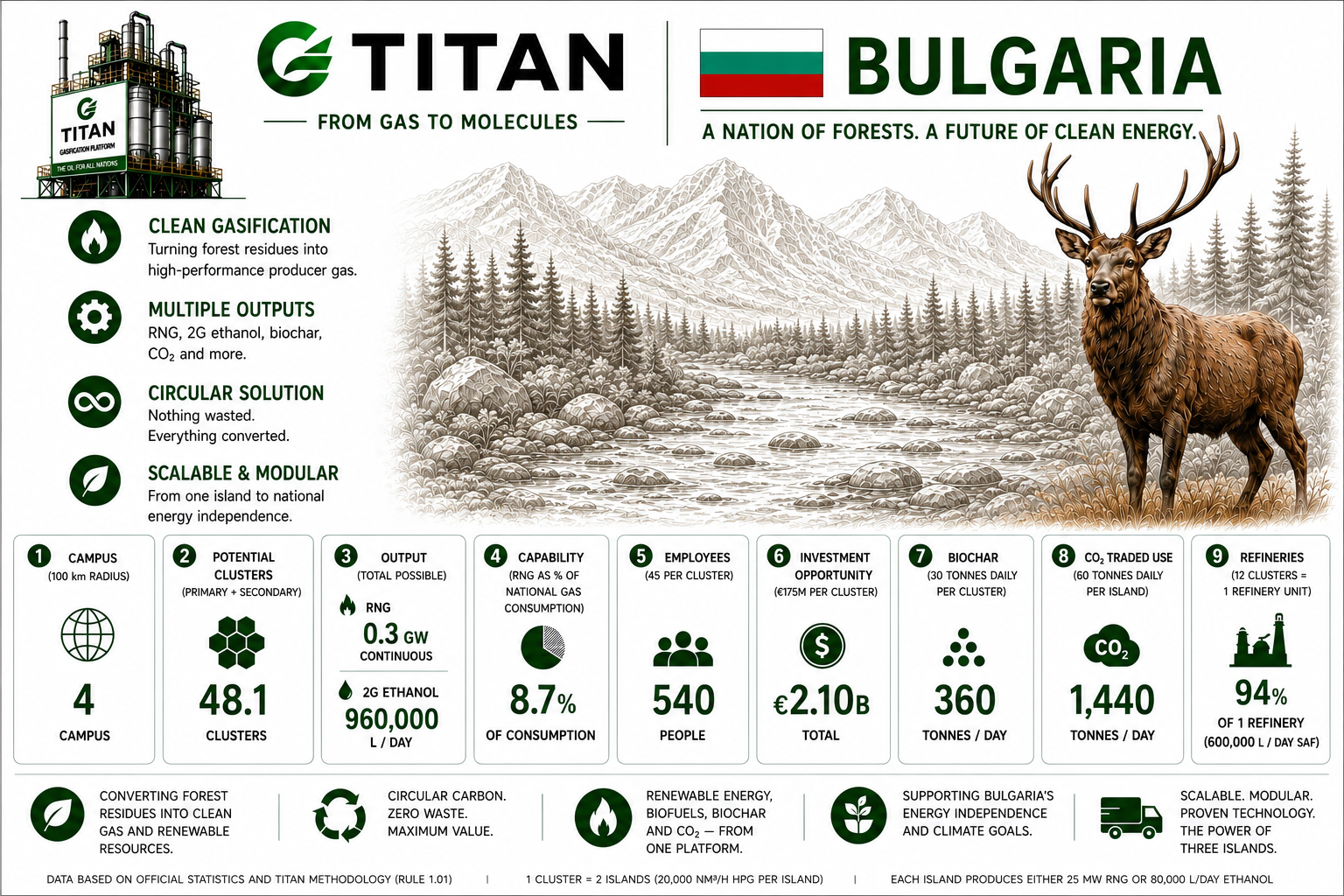
Bulgaria has a land area of 110,996 km² and is a 4-CAMPUS country under the TITAN 100 km planning model. Bulgaria is mountainous through significant parts of the country, but its forest resource is extensive and distributed sufficiently widely for all four CAMPUS to be relevant to TITAN when development sites are positioned on accessible plains, valleys and established transport corridors. Bulgaria’s primary forest resource supports 26.4 TITAN clusters before any secondary wood resources are included.
| BULGARIA — INSTANT REVIEW | Resource | TITAN Clusters | Assessment |
| Public Forest | 88.9% of forest | 23.5 | Exceptional |
| Private Forest | 11.1% of forest | 2.9 | Additional supply |
| Primary Forest Residue | 3.921 million ha | 26.4 | Exceptional |
| Sawmill Residue | 1.322 Mt/year | 8.8 | Major secondary market |
| Wood Manufacturing Residue | 0.617 Mt/year | 4.1 | Strong industrial market |
| Park & Avenue | 0.441 Mt/year | 2.9 | Distributed resource |
| Reclaimed Wood | 0.881 Mt/year | 5.9 | Strong circular resource |
| Secondary Resource | 3.260 Mt/year | 21.7 | Very strong |
| Total Identified Opportunity | 7.220 Mt/year | 48.1 | ★★★★★ |
1. Country & CAMPUS Geography
Bulgaria covers 110,996 km², equivalent to 4 TITAN CAMPUS under the 100 km radius planning model.
The country’s geography consists of the Danubian Plain in the north, the Balkan Mountains crossing the centre, the Sofia Basin in the west, the Upper Thracian Plain in the south and the Rila-Rhodope mountain systems in the southwest and south.
The mountains do not make the CAMPUS unusable. They determine where the processing infrastructure should be located.
TITAN CAMPUS should therefore be positioned on accessible plains, valleys and major road and rail corridors, allowing forest residues from the surrounding upland and mountain forestry areas to move toward central processing locations.
Bulgaria: 4 CAMPUS | 4 TITAN-relevant CAMPUS
This gives Bulgaria the geographic capacity for a genuine national TITAN programme.
2. Primary Forest Opportunity
Bulgaria has 3.921 million ha of forested land.
This forest base supports:
26.4 TITAN clusters
The ownership structure is particularly favourable to a coordinated national programme.
| Forest Ownership | Share | TITAN Clusters |
| Public Forest | 88.9% | 23.5 |
| Private Forest | 11.1% | 2.9 |
| Total | 100% | 26.4 |
The most important number is therefore 23.5 clusters from public forest.
This creates a strong institutional route to market. TITAN can establish its primary supply position through the state and municipal forestry system rather than depending initially upon aggregation of fragmented private holdings.
Private forest then provides additional supply and contingency capacity.
The forest floor remains the preferred TITAN supply position because it represents the largest primary resource and the lowest point in the wood value chain before competition increases downstream.
3. Sawmill Residues
Bulgaria has a substantial timber-processing industry supplied by its domestic forest economy.
The sawmill residue market provides:
1.322 million tonnes/year
supporting:
8.8 TITAN clusters
This represents the first major secondary supply market below the forest floor.
Sawmills provide geographically concentrated material and established industrial logistics, making this an important contingency and expansion resource for the Bulgarian TITAN programme.
4. Wood Manufacturing Residues
Further downstream, Bulgaria has an established woodworking, furniture and wood-products manufacturing sector.
The available wood-manufacturing residue resource is:
0.617 million tonnes/year
supporting:
4.1 TITAN clusters
These residues are more commercially competitive than forest-floor material but provide an important additional industrial carbon resource.
TITAN should therefore establish a market position within the Bulgarian wood-manufacturing sector without making factory-gate material the foundation of the primary supply strategy.
5. Park & Avenue
Bulgaria’s municipalities, roads, railways, electricity corridors, parks, urban forests, waterways and other managed infrastructure generate a continuing non-forest woody-residue stream.
The Park & Avenue resource provides:
0.441 million tonnes/year
supporting:
2.9 TITAN clusters
This material is generated through necessary maintenance rather than dedicated harvesting.
It therefore represents an attractive supplementary circular-carbon resource that can be aggregated around individual CAMPUS locations.
6. Reclaimed Wood
Bulgaria also has a significant reclaimed-wood resource generated through construction, demolition, pallets, packaging, furniture replacement and other end-of-life wood products.
The reclaimed-wood market provides:
0.881 million tonnes/year
supporting:
5.9 TITAN clusters
This represents another substantial contingency market and extends TITAN’s resource position beyond the forestry and manufacturing sectors into the wider circular economy.
7. Total TITAN Opportunity
Bulgaria’s primary forest resource supports:
26.4 TITAN clusters
The four secondary resource markets provide:
| Secondary Market | TITAN Clusters |
| Sawmill Residues | 8.8 |
| Wood Manufacturing Residues | 4.1 |
| Park & Avenue | 2.9 |
| Reclaimed Wood | 5.9 |
| Total Secondary | 21.7 |
The combined identified Bulgarian resource therefore supports:
48.1 TITAN CLUSTERS
This is a very strong national resource position.
The primary resource alone substantially exceeds the capacity required to establish TITAN across Bulgaria’s four CAMPUS areas, while the secondary markets provide significant additional supply depth.
Strategic Assessment
Bulgaria is a 4-CAMPUS country and all four CAMPUS are relevant to TITAN.
Its 3.921 million ha forest base supports 26.4 TITAN clusters, including 23.5 clusters from public forest.
The secondary wood economy adds another 21.7 clusters, producing a total identified national opportunity of:
48.1 TITAN clusters
The combination of extensive forest, dominant public ownership, four usable CAMPUS areas and a substantial downstream wood economy gives Bulgaria both resource scale and geographic coverage.
The development strategy is therefore clear: establish the initial TITAN supply position through public forest residues, locate CAMPUS infrastructure on accessible transport corridors serving the principal forestry regions, and progressively integrate sawmill, manufacturing, Park & Avenue and reclaimed wood resources.
BULGARIA — ★★★★★
4 CAMPUS | 4 TITAN-RELEVANT CAMPUS | 26.4 PRIMARY CLUSTERS | 48.1 TOTAL IDENTIFIED CLUSTERS
:::