
Warsaw 14:08:2026 Steve Walker
CYPRUS 🇨🇾
★★☆☆☆
TITAN Forest Residue Opportunity — Country Due Diligence
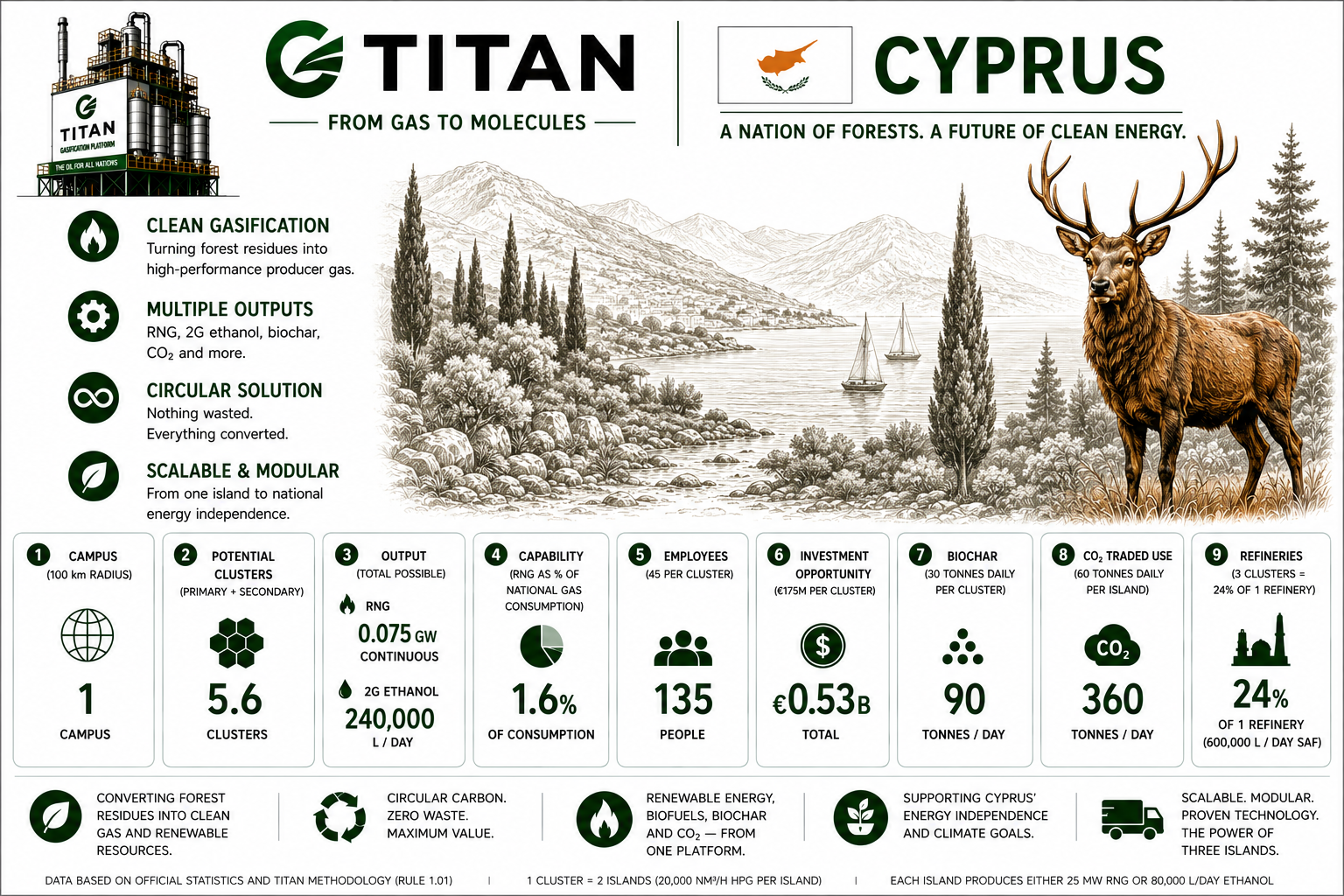
Cyprus has a land area of 9,251 km² and is a single-CAMPUS country under the TITAN 100 km planning model. The entire national market therefore sits within one CAMPUS geography. Cyprus is mountainous through its principal forest regions, particularly Troodos and Paphos, but the CAMPUS remains operationally relevant when located on the accessible edge of the forest resource and connected to the island’s principal road network. The official mapped forest resource supports 1.1 TITAN clusters under the standard TITAN forest-residue methodology. Cyprus is therefore a technically viable but resource-constrained TITAN market rather than a large forest-led deployment opportunity.(publications.gov.cy)
| CYPRUS — INSTANT REVIEW | Resource | TITAN Clusters | Assessment |
| Public / State Forest | 111,035 ha | 0.75 | Principal forest position |
| Private Forest | 54,934 ha | 0.37 | Fragmented supplementary market |
| Primary Forest Resource | 165,969 ha | 1.12 | Limited but material |
| Sawmill Residue | 2,400 t/year | 0.02 | Very limited |
| Wood Manufacturing Residue | 1,120 t/year | 0.01 | Very limited |
| Park & Avenue | 800 t/year | 0.01 | Supplementary |
| Reclaimed Wood | 1,600 t/year | 0.01 | Supplementary |
| Secondary Resource | 5,920 t/year | 0.04 | Limited |
| Total Identified Opportunity | 173,500 t/year resource equivalent | 1.16 | ★★☆☆☆ |
1. Country & CAMPUS Geography
Cyprus covers 9,251 km². The island extends 240 km from east to west and 100 km from north to south. (publications.gov.cy)
Under the TITAN 100 km radius planning model:
CYPRUS = 1 CAMPUS
1 CAMPUS | 1 TITAN-relevant CAMPUS
Cyprus is therefore one of the clearest examples of the CAMPUS concept: a single strategically located CAMPUS can address the national market.
The issue is not geographic coverage. It is the quantity and practical availability of forest carbon.
Cyprus contains extensive mountainous forest landscapes, while its population and industrial activity are concentrated around the principal urban and coastal corridors. TITAN infrastructure should therefore be located at an accessible logistics position serving the forest resource rather than within the mountain forest itself.
2. Primary Forest Opportunity
The Cyprus National Forestry Accounting Plan records 165,969 ha of mapped state, hali-land and private forest and other wooded land. Of this total, 107,181 ha is state forest, 3,854 ha is hali-land forest and 54,934 ha is private forest. (moa.gov.cy)
For TITAN DD purposes the public/state position is therefore:
111,035 ha — 0.75 TITAN clusters
The private position is:
54,934 ha — 0.37 TITAN clusters
giving a total primary resource position of:
1.12 TITAN clusters
| Forest Ownership | Area | TITAN Clusters |
| Public / State | 111,035 ha | 0.75 |
| Private | 54,934 ha | 0.37 |
| Total | 165,969 ha | 1.12 |
Cyprus therefore has enough theoretical forest-resource depth under the standard TITAN methodology to justify examining one cluster, but there is an important qualification.
Cyprus manages its forests primarily for protection, biodiversity, climate resilience and multiple ecosystem services. The Department of Forests has historically maintained a deliberately low sustainable timber harvest. Its national forestry plan states that sustainable roundwood harvesting was expected to remain only 4,000–5,000 m³/year, with increased removals occurring principally where salvage logging follows forest fires or other disturbance. (moa.gov.cy)
This means the 1.12-cluster resource calculation should not automatically be interpreted as 1.12 clusters of presently purchasable residue.
For Cyprus, practical availability must be established directly with the Department of Forests.
3. Sawmill Residues
Cyprus has a very small domestic roundwood economy.
Eurostat-linked national statistics record 8,000 m³ of roundwood production in 2023. More than 80% of Cypriot roundwood production has recently been fuelwood rather than industrial timber. (Destatis)
The resulting sawmill resource is:
2,400 tonnes/year
supporting only:
0.02 TITAN clusters
Sawmill residue is therefore not a material national contingency market for a full TITAN cluster.
4. Wood Manufacturing Residues
The domestic roundwood base also limits indigenous downstream wood-manufacturing residue.
The identified resource is:
1,120 tonnes/year
supporting:
0.01 TITAN clusters
This resource remains worth capturing locally but does not materially alter the TITAN investment case.
For Cyprus, downstream industrial wood should therefore be regarded as supplementary carbon rather than a platform-scale resource.
5. Park & Avenue
Cyprus’s municipalities, hotels, resorts, roads, utility corridors, urban trees, landscaping and extensive tourism infrastructure continuously generate arboricultural woody residues.
The Park & Avenue resource provides:
800 tonnes/year
supporting:
0.01 TITAN clusters
Although small compared with a full TITAN requirement, this stream has strategic value because much of it is already generated through necessary maintenance activity.
Within a single-CAMPUS island market, these distributed resources can be consolidated efficiently.
6. Reclaimed Wood
Construction, demolition, pallets, packaging, furniture and tourism infrastructure provide a further circular wood stream.
The identified reclaimed-wood resource provides:
1,600 tonnes/year
supporting:
0.01 TITAN clusters
Again, this is useful within an integrated CAMPUS but does not create an independent TITAN-scale market.
7. Total TITAN Opportunity
Cyprus’s theoretical primary forest resource supports:
1.12 TITAN clusters
The four conventional secondary markets provide only:
0.04 TITAN clusters
The identified resource position is therefore:
1.16 TITAN CLUSTERS
The figure needs to be interpreted differently from the larger forest economies.
Cyprus does not have several independent TITAN supply pools capable of supporting a large rollout. It has one national CAMPUS geography and a forest base theoretically sufficient for one cluster under the standard resource methodology, but official forest management policy deliberately limits commercial harvesting. (moa.gov.cy)
Strategic Assessment
Cyprus is a 1-CAMPUS country and that CAMPUS is TITAN-relevant, but TITAN should not be presented as the dominant national opportunity without confirmation of actual recoverable forest residue from the Cyprus Department of Forests.
The primary calculation supports 1.12 clusters, while conventional secondary wood markets add only 0.04 clusters.
The more important characteristic of Cyprus is therefore its single-CAMPUS geography.
A single integrated CAMPUS can address the island’s forest residue, municipal carbon, agricultural carbon, water-treatment and circular-resource markets. For Cyprus, this makes the wider CAMPUS model strategically more interesting than attempting to build a national programme around forest residues alone.
Cyprus should consequently be treated as a selective TITAN opportunity within a broader integrated CAMPUS, with a full TITAN development proceeding only after direct confirmation of sustainable forest-floor residue availability.
CYPRUS — ★★☆☆☆
1 CAMPUS | 1 TITAN-RELEVANT CAMPUS | 1.12 PRIMARY CLUSTERS | 1.16 TOTAL IDENTIFIED CLUSTERS