Warsaw 14:08:2026 Steve Walker
GREECE 🇬🇷
★★★★☆
TITAN Forest Residue Opportunity — Country Due Diligence
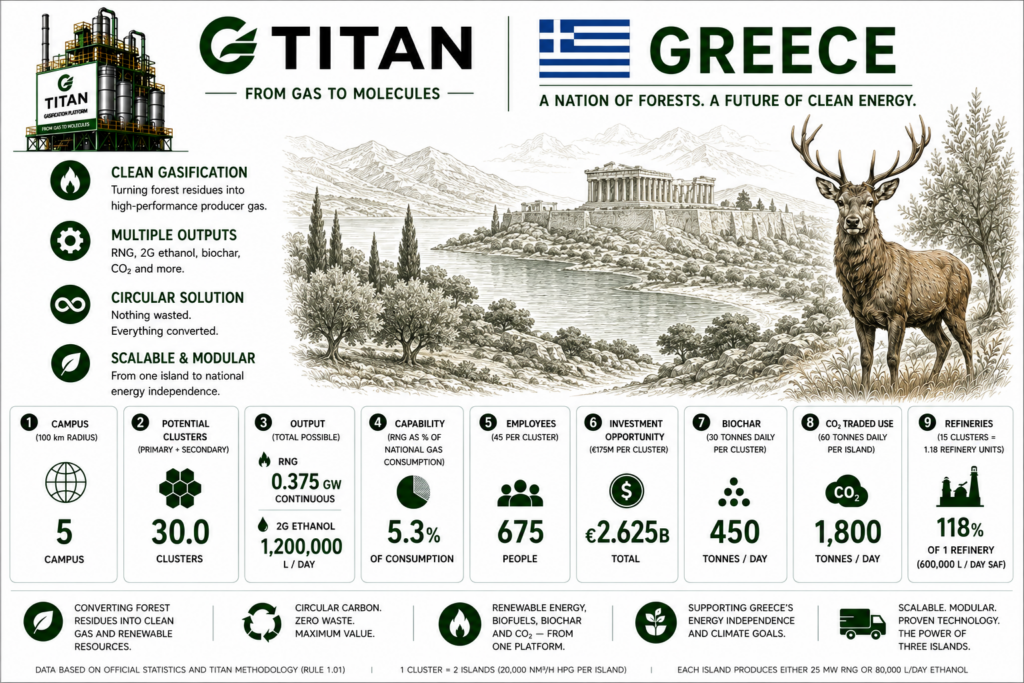
Greece has a national area of 131,990 km² and represents 5 geographic CAMPUS under the TITAN 100 km planning model. Four of these CAMPUS are directly relevant to TITAN because the principal commercially accessible forest resource is concentrated across mainland northern, central and western Greece and the Peloponnese. Greece has 3.902 million ha of forest, supporting 26.3 TITAN clusters from the primary forest resource before downstream wood markets are included. The total identified Greek opportunity supports 30.0 TITAN clusters. Greece therefore has substantial theoretical forest-resource depth, but mountainous terrain, protected forests, wildfire risk and historically low commercial timber removals mean TITAN development must concentrate on demonstrably managed and recoverable forest residues rather than treating all mapped forest equally. FAO reports that Greek forest area increased to 3.902 million ha by 2020. (Open Knowledge FAO)
| GREECE — INSTANT REVIEW | Resource | TITAN Clusters | Assessment |
| Public Forest | 77% of forest | 20.2 | Major institutional opportunity |
| Private Forest | 23% of forest | 6.0 | Additional market |
| Primary Forest Residue | 3.902 million ha | 26.3 | Strong theoretical resource |
| Sawmill Residue | 0.227 Mt/year | 1.5 | Limited downstream market |
| Wood Manufacturing Residue | 0.106 Mt/year | 0.7 | Limited |
| Park & Avenue | 0.076 Mt/year | 0.5 | Supplementary |
| Reclaimed Wood | 0.151 Mt/year | 1.0 | Supplementary circular resource |
| Secondary Resource | 0.560 Mt/year | 3.7 | Limited but useful |
| Total Identified Opportunity | 4.46 Mt/year resource equivalent | 30.0 | ★★★★☆ |
1. Country & CAMPUS Geography
Greece covers 131,990 km². Enterprise Greece describes the country as predominantly mountainous and extending into the Mediterranean through numerous peninsulas and islands. (Enterprise Greece)
Under the TITAN 100 km radius planning model:
GREECE = 5 GEOGRAPHIC CAMPUS
5 GEOGRAPHIC CAMPUS | 4 TITAN-RELEVANT CAMPUS
Greece requires a different geographic treatment from the flatter Central and Northern European markets.
The country contains extensive mountain systems, long coastlines and thousands of islands. The geographic CAMPUS calculation therefore gives the national coverage requirement, but it does not mean that all five areas provide an equivalent forest-resource opportunity.
The principal TITAN resource is concentrated across Macedonia and Thrace, Epirus, Thessaly and Central Greece, and the Peloponnese.
These four mainland operating geographies contain the strongest combination of forest resource, road access, settlements, industrial infrastructure and potential logistics nodes.
The fifth geographic CAMPUS primarily represents Greece’s fragmented island and peripheral geography and should not initially be treated as a forest-led TITAN market.
2. Primary Forest Opportunity
FAO reports:
3.902 MILLION ha OF FOREST
in Greece. (Open Knowledge FAO)
This forest base supports:
26.3 TITAN CLUSTERS
under the standard TITAN forest-resource methodology.
Greek forests have historically been dominated by public ownership. The established ownership position used for this assessment is:
| Forest Ownership | Share | TITAN Clusters |
| Public Forest | 77% | 20.2 |
| Private Forest | 23% | 6.0 |
| Total | 100% | 26.3 |
The strategic primary position is therefore:
20.2 CLUSTERS FROM PUBLIC FOREST
This gives TITAN a potentially strong institutional route into the Greek forest market.
However, Greece needs a more selective approach than countries with highly commercialised forestry.
FAO has previously identified 3.094 million ha as forest available for wood supply, demonstrating that the commercially usable forest estate is smaller than the total mapped forest area. (Open Knowledge FAO)
This distinction is important.
TITAN should not approach Greek forestry by assuming that every hectare of forest becomes an available residue source. The target resource should be managed forest where thinning, fire prevention, sanitary harvesting, storm damage, wildfire management and normal forestry operations already generate residues requiring removal.
3. Sawmill Residues
Greece has a relatively small domestic commercial timber sector compared with the size of its forest estate.
The European Forest Information System records 2024 Greek roundwood removals at 757,055 m³. (forest.eea.europa.eu)
This produces a sawmill residue market of:
0.227 MILLION TONNES/YEAR
supporting:
1.5 TITAN CLUSTERS
This is a very different market from Finland, Germany or France.
The Greek sawmill sector does not provide enough residue to become the foundation of a large national TITAN programme.
It remains useful as a secondary supply position around individual CAMPUS locations.
4. Wood Manufacturing Residues
Greece also has a smaller domestic wood-manufacturing base than the major Central and Northern European timber economies.
The identified wood-manufacturing residue market provides:
0.106 MILLION TONNES/YEAR
supporting:
0.7 TITAN CLUSTERS
These residues remain valuable because they are concentrated at manufacturing locations and can be contracted relatively easily.
However, they should be treated as supplementary rather than primary feedstock.
5. Park & Avenue
Greece’s municipalities, road network, electricity corridors, railway infrastructure, tourism developments, hotels, resorts, parks, olive-growing regions and urban landscapes produce continuing woody maintenance residues.
The Park & Avenue resource provides:
0.076 MILLION TONNES/YEAR
supporting:
0.5 TITAN CLUSTERS
Although modest nationally, this category is strategically interesting in Greece because vegetation management is closely linked to wildfire prevention and infrastructure protection.
Material that must already be removed from roadsides, power corridors, municipal land and the forest/urban interface can become a useful CAMPUS resource rather than a disposal cost.
6. Reclaimed Wood
Greece’s construction sector, tourism infrastructure, pallets, packaging, furniture and demolition activity create an additional circular wood market.
The reclaimed-wood resource provides:
0.151 MILLION TONNES/YEAR
supporting:
1.0 TITAN CLUSTER
This market is concentrated predominantly around the country’s larger population and industrial centres and therefore provides useful contingency supply for appropriately located CAMPUS developments.
7. Total TITAN Opportunity
Greece’s primary forest resource supports:
26.3 TITAN CLUSTERS
The conventional secondary markets provide:
| Secondary Market | TITAN Clusters |
| Sawmill Residues | 1.5 |
| Wood Manufacturing Residues | 0.7 |
| Park & Avenue | 0.5 |
| Reclaimed Wood | 1.0 |
| Total Secondary | 3.7 |
The combined identified national resource therefore supports:
30.0 TITAN CLUSTERS
The composition of this opportunity is significant.
Unlike Germany, Finland or Estonia, Greece is overwhelmingly a forest-floor opportunity.
Almost 88% of the identified TITAN resource comes from the primary forest base, rather than from sawmill and downstream industrial residues.
This means the success of a Greek TITAN programme depends primarily on securing the correct managed-forest residue streams.
Strategic Assessment
Greece is a 5-geographic-CAMPUS country with 4 CAMPUS directly relevant to TITAN.
Its 3.902 million ha forest estate supports 26.3 primary TITAN clusters, including:
20.2 public forest clusters
and
6.0 private forest clusters.
The secondary wood economy adds only:
3.7 TITAN CLUSTERS
taking the total identified national opportunity to:
30.0 TITAN CLUSTERS
Greece is therefore fundamentally different from the highly industrialised forestry markets.
The opportunity is not primarily at the sawmill or factory gate.
It is upstream on the forest floor.
Greece’s mountainous terrain, wildfire exposure and relatively low current timber removals mean the strongest TITAN proposition is likely to be associated with active forest management, thinning, fire-risk reduction, damaged timber, sanitary harvesting and other non-merchantable forest residue streams.
This creates a particularly strong alignment between carbon utilisation and forest resilience.
The development strategy should therefore concentrate initially on the four mainland TITAN-relevant CAMPUS, establish direct institutional relationships with the Greek forestry authorities, identify managed forests producing recoverable residues, and use sawmill, manufacturing, Park & Avenue and reclaimed wood only as supplementary markets.
Greece has sufficient primary resource to support a meaningful national TITAN programme, but resource accessibility and forest management — rather than theoretical forest area — will determine the actual rollout.
GREECE — ★★★★☆
5 GEOGRAPHIC CAMPUS | 4 TITAN-RELEVANT CAMPUS
26.3 PRIMARY CLUSTERS | 30.0 TOTAL IDENTIFIED CLUSTERS
:::