
Warsaw 14:08:2026 Steve Walker
FINLAND 🇫🇮
★★★★★
TITAN Forest Residue Opportunity — Country Due Diligence
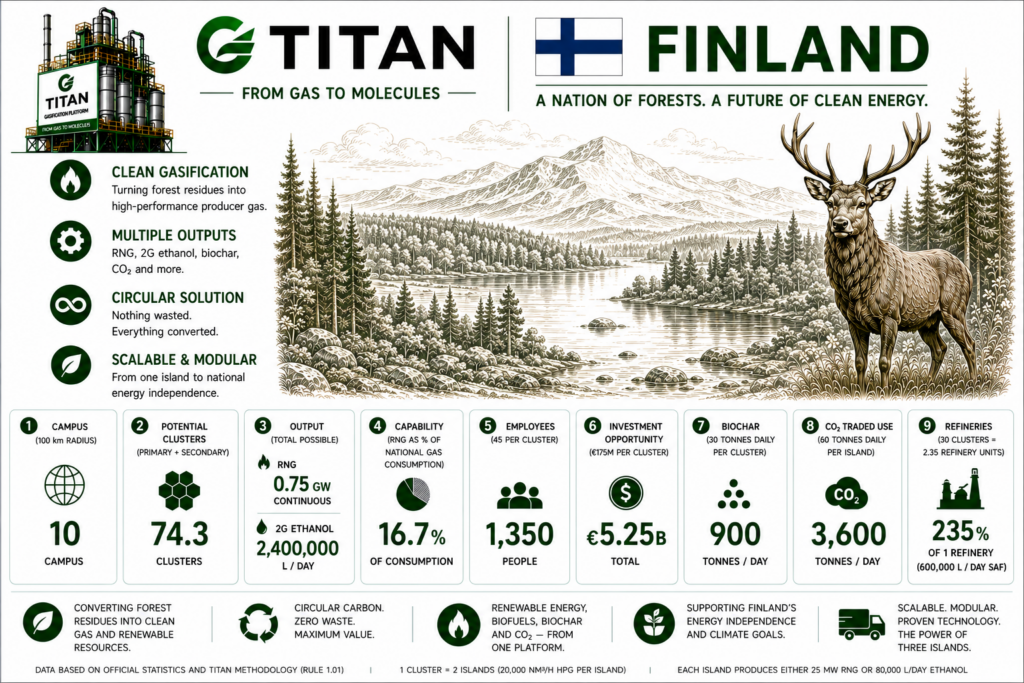
Finland has a land area of 303,940 km² and is a 10-CAMPUS country under the TITAN 100 km planning model. All 10 CAMPUS are relevant to TITAN, although commercial forest productivity and industrial processing are strongest across southern and central Finland. Finland has 20.3 million ha of forest available for timber production, supporting 136.7 TITAN clusters from primary forest residues alone. Its exceptionally large forestry and wood-processing economy increases the total identified resource opportunity to 505.2 TITAN clusters. Metsähallitus confirms that 20.3 million ha are available for timber production and that forests cover more than 70% of Finland’s land area. (Metsähallitus)
| FINLAND — INSTANT REVIEW | Resource | TITAN Clusters | Assessment |
| Public / Institutional Forest | 39% | 53.3 | Exceptional |
| Private Forest | 61% | 83.4 | Exceptional |
| Primary Forest Residue | 20.3 million ha | 136.7 | Exceptional |
| Sawmill Residue | 22.410 Mt/year | 149.4 | Exceptional |
| Wood Manufacturing Residue | 10.458 Mt/year | 69.7 | Exceptional |
| Park & Avenue | 7.470 Mt/year | 49.8 | Major distributed resource |
| Reclaimed Wood | 14.940 Mt/year | 99.6 | Exceptional circular resource |
| Secondary Resource | 55.278 Mt/year | 368.5 | Exceptional |
| Total Identified Opportunity | 75.783 Mt/year | 505.2 | ★★★★★ |
1. Country & CAMPUS Geography
Finland covers 303,940 km² of land.
Under the TITAN 100 km radius planning model:
FINLAND = 10 CAMPUS
10 CAMPUS | 10 TITAN-RELEVANT CAMPUS
Finland is one of Europe’s most forested countries. Forestry extends from the southern industrial regions through central Finland and deep into the north.
The country is predominantly low or gently rolling rather than mountainous. Its principal logistics constraints are distance, lakes and the increasingly remote nature of northern forestry rather than major topographical barriers.
The national railway network, forestry roads and established timber logistics already move very large quantities of wood between forests, sawmills, pulp mills and export terminals.
All 10 CAMPUS therefore contain forest-resource potential, although the highest-density TITAN development programme should begin in southern and central Finland where commercial forestry, wood-processing capacity and transport infrastructure overlap most strongly.
2. Primary Forest Opportunity
Finland has 26.2 million ha of forestry land, covering 86% of its land area. Of this, 20.3 million ha is available for timber production. (Luonnonvarakeskus)
For TITAN, the commercially available timber-production forest is the appropriate primary market.
This supports:
136.7 TITAN CLUSTERS
Finland is unusual because private forestry dominates the productive forest economy.
Metsähallitus reports that 61% of the 20.3 million ha available for timber production is privately owned. (Metsähallitus)
For the national TITAN assessment:
| Forest Position | Share | TITAN Clusters |
| Public / Institutional | 39% | 53.3 |
| Private | 61% | 83.4 |
| Total | 100% | 136.7 |
The private forest market therefore represents the largest primary opportunity.
Finland nevertheless retains a very substantial public position. Metsähallitus manages the state forest estate and harvests around 6 million m³ of timber each year from state-owned certified forests. (Metsähallitus)
The scale of both markets means TITAN does not need to choose between a public or private forestry strategy. A national Finnish programme can establish institutional positions in both.
3. Sawmill Residues
Finland is one of Europe’s largest active forestry economies.
Natural Resources Institute Finland reports that 74.7 million m³ of stemwood was harvested in 2024, of which 84% was industrial roundwood and 16% energy wood. (Luonnonvarakeskus)
The resulting sawmill residue market provides:
22.410 MILLION TONNES/YEAR
supporting:
149.4 TITAN CLUSTERS
This secondary resource alone exceeds the entire primary forest-floor cluster opportunity.
Finland therefore represents an exceptionally deep sawmill and primary wood-processing market for TITAN.
4. Wood Manufacturing Residues
Finland has a major downstream forest-products industry encompassing timber, engineered wood, panels, construction products, joinery, furniture, packaging and pulp-related manufacturing.
The wood-manufacturing residue market provides:
10.458 MILLION TONNES/YEAR
supporting:
69.7 TITAN CLUSTERS
These resources are more commercially contested than forest-floor residues but are concentrated at large industrial sites and benefit from mature timber logistics.
They therefore form an important second layer of TITAN resource security.
5. Park & Avenue
Finland’s towns, cities, roads, railways, electricity corridors, municipal forests, parks and other managed non-forest landscapes generate a continuing woody-residue stream.
The Park & Avenue market provides:
7.470 MILLION TONNES/YEAR
supporting:
49.8 TITAN CLUSTERS
The resource is geographically distributed but benefits from Finland’s existing forestry and biomass collection infrastructure.
It is particularly relevant around metropolitan and industrial CAMPUS areas where collection distances remain short.
6. Reclaimed Wood
Finland’s construction sector, extensive use of timber in buildings, pallets, packaging, furniture and industrial wood products create a major end-of-life wood resource.
The reclaimed-wood market provides:
14.940 MILLION TONNES/YEAR
supporting:
99.6 TITAN CLUSTERS
This creates a significant circular-carbon market beyond active forestry.
For TITAN, reclaimed wood provides both additional supply depth and a pathway for permanently recovering carbon that has already passed through one or more material-use cycles.
7. Total TITAN Opportunity
Finland’s primary timber-production forest supports:
136.7 TITAN CLUSTERS
The four secondary markets provide:
| Secondary Market | TITAN Clusters |
| Sawmill Residues | 149.4 |
| Wood Manufacturing Residues | 69.7 |
| Park & Avenue | 49.8 |
| Reclaimed Wood | 99.6 |
| Total Secondary | 368.5 |
The combined identified Finnish resource therefore supports:
505.2 TITAN CLUSTERS
Finland clearly does not require a programme approaching this theoretical maximum.
The number demonstrates the depth of the available market. A substantial multi-CAMPUS TITAN rollout can consume a relatively small share of Finland’s national forest and wood-resource economy.
Strategic Assessment
Finland is a 10-CAMPUS country and all 10 CAMPUS are relevant to TITAN.
Its 20.3 million ha of forest available for timber production supports 136.7 primary TITAN clusters, while the national forestry industry harvested 74.7 million m³ of stemwood in 2024. (Metsähallitus)
The private forest market accounts for 61% of timber-production land, while the state remains a major commercial forest owner and supplier through Metsähallitus. (Metsähallitus)
The four secondary wood markets add another 368.5 clusters, taking the total identified resource opportunity to:
505.2 TITAN CLUSTERS
Finland combines exceptionally high forest coverage, an established industrial forestry system, enormous annual timber throughput, mature residue logistics and 10 TITAN-relevant CAMPUS areas.
The development strategy should therefore begin with CAMPUS locations across the highest-density southern and central Finnish forestry and industrial corridors and progressively extend northward, establishing parallel contracting positions with Metsähallitus, private forest owners, sawmills and industrial wood processors.
Finland is not simply capable of supporting TITAN. It has the resource depth to support a national TITAN programme at substantial scale while remaining a minority participant in the country’s overall forestry economy.
FINLAND — ★★★★★
10 CAMPUS | 10 TITAN-RELEVANT CAMPUS | 136.7 PRIMARY CLUSTERS | 505.2 TOTAL IDENTIFIED CLUSTERS
:::