

| TITAN CAMPUS | Land / Länder | Principal Logistics Location | Opportunity | |
| CAMPUS DE01 | Black Forest – Offenburg | Baden-Württemberg | Offenburg | First 3 Clusters |
| CAMPUS DE02 | Swabia – Ulm | Baden-Württemberg | Ulm | First 3 Clusters |
| CAMPUS DE03 | Franconia – Nürnberg | Bavaria | Nürnberg | First 3 Clusters |
| CAMPUS DE04 | Bavarian Forest – Plattling / Regensburg | Bavaria | Plattling / Regensburg | First 3 Clusters |
| CAMPUS DE05 | Hesse – Bebra / Fulda | Hesse | Bebra / Fulda | First 3 Clusters |
| CAMPUS DE06 | Rhineland-Palatinate / Saar | Rhineland-Palatinate / Saarland | Rhine / Saar Corridor | First 3 Clusters |
| CAMPUS DE07 | Sauerland – Siegen / Kreuztal | North Rhine-Westphalia | Siegen / Kreuztal | First 3 Clusters |
| CAMPUS DE08 | Lower Saxony – Harz / Hannover | Lower Saxony | Harz / Hannover | First 3 Clusters |
| CAMPUS DE09 | Mecklenburg – Rostock | Mecklenburg-Vorpommern | Rostock | First 3 Clusters |
| CAMPUS DE10 | Brandenburg – Seddin | Brandenburg + Berlin | Seddin | First 3 Clusters |
| CAMPUS DE11 | Thuringia – Saxony Forest Arc | Thuringia / Saxony | Erfurt–Jena–Chemnitz–Zwickau Corridor | First 3 Clusters |
Warsaw 14:08:2026 Steve Walker
Germany TITAN CAMPUS Opportunities
GERMANY: 11 TITAN-RELEVANT CAMPUS AREAS | FIRST 33 TITAN CLUSTERS
GERMANY 🇩🇪
★★★★★
TITAN Forest Residue Opportunity — Country Due Diligence
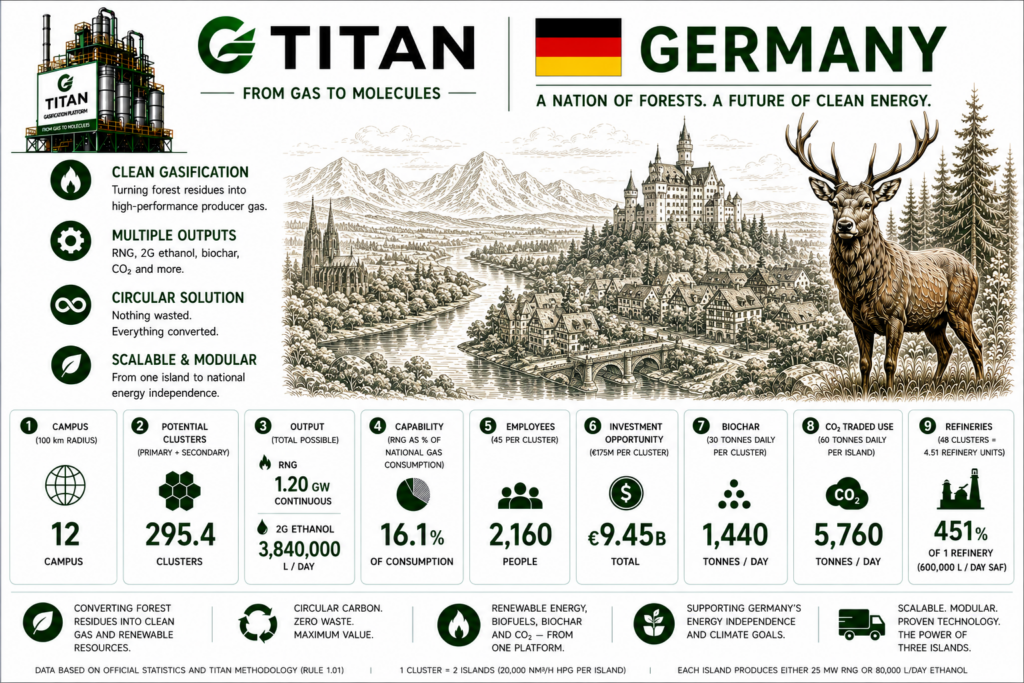
Germany has a land area of 353,260 km² and is a 12-CAMPUS country under the TITAN 100 km planning model however after removing Berlin and other major cities we have divided Germany into 11-Campus . All 11 CAMPUS are relevant to TITAN. Germany has 11.5 million ha of forest, covering 32% of the country, with forest distributed across every major national region. This primary forest resource supports 77.4 TITAN clusters before any secondary wood resources are included. Germany’s exceptionally large timber-processing, manufacturing, municipal and circular wood economy increases the total identified national opportunity to 379.4 TITAN clusters.
| GERMANY — INSTANT REVIEW | Resource | TITAN Clusters | Assessment |
| Public Forest | 52% of forest | 40.3 | Exceptional institutional market |
| Private Forest | 48% of forest | 37.2 | Exceptional additional market |
| Primary Forest Residue | 11.5 million ha | 77.4 | Exceptional |
| Sawmill Residue | 18.360 Mt/year | 122.4 | Exceptional |
| Wood Manufacturing Residue | 8.568 Mt/year | 57.1 | Exceptional industrial market |
| Park & Avenue | 6.120 Mt/year | 40.8 | Major distributed resource |
| Reclaimed Wood | 12.240 Mt/year | 81.6 | Exceptional circular resource |
| Secondary Resource | 45.288 Mt/year | 301.9 | Exceptional |
| Total Identified Opportunity | 56.903 Mt/year | 379.4 | ★★★★★ |
1. Country & CAMPUS Geography
Germany has a land area of 353,260 km².
Under the TITAN 100 km radius planning model:
GERMANY = 11 Actual CAMPUS
16 Land (Lander in the federal state structure), 12 CAMPUS (in geographical area), however, 11 TITAN-RELEVANT CAMPUS
Germany is geographically highly suitable for a national TITAN programme.
The National Planning Model identifies 11 CAMPUS areas for development. Due to the particular geography of Germany, Berlin falls within the Brandenburg CAMPUS catchment. The German TITAN programme therefore comprises 11 TITAN-relevant CAMPUS areas.
The north is predominantly low and flat. Central Germany consists largely of accessible uplands and forested Mittelgebirge, while the principal high-mountain terrain is concentrated along the southern Alpine boundary.
The forest resource is distributed nationally rather than confined to one region.
Substantial forest areas extend across Bavaria, Baden-Württemberg, Brandenburg, Lower Saxony, Hesse, North Rhine-Westphalia, Rhineland-Palatinate, Saxony and the other Länder.
Germany’s exceptional motorway, rail, inland-waterway and industrial infrastructure further strengthens the CAMPUS model.
All 11 geographic CAMPUS are therefore relevant to TITAN.
2. Primary Forest Opportunity
Germany’s Fourth Federal Forest Inventory records:
11.5 MILLION ha OF FOREST
covering 32% of Germany.
This forest base supports:
77.4 TITAN CLUSTERS
Germany has a particularly balanced forest ownership structure.
The Fourth Federal Forest Inventory reports:
- 48% private forest
- 29% Länder / state forest
- 20% municipal and corporate public forest
- 3% federal forest
Public ownership therefore represents 52% of the national forest estate, while private ownership represents 48%.
| Forest Ownership | Share | TITAN Clusters |
| Public Forest | 52% | 40.3 |
| Private Forest | 48% | 37.2 |
| Total | 100% | 77.4 |
The strategic primary position is therefore:
40.3 CLUSTERS FROM PUBLIC FOREST
This gives TITAN a substantial institutional route into the German market through Länder, federal and municipal forest estates.
At the same time, private forest provides another 37.2 clusters of resource depth.
Germany therefore has one of the most balanced public/private forest structures in the TITAN programme.
The forest floor remains the preferred primary supply position.
3. Sawmill Residues
Germany has one of Europe’s largest timber economies.
Official German statistics record:
61.2 MILLION m³ OF TIMBER HARVESTED IN 2024
The resulting sawmill residue market provides:
18.360 MILLION TONNES/YEAR
supporting:
122.4 TITAN CLUSTERS
This secondary market is substantially larger than the entire primary forest-floor opportunity.
Germany’s sawmill and primary timber-processing infrastructure is distributed across the country’s principal forestry regions.
This gives multiple CAMPUS direct access to concentrated industrial wood residues.
Sawmill residues therefore represent the first major contingency market below the forest floor.
4. Wood Manufacturing Residues
Germany has an enormous downstream wood economy encompassing construction products, engineered timber, furniture, joinery, panels, flooring, packaging and specialist wood manufacturing.
The wood-manufacturing residue resource provides:
8.568 MILLION TONNES/YEAR
supporting:
57.1 TITAN CLUSTERS
This is a major industrial carbon market in its own right.
The factory gate is more competitive than the forest floor.
However, Germany’s industrial scale means TITAN should establish a deliberate position within the wood-manufacturing sector as part of every relevant CAMPUS supply strategy.
5. Park & Avenue
Germany’s cities, municipalities, Autobahn network, railways, waterways, electricity corridors, parks, urban forests and other managed infrastructure generate a substantial continuing stream of non-forest woody material.
The Park & Avenue resource provides:
6.120 MILLION TONNES/YEAR
supporting:
40.8 TITAN CLUSTERS
Germany’s population and infrastructure density make this market particularly important.
The country contains more than 52,000 km² of settlement and transport land, creating an extensive national maintenance landscape generating woody residues outside the formal forest-floor market.
Park & Avenue is therefore a significant German TITAN resource rather than a marginal contingency.
6. Reclaimed Wood
Germany’s building stock, construction and demolition industry, furniture economy, pallets, packaging and industrial manufacturing create an exceptionally large end-of-life wood market.
The reclaimed-wood resource provides:
12.240 MILLION TONNES/YEAR
supporting:
81.6 TITAN CLUSTERS
This is Germany’s second-largest secondary TITAN market after sawmill residues.
It provides a major circular-carbon position in which wood that has already completed one or more useful material cycles can ultimately be recovered as feedstock rather than discarded.
7. Total TITAN Opportunity
Germany’s primary forest resource supports:
77.4 TITAN CLUSTERS
The four secondary markets provide:
| Secondary Market | TITAN Clusters |
| Sawmill Residues | 122.4 |
| Wood Manufacturing Residues | 57.1 |
| Park & Avenue | 40.8 |
| Reclaimed Wood | 81.6 |
| Total Secondary | 301.9 |
The combined identified German resource therefore supports:
379.4 TITAN CLUSTERS
Germany’s resource depth is exceptional.
A national programme of three TITAN clusters per CAMPUS would require:
36 TITAN CLUSTERS
This represents only:
9.5% OF THE IDENTIFIED GERMAN RESOURCE
Germany therefore provides considerable resource headroom around a 11-CAMPUS national deployment programme.
Strategic Assessment
Germany is an 11-CAMPUS country and all 11 CAMPUS are relevant to TITAN.
Its 11.5 million ha forest estate supports 77.4 primary TITAN clusters, divided almost equally between:
40.3 public-sector clusters
and
37.2 private-sector clusters.
Germany’s downstream opportunity is even larger.
Official 2024 timber harvesting reached 61.2 million m³, supporting one of Europe’s largest sawmill and wood-processing economies.
The four secondary markets add another:
301.9 TITAN CLUSTERS
taking the total identified national opportunity to:
379.4 TITAN CLUSTERS
Germany combines 11 TITAN-relevant CAMPUS, 32% forest coverage, substantial public forest, an equally substantial private forest market, one of Europe’s largest wood-processing economies and exceptional road, rail and industrial infrastructure.
The development strategy should be regional.
Each CAMPUS should establish its primary position within the relevant Länder and municipal forest systems, aggregate private forestry alongside that institutional base, and progressively integrate sawmill, manufacturing, Park & Avenue and reclaimed wood resources.
A 36-cluster national programme — three clusters per CAMPUS — requires only 9.5% of Germany’s identified resource opportunity.
GERMANY — ★★★★★
11 CAMPUS | 11 TITAN-RELEVANT CAMPUS
77.4 PRIMARY CLUSTERS | 379.4 TOTAL IDENTIFIED CLUSTERS