
Warsaw 14:08:2026 Steve Walker
ITALY 🇮🇹
★★★★★
TITAN Forest Residue Opportunity — Country Due Diligence
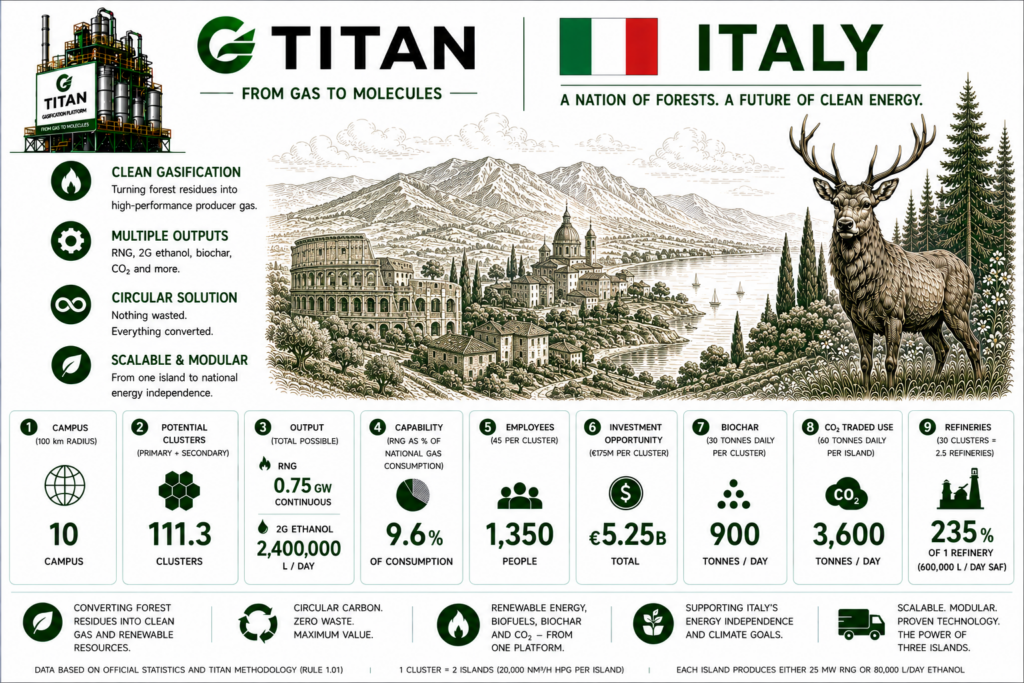
Italy has a national area of 302,110 km² and is a 10-CAMPUS country under the TITAN 100 km planning model. All 10 CAMPUS are relevant to TITAN, although resource intensity varies significantly between the Alpine north, the Apennine spine, the major plains and the islands. Italy has more than 10 million ha of mapped forest, supporting 67.3 TITAN clusters from the primary forest resource before downstream wood markets are included. Italy’s extensive wood-processing, furniture, municipal and reclaimed-wood economy increases the total identified national opportunity to 111.3 TITAN clusters.
| ITALY — INSTANT REVIEW | Resource | TITAN Clusters | Assessment |
| Public Forest | 34% of forest | 22.9 | Major institutional opportunity |
| Private Forest | 66% of forest | 44.4 | Principal national market |
| Primary Forest Residue | 10.0 million ha | 67.3 | Exceptional |
| Sawmill Residue | 2.673 Mt/year | 17.8 | Major secondary market |
| Wood Manufacturing Residue | 1.247 Mt/year | 8.3 | Strong industrial market |
| Park & Avenue | 0.891 Mt/year | 5.9 | Strong distributed resource |
| Reclaimed Wood | 1.782 Mt/year | 11.9 | Major circular resource |
| Secondary Resource | 6.593 Mt/year | 44.0 | Exceptional |
| Total Identified Opportunity | 16.593 Mt/year | 111.3 | ★★★★★ |
1. Country & CAMPUS Geography
Italy covers:
302,110 km²
Under the TITAN 100 km radius planning model:
ITALY = 10 CAMPUS
10 CAMPUS | 10 TITAN-RELEVANT CAMPUS
Italy’s long north-south geography makes the CAMPUS model particularly useful.
The national resource can broadly be divided between the Alpine forest belt, the Po Valley and northern industrial regions, the Apennine forest corridor running through central and southern Italy, and the major island markets of Sicily and Sardinia.
Italy is substantially more mountainous than Germany, Poland or Denmark.
Italy’s new national Forest Map shows that approximately:
6.5 MILLION ha OF FOREST
are situated above 500 metres elevation.
This does not make those forests unusable.
It means TITAN infrastructure should be positioned at accessible logistics locations below and adjacent to the forest resource, allowing residues to move toward CAMPUS processing rather than locating major industrial infrastructure within mountain forests.
All 10 CAMPUS therefore remain relevant, but their resource and logistics profiles will differ materially.
2. Primary Forest Opportunity
Italy’s new national Forest Map confirms that the country’s forest area has:
EXCEEDED 10 MILLION ha
and now covers approximately one-third of national territory.
The wider National Forest Inventory definition, which includes forest and other wooded land, records an even larger wooded estate of approximately 11.05 million ha.
For consistency with the TITAN country methodology, we use the 10.0 million ha mapped forest base.
This supports:
67.3 TITAN CLUSTERS
Italian forest ownership is predominantly private.
Approximately two-thirds of the forest estate is privately owned, with the remaining third held by municipalities, regions, the State and other public bodies.
For TITAN:
| Forest Ownership | Share | TITAN Clusters |
| Public Forest | 34% | 22.9 |
| Private Forest | 66% | 44.4 |
| Total | 100% | 67.3 |
The public forest position alone therefore supports:
22.9 TITAN CLUSTERS
This is sufficient to establish a substantial initial institutional programme.
The larger private estate provides another:
44.4 TITAN CLUSTERS
creating significant long-term expansion capacity.
Italy is also strengthening sustainable forest certification and chain-of-custody systems.
This is important for TITAN because demonstrable sustainable forest management and residue traceability will be fundamental to downstream 2G ethanol and SAF qualification.
3. Sawmill Residues
Italy has a substantial timber-processing economy, although its domestic roundwood production is considerably smaller than the overall scale of its wood-products industry.
The sawmill residue market provides:
2.673 MILLION TONNES/YEAR
supporting:
17.8 TITAN CLUSTERS
The market is concentrated particularly across northern Italy, where the Alpine forestry economy connects with sawmills, panel manufacturers, furniture producers and construction-product manufacturers.
Sawmill residues therefore represent the first major downstream contingency market below the forest floor.
Italy’s large wood-products economy also means TITAN must distinguish carefully between domestically generated residue and material associated with imported timber.
The TITAN resource case should remain based on identifiable Italian residue rather than simply the size of the Italian wood-products industry.
4. Wood Manufacturing Residues
Italy has one of Europe’s most developed downstream wood-manufacturing economies.
Furniture, joinery, flooring, panels, engineered wood, construction products, pallets, packaging and specialist manufacturing create substantial concentrated residue streams.
The identified wood-manufacturing residue resource provides:
1.247 MILLION TONNES/YEAR
supporting:
8.3 TITAN CLUSTERS
This market is particularly relevant across the industrial regions of northern and central Italy.
The material is concentrated and logistically attractive, but competition at the factory gate is higher than at the forest floor.
TITAN should therefore establish a downstream market position without making manufacturing residues the foundation of the national programme.
5. Park & Avenue
Italy has an extensive non-forest woody-resource market.
Its municipalities, roads, railways, electricity corridors, parks, historic estates, urban forests, tourism infrastructure and managed landscapes generate continuing woody residues.
The Park & Avenue resource provides:
0.891 MILLION TONNES/YEAR
supporting:
5.9 TITAN CLUSTERS
This category has particular relevance in Italy because vegetation management increasingly intersects with wildfire prevention, infrastructure protection and management of the forest-urban interface.
These residues arise through necessary maintenance rather than dedicated forest harvesting.
They therefore represent a genuinely additional carbon resource for individual CAMPUS.
6. Reclaimed Wood
Italy’s construction sector, building stock, furniture industry, pallets, packaging and demolition economy create a substantial end-of-life wood market.
The reclaimed-wood resource provides:
1.782 MILLION TONNES/YEAR
supporting:
11.9 TITAN CLUSTERS
This is Italy’s second-largest secondary TITAN resource after sawmill residues.
Italy’s particularly large furniture and wood-products economy strengthens the circularity argument.
Wood should first remain within productive material cycles wherever practical.
When material can no longer be economically reused or recycled, TITAN provides a final carbon-recovery pathway into fuels, chemicals and materials.
7. Total TITAN Opportunity
Italy’s primary forest resource supports:
67.3 TITAN CLUSTERS
The four secondary markets provide:
| Secondary Market | TITAN Clusters |
| Sawmill Residues | 17.8 |
| Wood Manufacturing Residues | 8.3 |
| Park & Avenue | 5.9 |
| Reclaimed Wood | 11.9 |
| Total Secondary | 44.0 |
The combined identified Italian resource therefore supports:
111.3 TITAN CLUSTERS
A national programme based on:
3 TITAN CLUSTERS PER CAMPUS
would require:
30 TITAN CLUSTERS
equal to:
27.0% OF THE IDENTIFIED ITALIAN RESOURCE
Italy therefore provides sufficient resource headroom for a 10-CAMPUS national programme without requiring anything approaching the full identified resource base.
Strategic Assessment
Italy is a:
10-CAMPUS COUNTRY
and all 10 CAMPUS are relevant to TITAN.
Its more than 10 million ha mapped forest estate supports 67.3 primary TITAN clusters, divided between:
22.9 public-sector clusters
and
44.4 private-sector clusters.
Italy’s forest resource is continuing to expand. The new national Forest Map confirms that forest has exceeded 10 million ha, while the broader National Forest Inventory records more than 11 million ha of forest and other wooded land.
The principal operational issue is therefore not whether Italy has enough forest.
It is:
ACCESSIBILITY
Around 6.5 million ha of Italian forest lies above 500 metres, meaning the TITAN programme should be designed around strategically positioned collection and processing nodes serving mountain forestry rather than attempting to place infrastructure directly within difficult terrain.
The four secondary markets add:
44.0 TITAN CLUSTERS
taking the total identified national opportunity to:
111.3 TITAN CLUSTERS
Italy therefore combines 10 TITAN-relevant CAMPUS, a growing national forest estate, substantial public forest, a much larger private forest market, one of Europe’s leading wood-manufacturing economies and significant circular wood-resource availability.
The development strategy should establish the initial forest-floor position through public and organised private forestry, locate CAMPUS at accessible logistics gateways serving the Alpine and Apennine forest belts, and progressively integrate sawmill, manufacturing, Park & Avenue and reclaimed wood.
A 30-cluster national programme — three clusters per CAMPUS — requires 27.0% of Italy’s identified resource opportunity.
ITALY — ★★★★★
10 CAMPUS | 10 TITAN-RELEVANT CAMPUS
67.3 PRIMARY CLUSTERS | 111.3 TOTAL IDENTIFIED CLUSTERS