
Warsaw 15:08:2026 Steve Walker
SLOVAKIA 🇸🇰
★★★★★
TITAN Forest Residue Opportunity — Country Due Diligence
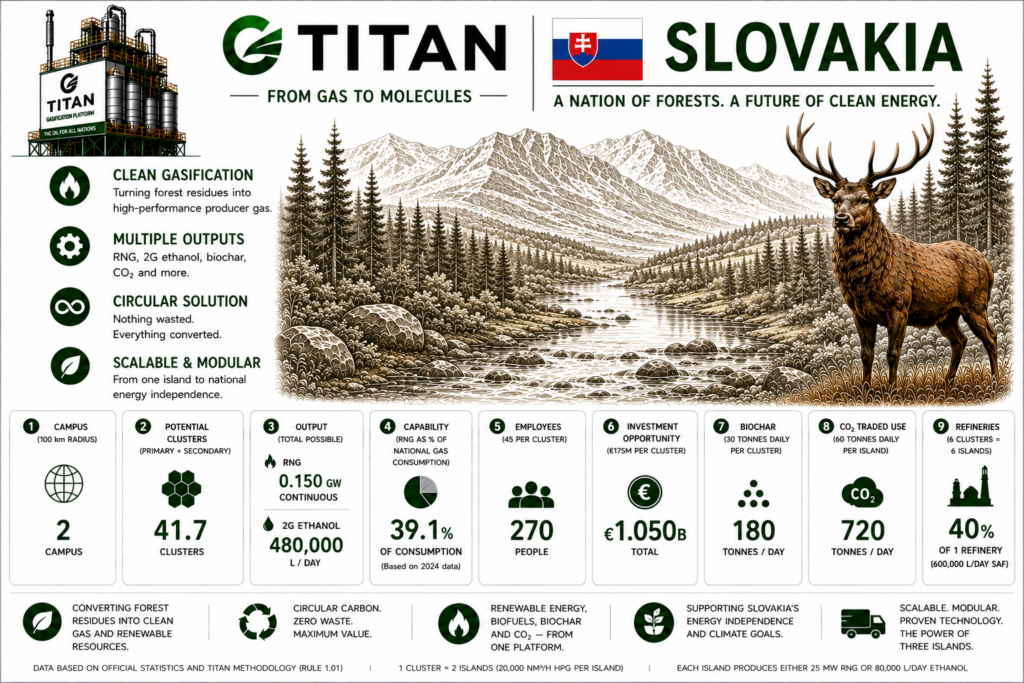
Slovakia has a geographical area of 49,035 km² and is a 2-CAMPUS country under the TITAN 100 km planning model. Both CAMPUS are relevant to TITAN. Slovakia is mountainous through much of its northern and central territory, but the forest resource is extensive and sits within a compact national geography connected by established road and rail corridors. Slovakia has 1.952 million ha of managed forest stands, supporting 13.2 TITAN clusters from the primary forest resource before downstream wood markets are included. The four secondary wood markets increase the total identified national opportunity to 41.7 TITAN clusters. The Slovak Ministry of Agriculture records forest cover of 41.3%, with forest area continuing to increase over the long term.
| SLOVAKIA — INSTANT REVIEW | Resource | TITAN Clusters | Assessment |
| State-managed Forest | 50.9% | 6.7 | Major institutional opportunity |
| Non-state Forest | 49.1% | 6.5 | Major additional market |
| Primary Forest Residue | 1.952 million ha | 13.2 | Exceptional |
| Sawmill Residue | 1.733 Mt/year | 11.6 | Major secondary market |
| Wood Manufacturing Residue | 0.809 Mt/year | 5.4 | Strong industrial market |
| Park & Avenue | 0.578 Mt/year | 3.9 | Strong distributed resource |
| Reclaimed Wood | 1.156 Mt/year | 7.7 | Major circular resource |
| Secondary Resource | 4.276 Mt/year | 28.5 | Exceptional |
| Total Identified Opportunity | 6.228 Mt/year | 41.7 | ★★★★★ |
1. Country & CAMPUS Geography
Slovakia covers:
49,035 km²
under current Eurostat country statistics.
Under the TITAN 100 km radius planning model:
SLOVAKIA = 2 CAMPUS
2 CAMPUS | 2 TITAN-RELEVANT CAMPUS
Slovakia is more mountainous than neighbouring Poland or Hungary.
The Carpathian system occupies much of northern and central Slovakia, while the principal lowlands lie in the southwest around the Danube and in the southeast.
This geography does not prevent a two-CAMPUS TITAN programme.
It determines where the processing infrastructure should be positioned.
TITAN CAMPUS should sit on accessible valleys, basins and national road and rail corridors, allowing forest residues to move out of the forestry regions toward central processing locations.
Because Slovakia is compact and forest is extensive across the northern, central and eastern regions:
BOTH CAMPUS ARE RELEVANT TO TITAN
2. Primary Forest Opportunity
The Slovak Ministry of Agriculture records:
1.9515 MILLION ha OF FOREST STANDS
with forest cover of:
41.3%
The Ministry also identifies another 288,000 ha of agricultural and other land naturally overgrown by forest vegetation, but these areas are not included in the primary TITAN calculation.
The established forest base supports:
13.2 TITAN CLUSTERS
Slovakia has an almost evenly divided management structure.
State forest enterprises manage 993,400 ha, equal to 50.9% of forest stands, while non-state organisations manage the remaining 958,100 ha. The non-state sector includes private, municipal, church, community and agricultural-cooperative forests.
| Forest Position | Share | TITAN Clusters |
| State-managed Forest | 50.9% | 6.7 |
| Non-state Forest | 49.1% | 6.5 |
| Total | 100% | 13.2 |
The institutional entry position therefore represents:
6.7 TITAN CLUSTERS
This creates a strong initial route into the Slovak forestry market through State forestry organisations.
The non-state sector provides an almost equally large second market.
The forest floor should therefore remain the preferred TITAN supply position.
3. Sawmill Residues
Slovakia has an established commercial forestry and timber-processing economy.
Official sector reporting recorded 7.223 million m³ of timber harvesting in 2023. Current Slovak climate reporting indicates that harvested wood volume then fell by around 20% in 2024, giving a 2024 reference base of 5.78 million m³.
The sawmill residue market therefore provides:
1.733 MILLION TONNES/YEAR
supporting:
11.6 TITAN CLUSTERS
This is almost equal to the entire primary forest opportunity.
Sawmills therefore represent the first major downstream contingency position after the forest floor.
4. Wood Manufacturing Residues
Slovakia has an established woodworking, furniture, construction-products, joinery and packaging sector.
The wood-manufacturing residue resource provides:
0.809 MILLION TONNES/YEAR
supporting:
5.4 TITAN CLUSTERS
These residues are concentrated at industrial sites and therefore attractive from a logistics perspective.
Competition at the factory gate is greater than on the forest floor.
TITAN should therefore establish a position within the manufacturing market while maintaining forest residues as the preferred primary resource.
5. Park & Avenue
Slovakia’s municipalities, roads, railway corridors, electricity networks, parks, waterways and other managed landscapes generate continuing non-forest woody residues.
The Park & Avenue market provides:
0.578 MILLION TONNES/YEAR
supporting:
3.9 TITAN CLUSTERS
This material is additional to the formal forest market.
It arises through necessary vegetation management, infrastructure maintenance, urban tree management and storm clearance.
Within Slovakia’s compact two-CAMPUS geography, these distributed resources can be efficiently aggregated.
6. Reclaimed Wood
Slovakia’s construction sector, furniture industry, pallets, packaging and demolition activity create a substantial end-of-life wood resource.
The reclaimed-wood market provides:
1.156 MILLION TONNES/YEAR
supporting:
7.7 TITAN CLUSTERS
This becomes Slovakia’s second-largest secondary market after sawmill residues.
The circular hierarchy remains:
Reuse → material recycling → TITAN recovery
TITAN therefore becomes the final carbon-recovery pathway after economically viable material uses have been exhausted.
7. Total TITAN Opportunity
Slovakia’s primary forest resource supports:
13.2 TITAN CLUSTERS
The four secondary markets provide:
| Secondary Market | TITAN Clusters |
| Sawmill Residues | 11.6 |
| Wood Manufacturing Residues | 5.4 |
| Park & Avenue | 3.9 |
| Reclaimed Wood | 7.7 |
| Total Secondary | 28.5 |
The combined identified Slovak resource therefore supports:
41.7 TITAN CLUSTERS
A national programme based on:
3 TITAN CLUSTERS PER CAMPUS
would require:
6 TITAN CLUSTERS
equal to:
14.4% OF THE IDENTIFIED SLOVAK RESOURCE
This provides substantial resource headroom around a two-CAMPUS national programme.
Strategic Assessment
Slovakia is a:
2-CAMPUS COUNTRY
and both CAMPUS are relevant to TITAN.
Its 1.952 million ha forest estate supports 13.2 primary TITAN clusters, divided almost equally between:
6.7 state-managed forest clusters
and
6.5 non-state forest clusters.
The forest management structure is particularly attractive because neither side of the market needs to carry the complete national programme.
TITAN can establish an institutional position with the State forestry sector while developing municipal, community and private forest resources in parallel.
Slovakia also has a significant protected forest estate. Natura 2000 includes 951,000 ha of forest stands, so resource contracting must distinguish clearly between sustainably managed commercial forest residues and areas subject to nature-protection restrictions.
The downstream markets add:
28.5 TITAN CLUSTERS
taking the total identified national opportunity to:
41.7 TITAN CLUSTERS
Slovakia therefore combines two TITAN-relevant CAMPUS, more than 40% forest coverage, a balanced State/non-state forestry structure, an established timber-processing economy and excellent access to the wider Central European market.
A six-cluster national programme — three clusters per CAMPUS — requires only 14.4% of Slovakia’s identified resource opportunity.
SLOVAKIA — ★★★★★
2 CAMPUS | 2 TITAN-RELEVANT CAMPUS
13.2 PRIMARY CLUSTERS | 41.7 TOTAL IDENTIFIED CLUSTERS