
Warsaw 15:08:2026 Steve Walker
SPAIN 🇪🇸
★★★★★
TITAN Forest Residue Opportunity — Country Due Diligence
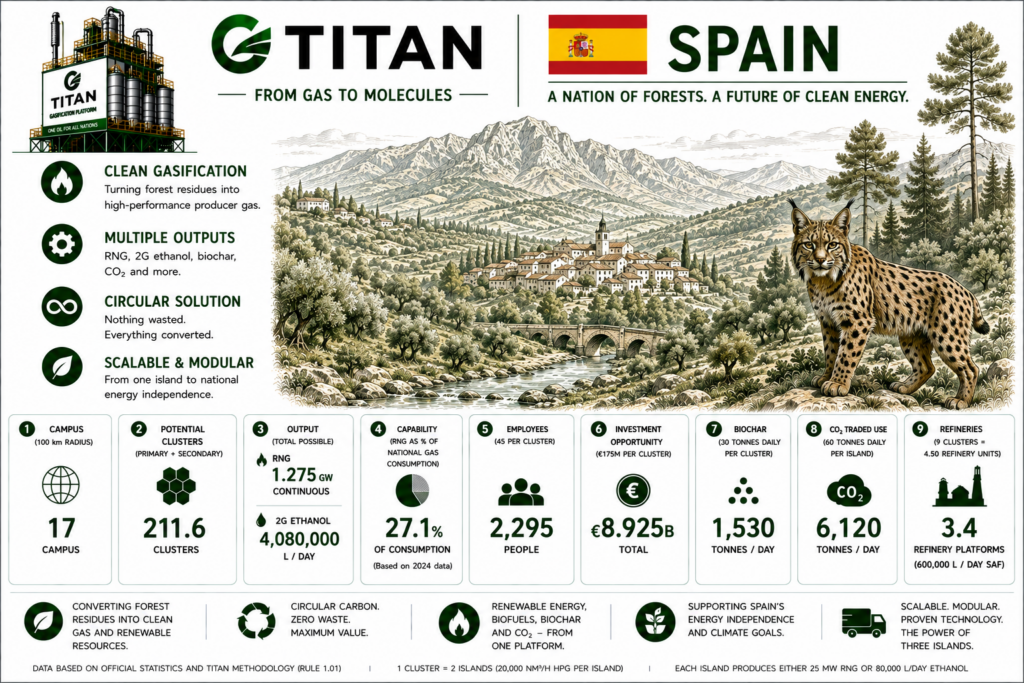
Spain has a geographical area of 505,983 km² and is a 17-CAMPUS country under the TITAN 100 km planning model. All 17 CAMPUS are relevant to TITAN, although resource intensity varies substantially between the Atlantic north-west, northern mountain regions, the Mediterranean interior and the island territories. Spain has 18.7 million ha of wooded forest, covering nearly 37% of national territory. This primary forest resource supports 125.9 TITAN clusters before any secondary wood markets are included. Official 2024 timber harvesting reached 17.366 million m³, and the four secondary resource markets increase the total identified national opportunity to 211.6 TITAN clusters. Spain therefore combines enormous forest scale with relatively low current timber extraction, creating a major TITAN opportunity particularly where residue removal can support active forest management and wildfire-risk reduction.
| SPAIN — INSTANT REVIEW | Resource | TITAN Clusters | Assessment |
| Public Forest | 31.4% of forest | 39.5 | Exceptional institutional market |
| Private Forest | 68.6% of forest | 86.4 | Principal national market |
| Primary Forest Residue | 18.7 million ha | 125.9 | Exceptional |
| Sawmill Residue | 5.210 Mt/year | 34.7 | Major secondary market |
| Wood Manufacturing Residue | 2.431 Mt/year | 16.2 | Major industrial market |
| Park & Avenue | 1.737 Mt/year | 11.6 | Major distributed resource |
| Reclaimed Wood | 3.473 Mt/year | 23.2 | Major circular resource |
| Secondary Resource | 12.851 Mt/year | 85.7 | Exceptional |
| Total Identified Opportunity | 31.738 Mt/year | 211.6 | ★★★★★ |
1. Country & CAMPUS Geography
Spain covers:
505,983 km²
under current Eurostat country data.
Under the TITAN 100 km radius planning model:
SPAIN = 17 CAMPUS
17 CAMPUS | 17 TITAN-RELEVANT CAMPUS
Spain is a geographically diverse market.
The country includes the Atlantic forest regions of Galicia and northern Spain, the Pyrenees, the central plateau, the Iberian mountain systems, extensive Mediterranean forest, Andalusia and the island territories.
Terrain therefore matters.
However, the Spanish forest resource is distributed across such a large proportion of the country that the national TITAN opportunity is not restricted to one forestry region.
TITAN infrastructure should be located on accessible road, rail, industrial and port corridors serving forest catchments rather than within difficult mountain terrain.
Spain’s extensive motorway network, ports and established forest-product logistics provide the basis for a regional CAMPUS structure.
2. Primary Forest Opportunity
Spain contains more than:
28 MILLION ha OF FOREST LAND
under the broader legal forest definition.
Within this total, more than:
18.7 MILLION ha IS WOODED FOREST
representing almost:
37% OF SPAIN
This 18.7 million ha wooded forest base is the appropriate TITAN primary reference.
It supports:
125.9 TITAN CLUSTERS
Spain’s forest ownership is dominated by the private sector.
Official Spanish forestry reporting identifies:
- Public forest — 31.4%
- Private forest — 68.6%
For TITAN:
| Forest Ownership | Share | TITAN Clusters |
| Public Forest | 31.4% | 39.5 |
| Private Forest | 68.6% | 86.4 |
| Total | 100% | 125.9 |
The institutional forest position alone therefore supports:
39.5 TITAN CLUSTERS
This is sufficient to establish a major initial Spanish programme before relying upon the much larger private forest estate.
Private forestry then provides:
86.4 TITAN CLUSTERS
of additional national resource.
The private market will require regional aggregation because ownership structures differ substantially between Galicia, Castilla y León, Catalonia, the Mediterranean regions and other autonomous communities.
3. Sawmill Residues
Spain’s Ministry for Ecological Transition records:
17.366 MILLION m³ OF TIMBER HARVESTED IN 2024
comprising 10.131 million m³ of conifers and 7.235 million m³ of broadleaves.
The resulting sawmill residue resource provides:
5.210 MILLION TONNES/YEAR
supporting:
34.7 TITAN CLUSTERS
The geographic distribution is particularly important.
Galicia alone accounted for 8.999 million m³ of 2024 timber harvesting, more than half the Spanish total. Castilla y León, the Basque Country, Asturias, Catalonia and Cantabria are also major harvesting regions.
This immediately identifies the Atlantic north-west as one of the strongest first-development zones for TITAN Spain.
Sawmill residues are therefore the first major contingency market below the forest floor.
4. Wood Manufacturing Residues
Spain has a substantial downstream wood-products economy encompassing furniture, panels, construction products, joinery, flooring, packaging, pallets and other manufactured products.
The wood-manufacturing residue market provides:
2.431 MILLION TONNES/YEAR
supporting:
16.2 TITAN CLUSTERS
These resources are industrially concentrated and therefore logistically attractive.
The factory gate remains more competitive than the forest floor.
TITAN should therefore establish downstream positions as individual CAMPUS develop without making manufacturing residue the foundation of the national programme.
5. Park & Avenue
Spain has a major non-forest woody-resource market generated through:
municipal tree management, road corridors, railway corridors, electricity networks, parks, urban forests, waterways, tourism infrastructure and wildfire-management corridors.
The Park & Avenue resource provides:
1.737 MILLION TONNES/YEAR
supporting:
11.6 TITAN CLUSTERS
This category is particularly strategically important in Spain.
Wildfire management requires the continuing removal of vegetation and combustible woody material from forests, roadsides, settlements, electricity corridors and the forest-urban interface.
Spain’s national wildfire strategy explicitly identifies forest and landscape management as fundamental to reducing wildfire risk.
TITAN can therefore create productive demand for woody material whose removal also contributes to landscape resilience.
6. Reclaimed Wood
Spain’s construction sector, building stock, furniture industry, pallets, packaging, tourism economy and demolition activity create a substantial reclaimed-wood resource.
The reclaimed-wood market provides:
3.473 MILLION TONNES/YEAR
supporting:
23.2 TITAN CLUSTERS
This is Spain’s second-largest secondary resource after sawmill residues.
The circular hierarchy remains:
Reuse → material recycling → TITAN recovery
TITAN therefore provides a final carbon-recovery pathway after higher-value material applications have been exhausted.
7. Total TITAN Opportunity
Spain’s primary forest resource supports:
125.9 TITAN CLUSTERS
The four secondary markets provide:
| Secondary Market | TITAN Clusters |
| Sawmill Residues | 34.7 |
| Wood Manufacturing Residues | 16.2 |
| Park & Avenue | 11.6 |
| Reclaimed Wood | 23.2 |
| Total Secondary | 85.7 |
The combined identified Spanish resource therefore supports:
211.6 TITAN CLUSTERS
A national programme based on:
3 TITAN CLUSTERS PER CAMPUS
would require:
51 TITAN CLUSTERS
equal to:
24.1% OF THE IDENTIFIED SPANISH RESOURCE
Spain therefore has substantial resource headroom around a 17-CAMPUS national rollout.
Strategic Assessment
Spain is a:
17-CAMPUS COUNTRY
and all 17 CAMPUS are relevant to TITAN.
Its 18.7 million ha wooded forest estate supports 125.9 primary TITAN clusters, divided between:
39.5 public forest clusters
and
86.4 private forest clusters.
Spain’s 2024 timber statistics reveal another important characteristic.
Despite its enormous forest estate, annual recorded timber harvesting was only:
17.366 MILLION m³
and 81% of that timber was harvested from privately owned forest, compared with 19% from public forest.
This demonstrates that Spain’s principal commercial forestry market is already private.
It also demonstrates a major regional concentration: Galicia alone supplied 8.999 million m³ of the national 17.366 million m³ harvest in 2024.
For TITAN, this suggests a clear first-development priority:
GALICIA / ATLANTIC NORTH-WEST
followed by the major forestry regions of northern and central Spain.
The four secondary markets add:
85.7 TITAN CLUSTERS
taking the total identified national opportunity to:
211.6 TITAN CLUSTERS
Spain therefore combines 17 TITAN-relevant CAMPUS, one of Europe’s largest forest estates, a major private forest market, substantial public forest, significant regional timber processing and a powerful additional case for residue removal through wildfire-risk reduction and active landscape management.
A 51-cluster national programme — three clusters per CAMPUS — requires only 24.1% of Spain’s identified resource opportunity.
SPAIN — ★★★★★
17 CAMPUS | 17 TITAN-RELEVANT CAMPUS
125.9 PRIMARY CLUSTERS | 211.6 TOTAL IDENTIFIED CLUSTERS