
Warsaw 16:08:2026
SWITZERLAND 🇨🇭
★★★★★
TITAN Forest Residue Opportunity — Country Due Diligence
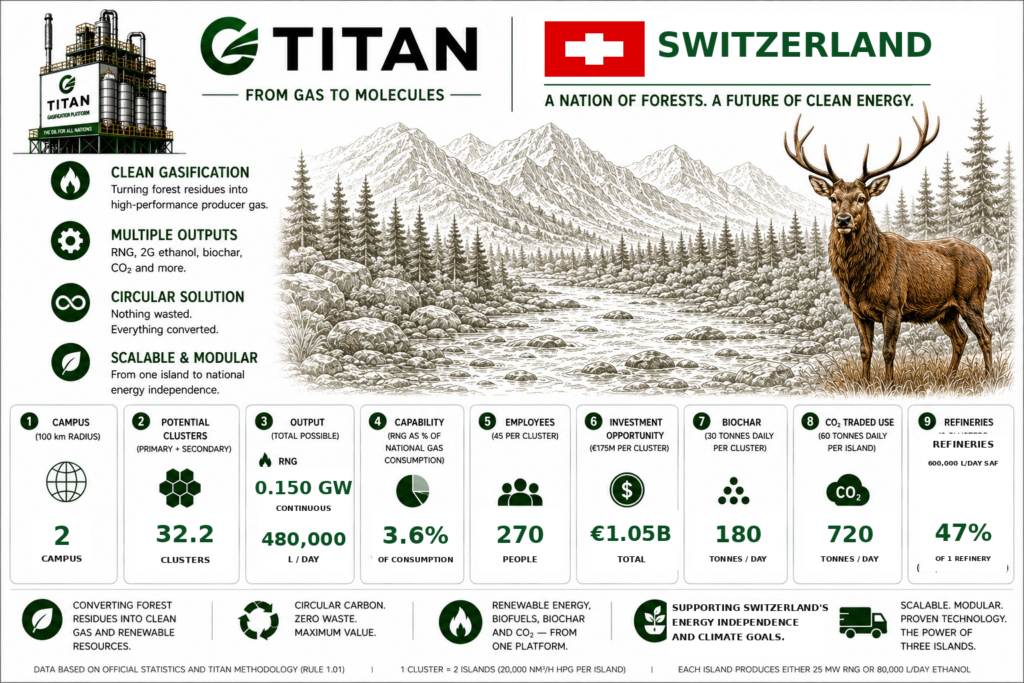
Switzerland has a land area of 39,510 km² and is a 2-CAMPUS country under the TITAN 100 km planning model. Both CAMPUS are relevant to TITAN. Switzerland is heavily mountainous, but its 1.276 million ha forest estate extends across the Jura, Central Plateau, Prealps, Alps and Southern Alps. The primary forest resource supports 8.5 TITAN clusters before downstream wood markets are included. Switzerland’s active forestry and wood-processing economy increases the total identified national opportunity to 32.2 TITAN clusters. The opportunity is therefore substantial for such a compact country, but CAMPUS infrastructure must be positioned in accessible valleys, plateau locations and established logistics corridors rather than within high-Alpine terrain. Official Swiss forestry statistics recorded 12,759 km² of forest land and 4.803 million m³ of timber harvesting in 2024.
| SWITZERLAND — INSTANT REVIEW | Resource | TITAN Clusters | Assessment |
| Public Forest | 70.6% of forest | 6.0 | Exceptional institutional position |
| Private Forest | 29.4% of forest | 2.5 | Strong additional market |
| Primary Forest Residue | 1.276 million ha | 8.5 | Exceptional |
| Sawmill Residue | 1.441 Mt/year | 9.6 | Major secondary market |
| Wood Manufacturing Residue | 0.672 Mt/year | 4.5 | Strong industrial market |
| Park & Avenue | 0.480 Mt/year | 3.2 | Strong distributed resource |
| Reclaimed Wood | 0.961 Mt/year | 6.4 | Major circular resource |
| Secondary Resource | 3.554 Mt/year | 23.7 | Exceptional |
| Total Identified Opportunity | 4.830 Mt/year | 32.2 | ★★★★★ |
1. Country & CAMPUS Geography
Switzerland has a land area of:
39,510 km²
Under the TITAN 100 km radius planning model:
SWITZERLAND = 2 CAMPUS
2 CAMPUS | 2 TITAN-RELEVANT CAMPUS
Switzerland requires careful geographic planning because the Alps occupy a large part of the national territory.
However, forest is not confined to inaccessible high mountains.
Official Swiss forestry statistics divide the forest estate across the Jura, Central Plateau, Prealps, Alps and Southern Alps, confirming a broad national distribution of the resource.
The TITAN strategy is therefore straightforward:
the forest can be mountainous; the CAMPUS does not need to be.
CAMPUS infrastructure should be located within the Central Plateau, major Alpine valleys and established road and rail corridors from which surrounding forest residues can be aggregated.
Both geographic CAMPUS are consequently relevant to TITAN.
2. Primary Forest Opportunity
Swiss Federal Statistical Office data record:
1.276 MILLION ha OF FOREST
in 2024.
This forest base supports:
8.5 TITAN CLUSTERS
Switzerland has an unusually strong public forest ownership position.
Detailed Swiss forestry statistics record 897,504 ha of public forest and 373,701 ha of private forest, giving an ownership structure of 70.6% public and 29.4% private.
| Forest Ownership | Share | TITAN Clusters |
| Public Forest | 70.6% | 6.0 |
| Private Forest | 29.4% | 2.5 |
| Total | 100% | 8.5 |
The strategic institutional position therefore supports:
6.0 TITAN CLUSTERS
This is particularly attractive for a country containing only two geographic CAMPUS.
The private forest market provides another:
2.5 TITAN CLUSTERS
The public forest estate therefore provides the logical first route into Switzerland, followed by organised private forestry.
3. Sawmill Residues
The Swiss Federal Statistical Office recorded:
4.803 MILLION m³ OF TIMBER HARVESTED IN 2024
comprising sawlogs, industrial roundwood, fuelwood and other wood.
The resulting sawmill residue market provides:
1.441 MILLION TONNES/YEAR
supporting:
9.6 TITAN CLUSTERS
This secondary market is slightly larger than the entire primary forest opportunity.
Switzerland already has an established sawmill and timber-processing sector. Official 2024 sawmill statistics record approximately 2.0 million m³ of roundwood processed, with 40.2% emerging as by-products, demonstrating the material scale of the secondary wood stream.
Sawmills therefore represent the first major contingency market immediately below the forest floor.
4. Wood Manufacturing Residues
Switzerland has a developed downstream timber economy covering construction products, joinery, furniture, flooring, packaging and specialist manufacturing.
The wood-manufacturing residue market provides:
0.672 MILLION TONNES/YEAR
supporting:
4.5 TITAN CLUSTERS
These residues are concentrated at industrial facilities and therefore attractive from a logistics perspective.
Competition increases at the factory gate, so these materials should remain a strategic secondary supply source rather than the foundation of the Swiss programme.
5. Park & Avenue
Switzerland’s municipalities, railways, roads, electricity corridors, parks, urban landscapes and managed transport infrastructure generate continuing non-forest woody material.
The Park & Avenue resource provides:
0.480 MILLION TONNES/YEAR
supporting:
3.2 TITAN CLUSTERS
This category has particular relevance in Switzerland because extensive transport, rail and electricity infrastructure crosses forested and mountainous terrain.
Vegetation management around these assets is necessary irrespective of TITAN demand.
The resulting woody material therefore represents an additional resource outside the conventional forest-products market.
6. Reclaimed Wood
Switzerland’s construction sector, building stock, pallets, packaging, furniture and demolition activities create a substantial reclaimed-wood market.
The reclaimed-wood resource provides:
0.961 MILLION TONNES/YEAR
supporting:
6.4 TITAN CLUSTERS
This becomes Switzerland’s second-largest secondary TITAN resource after sawmill residues.
The circular hierarchy remains:
Reuse → material recycling → TITAN recovery
This approach is also consistent with Switzerland’s new Integrated Forest and Wood Strategy 2050, which explicitly supports efficient use of wood according to the cascade principle and seeks the highest possible added value from the resource.
7. Total TITAN Opportunity
Switzerland’s primary forest resource supports:
8.5 TITAN CLUSTERS
The four secondary markets provide:
| Secondary Market | TITAN Clusters |
| Sawmill Residues | 9.6 |
| Wood Manufacturing Residues | 4.5 |
| Park & Avenue | 3.2 |
| Reclaimed Wood | 6.4 |
| Total Secondary | 23.7 |
The combined identified Swiss resource therefore supports:
32.2 TITAN CLUSTERS
A national programme based on:
3 TITAN CLUSTERS PER CAMPUS
would require:
6 TITAN CLUSTERS
equal to:
18.6% OF THE IDENTIFIED SWISS RESOURCE
This provides substantial resource headroom around a two-CAMPUS national programme.
Strategic Assessment
Switzerland is a:
2-CAMPUS COUNTRY
and both CAMPUS are relevant to TITAN.
Its 1.276 million ha forest estate supports 8.5 primary TITAN clusters, divided between:
6.0 public forest clusters
and
2.5 private forest clusters.
The public ownership position is particularly attractive because more than 70% of Swiss forest is publicly owned.
The four secondary markets add:
23.7 TITAN CLUSTERS
taking the total identified national opportunity to:
32.2 TITAN CLUSTERS
Switzerland’s central development issue is not resource quantity.
It is:
ACCESSIBILITY
The forest resource extends extensively into mountainous terrain, while Swiss forests also perform critical protective, biodiversity, recreational and water-management functions. The Swiss Forest Report 2025 highlights these multiple ecosystem functions and the continuing expansion of forest reserves.
The TITAN proposition must therefore focus on actively managed forest residues and accessible forestry operations, not protected or ecologically sensitive forest.
The development strategy should establish two strategically located CAMPUS in accessible logistics corridors, secure the initial position with public forest owners and cantonal/municipal forestry organisations, and then progressively integrate private forestry, sawmills, manufacturing residues, Park & Avenue material and reclaimed wood.
A six-cluster Swiss national programme — three clusters per CAMPUS — requires only 18.6% of the identified resource opportunity.
SWITZERLAND — ★★★★★
2 CAMPUS | 2 TITAN-RELEVANT CAMPUS
8.5 PRIMARY CLUSTERS | 32.2 TOTAL IDENTIFIED CLUSTERS