stevewalker@solideagrouptitan.com
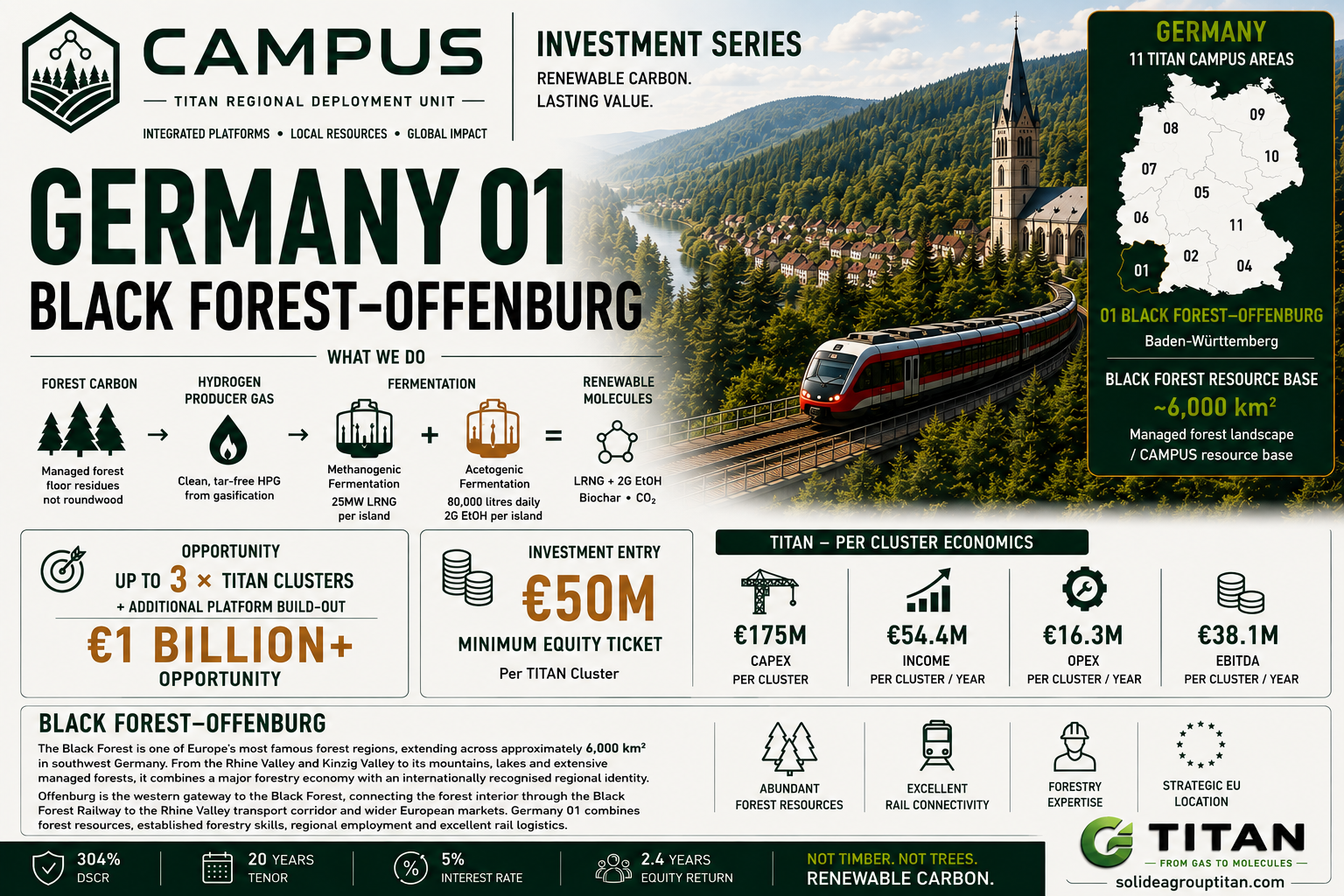
HESSE — BEBRA/FULDA
Hesse is one of Germany’s major forestry regions, with extensive managed forests across the Knüll, Vogelsberg and Spessart. Bebra/Fulda provides excellent rail connectivity to the Rhine-Main region and wider European markets.
Germany 05 represents approximately 6,200 km² of managed forest landscape, providing a strong regional resource base for recoverable forest-management residues.
Not timber. Not roundwood.
THE TITAN OPPORTUNITY
TITAN converts forest residues into clean Hydrogen Producer Gas (HPG) and, through targeted microbial fermentation, into LRNG and second-generation ethanol, with biochar and biogenic CO₂ as additional products.
The opportunity begins with one TITAN and can develop to up to three clusters, creating a potential €1 billion+ regional business.
REGIONAL INVESTMENT PARTNER
SOLIDEA is seeking an established regional partner capable of committing a minimum €50 millionequity ticket toward the first TITAN.
The right partner brings more than capital: regional standing, local relationships and the capability to derisk feedstock, land, logistics, permitting and project delivery.
SOLIDEA and Syngas Project provide the technology, development, engineering integration, international supply chain, product offtake and training.
€50 million starts the journey. Successful development creates the platform for regional growth.
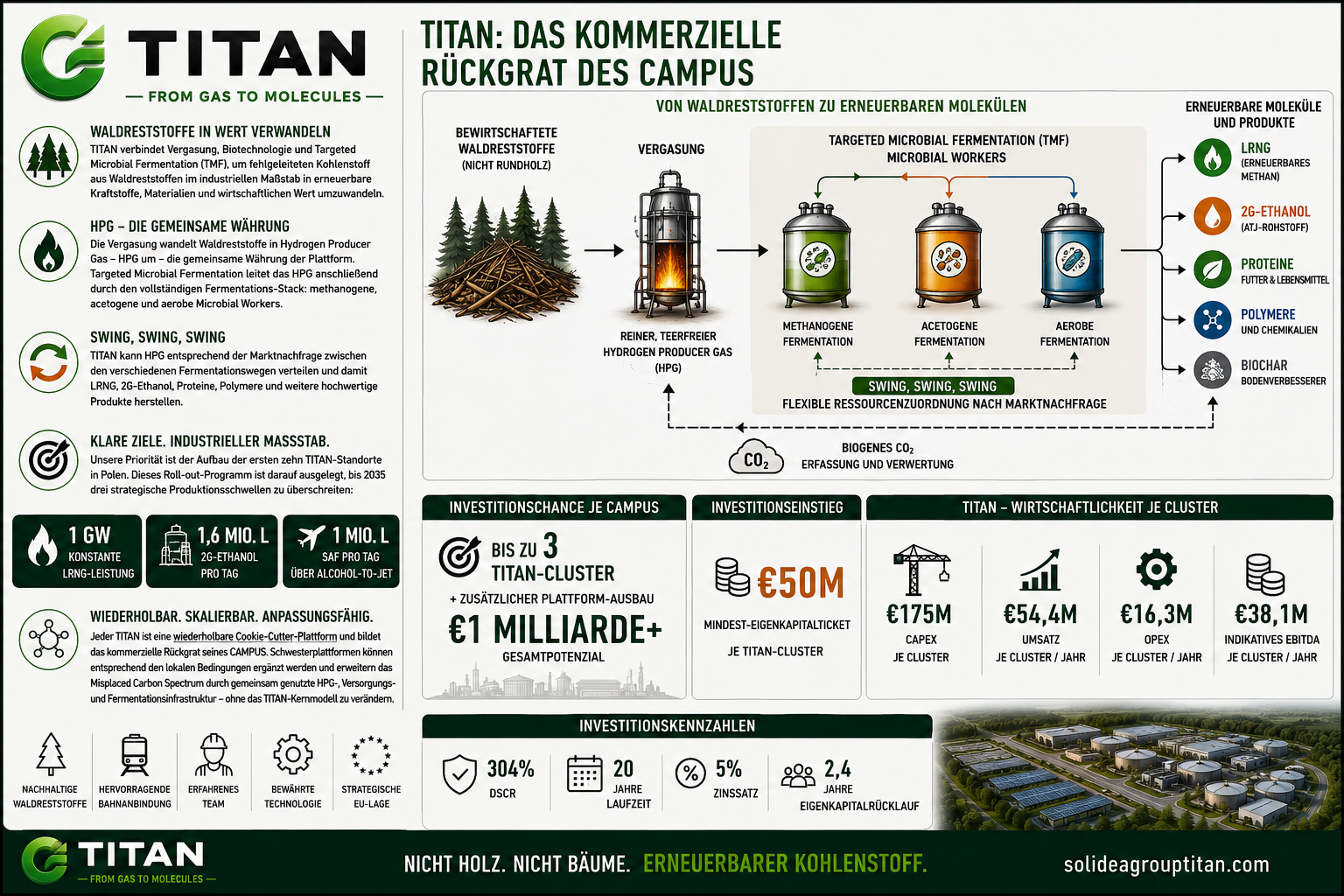
TITAN: Das kommerzielle Rückgrat des CAMPUS
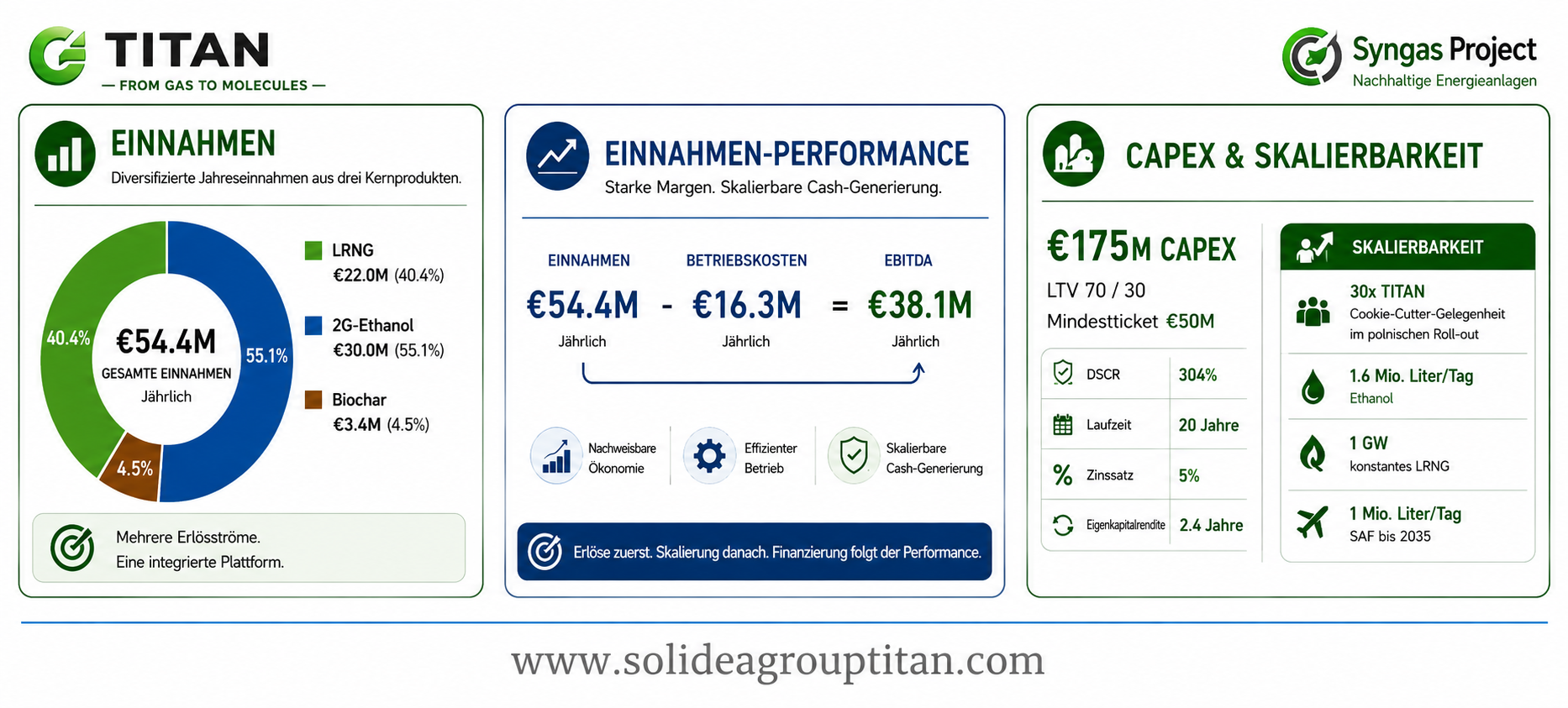
TITAN verbindet Vergasung, Biotechnologie und Targeted Microbial Fermentation (TMF), um fehlgeleiteten Kohlenstoff aus Waldreststoffen im industriellen Maßstab in erneuerbare Kraftstoffe, Materialien und wirtschaftlichen Wert umzuwandeln.
Die Vergasung wandelt Waldreststoffe in Hydrogen Producer Gas – HPG um – die gemeinsame Währung der Plattform. Targeted Microbial Fermentation leitet das HPG anschließend durch den vollständigen Fermentations-Stack: methanogene, acetogene und aerobe Microbial Workers.
Swing, Swing, Swing. TITAN kann HPG entsprechend der Marktnachfrage zwischen den verschiedenen Fermentationswegen verteilen und damit LRNG, 2G-Ethanol, Proteine, Polymere und weitere hochwertige Produkte herstellen.
Unsere Priorität ist der Aufbau der ersten zehn TITAN-Standorte in Polen. Dieses Roll-out-Programm ist darauf ausgelegt, bis 2035 drei strategische Produktionsschwellen zu überschreiten: 1 GW konstante LRNG-Leistung, 1,6 Millionen Liter 2G-Ethanol pro Tag und – über den Alcohol-to-Jet-Pfad – 1 Million Liter SAF pro Tag.
Jeder TITAN ist eine wiederholbare Cookie-Cutter-Plattform und bildet das kommerzielle Rückgrat seines CAMPUS. Schwesterplattformen können entsprechend den lokalen Bedingungen ergänzt werden und erweitern das Misplaced Carbon Spectrum durch gemeinsam genutzte HPG-, Versorgungs- und Fermentationsinfrastruktur – ohne das TITAN-Kernmodell zu verändern.