stevewalker@solideagrouptitan.com
GERMANY 05 — HESSE–BEBRA/FULDA
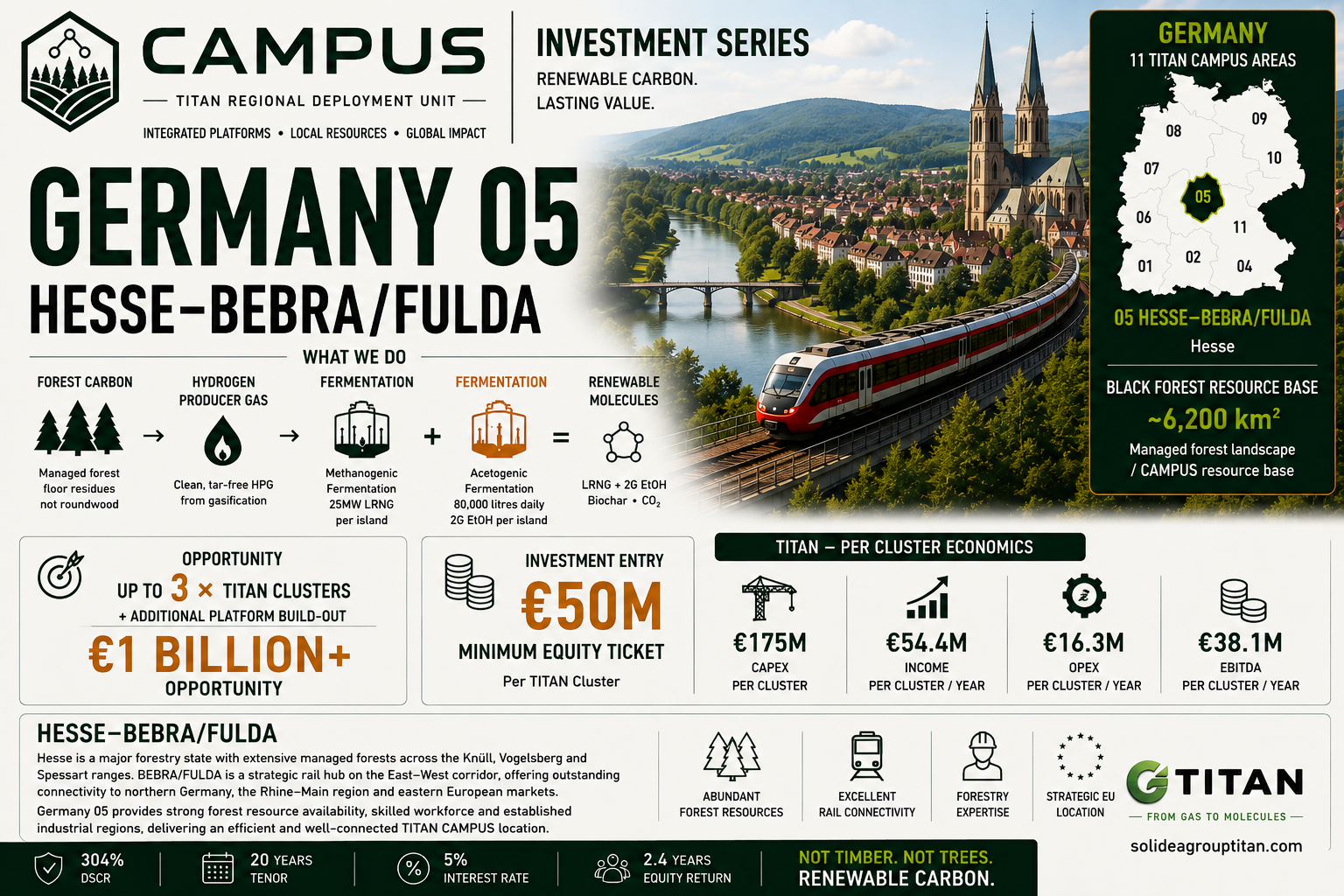
Germany 05 covers the central German CAMPUS region centred on Bebra and Fulda, combining the heavily forested landscapes of Hesse with a strategic position at the intersection of major north–south and east–west transport corridors.
Germany’s 11-CAMPUS structure represents an average regional area of approximately 32,500 km². Germany 05 is assessed at approximately 42% forest cover, equivalent to around 1.37 million hectares of forest.
Forest Resource
| Germany 05 | |
| CAMPUS area | ~32,500 km² |
| Forest cover | ~42% |
| Forest area | ~1.37 million ha |
| Rule 1.01 recoverable residues | ~1.38 Mt/year |
| Upstream resource equivalent | ~9.2 TITAN clusters |
| Proposed deployment | Up to 3 clusters |
| 3-cluster requirement | 450,000 t/year |
| Primary-resource utilisation | ~33% |
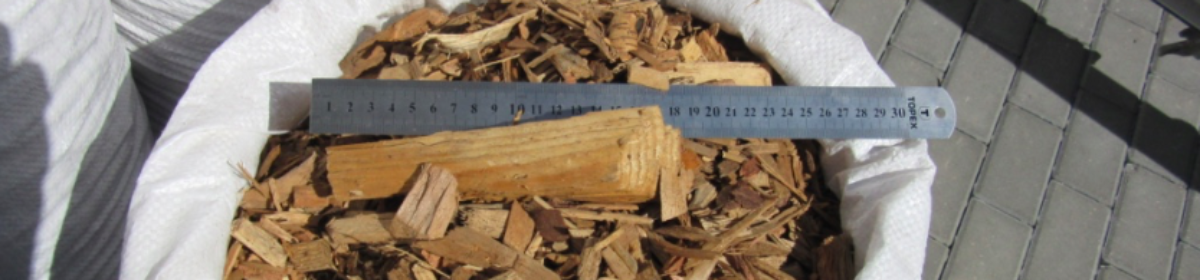
Applying Rule 1.01 — 1.01 tonnes of recoverable forest-floor residue per managed hectare per year — indicates approximately 1.38 million tonnes/year of potential upstream resource, equivalent to approximately 9.2 TITAN clusters.
The proposed three-cluster CAMPUS therefore requires only around 33% of the indicative upstream resource, providing substantial feedstock headroom. The primary resource is managed forest-floor harvest and maintenance residue; merchantable timber and roundwood are excluded from the TITAN feedstock case.
Hesse has an established forestry and wood-processing economy. The Knüll, Vogelsberg and Spessart landscapes provide a strong regional forestry base, while sawmill residues, wood-manufacturing residues, parks and avenue maintenance and reclaimed wood provide additional downstream resource opportunity and are not required to establish the primary Rule 1.01 forest-floor investment case.
Bebra and Fulda provide a particularly strong logistics proposition. Their central position gives the CAMPUS excellent rail access along Germany’s north–south and east–west corridors, connecting the forest resource to the Rhine-Main industrial region, northern Germany and markets toward eastern Germany and Central Europe.
Investment proposition: up to 3 TITAN clusters, approximately €525 million total CAPEX, with additional integrated CAMPUS platforms creating the potential for a €1 billion+ regional investment opportunity.
NOT TIMBER. NOT TREES. RENEWABLE CARBON.
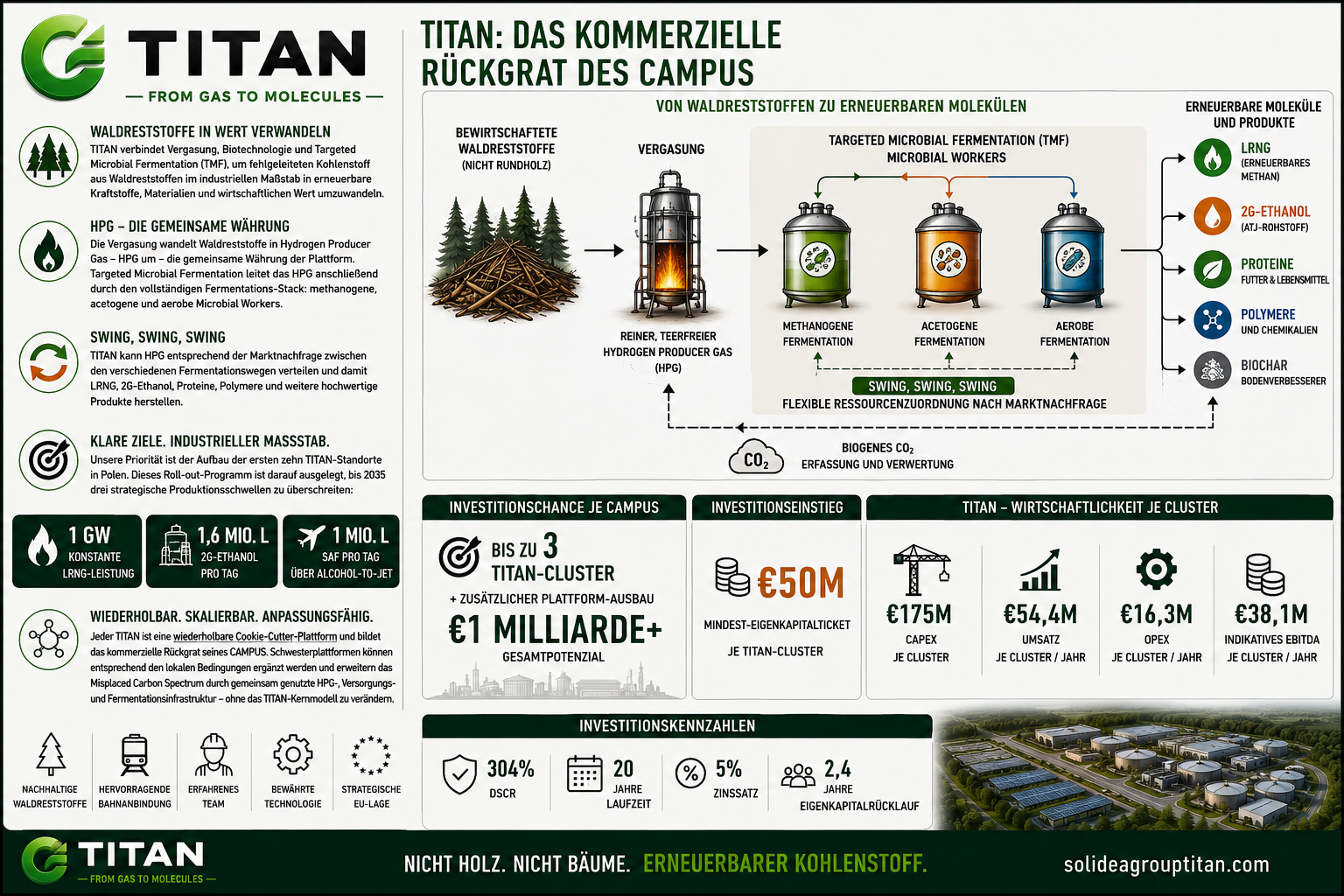
TITAN: Das kommerzielle Rückgrat des CAMPUS
TITAN verbindet Vergasung, Biotechnologie und Targeted Microbial Fermentation (TMF), um fehlgeleiteten Kohlenstoff aus Waldreststoffen im industriellen Maßstab in erneuerbare Kraftstoffe, Materialien und wirtschaftlichen Wert umzuwandeln.
Die Vergasung wandelt Waldreststoffe in Hydrogen Producer Gas – HPG um – die gemeinsame Währung der Plattform. Targeted Microbial Fermentation leitet das HPG anschließend durch den vollständigen Fermentations-Stack: methanogene, acetogene und aerobe Microbial Workers.
Swing, Swing, Swing. TITAN kann HPG entsprechend der Marktnachfrage zwischen den verschiedenen Fermentationswegen verteilen und damit LRNG, 2G-Ethanol, Proteine, Polymere und weitere hochwertige Produkte herstellen.
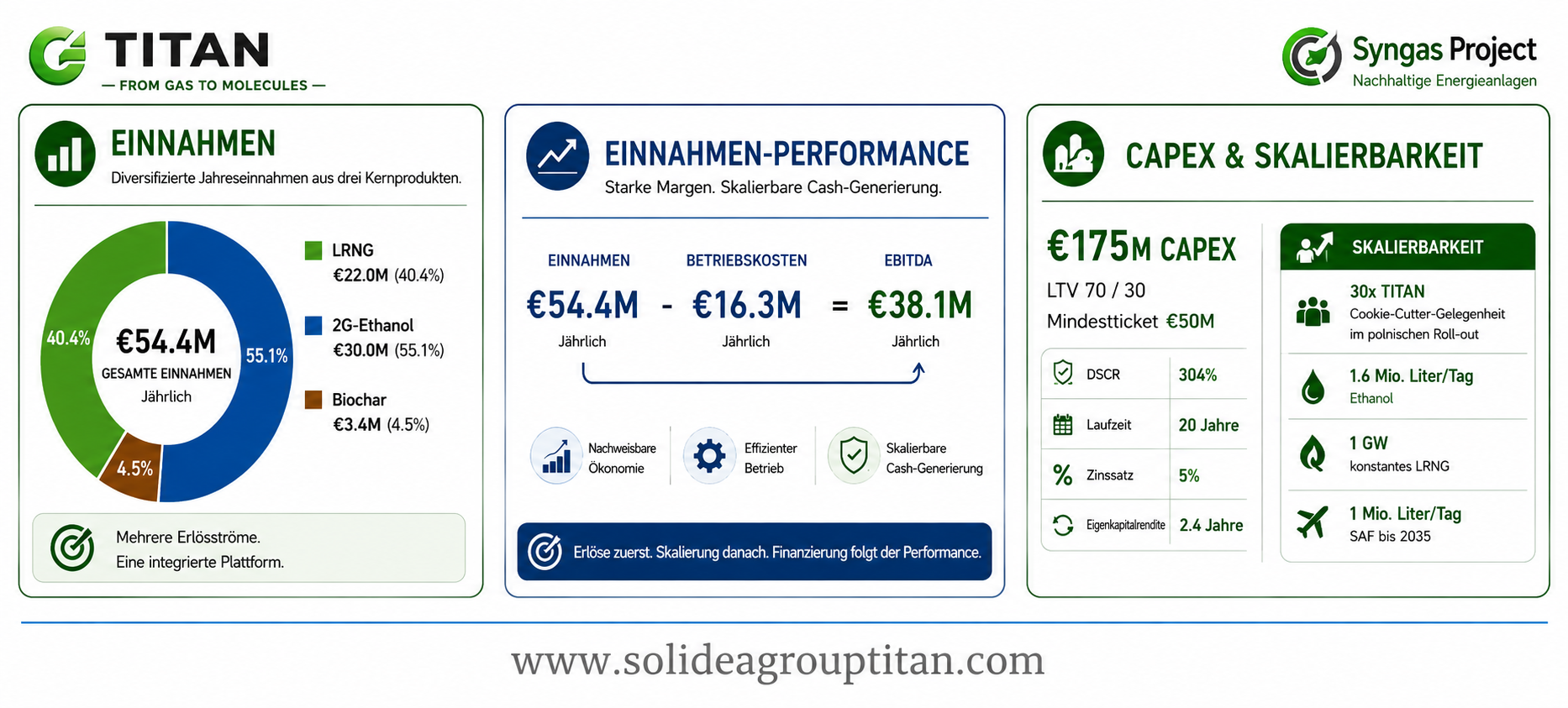
Unsere Priorität ist der Aufbau der ersten zehn TITAN-Standorte in Polen. Dieses Roll-out-Programm ist darauf ausgelegt, bis 2035 drei strategische Produktionsschwellen zu überschreiten: 1 GW konstante LRNG-Leistung, 1,6 Millionen Liter 2G-Ethanol pro Tag und – über den Alcohol-to-Jet-Pfad – 1 Million Liter SAF pro Tag.
Jeder TITAN ist eine wiederholbare Cookie-Cutter-Plattform und bildet das kommerzielle Rückgrat seines CAMPUS. Schwesterplattformen können entsprechend den lokalen Bedingungen ergänzt werden und erweitern das Misplaced Carbon Spectrum durch gemeinsam genutzte HPG-, Versorgungs- und Fermentationsinfrastruktur – ohne das TITAN-Kernmodell zu verändern.