Warsaw 20:08:2026 Steve Walker
ACETOGENIC FERMENTATION – OPEN KIMONO
TITAN Technology Due Diligence
Open the Kimono — Confidential Technology Disclosure Under NDA
Syngas Project sp. z o.o. | TITAN
1. PURPOSE
This document forms part of the TITAN Technology Series — Open the Kimono, a suite of technical Due Diligence disclosures provided under NDA.
Our public material explains what TITAN does.
The Open the Kimono Series explains how we intend to do it.
Acetogenic Fermentation within TITAN is a C1 biological manufacturing platform.
The initial commercial programme is the production of second-generation ethanol — 2G EtOH from cleaned and conditioned Hydrogen Producer Gas — HPG.
But the Fat Boy fermentation station is not designed around the assumption that ethanol will remain its only useful product throughout the operating life of the asset.
TITAN provides the steel, gas-transfer infrastructure, pressure capability, water, energy, laboratory, controls and operating environment.
The microbial worker and target product can continue to evolve.
The platform remains. The biology improves. The product opportunity expands.
2. THE PROCESS IN ONE LINE
The initial TITAN Acetogenic pathway is:
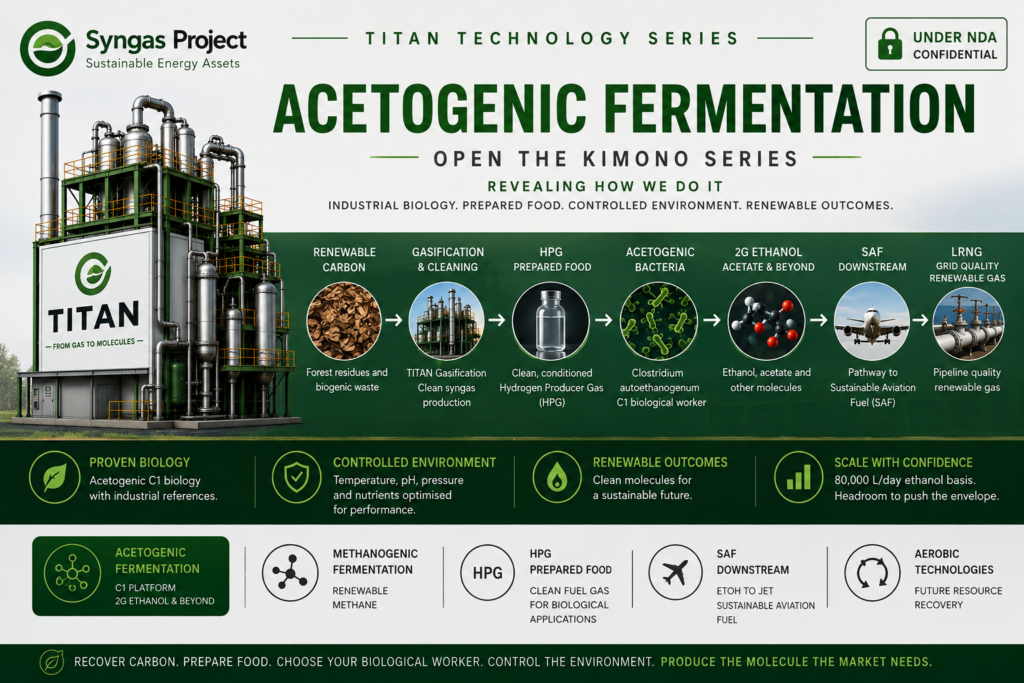
RENEWABLE CARBON → GASIFICATION → HPG → DEEP CLEANING → CONDITIONING → ACETOGENIC FERMENTATION → 2G ETHANOL
The process deliberately separates heterogeneous carbon from the biological manufacturing environment.
The Acetogenic microorganisms never see a tree.
They do not see wood chips.
They do not see ash, soil or heterogeneous forest material.
They see a prepared gaseous feed.
Gasification prepares the carbon. Fermentation manufactures the molecule.
3. THE MICROBIAL WORKER
Acetogens are anaerobic bacteria capable of fixing single-carbon compounds through the Wood–Ljungdahl Pathway — WLP, also known as the reductive acetyl-CoA pathway.
An important organism in the industrial development of gas fermentation is Clostridium autoethanogenum.
The organism can utilise gaseous C1 substrates including carbon monoxide and carbon dioxide, with hydrogen providing reducing power depending upon the metabolic route and gas composition.
The pathway brings carbon towards acetyl-CoA, from which biological metabolism can be directed towards products including ethanol and other molecules.
| Biological Parameter | Acetogenic Basis |
| Organism family | Acetogenic bacteria |
| Key industrial species | Clostridium autoethanogenum |
| Principal pathway | Wood–Ljungdahl Pathway |
| CO | Direct C1 substrate |
| CO₂ | C1 substrate |
| H₂ | Reducing power / electron source |
| Central metabolic intermediate | Acetyl-CoA |
| Initial TITAN product | 2G Ethanol |
| Initial TITAN ethanol programme | Non-GMO |
4. C1 BIOLOGY CHANGES THE HPG DESIGN
This is an important distinction between TITAN’s Methanogenic and Acetogenic systems.
The Acetogenic worker can consume the C1 carbon already contained within HPG.
CO is therefore not an unwanted intermediate that must automatically be converted before fermentation.
CO is food.
CO₂ is food.
H₂ provides reducing power.
Consequently, we do not apply Water-Gas Shift merely to convert biologically valuable CO into H₂ and CO₂ before the Acetogenic boundary.
That is different from the Methanogenic train, where gas conditioning is directed towards establishing the appropriate H₂/CO₂ relationship for methane production.
| Methanogenic | Acetogenic | |
| Principal worker | Archaea | Acetogenic bacteria |
| Principal feed relationship | H₂ + CO₂ | CO / CO₂ / H₂ |
| CO | Requires appropriate upstream management | Useful biological substrate |
| WGS | Applied where required for H₂/CO₂ balance | Not required simply to remove useful CO |
| Product | CH₄ | 2G EtOH / other products |
The engineering philosophy is therefore:
Do not make every HPG stream identical.
Prepare the right food for the worker receiving it.
5. THE FAT BOY FERMENTATION STATION
Within TITAN, the Acetogenic vessels are referred to as the Fat Boys.
These are large industrial gas-fermentation reactors rather than conventional waste digesters.
The physical scale matters.
| Parameter | TITAN Acetogenic Design Basis |
| Gross Fat Boy vessel volume | ~720 m³ |
| Normal working volume | ~650 m³ |
| Installed configuration | 2 + 1 |
| Normal duty vessels | 2 |
| Additional installed vessel | 1 |
| HPG island basis | 20,000 Nm³/h |
| Current principal product | 2G Ethanol |
| Nominal production | 80,000 L/day |
| Product-energy equivalent | ~19 MW |
| Operating temperature | ~37°C |
| Biological pH | ~5.5 |
| Pressure | Positive-pressure fermentation; final operating pressure confirmed through detailed design |
| Nutrient planning allowance | < €2/MW |
The 2+1 architecture is deliberate.
TITAN does not install only the minimum vessel capacity necessary to reach today’s production number.
The third installed Fat Boy provides operability, resilience and development headroom.
6. 2+1 — BUILDING HEADROOM INTO DAY ONE
The additional installed vessel creates several operating possibilities.
| 2+1 Capability | Purpose |
| Production resilience | Maintain greater operating continuity during intervention |
| Biological management | Flexibility in inoculation, stabilisation and culture management |
| Maintenance | Individual vessel intervention without removing the entire station |
| Campaign operation | Opportunity for alternative biological campaigns |
| Strain introduction | Controlled introduction of future qualified workers |
| Capacity development | Opportunity to test higher biological productivity |
| Product development | Future alternative molecule programmes |
| Process optimisation | Greater flexibility in residence time and reactor utilisation |
The third vessel should therefore not be described simply as a spare.
It is installed biological headroom.
That distinction is important to the long-term value of the fermentation station.
7. TEMPERATURE, pH AND PRESSURE
The Fat Boy is a controlled industrial workplace for microorganisms.
The biological performance depends upon maintaining that workplace inside a defined operating envelope.
The public technical literature around C. autoethanogenum establishes operation at approximately 37°C and mildly acidic conditions around pH 5.5, while gas fermentation can use positive pressure to support gas transfer.
TITAN incorporates these requirements into the fermentation-station design.
Temperature — approximately 37°C
The process operates close to human body temperature. This is biologically significant but also advantageous for industrial thermal integration: we are maintaining a controlled microbial environment rather than a high-temperature chemical reactor.
pH — approximately 5.5
The broth chemistry is controlled to maintain the appropriate biological environment and product pathway.
Pressure — designed in from Day One
Positive pressure can increase gaseous-substrate availability and improve gas-liquid mass transfer.
The final commercial operating pressure will be established through detailed technology-provider engineering.
But the important TITAN design decision is already made:
Pressure capability is built into the platform from Day One.
We do not want future biological improvement to be constrained because the original steel was designed only around today’s minimum operating condition.
8. GAS TRANSFER — WHERE BIOLOGY MEETS ENGINEERING
Supplying HPG to the vessel is not enough.
The microbial worker exists principally in the liquid phase.
Its food arrives principally in the gas phase.
The engineering challenge is therefore to move CO, CO₂ and H₂ across the gas-liquid interface efficiently enough for the biological worker to consume them.
This makes gas transfer one of the critical performance variables of the Fat Boy.
The relevant engineering relationship is commonly expressed through:
Gas Transfer Rate ∝ kLa × Driving Force
where kLa represents the volumetric gas-liquid mass-transfer coefficient.
Biological performance can therefore be constrained not simply by the capability of the microorganism but by how quickly the gaseous food can physically reach it.
That is why TITAN considers sparging, agitation and pressure together.
9. SPARGER + STIRRER + PRESSURE — BUILT IN FROM DAY ONE
The TITAN Fat Boy incorporates an important future-operability principle.
Sparger technology, mechanical stirring and pressure capability are designed as complementary and interchangeable operating tools.
We are deliberately not locking a long-life biological asset into one fixed gas-transfer philosophy.
| Gas-Transfer Tool | Function |
| Sparger | Creates gas-liquid contact and controls bubble distribution |
| Stirrer / agitation | Improves bulk mixing, gas dispersion and liquid circulation |
| Pressure | Increases gas solubility / driving force and can improve transfer |
| Gas recirculation | Provides additional opportunity for utilisation of unconsumed gaseous substrate |
| Process control | Balances transfer performance against biological requirement and energy consumption |
These mechanisms can be optimised individually or together.
That creates an important future opportunity.
A future microbial strain may consume gas faster.
A future product programme may require a different gas composition.
Improved sparger technology may reduce agitation demand.
Higher pressure may increase gas-transfer performance.
A different operating campaign may favour mechanical mixing.
TITAN does not want the biology of 2040 constrained by the gas-transfer decision made in 2026.
The physical capability is therefore built into the Fat Boy from Day One.
10. PUSHING THE ENVELOPE
The 80,000 L/day ethanol output is the current TITAN design basis.
It is not intended to represent the ultimate physical limit of the installed fermentation station.
The combination of:
2+1 vessels + ~650 m³ working volume per vessel + sparging + agitation + pressure capability + future strain development
creates an opportunity to improve productivity over the operating life of the plant.
Potential improvement can come from several directions simultaneously:
| Development | Potential Effect |
| Improved microbial productivity | More product per unit reactor volume |
| Improved gas uptake | Higher substrate utilisation |
| Improved sparging | Higher kLa / lower parasitic energy |
| Improved agitation | Better mixing / gas distribution |
| Increased operating pressure | Increased gas-transfer driving force |
| Improved selectivity | More target molecule |
| Improved tolerance | Wider operating envelope |
| Better controls | Operation closer to biological optimum |
| Better product recovery | Reduced downstream constraint |
| Third-vessel utilisation | Increased station productivity / flexibility |
We therefore distinguish between:
Current guaranteed design duty
and
Installed future operating capability.
The first must be contractual.
The second is deliberate engineering headroom.
11. THE BIOLOGY IS A CIRCUS, NOT FRANKENSTEIN
The initial TITAN ethanol programme uses non-GMO biology.
Our philosophy is straightforward.
The biology is a circus, not Frankenstein.
We select naturally capable microbial workers.
We breed, select and adapt.
We provide the correct food.
We provide the correct temperature.
We control pH.
We manage pressure.
We improve gas transfer.
We provide nutrients.
And we progressively teach the worker to perform its job more effectively.
This is not presented as a scientific definition. It is the simplest description of our engineering philosophy.
Better worker + better food + better workplace = better biological performance.
12. THE WORKFORCE CAN IMPROVE AFTER THE FACTORY IS BUILT
This is one of the most attractive characteristics of industrial biotechnology.
The 720 m³ vessel is steel.
Its infrastructure has a long design life.
The microbial worker can develop much faster.
| Installed Infrastructure | Evolution Opportunity |
| Fat Boy vessel | Improved microbial worker |
| Pressure capability | Higher transfer strategy |
| Sparger | Improved bubble / transfer technology |
| Stirrer | Alternative agitation regime |
| Gas conditioning | Improved feed optimisation |
| Controls | Improved biological control |
| Laboratory | Better monitoring and strain management |
| Product recovery | New molecule / improved separation |
We build the factory once. We keep improving the workforce.
Future biological development is subject to qualification, licensing, process compatibility and appropriate regulatory assessment.
But the platform is deliberately engineered not to prevent that development.
13. NUTRIENTS — FEEDING THE WORKFORCE
The microorganisms require nutrients and trace components in addition to gaseous carbon.
Syngas Project uses Ghent operating consumption as the current planning reference.
| Parameter | TITAN DD Basis |
| Nominal ethanol output | 80,000 L/day |
| Product-energy equivalent | ~19 MW |
| Nutrient planning allowance | < €2/MW |
| Reference | Ghent operating consumption |
| Exact formulation | Technology-provider IP |
| Final guaranteed consumption | Contractual confirmation |
The formulation itself is not ours to disclose.
The DD issue is cost and consumption.
The nutrient requirement is a controlled consumable, not a material threat to the TITAN operating model.
14. PLATFORM, NOT ETHANOL PLANT
The Fat Boy is initially configured for 2G ethanol because ethanol provides an immediate large-scale market.
But the biological platform has a wider potential envelope.
| Programme | Product Opportunity |
| Acetogenic | 2G Ethanol |
| Acetogenic | Other alcohols / chemicals |
| ABE | Acetone / Butanol / Ethanol |
| Protein | Microbial proteins |
| Future qualified programmes | Fuels / chemicals / materials |
Different programmes will require their own technical qualification.
Some may require different organisms.
Some may require different nutrients.
Some may require different product recovery.
Some may require changes to operating conditions.
But they do not necessarily require rebuilding the entire upstream carbon, HPG, utility and fermentation infrastructure.
The fermentation station is the asset. Ethanol is today’s principal programme.
15. MULTIPLE SOURCES OF MISPLACED CARBON
The same philosophy applies upstream.
TITAN begins with forest residues.
Over time, Syngas Project intends complementary platforms to widen the recoverable-carbon envelope.
| Platform | Resource Function |
| TITAN | Dry renewable forest carbon |
| ASMARA | Sorted municipal / recovered carbon |
| AQUIS | Water, sludge, digestate and recoverable residual carbon |
| IGNIS | Complementary carbon-recovery pathway |
| STRATA | Complementary carbon-recovery pathway |
| CUMULUS | Complementary carbon / molecule platform |
The objective is not to put every feedstock into the same gasifier.
Different misplaced-carbon problems require different upstream solutions.
But once suitable carbon is converted into a controlled gaseous feed, biological manufacturing becomes increasingly independent of where that carbon originally came from.
16. METHANOGENIC + ACETOGENIC
The Methanogenic Tall Boys and Acetogenic Fat Boys sit side by side within the TITAN architecture.
Their biology is different.
Their gas-conditioning requirements are different.
Their products are different.
But much of their industrial infrastructure is common.
| Tall Boy | Fat Boy | |
| Process | Methanogenic | Acetogenic |
| Worker | Archaea | Acetogenic bacteria |
| Gas requirement | H₂ + CO₂ | CO / CO₂ / H₂ |
| WGS | Where required | Not simply to eliminate CO |
| Product | CH₄ | 2G EtOH / future molecules |
| HPG production | Shared | Shared |
| Deep cleaning | Shared | Shared |
| Gas management | Shared | Shared |
| Water | Shared | Shared |
| Energy | Shared | Shared |
| Laboratory | Shared | Shared |
| Controls | Shared | Shared |
| CAMPUS | Shared | Shared |
Different biological boundaries. Common industrial platform.
17. RESOURCE RECOVERY
The ethanol is not the only useful output from the Acetogenic station.
The current TITAN architecture considers the complete material and energy balance.
Two Acetogenic islands provide approximately 4 MW of internal energy from header gas.
That residual gas is therefore a resource.
So are heat, water and recoverable carbon.
The design philosophy is:
Do not optimise the fermenter while throwing away the rest of the molecule.
We optimise the platform.
18. SAF IS DOWNSTREAM
The initial commercial programme produces 2G ethanol.
Syngas Project currently plans two downstream SAF refinery platforms in Poland, creating a major potential internal market for that ethanol.
But the sequence remains:
TITAN → HPG → FAT BOY → 2G ETHANOL
and only then:
2G ETHANOL → ALCOHOL-TO-JET → SAF
The Fat Boy does not manufacture SAF.
SAF is an important downstream market. It does not define the fermentation platform.
19. CURRENT DD DESIGN BASIS
| Parameter | TITAN Acetogenic Basis |
| Biological technology | Acetogenic C1 gas fermentation |
| Key species | Clostridium autoethanogenum |
| Pathway | Wood–Ljungdahl |
| Initial ethanol programme | Non-GMO |
| HPG island basis | 20,000 Nm³/h |
| Fat Boy gross volume | ~720 m³ |
| Normal working volume | ~650 m³ |
| Configuration | 2+1 |
| Temperature | ~37°C |
| pH | ~5.5 |
| Pressure | Positive-pressure capability built in; final duty subject to detailed design |
| Gas-transfer systems | Sparger + stirrer/agitation + pressure capability |
| Current product | 2G Ethanol |
| Nominal output | 80,000 L/day |
| Product-energy equivalent | ~19 MW |
| Nutrient planning basis | < €2/MW |
| Nutrient reference | Ghent operating consumption |
| Header-gas energy | ~8 MW / two Acetogenic islands |
| Future biological programmes | Built into platform philosophy; qualification required |
| Final performance guarantees | Technology-provider / EPC contract |
20. EU REGULATORY POSITION
The fermentation technology and the regulatory classification of its products must be kept separate.
For TITAN, the principal relevant framework includes RED III, RED Annex IX, ReFuelEU Aviation, the Industrial Emissions Directive, and—where genetically modified microorganisms were ever introduced—the EU contained-use framework for GMMs.
The initial TITAN ethanol programme is non-GMO.
We do not claim an additional ReFuelEU premium today simply because the biological worker is non-GMO.
The strategic position is simpler:
We are not claiming an advantage today. We are avoiding an unnecessary potential disadvantage tomorrow.
For downstream SAF, eligibility and incentive treatment ultimately follow the certified feedstock, chain of custody, production pathway, lifecycle GHG performance and final fuel qualification.
21. TECHNOLOGY READINESS
| Item | DD Position |
| Acetogenic C1 biology | Established |
| Wood–Ljungdahl metabolism | Established |
| Gas fermentation to ethanol | Commercially demonstrated |
| Large-scale operating references | Available publicly |
| TITAN HPG interface | Defined |
| Fat Boy physical architecture | Defined project basis |
| 720 / ~650 m³ vessel basis | Defined project basis |
| 2+1 configuration | Defined |
| Temperature / pH basis | Established operating basis |
| Pressure capability | Designed in |
| Sparger capability | Designed in |
| Stirrer/agitation capability | Designed in |
| Future transfer optimisation | Designed in |
| 80,000 L/day basis | Defined TITAN design basis |
| Nutrient budget | Defined planning basis |
| Future strain/product development | Platform opportunity |
| Final detailed engineering | Project execution |
| Final performance guarantees | Contractual |
| Fundamental proof of biology | Not required |
| Critical next step | Green light |
22. DD CONCLUSION
The TITAN Acetogenic system is a C1 biological manufacturing station.
Its current commercial task is straightforward:
Convert prepared HPG into 80,000 litres/day of 2G ethanol per island.
But the engineering philosophy extends considerably beyond today’s production number.
Each Fat Boy provides approximately 720 m³ gross vessel capacity and approximately 650 m³ normal working volume.
The station is installed 2+1.
The biology operates at approximately 37°C and pH 5.5.
The vessels incorporate positive-pressure capability.
Gas transfer can be developed through sparging, mechanical agitation and pressure, with these tools built into the architecture from Day One to preserve future operating flexibility.
That matters because the biology will not stand still.
The next microbial worker may be faster.
It may consume gas more efficiently.
It may tolerate a wider operating envelope.
It may favour another gas-transfer regime.
It may manufacture another molecule.
We do not want tomorrow’s biology constrained by today’s steel.
That is why the third vessel is installed.
That is why pressure capability is installed.
That is why sparger and stirrer capability are installed.
That is why TITAN retains the opportunity to push the envelope.
Upstream, TITAN and the wider ASMARA, AQUIS, IGNIS, STRATA and CUMULUS family are intended progressively to widen the sources of carbon that can be recovered.
Downstream, 2G ethanol provides an immediate route into major markets including SAF.
But neither the original waste nor the final product defines the Fat Boy.
The fermentation station is the long-life asset.
The carbon source can broaden.
The microbial worker can improve.
The gas-transfer regime can improve.
The target molecule can change.
The market can change.
The platform remains.
Recover the carbon.
Prepare the food.
Select the worker.
Control the workplace.
Keep improving the workplace.
Manufacture the molecule the market needs.
TITAN TECHNOLOGY SERIES
OPEN THE KIMONO — TECHNOLOGY DUE DILIGENCE UNDER NDA
Syngas Project sp. z o.o. | TITAN