Warsaw 18:08:2026 Steve Walker
AEROBIC — THE EXTERNAL WORKFORCE
OPEN KIMONO | TITAN ONE PHASE TWO | SECTOR 5.1 — FERMENTATION STATION
HPG gave us the molecule. Biotechnology taught us what else we could ask it to do.
TITAN began with gas.
Hydrogen Producer Gas — HPG — remains the common molecular currency running through everything we build.
Gasification recovers stranded renewable carbon.
Fermentation decides what that carbon can become.
In TITAN One Phase Two, Sector 5.1 — Fermentation Station completes another important part of that journey.
We add:
AEROBIC FERMENTATION
It completes our fermentation stack.
Acetogenic.
Methanogenic.
Aerobic.
Three biological pathways.
One common CAMPUS.
And HPG running through the middle.
1. WHY NOW?
Aerobic biology requires something our original TITAN configuration deliberately tried not to consume unnecessarily:
oxygen.
The resource environment has changed.
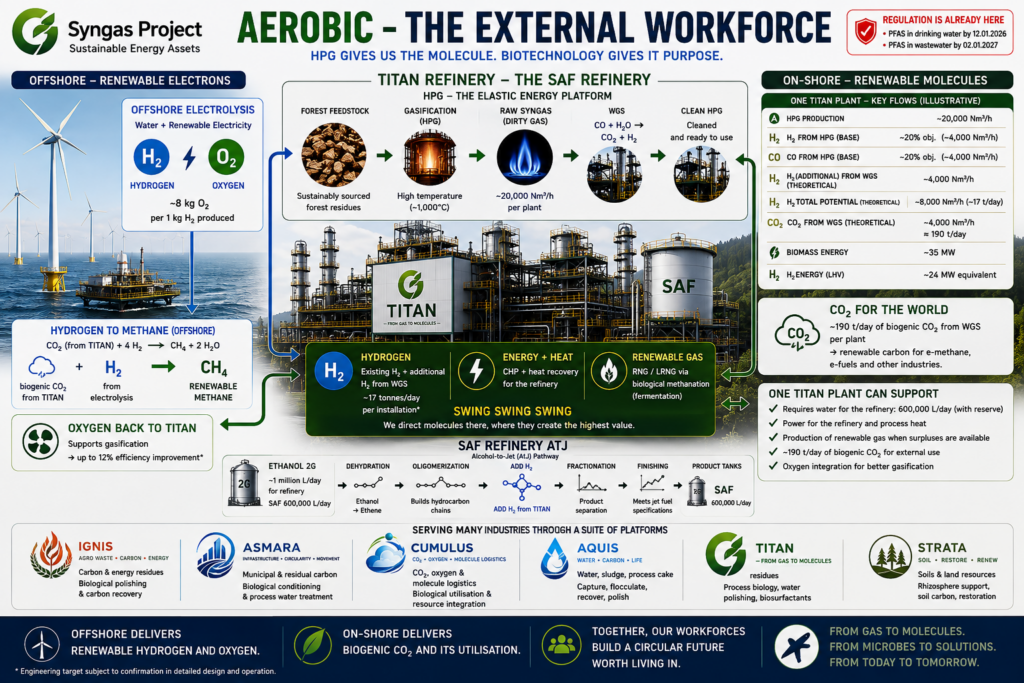
The expanding renewable-hydrogen economy creates oxygen as a coproduct of electrolysis.
For approximately every kilogram of hydrogen produced by water electrolysis, around 8 kg of oxygen is produced stoichiometrically.
That oxygen has value.
CUMULUS is already developing the logistics around renewable molecules including LCO₂ and LOX.
TITAN therefore gains access to an increasingly interesting external oxygen resource.
A portion can support oxygen-enhanced gasification and reduce unnecessary nitrogen entering HPG.
But only a relatively small part of the opportunity belongs there.
The much more interesting question is:
What else can we do with abundant renewable oxygen?
The answer takes us back to Sector 5.1.
Fermentation.
2. THE FULL STACK
TITAN’s fermentation capability can now be understood as three complementary biological systems.
| Fermentation pathway | Principal environment | Primary role |
| Acetogenic | Anaerobic | HPG → 2G ethanol and chemical intermediates |
| Methanogenic | Anaerobic | HPG → renewable methane / RNG / LRNG |
| Aerobic | Oxygen-supported | Production and deployment of microbial workers and biological products |
Aerobic therefore does something strategically different.
It allows us to manufacture biology that can leave the Fermentation Station and go to work elsewhere.
We call these microorganisms:
OUR EXTERNAL WORKFORCE
3. FIRST DAY AT WORK — AQUIS
Like any new workforce, ours needs somewhere to start.
Their first workplace is AQUIS.
That is deliberate.
AQUIS begins by protecting TITAN’s own closed-loop water system before developing into a wider water and environmental platform.
Aerobic fermentation gives AQUIS access to biological tools that can help capture, concentrate, separate and manage contaminants.
Two early duties are particularly interesting.
SURFACTANTS
Microbially produced surfactants — biosurfactants — can change the behaviour of interfaces between water, particles, oils and other materials.
In simple terms, they can help move difficult contaminants away from where they are hiding and towards the separation process.
They make pollutants easier to mobilise, aggregate, float, capture or otherwise manage.
They are biological helpers working between phases and surfaces.
Then another group takes over.
FLOCCULATION
Microbial flocculants and bioflocculant-producing organisms can encourage dispersed particles and molecules to come together into larger aggregates.
Instead of trying to filter billions of tiny individual targets, AQUIS can encourage them to assemble into something much easier to separate.
The principle is beautifully simple:
SURFACTANT
↓
MOBILISE
↓
FLOCCULATE
↓
AGGREGATE
↓
FILTER
↓
CAPTURE
↓
EXTINCTION
The final step takes us back to the NEPSD story.
Because our microbial workers help us catch the problem.
They do not give us permission merely to move it somewhere else.
4. MICROBIAL CONSORTIA
Nature rarely operates with one microorganism doing everything.
Neither should we.
Different microorganisms can work together as consortia.
One organism may produce a useful enzyme.
Another may alter pH or local chemistry.
Another may metabolise an intermediate.
Another may capture a nutrient.
Another may produce a biosurfactant or extracellular polymer.
Together, microbial communities can perform tasks that would be difficult for a single strain.
That opens a much larger toolbox for AQUIS and the wider TITAN CAMPUS.
Potential duties include:
- biosurfactant production;
- bioflocculant production;
- nutrient recovery;
- nitrogen and phosphorus management;
- hydrocarbon biodegradation;
- degradation of selected organic contaminants;
- odour control;
- biological polishing of process water;
- sludge conditioning;
- digestate conditioning;
- mobilisation or immobilisation of selected metals;
- production of enzymes and extracellular polymers;
- biofilm management;
- soil and rhizosphere support;
- biological carbon transformation;
- recovery of useful molecules from dilute waste streams.
Not every organism performs every task.
Not every application is ready today.
And not every microbial pathway should be released into an operating environment simply because it works in a laboratory.
That is why another member of CAMPUS joins the story.
5. BRAD WATCHES THE WORKFORCE
A biological workforce needs supervision.
AQUIS therefore works with BRAD.
BRAD is our CAMPUS intelligence layer.
Sensors tell us what is happening.
Laboratories tell us what is present.
Scientific literature tells us what is becoming possible.
Regulation tells us what society is beginning to care about.
BRAD brings those information streams together.
For aerobic fermentation that creates another responsibility:
know what is out there.
There are hundreds of universities, microbiology institutes, biotechnology centres and specialist laboratories around the world developing organisms, enzymes, microbial consortia and fermentation processes.
The biological toolbox is expanding rapidly.
AI will accelerate that development further.
Machine learning can already support strain screening, metabolic pathway analysis, fermentation optimisation, protein and enzyme discovery and the identification of promising microbial combinations.
Today our intended microbial workers are non-GMO.
Tomorrow’s toolbox will become substantially larger.
That does not mean automatically deploying whatever biotechnology produces next.
It means watching.
Testing.
Understanding.
Validating.
And introducing new biological capability only when its performance, containment, environmental implications and regulatory position are understood.
BRAD watches.
Scientists verify.
Engineers decide.
6. PROTECTING BOTH WORKFORCES
There are two workforces on CAMPUS.
The microbial workforce.
And the human one.
Both need protection.
AQUIS and BRAD therefore have another shared duty.
Monitor what enters CAMPUS.
Monitor what develops inside it.
Monitor what leaves it.
Water chemistry.
Microbial populations.
PFAS.
MNPs.
Metals.
Hydrocarbons.
Pharmaceutical residues.
Unexpected biological activity.
Process stability.
Environmental performance.
The objective is not simply to operate fermentation.
It is to understand the biological environment in which fermentation operates.
7. FROM ONE FERMENTATION STATION TO A FAMILY OF PLATFORMS
This is where aerobic fermentation becomes much bigger than TITAN One.
Sector 5.1 gives CAMPUS a biological production capability.
Once that capability exists, the microbial workforce can serve other platforms.
And this reveals the wider SOLIDEA architecture.
HPG IS THE COMMON CURRENCY
We began as a gas company.
Then biotechnology changed what gas could become.
And eventually we realised that the combination of gas + microbes could address something considerably larger:
stranded carbon.
Carbon stranded in forest residues.
Carbon stranded in municipal waste.
Carbon stranded in wastewater.
Carbon stranded in sludge.
Carbon stranded in digestate.
Carbon stranded in contaminated water.
Carbon stranded in industrial residues.
Different feedstocks.
Different problems.
Different products.
But increasingly the same underlying toolkit:
GASIFICATION
- ●
HPG
- ●
FERMENTATION
- ●
MICROBIAL WORKERS
- ●
SEPARATION
- ●
CARBON RECOVERY
8. THE WIDER PLATFORM FAMILY
Aerobic capability therefore becomes a shared CAMPUS resource.
| Platform | Stranded resource / challenge | Example aerobic microbial duty |
| TITAN | Forest residues | Water polishing, biosurfactants, bioflocculants, process biology |
| AQUIS | Water, sludge, process cake | Contaminant mobilisation, flocculation, nutrient recovery, biological polishing |
| ASMARA | Sorted municipal and residual carbon | Biological conditioning, process-water treatment, recovery support |
| CUMULUS | CO₂ / oxygen / renewable molecule logistics | Biological utilisation pathways and CAMPUS resource integration |
| IGNIS | Carbon and energy residues | Biological polishing and recovery of residual carbon streams |
| STRATA | Soil and land resources | Rhizosphere support, nutrient cycling, soil-carbon and biological restoration |
This list is not exhaustive.
It is the beginning.
Because once CAMPUS can manufacture and manage its own microbial workforce, every difficult carbon or water stream becomes a slightly different question:
Can biology do part of this job better?
Sometimes the answer will be no.
Sometimes chemistry wins.
Sometimes gasification wins.
Sometimes filtration wins.
Sometimes plasma wins.
And increasingly:
sometimes a microbe gets the job.
9. FROM GAS TO MICROBES
This is the important evolution.
We are still a gas company.
HPG remains our common currency.
But we have learned that the value of gas is not determined solely by what we can burn.
Methanogens turn it into renewable methane.
Acetogens turn it into ethanol and chemical intermediates.
Aerobic fermentation gives us another class of products entirely:
workers.
Microorganisms.
Biosurfactants.
Bioflocculants.
Enzymes.
Biopolymers.
Consortia.
Biological tools capable of leaving Sector 5.1 and performing useful work throughout CAMPUS.
That completes another piece of the TITAN architecture.
Gas gives us molecules.
Fermentation gives those molecules purpose.
Aerobic fermentation gives us workers.
And now we can send them to work.
Welcome to Sector 5.1.