
Warsaw 24:08:2026 Steve Walker
OFFSHORE WIND MEETS ONSHORE CARBON
TITAN at the SAF Refinery
The primary input to an Alcohol-to-Jet SAF refinery is 2G ethanol.
At our current design basis:
1.7 litres 2G ethanol → 1 litre SAF
A 600,000 litre/day SAF refinery therefore requires approximately:
600,000 × 1.7 = 1.02 million litres 2G ethanol/day
For back-of-the-envelope planning:
~1 million litres of 2G ethanol per day
At approximately 80,000 litres/day of 2G ethanol production per CAMPUS island, this represents the production of approximately 12.5–13 islands.
That is the primary molecule.
But an AtJ refinery needs another important input.
Hydrogen.
And this is where the story becomes more interesting.
HYDROGEN DOES NOT HAVE TO BEGIN WITH ELECTROLYSIS
Renewable hydrogen is commonly associated with electrolysis:
RENEWABLE ELECTRICITY + WATER → H₂ + O₂
Wind generates electricity.
The electricity powers an electrolyser.
Water is separated into hydrogen and oxygen.
The hydrogen is conditioned and supplied to the process requiring it.
This is an important renewable-hydrogen pathway.
But it is not the only pathway.
TITAN starts somewhere completely different.
TITAN already produces hydrogen.
TITAN converts forest residues into Hydrogen Producer Gas — HPG.
HPG is exactly what its name describes:
hydrogen in a carrier gas.
For some applications, this can make HPG less convenient than producing a dedicated hydrogen stream.
HPG must be cleaned and conditioned.
Hydrogen must be separated when a dedicated H₂ stream is required.
The carrier gas contains other molecules, including carbon monoxide, methane, carbon dioxide and nitrogen.
But convenience and usefulness are not necessarily the same thing.
At an integrated SAF refinery, we need more than hydrogen.
We need:
HYDROGEN + ELECTRICITY + HEAT
and we want the ability to produce:
RNG / LRNG
when those refinery requirements change.
That changes the equation.
START WITH ONE TITAN ISLAND
One TITAN island has an approximate forest-residue energy input of:
~35 MW
and produces approximately:
20,000 Nm³/h HPG
Using the current illustrative TITAN HPG composition for back-of-the-envelope calculation:
| ONE TITAN ISLAND | ILLUSTRATIVE BASIS |
| Forest-residue energy input | ~35 MW |
| HPG production | ~20,000 Nm³/h |
| H₂ | ~20 vol.% |
| CO | ~20 vol.% |
| Existing H₂ | ~4,000 Nm³/h |
| CO available for WGS | ~4,000 Nm³/h |
The first hydrogen is therefore already present in the gas.
Approximately:
4,000 Nm³/h H₂
or:
~8.6 tonnes H₂/day
But that is only the beginning.
THE HYDROGEN HIDING IN THE CO
TITAN HPG also contains carbon monoxide.
For some applications CO can be regarded as something that must be managed.
At TITAN it becomes another resource.
We use the well-established Water-Gas Shift — WGS reaction:
CO + H₂O → CO₂ + H₂
The important relationship is straightforward.
One mole of CO converted through WGS creates one mole of additional hydrogen.
Therefore, on our illustrative basis:
~4,000 Nm³/h existing H₂
plus theoretically:
~4,000 Nm³/h additional H₂ from WGS
gives approximately:
~8,000 Nm³/h gross theoretical H₂ potential
or:
~17 tonnes H₂/day
before WGS conversion, gas-conditioning, separation, purification and compression losses.
Expressed as hydrogen energy, this is approximately:
~24 MW H₂ — LHV
from an initial forest-residue energy input of approximately:
~35 MW
These are deliberately back-of-the-envelope calculations.
They are not equipment guarantees.
Actual performance will depend upon measured HPG composition, WGS conversion, gas conditioning, hydrogen recovery, purity requirements and final process design.
But they demonstrate something important.
HPG is not simply a gas containing some hydrogen.
Its CO can become another source of hydrogen.
NOW COMPARE WIND + WATER
Imagine producing approximately the same quantity of hydrogen through renewable electrolysis.
The pathway becomes:
OFFSHORE WIND → ELECTRICITY → WATER ELECTROLYSIS → H₂
At a working back-of-the-envelope electrolyser consumption of approximately 52 kWh/kg H₂, producing around 17 tonnes H₂/day requires approximately:
~37 MW of continuous electrical input
Wind turbines do not operate continuously at their nameplate capacity.
At an illustrative 40% capacity factor, supplying this average electrical requirement would correspond to approximately:
~90–95 MW of installed offshore wind capacity
The comparison is not intended to suggest that 35 MW thermal and 95 MW installed wind are equivalent forms of capacity.
They are not.
It demonstrates the very different infrastructure pathways capable of supplying approximately the same daily hydrogen requirement.
| TITAN | OFFSHORE WIND + ELECTROLYSIS | |
| Primary renewable resource | Forest residues | Wind |
| Conversion route | Gasification + WGS | Electricity + electrolysis |
| Illustrative H₂ | ~17 t/day gross potential | ~17 t/day |
| Dedicated electrolyser | No | Yes |
| Continuous electricity for electrolysis | No | ~37 MW |
| Approx. installed wind at 40% CF | — | ~90–95 MW |
| Major additional useful streams | CO₂ + HPG | O₂ |
At first sight these look like competing approaches to renewable hydrogen.
They do not have to be.
In fact, they have the potential to complement each other remarkably well.
TITAN HAS SOMETHING OFFSHORE HYDROGEN NEEDS
When we shift the CO contained in TITAN HPG:
CO + H₂O → CO₂ + H₂
we do not only produce additional hydrogen.
We also produce biogenic CO₂.
From the illustrative:
4,000 Nm³/h CO
WGS theoretically produces approximately:
4,000 Nm³/h CO₂
This represents approximately:
~190 tonnes/day of biogenic CO₂
from shifted CO alone.
Any CO₂ already contained in the incoming HPG would be additional to this gross WGS-generated quantity.
This carbon came from forest residues.
It is therefore biogenic carbon.
And that makes it potentially valuable to another renewable-energy industry.
OFFSHORE HYDROGEN NEEDS CARBON
Renewable hydrogen can be converted into renewable methane.
But hydrogen alone cannot make methane.
It needs carbon.
The methanation reaction is:
CO₂ + 4H₂ → CH₄ + 2H₂O
Offshore wind can therefore provide the renewable hydrogen.
TITAN can provide the biogenic carbon.
Our illustrative ~190 tonnes/day of WGS-derived CO₂ represents sufficient carbon, theoretically, to react with approximately:
~34 tonnes/day H₂
and produce approximately:
~69 tonnes/day renewable CH₄
before real-world conversion and process losses.
Suddenly the TITAN CO₂ stream is not simply something to capture.
It is a renewable-carbon feedstock.
AND OFFSHORE WIND HAS SOMETHING TITAN CAN USE
Electrolysis does not only produce hydrogen.
It produces oxygen.
Approximately:
1 kg H₂ → 8 kg O₂
Therefore an electrolyser producing approximately 17 tonnes/day H₂ also produces approximately:
~136–138 tonnes/day O₂
That oxygen can have relatively limited value if there is no nearby consumer.
TITAN is a potential consumer.
Why?
Because conventional air-blown gasification introduces nitrogen with the oxygen contained in air.
The oxygen participates in the process.
The nitrogen largely travels with the gas.
It dilutes the useful HPG.
If recovered oxygen from electrolysis is introduced into the TITAN gasification system, part of the air requirement can potentially be displaced.
That means:
MORE O₂
↓
LESS AIR
↓
LESS N₂
↓
LESS HPG DILUTION
↓
HIGHER USEFUL GAS CONCENTRATION
TITAN’s current engineering proposition is that oxygen enrichment could potentially improve gasification performance by up to approximately 12%.
That figure remains an engineering target to be confirmed through detailed design and operating validation.
But the direction is clear.
The offshore industry’s coproduct can become an onshore process input.
OFFSHORE WIND MEETS ONSHORE CARBON
Now the two systems begin to fit together.
OFFSHORE
WIND + WATER
↓
ELECTRICITY
↓
ELECTROLYSIS
↓
H₂ + O₂
The hydrogen needs renewable carbon if it is to become renewable methane.
The oxygen needs a productive industrial use.
ONSHORE
FOREST RESIDUES
↓
TITAN
↓
HPG
↓
WGS
↓
H₂ + BIOGENIC CO₂
TITAN can use oxygen.
Offshore hydrogen can use TITAN’s biogenic CO₂.
Each system produces something the other system needs.
AND THE SAF REFINERY SITS BETWEEN THEM
This is why the location of TITAN matters.
We put TITAN at the SAF refinery.
The refinery has an immediate requirement for hydrogen.
It also requires electricity and process heat.
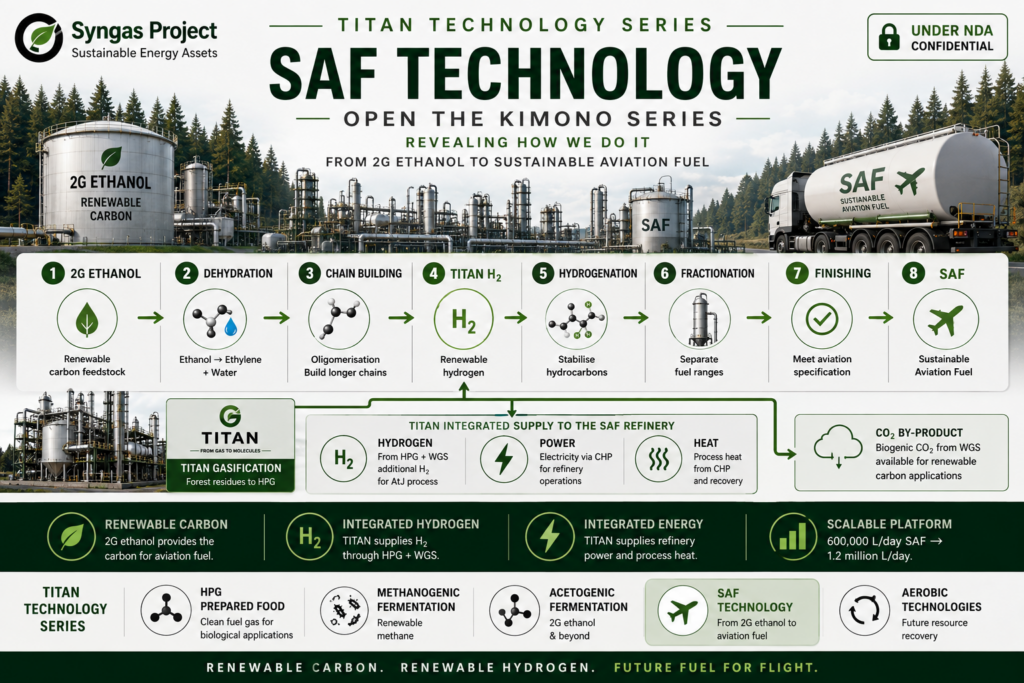
TITAN can supply all three from the same HPG platform.
HYDROGEN
HPG → WGS → H₂ RECOVERY → AtJ
POWER + HEAT
HPG → CHP → ELECTRICITY + PROCESS HEAT
RENEWABLE GAS
HPG → METHANOGENIC FERMENTATION → RNG / LRNG
This gives TITAN something a dedicated hydrogen plant does not inherently possess.
Optionality.
SWING SWING SWING
The refinery does not consume exactly the same amount of hydrogen, electricity and heat every hour.
Solar production changes.
BESS state of charge changes.
Refinery throughput changes.
Maintenance happens.
TITAN can respond.
| CONDITION | TITAN RESPONSE |
| H₂ demand increases | Increase HPG allocation to H₂ |
| H₂ demand decreases | Increase HPG available for RNG |
| Electricity demand increases | Increase CHP allocation |
| Solar generation increases | Reduce HPG electrical duty |
| BESS supplies peak load | Reduce peak CHP requirement |
| Heat demand increases | Increase thermal utilisation |
| Refinery throughput falls | Swing HPG towards RNG/LRNG |
| Refinery offline | Maintain alternative HPG utilisation |
We call this:
SWING SWING SWING
The HPG molecule is directed to where it creates the greatest operating value.
THIS IS INDUSTRIAL CIRCULARITY
The conventional view separates the industries.
Offshore wind produces renewable electricity.
Electrolysers produce hydrogen.
Forestry produces residues.
Gasification produces gas.
SAF refineries consume ethanol and hydrogen.
Methane producers need hydrogen and carbon.
We see the opportunity differently.
Connect the molecules.
Offshore wind produces:
H₂ + O₂
TITAN produces:
HPG + H₂ + BIOGENIC CO₂
The SAF refinery consumes:
2G ETHANOL + H₂ + POWER + HEAT
Methanogenic conversion consumes:
H₂ + BIOGENIC CARBON
TITAN gasification can potentially use:
O₂
So instead of separate energy systems, we create a circular industrial relationship:
OFFSHORE H₂ + ONSHORE BIOGENIC CO₂ → RENEWABLE METHANE
OFFSHORE O₂ → ONSHORE TITAN → IMPROVED GASIFICATION
TITAN H₂ → AtJ → SAF
TITAN HPG → CHP → REFINERY POWER + HEAT
SURPLUS TITAN HPG → RNG / LRNG
Yesterday’s coproduct becomes tomorrow’s feedstock.
OFFSHORE WIND MEETS ONSHORE CARBON
This is not an argument for HPG instead of electrolysis.
Nor is it an argument for offshore wind instead of biomass.
The more interesting proposition is that they complement each other.
Offshore wind has renewable hydrogen and oxygen.
Onshore TITAN has renewable carbon, HPG and a productive use for oxygen.
The SAF refinery has immediate demand for hydrogen, power and heat.
Put them together and the apparent disadvantages of each individual system begin to become advantages of the combined system.
Wind provides the renewable electrons.
TITAN provides the renewable carbon.
The refinery connects them.
And TITAN keeps the whole system flexible:
H₂ → POWER + HEAT → RNG
SWING SWING SWING
That is TITAN at the SAF refinery.