Warsaw 02:09:2026 Steve Walker
COMPLEMENTARY PLATFORMS
What TITAN Can Unlock
1. First TITAN. Then We Earn the Right to Expand.
TITAN comes first.
It must be built, commissioned, operated and demonstrated as a successful business in its own right. None of the opportunities described in this Spoiler is required to support the TITAN One investment case.
That distinction is fundamental.
However, once TITAN is operating, Syngas Project owns considerably more than a production plant. We have established people, O&M+Fuel, resource logistics, HPG production, gas cleaning, fermentation, utilities, water systems, BRAD intelligence, product handling, stakeholder relationships and an operating industrial location.
Most importantly, we have established CAMPUS.
The question then changes from:
Can we build TITAN?
to:
What else can we responsibly build from the capability TITAN has already created?
That is where the wider Syngas Project business begins.
2. CAMPUS — Build on What We Already Have
A mature TITAN CAMPUS can develop to three clusters comprising six islands. This establishes substantial common infrastructure and a permanent regional industrial presence.
Syngas Project does not then need to start every subsequent business from an empty field.
New activities can share knowledge, people, utilities, control systems, logistics, operating relationships and, where appropriate, the common HPG architecture.
The commercial principle is important: we start new capabilities at home before asking them to survive outside it.
AQUIS can begin by managing our own water. CUMULUS can begin with our own gases. PowerCan can begin with our own forest operations. RADAR can begin by understanding the carbon surrounding our own CAMPUS.
Each capability starts with a real job.
Each can be managed as an identifiable cost centre.
Only when capability, demand and commercial pipeline justify expansion does it develop into a larger standalone business.
The progression is deliberately controlled:
Internal Capability → Cost Centre → External Service → Revenue → Pipeline → Platform → Replication
This is organic growth in the commercial sense as well as the literal one.
3. RADAR — Read the Territory
TITAN establishes CAMPUS on forest carbon.
RADAR then looks beyond the forest.
Its purpose is to identify stranded and misplaced carbon and associated resources within the CAMPUS territory.
RADAR asks practical questions. What exists locally? How much? Who controls it? What happens to it today? What does that cost? What is its moisture, composition and energy value? What useful materials or nutrients are mixed with it? Can it be recovered commercially? Which Syngas Project capability is appropriate?
This changes the long-term resource strategy.
We do not assume that forest residue must provide every tonne of carbon required by every future activity on CAMPUS.
TITAN establishes the regional position. RADAR tells us where growth should go next.
4. HPG — The Common Technological Door
The resources identified by RADAR can be very different.
Forest residue is not RDF. RDF is not digestate. Digestate is not sludge. Each requires appropriate recovery, separation and preparation.
The common architecture begins once suitable carbon has been prepared for conversion:
Resource → Recovery & Separation → Feedstock Preparation → Energy and Moisture Balance → Gasification → Clean HPG → Selected Downstream Duty
This is one of the most important characteristics of the Syngas Project model.
Before HPG, different platforms specialise in different resources.
After HPG, we increasingly deal with a controlled gaseous intermediate.
HPG is the common door.
What we do on the other side of that door depends upon the highest-value technically and commercially appropriate use.
5. ASMARA — Community Carbon
ASMARA extends CAMPUS into the community resource economy.
In many locations, the difficult part has already been done. Municipal and private waste operators collect material, recover recyclable fractions and manufacture RDF.
ASMARA does not need to replace those operators.
It can provide something they need: a long-term, technically qualified, third-party endorsed and ultimately bankable offtake for specification-compliant RDF.
The relationship can therefore remain extremely simple:
Community → Existing Operator → Sorting & Resource Recovery → RDF → ASMARA → HPG → Energy + Renewable Molecules
This allows established operators to continue collecting, sorting, preparing and potentially transporting the resource. Where commercially appropriate, the same industrial partners can operate the ASMARA conversion facility.
Existing thermal infrastructure does not need to close for ASMARA to succeed. Those assets can continue performing their present role.
Our opportunity is increasingly what gets built next.
Where rural or regional communities would benefit from a different resource-management structure, ASMARA can also support Wet/Dry separation, with the wet biological fraction directed toward AD and the prepared dry carbon fraction toward materials recovery and gasification.
The resulting digestate, water and nutrient streams then create opportunities for IGNIS and AQUIS.
6. From Today’s RDF to Yesterday’s Landfill
ASMARA can begin with carbon already moving through today’s waste-management system.
The longer-term opportunity is considerably larger.
Europe has accumulated enormous quantities of historical municipal material in landfill. Those sites contain carbon and recoverable materials while continuing to create long-term environmental liabilities.
As sorting, analytical, gas-cleaning and process-protection systems continue improving, ASMARA can progressively move backwards into this historical resource.
The objective is not simply to excavate a landfill and gasify its contents.
Materials should first be characterised and separated. Recoverable materials should be recovered. Suitable carbon can then be prepared for conversion, while inappropriate fractions receive the treatment they require.
AQUIS naturally participates in the associated water and leachate challenge.
The long-term philosophy is straightforward:
First, create a better destination for today’s community carbon. Then progressively recover the resources previous generations buried.
7. IGNIS — Agricultural Carbon
IGNIS extends the resource map into agriculture.
Agricultural production and biological processing create dry residues, digestate and other concentrated carbon and nutrient streams. Some are already well used; others remain stranded or represent a cost to their producer.
IGNIS identifies where those resources can be separated and returned to productive use.
IGNIS Broiler focuses specifically on concentrated poultry-production residuals, recovering useful fractions and preparing suitable carbon for conversion.
The principle remains the same across the platform: recover before converting.
We do not gasify something merely because it contains carbon. We first determine whether another component has greater value and then prepare the appropriate residual carbon for HPG.
8. AQUIS — Recover What Water Is Carrying
AQUIS starts with our own process-water requirement.
Its role then expands from water management into resource recovery from water and liquid systems.
Wastewater is not necessarily a useless liquid. It can be water carrying carbon, nutrients, minerals and other recoverable resources.
Water treatment itself concentrates stranded carbon into sludge and process solids. AQUIS manages appropriate drying and recovery routes, allowing suitable carbon to return to productive use and recoverable minerals to be separated where commercially justified.
AQUIS also works with nutrient-rich liquid fractions — our tea — providing recovered nutrients for fermentation and other biological processes.
Through AQUATEC EPS, AQUIS develops filtration/loading-media services and subsequent recovery from loaded media. Through AQUATEC MS — Microbial Systems, it develops microbial water treatment, closed-loop process-water systems and related biological applications.
The first customer remains Syngas Project.
TITAN, future SAF facilities, PowerCan and the wider CAMPUS all require water and fluid management.
Once proven at home, AQUIS capability can travel.
9. CUMULUS — Molecules Between Industries
CUMULUS also starts on Day One because TITAN itself creates a gas business.
TITAN produces and manages HPG, renewable methane, hydrogen and biogenic CO₂. The surrounding industrial economy simultaneously creates requirements and opportunities around oxygen, CO₂ and industrial off-gases.
CUMULUS develops those interfaces.
This is particularly interesting at the boundary between the onshore carbon economy and the developing PtX economy.
Electrolysis produces hydrogen together with substantial industrial oxygen. Renewable-fuel and PtX systems can require CO₂. TITAN and other biological processes can produce biogenic CO₂.
CUMULUS does not require every molecule to be physically swapped tonne-for-tonne. It creates the commercial and technical capability to aggregate, route, trade and use these gas streams where the economics make sense.
The same expertise can progressively extend toward steel, alloys, smelting and other industrial off-gas opportunities.
10. PowerCan — Take the Energy Outside the Fence
PowerCan begins with another internal requirement.
TITAN’s forest supply chain requires energy.
DIAMENT and associated forest operations provide the first environment in which Syngas Project can develop dispatchable renewable-energy services using its own renewable gas capability.
From there, PowerCan can progressively support other distributed applications where controllable local energy has value.
Again, we do not begin by building an external business and looking for its first customer.
The first customer is at home.
11. Phase 2 — Full-Stack Fermentation
TITAN establishes commercial experience around HPG and anaerobic biological conversion.
Phase 2 expands this capability through aerobic fermentation.
This does not mean Syngas Project waits for a future scientific breakthrough. Industrial microbial capability already exists across fermentation, water treatment, agriculture, mining and numerous other sectors.
The opportunity is to deploy that capability progressively within an operating industrial environment.
Microorganisms can be understood as biological workers. Different organisms and microbial consortia perform different tasks: producing molecules, transforming nutrients, treating water, processing materials and assisting recovery.
Initially those workers have jobs within their own CAMPUS.
As experience grows, the capability can transcend the cluster. A microbial system proven by AQUIS can be deployed elsewhere. A biological process developed around IGNIS can become an external service. A consortium capable of performing a particular materials-recovery task can ultimately work in another industry.
CAMPUS therefore begins to export not only molecules and energy, but industrial biological capability.
12. STRATA — Re-Mining the Industrial Past
STRATA is a natural destination for part of that developing capability.
Europe’s historical industrial economy has created another enormous stranded-resource inventory: tailings, slag heaps and other industrial residues.
These deposits can contain metals, minerals, critical-material fractions and misplaced carbon while simultaneously contributing to serious environmental and water-management problems.
The clean-up is necessary.
STRATA asks an additional question:
What should be recovered before the liability is removed?
The mining industry has used microbial processes for decades. Modern analytics and AI are improving the ability to understand, select, combine and monitor microbial systems for specific recovery tasks.
STRATA does not need to become a mining company. It can develop as a specialist service provider to the emerging re-mining and advanced materials-recovery industry.
There is a deliberate relationship between the two long-term recovery businesses:
ASMARA re-mines the municipal past; STRATA re-mines the industrial past.
13. CAMPUS Does Not Become Six Unrelated Businesses
This is the point at which discipline matters most.
The purpose of complementary platforms is not to turn Syngas Project into a collection of unrelated ventures.
They share an underlying logic.
RADAR identifies the resource. The appropriate platform recovers and prepares it. HPG provides a common conversion route where appropriate. Fermentation and other downstream systems extract value. BRAD captures the operating intelligence. Established industrial partners provide capabilities where they are better positioned to do so.
Each new activity must justify itself commercially.
If a resource does not justify a platform, we do not build one.
If an established partner can perform a function better, we partner.
If an internal capability cannot develop an external commercial case, it remains an internal service.
Growth follows evidence, not ambition.
14. The Syngas Project Business Begins to Appear
TITAN One remains the plant at hand.
But successful TITAN deployment changes what Syngas Project possesses.
One operating TITAN gives us experience.
A CAMPUS gives us regional presence.
Repeated CAMPUS locations create a network.
That network provides access to different carbon resources, different industrial partners, different communities and different commercial opportunities.
The wider business can therefore develop progressively:
TITAN → CAMPUS → RADAR → Additional Resources → Complementary Capabilities → External Services → New Platforms → Replication
None of those later steps is required to make the first step viable.
Each is an option created by successfully completing the step before it.
THE OPPORTUNITY TITAN UNLOCKS
TITAN establishes our position in the renewable-carbon economy.
Then we look around.
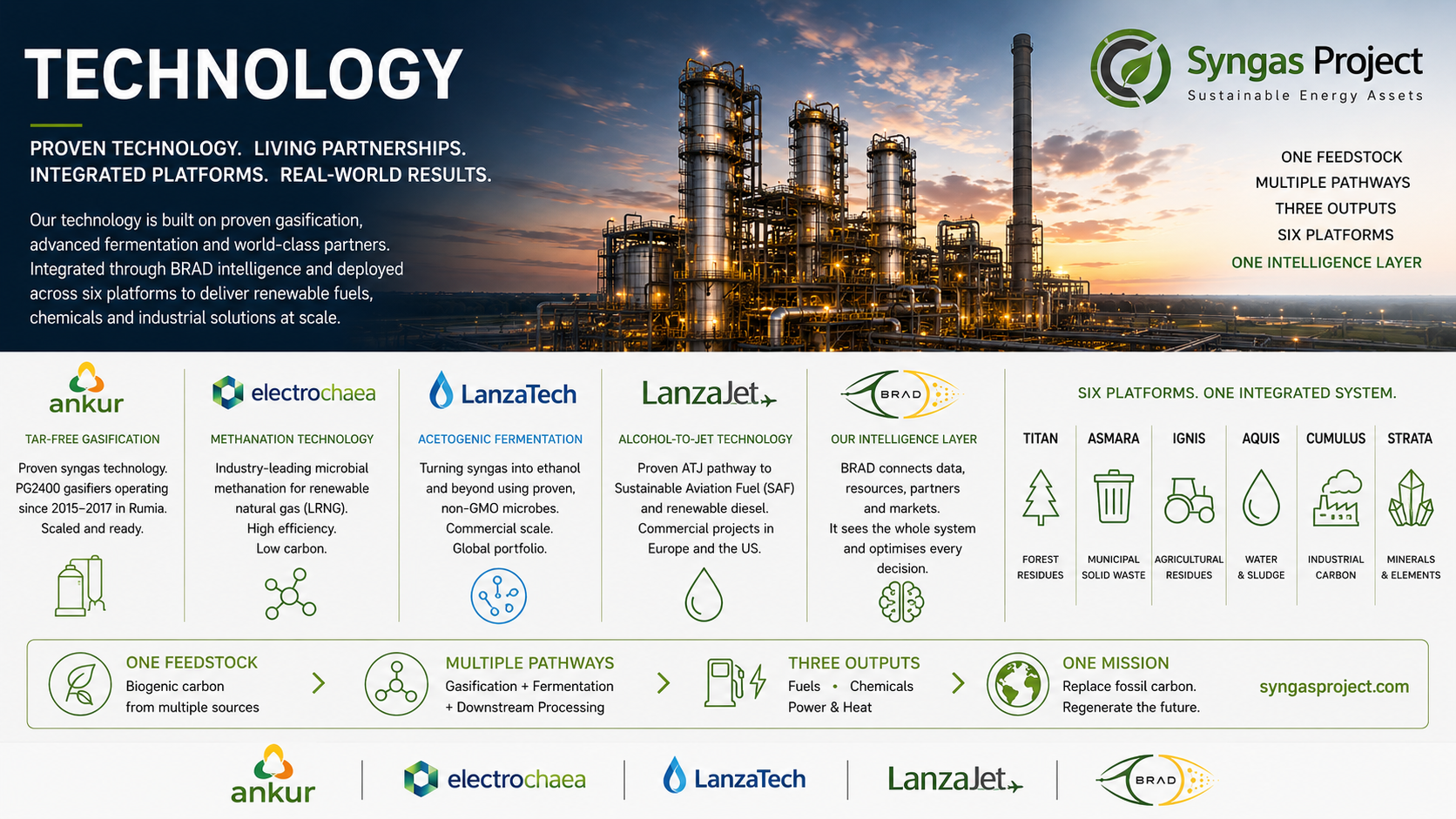
We find community carbon through ASMARA, agricultural carbon through IGNIS, stranded carbon and nutrients through AQUIS, gaseous opportunities through CUMULUS and distributed-energy opportunities through PowerCan.
Full-stack fermentation progressively gives those businesses a larger biological toolbox. STRATA provides a route for that capability into the emerging re-mining industry.
We do not build all of it tomorrow.
We build capability where we already have work for it. We measure its cost. We prove it internally. We find the external customer. We establish revenue. We build the pipeline. Then, and only then, do we build the next platform.
TITAN therefore does something much more important than introduce Syngas Project to one market.
It gives Syngas Project a place from which to grow.
And once that platform exists, we can begin to see the larger industrial transition of which Syngas Project itself is only one part.
That is the big game — and it comes next.