Warsaw 07:09:2026 Steve Walker
CUMULUS: Making the Dedicated Pipeline Redundant
The cryogenic infrastructure connecting Europe’s onshore and offshore renewable-molecule industries
Natural gas was hailed as Europe’s transition fuel. Its flexibility made it valuable to industry, electricity generation, heating, hospitals and transport.
But Europe’s model depended upon enormous quantities of fossil gas travelling through intercontinental pipelines from a limited number of distant production regions.
Geopolitical disruption exposed the strategic weakness of that dependence.
Europe is now building a different energy system. Renewable energy is increasingly produced where the resource exists: offshore wind in the Baltic and North Sea, forestry and agricultural residues across rural Europe, biogas close to agriculture and waste, and renewable electricity wherever suitable generation capacity can be developed.
The challenge is no longer simply producing renewable energy.
It is moving renewable molecules from where they can be produced efficiently to where industry, transport and critical infrastructure need them.
A new dedicated pipeline cannot economically connect every producer to every customer.
CUMULUS provides another route.
Liquefaction → storage → road → rail → ports → vaporisation → local gas infrastructure.
Instead of extending the pipeline to every molecule, CUMULUS moves the molecule.
TITAN — the onshore counterpart to Baltic PtX
A conventional anaerobic-digestion project reaching 5 MW is considered a substantial renewable-gas facility.
TITAN starts at five times that scale — 25 MW — and multiplies from there.
Its hydrogen producer-gas and targeted microbial-fermentation architecture develops renewable-methane production through repeatable industrial increments:
25 MW → 50 MW → 75 MW → 100 MW
TITAN is therefore not simply a larger biogas plant.
It represents a different approach to renewable-molecule infrastructure.
Each additional production block is accompanied by corresponding liquefaction, tanking, vaporisation and logistics capacity. Production and infrastructure expand together using a repeatable cookie-cutter architecture.
That approach runs in parallel with the industrial architecture now emerging around Baltic offshore renewable power and PtX.
Offshore PtX converts renewable electricity into molecules.
TITAN converts renewable biogenic carbon and residues into molecules.
One develops offshore.
The other develops onshore.
Both require the same next layer of physical infrastructure: liquefaction, storage, transport, aggregation and delivery.
TITAN therefore represents the onshore counterpart to the emerging offshore PtX industry.
And CUMULUS provides the physical molecule infrastructure connecting the two.
A two-way Baltic molecule economy
The relationship is not simply producer to customer.
It can become an exchange.
TITAN produces renewable methane and biogenic carbon dioxide. Baltic PtX and industrial-gas infrastructure can provide oxygen generated alongside hydrogen and other renewable molecules.
The basic exchange becomes:
TITAN → LRNG + LCO₂ → PORT / INDUSTRY
BALTIC PtX → LOX → TITAN
In future, LIN and other compatible cryogenic molecule flows can use the same infrastructure.
This creates the opportunity for outward and return logistics rather than one-directional supply chains.
Road tankers, railway wagons and port infrastructure can increasingly carry a useful molecule in both directions.
CUMULUS turns those individual movements into a network.
CUMULUS CRYOGENIC INFRASTRUCTURE
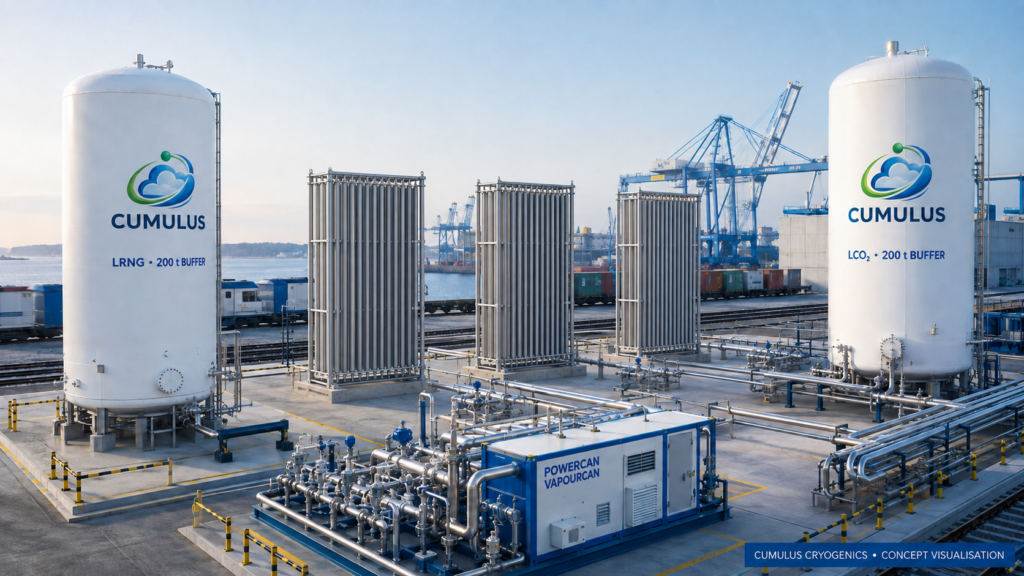
TITAN One — LRNG / LCO₂ buffer storage + LOX / LRNG / LCO₂ vaporisation
See CUMULUS hero graphic above.
Three principal CUMULUS molecules
LRNG — renewable energy that can move
Renewable methane produced by TITAN is liquefied into LRNG — Liquefied Renewable Natural Gas.
Liquefaction radically increases the amount of energy that can be transported in a practical physical volume.
The gas is no longer dependent upon an immediate pipeline connection.
It can be stored.
It can travel by road.
It can travel by rail.
It can pass through ports.
And it can be vaporised back into renewable gas wherever it is required.
This transforms renewable methane from a locally constrained product into a transportable industrial energy commodity.
LCO₂ — biogenic carbon becomes a molecule
TITAN also produces a substantial biogenic carbon dioxide stream.
Rather than treating that carbon as an unmanaged emission, CUMULUS captures, liquefies, measures and transports it as LCO₂.
It can then move to industrial users, chemicals, mineralisation, greenhouse applications, synthetic-fuel production, PtX facilities or permanent storage.
Carbon gains an origin, quantity and destination.
It becomes part of the molecule economy.
LOX — the molecule coming back
The third principal molecule moves in the opposite direction.
Liquid oxygen enters TITAN.
LOX is stored and vaporised to support progressive oxygen enrichment and intensification of the hydrogen producer-gas process.
This creates the foundations of a two-way molecule network:
LRNG + LCO₂ OUT ↔ LOX IN
And because oxygen is itself a major co-product of electrolytic hydrogen production, this creates a natural physical relationship between TITAN and the emerging Baltic PtX industry.
LiquiCan — liquefaction grows with production
TITAN One begins renewable-methane production at 25 MW, approximately 45 tonnes of LRNG per day.
But the cryogenic infrastructure is designed for what comes next.
TITAN grows:
25 MW → 50 MW → 75 MW → 100 MW
LiquiCan grows alongside it.
Modular liquefaction avoids constructing one enormous plant sized around an uncertain future requirement. Capacity is installed in repeatable units as molecule production increases.
A 45-tonne/day LRNG module matches the first 25 MW production step.
Additional modules follow subsequent production increments.
At 100 MW, the architecture provides four operating modules with additional capacity for maintenance resilience and operational flexibility.
The same PowerCan service philosophy extends across the CUMULUS molecule family, including LCO₂ and future cryogenic requirements.
Nothing installed for Phase 1 becomes redundant when Phase 2 arrives.
The infrastructure multiplies rather than being replaced.
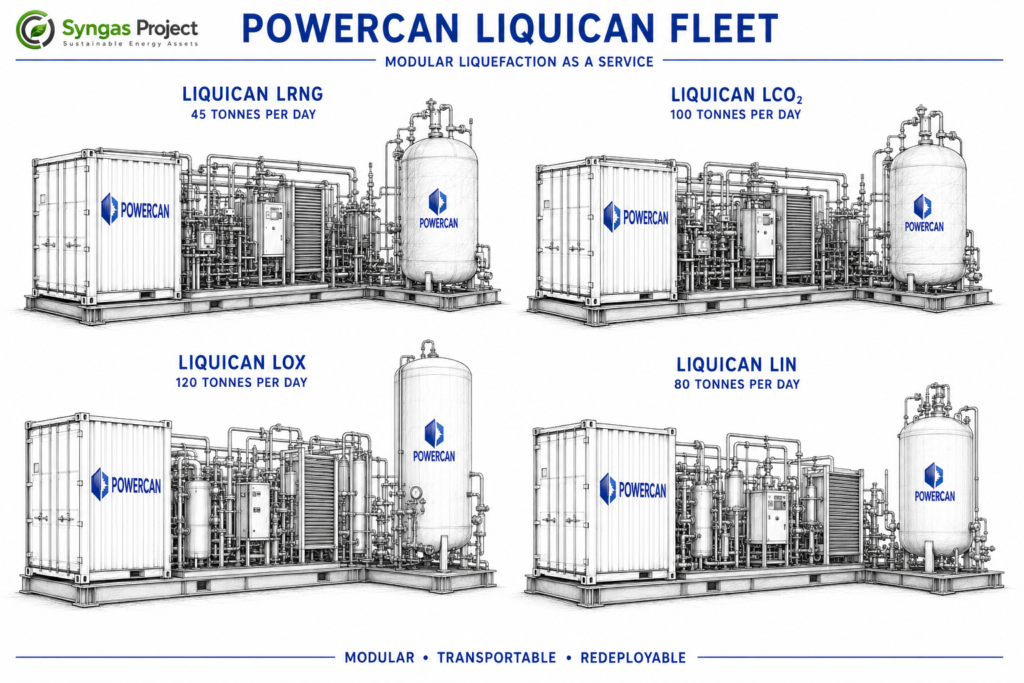
POWERCAN LIQUICAN FLEET
Modular liquefaction as a service
LRNG 45 t/day | LCO₂ 100 t/day | LOX 120 t/day | LIN 80 t/day
Buffering constant production
TITAN produces continuously.
Transport networks do not operate continuously.
A train can be delayed. A customer may receive only during particular windows. Trucks rotate. Ships follow schedules. Equipment requires maintenance.
CUMULUS therefore places storage between production and transport.
At TITAN One the initial architecture provides approximately 200 tonnes of LRNG buffer capacity and 200 tonnes of LCO₂ buffer capacity.
The purpose is not simply inventory.
It is to separate the production clock from the logistics clock.
TITAN continues producing while CUMULUS decides when and how the molecule moves.
The same infrastructure receives incoming LOX and provides the necessary vaporisation capability.
VapourCan — rebuilding the gas connection at the destination
Moving a cryogenic liquid solves only half of the infrastructure problem.
At the destination, the molecule must become useful again.
PowerCan VapourCan provides that interface.
For LRNG:
LRNG → VapourCan → regulation + metering → local gas island
For TITAN:
LOX → storage → VapourCan → gaseous oxygen → producer-gas system
The same modular architecture can support CO₂ and, where required, nitrogen.
This creates two independent dimensions of customer capacity.
More tanks = more MWh of stored energy.
More VapourCan capacity = more MW of instantaneous gas delivery.
A receiving installation can therefore expand progressively rather than being designed around its ultimate capacity on day one.
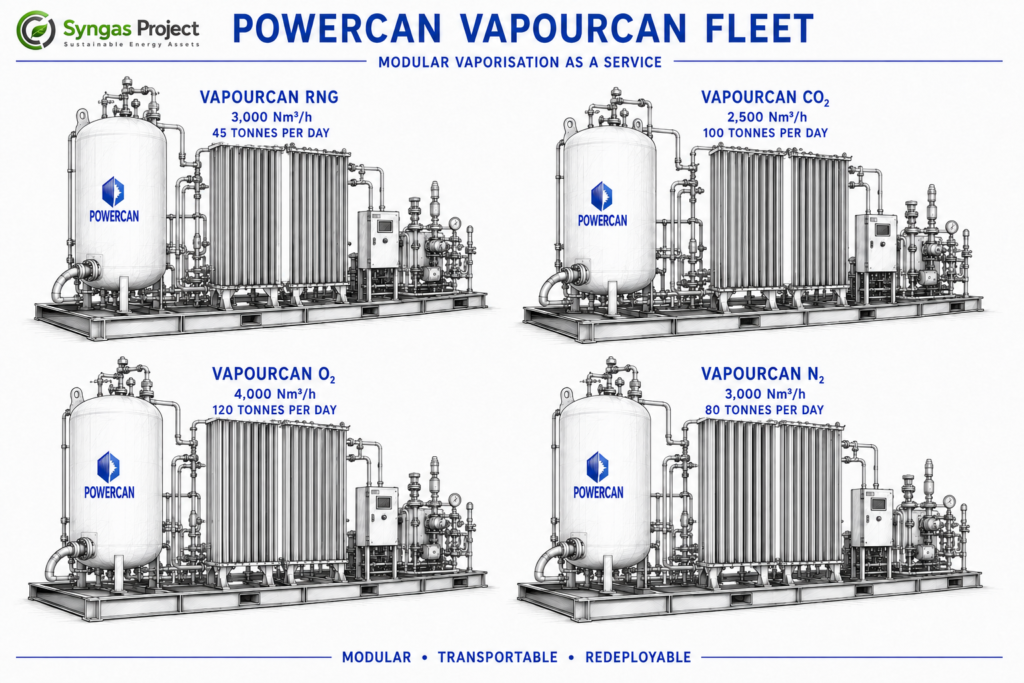
POWERCAN VAPOURCAN FLEET
Modular vaporisation as a service
RNG | CO₂ | O₂ | N₂.
Two transport layers
CUMULUS does not attempt to make one transport asset perform every job.
The system uses two complementary logistics layers.
GasCan T75 — local and regional molecule infrastructure
For local and regional distribution, CUMULUS uses 20-foot T75 cryogenic ISO tank containers.
A T75 carrying LRNG provides approximately 118 MWh of renewable-gas energy on the current planning basis.
That is an important number.
One relatively small intermodal container carries enough energy to become a meaningful component of an industrial or local gas island.
The container can move between modes without transferring its contents:
fill at TITAN → road → rail → terminal/customer → supply → return → refill
The tank therefore becomes more than packaging.
It becomes mobile energy infrastructure.
T75 is particularly suited to industrial gas islands, ports, logistics facilities, transport depots, regional customers, temporary supply, emergency energy and customers that do not require permanent large-scale cryogenic storage.
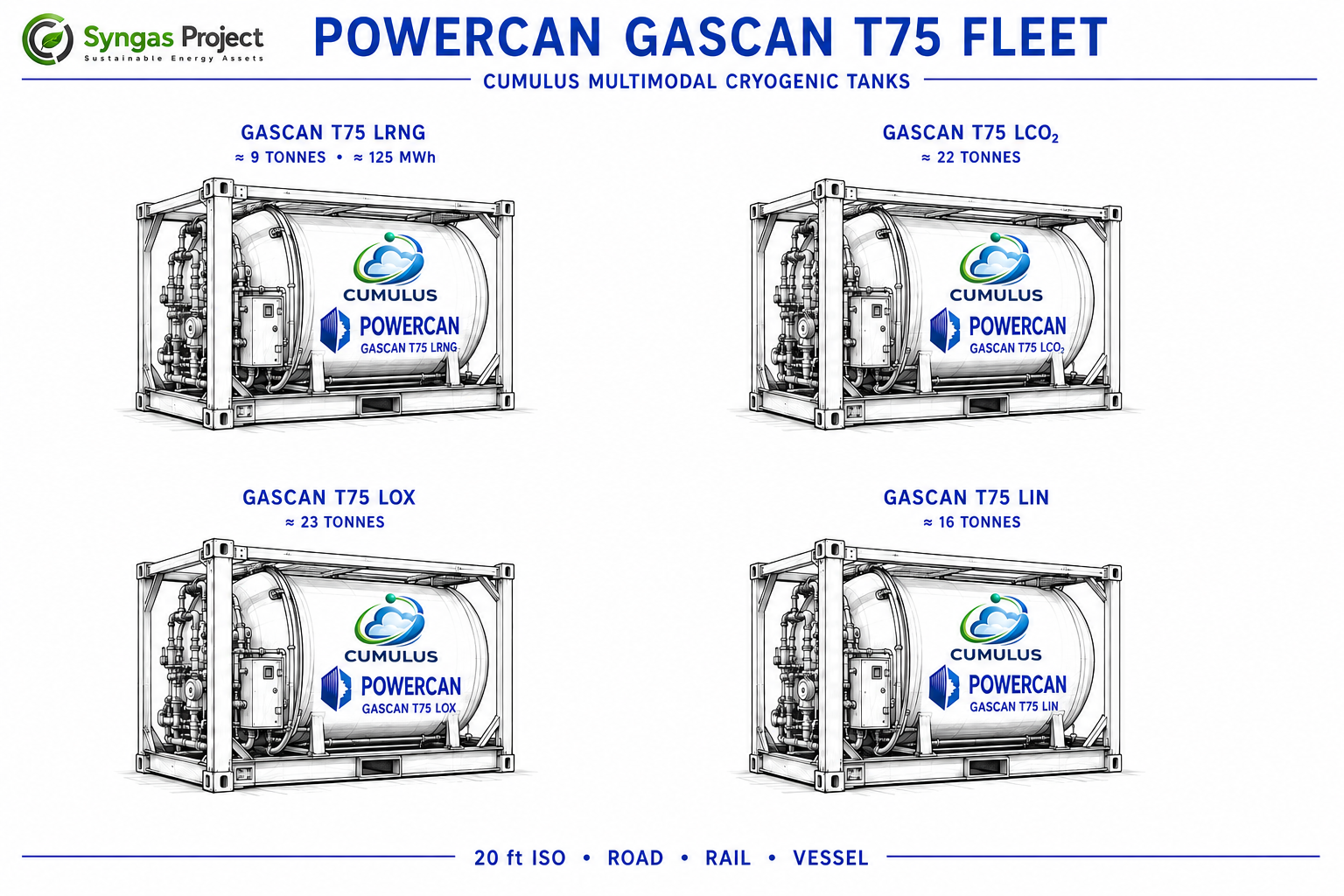
POWERCAN GASCAN T75 FLEET
Intermodal cryogenic molecule containers
LRNG | LCO₂ | LOX | LIN
T75 transport — the island pipeline
The real significance of T75 is intermodality.
The same certified tank can travel by road and rail while the molecule remains inside it.
For local and regional supply, this creates what can effectively be regarded as an island pipeline.
Except the pipeline moves.
Two T75 units can travel on the appropriate road configuration and two units on the rail configuration used in the current CUMULUS planning basis, subject in every case to certified equipment, vehicle and route limits.
A circulating fleet occupies four positions:
loading → travelling → supplying → returning
Fleet size can therefore be engineered around the customer’s consumption rather than around kilometres of permanent pipe.
A customer requiring greater energy reserve receives more tanks.
A customer requiring greater instantaneous flow receives more vaporisation capacity.
The system scales by replication.
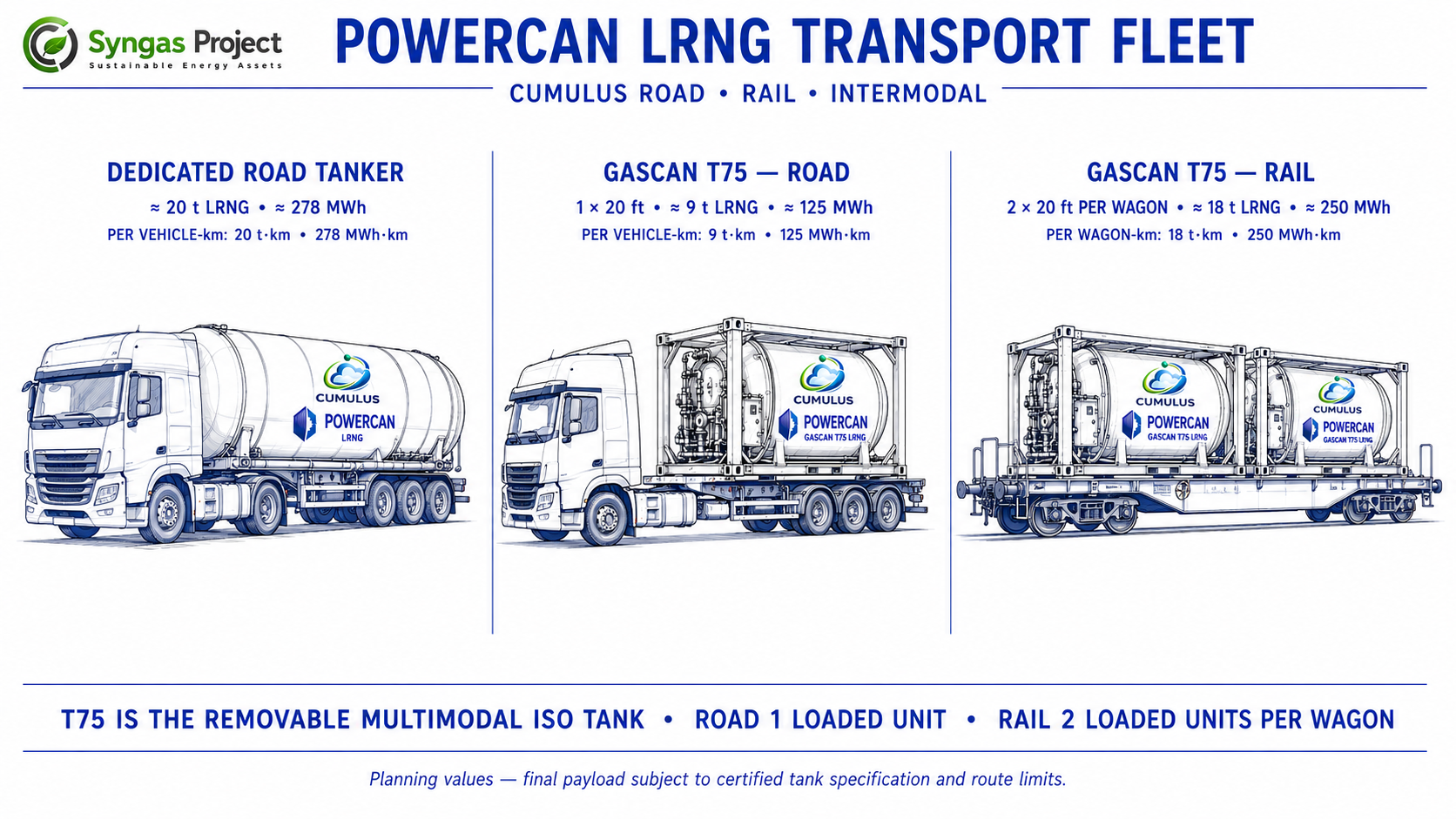
POWERCAN T75 TRANSPORT FLEET
Dedicated tanker • GasCan T75 road • GasCan T75 rail
Fixed rail tankers — when the molecule goes further
T75 provides the local and regional layer.
It does not need to perform the national and international job.
For larger volumes, major industrial customers, traders, ports and long-distance European movements, CUMULUS can use conventional fixed rail tank wagons.
These are fundamentally different from PowerCan’s T75 infrastructure.
The wagon belongs to the railway company, rolling-stock lessor, logistics provider, trader or customer.
We do not need to own the tanker to put it to good use.
When dedicated to the molecule service, the equipment can carry the corresponding CUMULUS or TITAN identity:
CUMULUS — LRNG
TITAN — 2G ETHANOL
CUMULUS — LOX
CUMULUS — LCO₂
This is an important part of the economics.
Europe already possesses an enormous road, rail and port logistics system.
CUMULUS does not propose rebuilding it.
It puts renewable molecules into it.
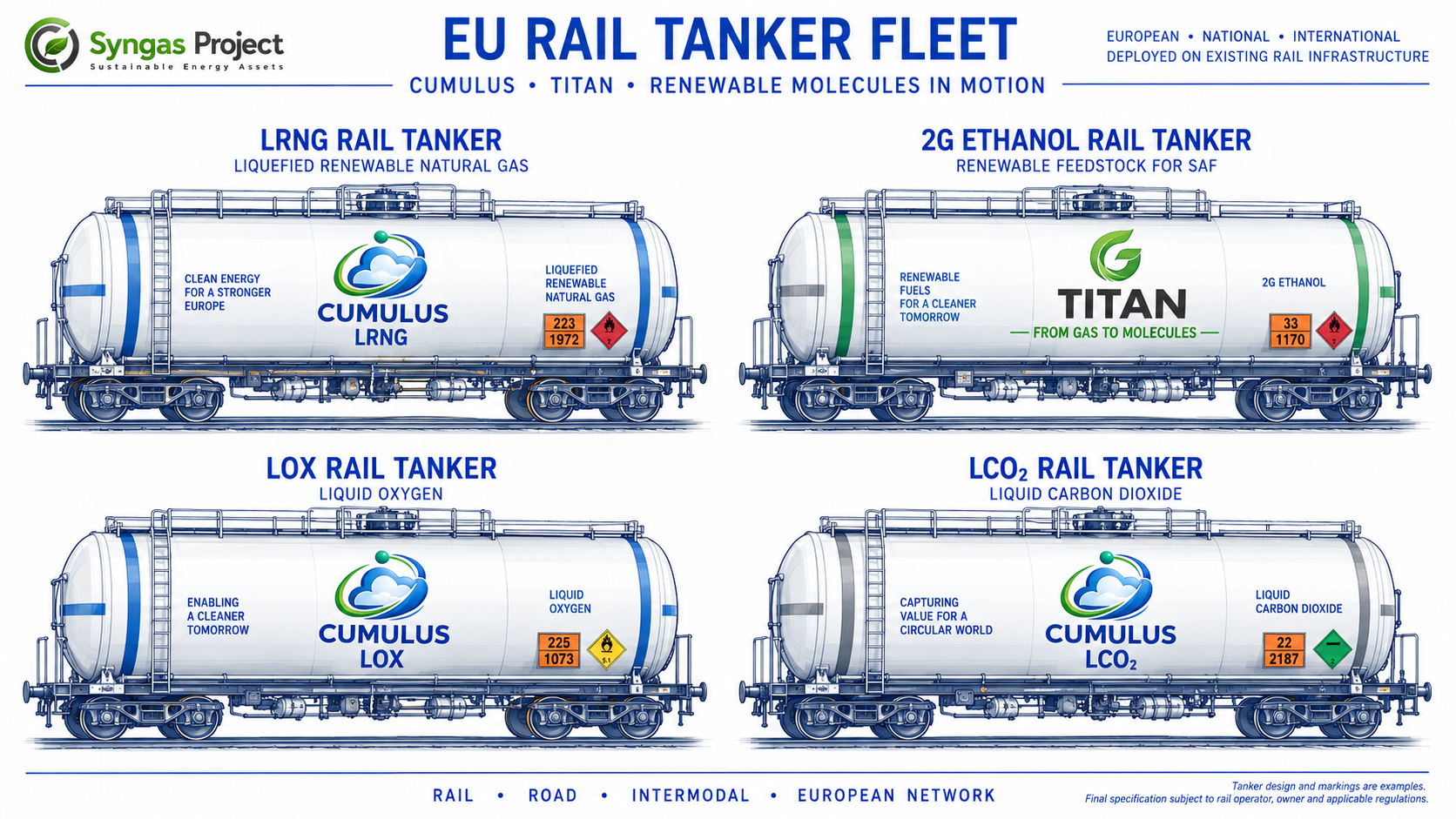
CUMULUS / TITAN EUROPEAN RAIL MOLECULE LOGISTICS
LRNG | 2G ETHANOL | LOX | LCO₂
From T75 to the gas island
The energy carried by LRNG makes a distributed gas network practical.
On the current planning basis:
1 T75 ≈ 118 MWh
Two tanks provide approximately 236 MWh.
Ten provide approximately 1.18 GWh.