Oxygen Is Already in the TITAN DNA
Oxygen is not introduced for the first time when the Aerobic facility is installed.
The capability to receive, control and distribute industrial oxygen is built into TITAN Phase 1.
TITAN uses oxygen enrichment during gasification to displace part of the nitrogen that would otherwise enter with atmospheric air.
Reducing nitrogen at the beginning of the process means less inert gas passes through the complete gas train.
This supports a more concentrated Hydrogen Producer Gas, improves useful gas energy density, reduces downstream gas volumes and lowers compression, handling and cleaning requirements.
Oxygen is therefore already treated as a strategic process input before Aerobic fermentation begins.
When Sector 5a is installed during Phase 2, it connects to an established oxygen backbone rather than requiring an entirely new utility system.
The Biogenic CO₂–Renewable Oxygen Exchange
The Fermentation CAMPUS and renewable e-fuel production have complementary material requirements.
Renewable electrolysis produces hydrogen together with significant quantities of oxygen.
The e-fuel process has a high demand for reliable biogenic carbon dioxide.
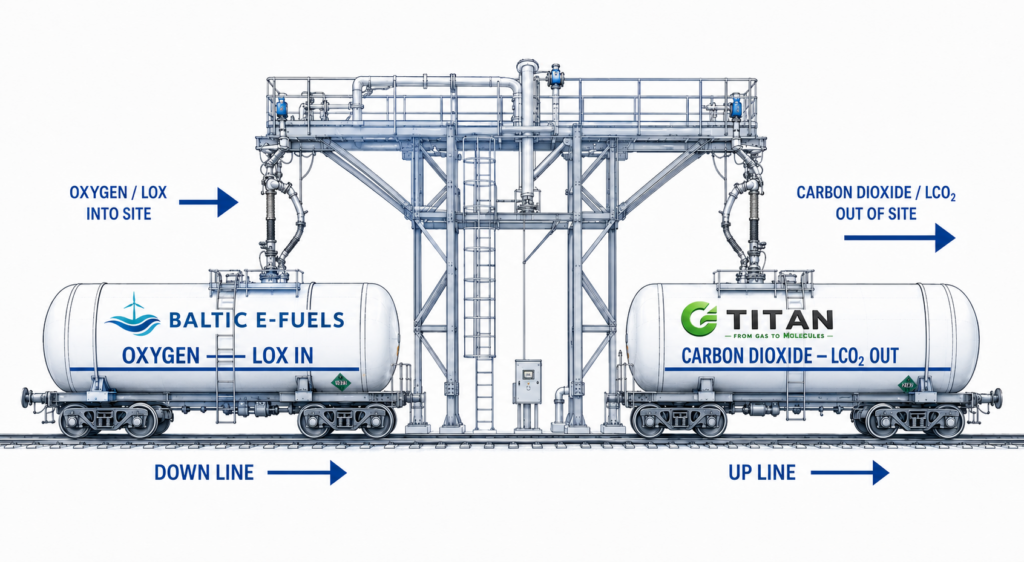
The Fermentation CAMPUS produces recoverable biogenic CO₂ while requiring industrial oxygen from a renewable source.
This creates a natural two-way exchange.
The Fermentation CAMPUS supplies biogenic CO₂ to the e-fuel producer. The e-fuel producer supplies renewable electrolysis oxygen to the Fermentation CAMPUS.
The biogenic CO₂ becomes a carbon input for e-fuels, chemicals and other carbon-based products.
The renewable oxygen returns to the CAMPUS for oxygen-enriched gasification, nitrogen displacement, Aerobic fermentation, heavy-biomass production, water treatment and specialist biological processes.
One system’s excess becomes another system’s strategic input.
E-fuel production creates excess renewable oxygen and requires biogenic CO₂. Fermentation creates excess biogenic CO₂ and requires renewable industrial oxygen.
The exchange connects renewable electricity, electrolysis, gasification, fermentation and e-fuel production within one circular carbon-and-oxygen relationship.
Factory Workers and Field Workers
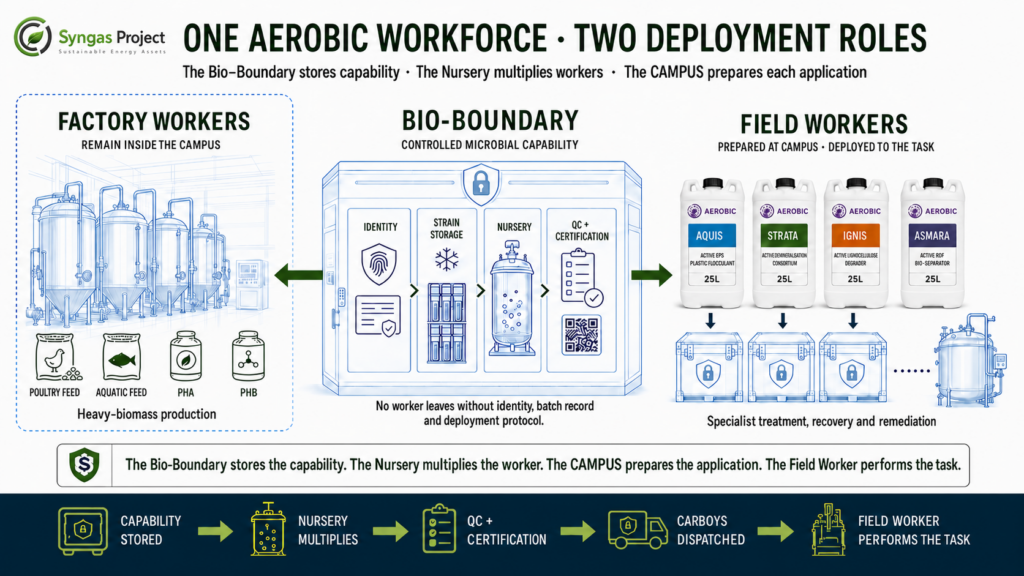
The Aerobic Microbial Workforce is divided into two groups:
Factory Workers and Field Workers.
Factory Workers remain within the Fermentation CAMPUS and manufacture commercial products.
Field Workers are prepared within the CAMPUS and deployed into external systems where their biological capability is required.
Factory Workers make products. Field Workers perform tasks.
Together, they extend microbial fermentation beyond the reactor vessel.
Factory Workers
Factory Workers produce heavy-biomass commercial outcomes within the CAMPUS.
Their principal applications include poultry-feed proteins, aquatic-feed proteins, single-cell proteins, specialist feed ingredients, PHA biopolymers, PHB biopolymers and other biological materials.
Aerobic fermentation is particularly suited to applications where microbial biomass forms part of the commercial product.
This creates an important distinction within the complete fermentation stack.
Methanogenic and Acetogenic Microbes primarily produce gaseous or liquid outcomes.
Factory Workers create solid biological products from cultivated biomass.
Poultry Feed and Aquatic Feed
Aerobic microorganisms can convert prepared carbon and nutrients into concentrated microbial protein.
The resulting biomass can be harvested, separated, washed, dried and formulated into poultry feed, aquatic feed, specialist animal nutrition and functional feed ingredients.
Microbial protein production can reduce dependence on conventional feed supply chains based on imported protein crops, agricultural expansion and long-distance transportation.
The objective is to manufacture useful nutrition from carbon and nutrients that would otherwise remain misplaced, discarded or underused.
For IGNIS, this creates a direct connection between agricultural carbon, nutrient recovery and feed production.
PHA and PHB
Some Aerobic Microbes naturally accumulate polymers within their cells.
These include PHA — polyhydroxyalkanoates and PHB — polyhydroxybutyrate.
These microbial polymers can be recovered from the biomass and processed into biodegradable materials.
Potential applications include medical and biomedical materials, controlled-release systems, specialist packaging, coatings, fibres, moulded components and other biodegradable products.
Medical uses may provide valuable specialist markets, but the opportunity is not limited to medicine.
PHA and PHB connect microbial fermentation with the future materials economy.
This allows the Fermentation CAMPUS to manufacture biological materials alongside renewable fuels, chemicals and nutrients.
Field Workers
Field Workers are cultivated, maintained and prepared within the Fermentation CAMPUS before being deployed into external operating environments.
They do not remain within one fixed production line.
They carry Microbial Capability into the wider SOLIDEA platform family and into specialist treatment, recovery, extraction and remediation systems.
Their applications include flocculation, microplastic and nanoplastic capture, PFAS treatment support, water treatment, mineral dissolution, bioleaching, mine-water treatment, legacy mining cleanup, metal recovery, electronics salvage, recovery from ash and industrial residues, sludge treatment and specialist environmental remediation.
More than 60 different Field Worker capabilities are already deployed across mining and materials-recovery applications alone.
Today, hundreds of research teams, universities, biotechnology companies and specialist Biofoundries are developing next-generation microbial workers for mining, water treatment, materials recovery, agriculture, pollution control and industrial remediation.
What makes this period unique is not simply the level of investment, but the pace of technological change. Only a few years ago, many of the tools now driving microbial innovation either did not exist or were not widely available. Advances in CRISPR gene editing, AlphaFold protein prediction, TIGR genomic resources, AI-assisted strain engineering and automated Biofoundries are transforming how quickly new Microbial Capabilities can be discovered, designed and commercialised.
For the first time, researchers can predict protein structures, redesign metabolic pathways, edit genomes with unprecedented precision and rapidly test thousands of microbial variants. In many applications these advances are delivering significant improvements in productivity, robustness, product selectivity and industrial performance, while opening entirely new commercial opportunities that were previously uneconomic.
For Syngas Project, the strategic asset is not simply fermentation—it is the capability to deploy the next generation of Microbial Capability as it becomes commercially available. The clean HPG supply, fermentation infrastructure and industrial process platform remain largely unchanged, while the biology continues to evolve. As new microbial workers emerge, the same Syngas Project Platform can be upgraded to manufacture higher-value fuels, chemicals, materials and environmental products from different sources of stranded carbon.
What is marginally economic today may become highly profitable tomorrow—not because the factory changes, but because the Microbial Capability does.
Change the Worker. Change the Molecule. Upgrade the Capability. Keep the Platform.
The strategic value of the CAMPUS therefore lies not only in the workers available when Phase 2 begins.
It lies in the capacity to receive new Microbial Capabilities, preserve them and batch-produce specialist workers for industrial deployment.
Field Workers join Factory Workers as our microbial services spread their wings beyond the Fermentation CAMPUS.
The Bio-Boundary
Phase 2 requires a dedicated Bio-Boundary.
The Bio-Boundary is the controlled biological zone where specialist microbial strains are received, stored, maintained, tested, multiplied and prepared for deployment.
It includes secure refrigerated and frozen storage for master seed cultures, working seed cultures, backup cultures, application-specific microbial consortia, specialist Field Worker strains, Factory Worker production strains and reference samples.
The Bio-Boundary protects biological continuity.
It allows the CAMPUS to preserve proven workers, maintain controlled lineage and rapidly prepare new batches when a specific application is required.
The objective is not to keep a large population of every worker in permanent production.
It is to maintain secure seed cultures that can be expanded when needed.
Batch Production of Specialist Workers
When a Field Worker is selected for an application, the seed culture moves through a controlled scale-up process.
Master Seed → Working Seed → Nursery Culture → Application Batch → Field Deployment
This allows the CAMPUS to batch-produce specialist microbial workers according to the required task, operating environment, target contaminant, mineral or material, deployment volume, treatment schedule and receiving platform.
AQUIS may require a flocculant or contaminant-capture worker.
STRATA may require a mineral-dissolving or bioleaching worker.
IGNIS may require a nutrient-recovery or feed-related worker.
ASMARA may require a specialist separation or municipal-resource-recovery culture.
The Bio-Boundary prepares the correct worker for each application.
A Living Capability Library
The Bio-Boundary turns the Fermentation CAMPUS into a living capability library.
New strains can be introduced as they become commercially available through contracted Handlers and specialist Biofoundries.
Each Microbial Capability may include proprietary strains, commercial licences, terms and conditions, CSTR protocols, defined reactor configurations, sparger technology, nutrient requirements, operating parameters, process integration, technical support, maintenance, proliferation and supply.
Syngas Project does not claim ownership of every microbial strain.
Its role is to create the industrial infrastructure required to receive, protect, proliferate, integrate and deploy these capabilities at scale.
Biological Containment and Control
The Bio-Boundary provides the physical and procedural separation required for safe biological operation.
It includes controlled access, strain identification, traceability, separated storage areas, contamination prevention, sterilisation systems, validated transfer procedures, batch records, quarantine capability, waste treatment and secure dispatch.
No microbial worker leaves the Bio-Boundary without a defined identity, application, batch record and deployment protocol.
The Bio-Boundary stores the capability. The nursery multiplies the worker. The CAMPUS prepares the application. The Field Worker performs the task.
Field Workers for AQUIS
AQUIS requires specialist microbial workers able to operate within water-treatment systems.
These workers may support flocculation, aggregation of suspended material, capture of microplastics and nanoplastics, concentration of contaminants for physical removal, PFAS treatment support, industrial-water treatment, municipal-water treatment and sludge treatment.
The Field Worker does not replace filtration.
It improves the ability of the treatment system to find, bind, concentrate or separate contaminants that are otherwise difficult to remove.
Captured material can then be physically removed and directed toward controlled recovery or extinction.
Field Workers for STRATA
STRATA uses specialist microbial workers to interact with minerals, metals and legacy materials.
These workers may support mineral dissolution, selective bioleaching, recovery of valuable metals, mine-water treatment, legacy mining cleanup, recovery from ash, industrial-residue treatment, electronics salvage, battery-material recovery and treatment of contaminated mineral streams.
Different workers can be selected for different metals, minerals and operating environments.
The Fermentation CAMPUS becomes the location where these capabilities are received, protected, multiplied and prepared for deployment.
Field Workers for IGNIS and ASMARA
For IGNIS, Field Workers may support nutrient recovery, agricultural-residue treatment, biological treatment of liquid agricultural streams, feed-protein production and specialist microbial products for animal husbandry.
For ASMARA, they may support biological separation, treatment of selected municipal-carbon streams, recovery of nutrients and materials, specialist municipal-resource recovery and preparation of microbial products for external use.
The CAMPUS does not depend on one universal organism.
It deploys the correct Microbial Capability for the required task.
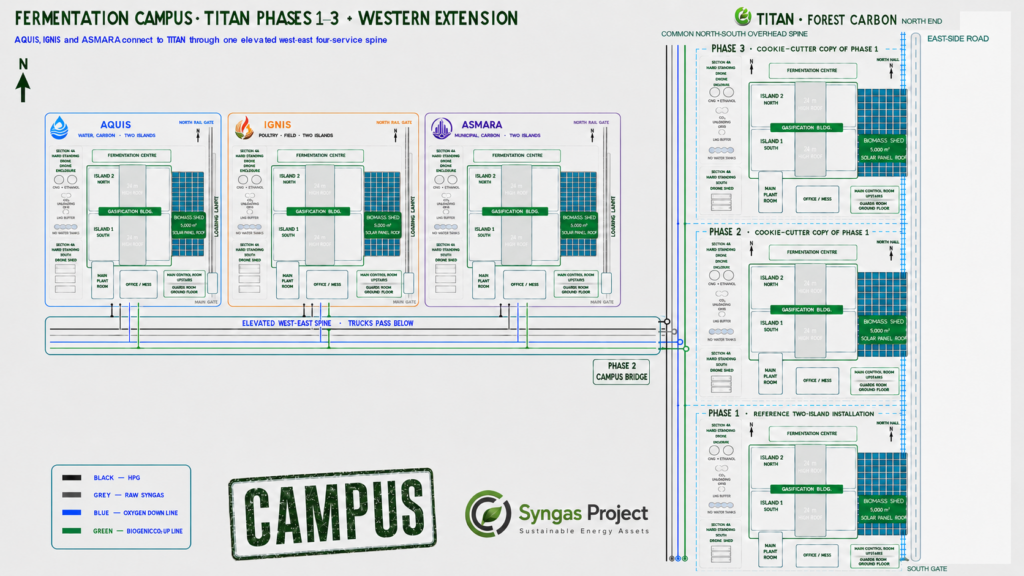
The Main Gas Spine
All clusters within the Fermentation CAMPUS are connected through the main gas spine.
The system carries two defined gas supplies.
Black HPG Spine — Universal
The Black Spine distributes Hydrogen Producer Gas.
HPG is the common carbon and hydrogen carrier across the SOLIDEA platform family.
It creates the universal prepared-gas foundation for multiple microbial and industrial pathways.
Grey Syngas Spine — Specialist
The Grey Spine distributes conditioned synthesis gas for processes requiring a more specific gas composition.
This allows specialist microbial workers and downstream systems to receive the gas quality required for their particular task.
The two gas spines connect the complete CAMPUS.
Prepared carbon can be directed toward the correct fermentation family, reactor cluster or specialist process without duplicating the main gas infrastructure.
The oxygen backbone operates alongside the two gas spines.
Together, they provide universal HPG supply, specialist syngas supply and oxygen for gasification, Aerobic fermentation, water treatment and specialist biological processes.
The Misplaced Carbon Spectrum
The Fermentation CAMPUS is designed to capitalise on carbon from across the Misplaced Carbon Spectrum.
This includes carbon found within forest residues, sorted municipal waste, agricultural residues, animal-husbandry residues, contaminated water and sludge, industrial gases, legacy deposits, mining residues and recoverable materials.
These carbon sources are different.
Their preparation requirements are different.
Their strongest commercial outcomes may also be different.
The Fermentation CAMPUS creates the infrastructure required to prepare these carbon sources and direct them toward the most appropriate microbial pathway.
The CAMPUS captures carbon from across the Misplaced Carbon Spectrum and directs each molecule toward its best available outcome.
Full-Stack Fermentation
Achieving full-stack fermentation is a major strategic milestone.
The CAMPUS brings together Methanogenic Microbes, Acetogenic Microbes, Aerobic Microbes, Factory Workers, Field Workers, the Bio-Boundary, the Black HPG Spine, the Grey Syngas Spine, the oxygen backbone, shared utilities and shared operating knowledge.
This creates genuine diversification of pathway.
Prepared carbon is no longer restricted to one microbial family, one product or one market.
It can be directed toward the pathway that provides the strongest technical and commercial outcome.
The CAMPUS can produce fuels, chemicals, materials, nutrients and microbial services.
This is FCMN at Industrial Scale.
Molecule Risk Strategy
The complete fermentation stack provides two complementary forms of diversification.
Diversification of Outcomes
Diversification of outcomes reduces exposure to negative product-price shocks.
When one market weakens, prepared carbon may be directed toward another commercial outcome with stronger demand or value.
The platform is not dependent on one product.
Diversification of Pathways
Diversification of pathways reduces the risk of stranded molecules.
Hydrogen Producer Gas, synthesis gas, carbon dioxide, hydrogen and other prepared molecules can be directed toward different microbial workers and conversion routes.
The platform is not dependent on one fermentation pathway.
Outcome diversification protects value. Pathway diversification prevents stranded molecules.
The platform manages market risk not only through long-term contracts, but through the structural ability to change what each molecule becomes.
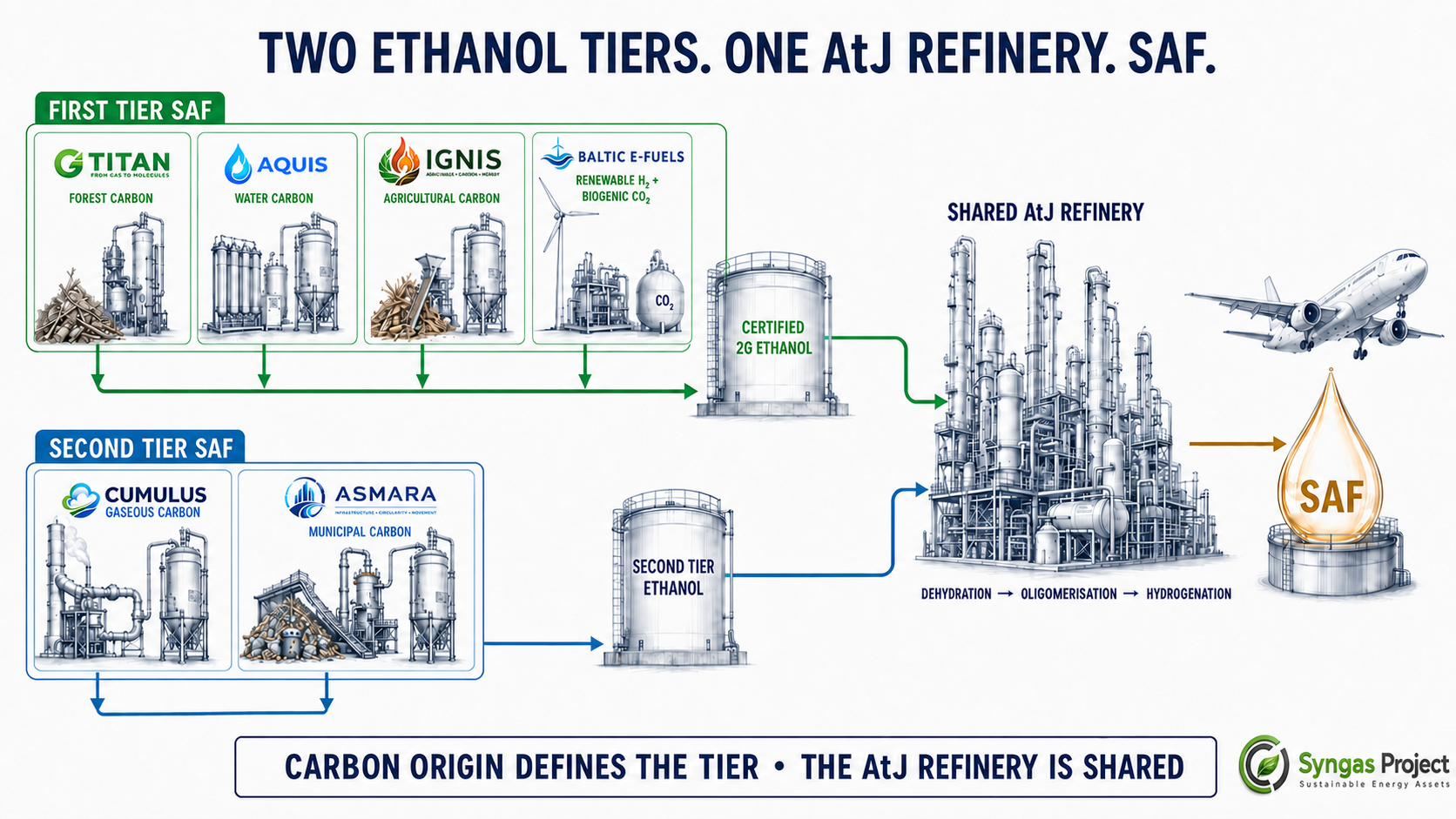
CUMULUS Connects Production with the SAF Refinery
CUMULUS connects Syngas Project with the downstream SAF refinery.
It is important to distinguish the role of CUMULUS from the role of TITAN.
TITAN is a biogenic carbon platform.
It converts forest residues into Hydrogen Producer Gas and then into products including 2G ethanol, renewable methane, biochar and biogenic CO₂.
CUMULUS is not classified as a biogenic production platform and does not automatically qualify for the same biogenic status as TITAN.
CUMULUS manages gases and molecules moving between production platforms, external infrastructure and downstream users.
It may transport, condition, store and export 2G ethanol produced by TITAN, but the biogenic status belongs to the certified feedstock and production pathway, not to CUMULUS itself.
For the SAF pathway, the route is:
TITAN Forest Residues → Hydrogen Producer Gas → Acetogenic Fermentation → Certified 2G Ethanol → CUMULUS Export → Alcohol-to-Jet Refinery → SAF
CUMULUS provides the logistics and molecule-management connection between the Fermentation CAMPUS and the downstream refinery.
It does not create the biogenic status of the ethanol.
It preserves the identity, quality, traceability and chain of custody of the molecule as it moves from the certified production platform to the refinery.
Some molecules handled by CUMULUS may be biogenic.
Others may be recycled, industrial, renewable or fossil in origin.
The classification of each molecule depends on its source, production pathway and certification.
TITAN creates the certified biogenic molecule. CUMULUS manages and delivers it. The Alcohol-to-Jet refinery converts the ethanol into SAF.
The Bridge
Aerobic fermentation completes the connection.
It links fuel production with proteins, polymers, water treatment, mineral recovery and deployable biological services.
It connects TITAN with ASMARA, AQUIS, STRATA and IGNIS.
It connects Factory Workers with Field Workers.
It connects the Bio-Boundary with the next generation of specialist microbial strains.
It connects the main gas spine with the oxygen backbone.
It connects renewable e-fuel production with the Fermentation CAMPUS through the exchange of biogenic CO₂ and renewable industrial oxygen.
It connects the complete fermentation stack with the Misplaced Carbon Spectrum.
CUMULUS then connects the certified molecules produced by the platform with downstream markets and the SAF refinery.
This is why we call Aerobic Microbes The Bridge.
Aerobic Worker Profile
| Characteristic | Aerobic profile |
| Microbial family | Bacteria, yeasts, fungi and specialist aerobic cultures |
| Fermentation family | Oxygen Side |
| Carbon diet | Prepared carbon, gaseous carbon, organic intermediates and nutrients |
| Principal outcomes | Proteins, feed ingredients, PHA, PHB and specialist biomass |
| Biomass production | Heavy |
| Oxygen requirement | Industrial oxygen required |
| Oxygen source | Renewable electrolysis oxygen and the CAMPUS oxygen backbone |
| Impurity tolerance | Worker-specific |
| Preferred environment | Controlled and oxygenated cultivation |
| Worker categories | Factory Workers and Field Workers |
| Best Factory Worker applications | Poultry feed, aquatic feed, proteins, PHA and PHB |
| Best Field Worker applications | Water treatment, plastics capture, PFAS treatment support, mineral dissolution, bioleaching and remediation |
| Bio-Boundary role | Seed-culture storage, controlled scale-up, batch preparation and secure deployment |
| CAMPUS role | The Bridge connecting TITAN, ASMARA, AQUIS, STRATA and IGNIS |
| Gas connection | Black HPG Spine and Grey Syngas Spine |
| Oxygen connection | Phase 1 oxygen backbone extended into Sector 5a |
| Carbon exchange | Biogenic CO₂ supplied to e-fuels in exchange for renewable oxygen |
| Downstream connection | CUMULUS manages certified molecule export to the SAF refinery |
| Syngas Project role | Feed preparation, Microbial Capability integration and industrial deployment |
The Workers Spread Their Wings
Factory Workers remain within the Fermentation CAMPUS and manufacture products.
Field Workers leave the CAMPUS to perform biological tasks wherever their capability is required.
The Bio-Boundary protects the seed cultures, multiplies the workers and prepares each application batch.
Together, they extend microbial fermentation beyond the production vessel.
Field Workers join Factory Workers as our microbial services spread their wings beyond the Fermentation CAMPUS.
The Bridge in One Line
Aerobic fermentation completes the full fermentation stack, connecting the Misplaced Carbon Spectrum with Factory Workers, Field Workers and the best available pathway for each molecule.