This makes early capture essential.
Nanoplastics are smaller, more mobile and much more difficult to detect and collect. Scientific understanding of their complete health effects is still developing, but their ability to move at such a small scale makes them potentially the most challenging of the three AQUIS threats.
The European Food Safety Authority confirms that nanoplastics can be created through the fragmentation of microplastic debris. It also identifies substantial knowledge gaps concerning human exposure and health effects. European Food Safety Authority, World Health Organization.
AQUIS will not wait for every scientific uncertainty to be resolved before acting.
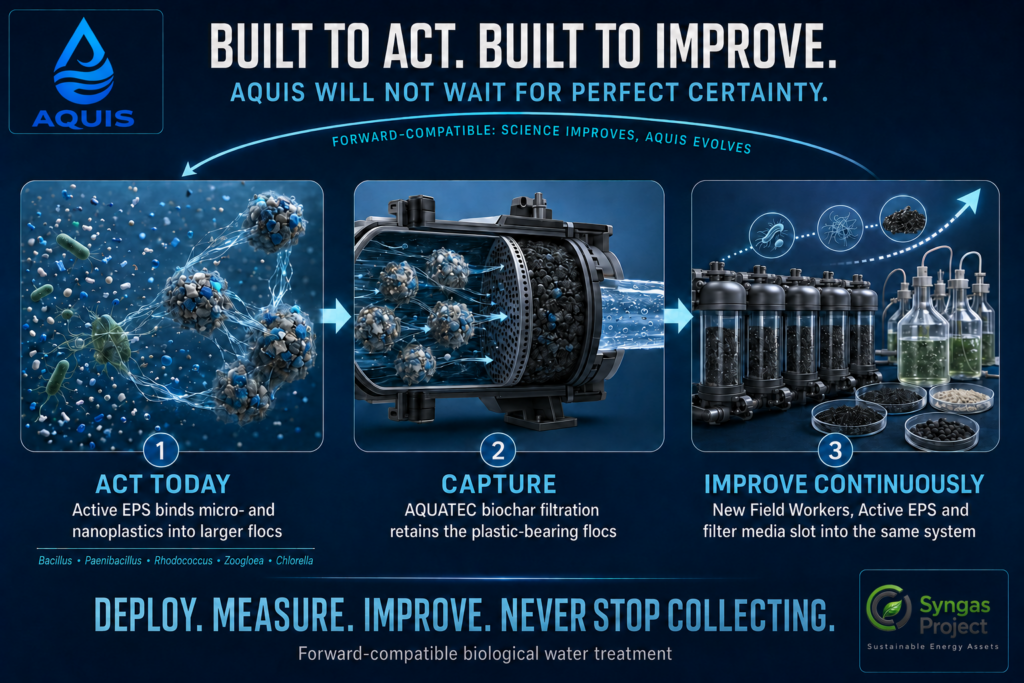
The responsible response is to intercept plastic while it remains accessible, prevent further fragmentation and remove it permanently from the water cycle.
Why AQUIS does not rely on microbes eating plastic
Substantial research is being directed towards microbes and enzymes that can break down particular plastics. This work may eventually produce valuable technologies.
However, “eating plastic” is not automatically the same as making plastic extinct.
A genuinely complete biological process would have to mineralise the polymer without leaving plastic fragments, harmful metabolites or persistent residues. An incomplete process may weaken or fragment the material without completing its destruction.
That creates a risk: instead of eliminating the microplastic, the process may generate smaller fragments that are harder to detect and recover.
In simple language:
Breaking a microplastic into nanoplastic crumbs is not extinction.
AQUIS therefore gives its microbial workers a different primary task.
They will help find, bind, flocculate, concentrate and separate microplastics and nanoplastics from water. They will bring dispersed particles together so that the contamination can be recovered as a controlled material.
AQUIS will then direct that material towards a validated destruction pathway.
We will use biology to collect the threat—not to lose sight of it as it becomes smaller.
PFAS: capture followed by verified destruction
PFAS require a separate discipline.
They are a large family of persistent fluorinated chemicals with exceptionally strong carbon-fluorine bonds. They can enter public water and become concentrated in sludge, AD digestate, activated carbon and spent filtration media.
Capturing PFAS is necessary, but capture alone does not destroy them.
AQUIS will therefore establish a dedicated PFAS protocol covering:
- Sampling and analytical baselines
- Identification of PFAS sources
- Capture and concentration
- Segregation of PFAS-bearing material
- Secure storage and transport
- Selection of a validated destruction pathway
- Treatment of gases and incomplete destruction products
- Testing of ash, char and other residual material
- Independent verification
- Reprocessing where the required standard is not achieved
Gasification, pyrolysis, plasma treatment and other thermal processes may form part of a PFAS destruction system. However, their effectiveness depends upon the complete operating configuration, including temperature, residence time, secondary oxidation, emissions treatment and residue management.
AQUIS will not claim PFAS destruction unless the evidence proves it.
Current regulatory guidance similarly recognises that PFAS destruction requires careful evaluation of operating conditions, emissions and possible products of incomplete destruction. US EPA—PFAS destruction guidance.
The AQUIS Vow
Capture is not extinction.
AQUIS will not declare success simply because contamination has disappeared from the water.
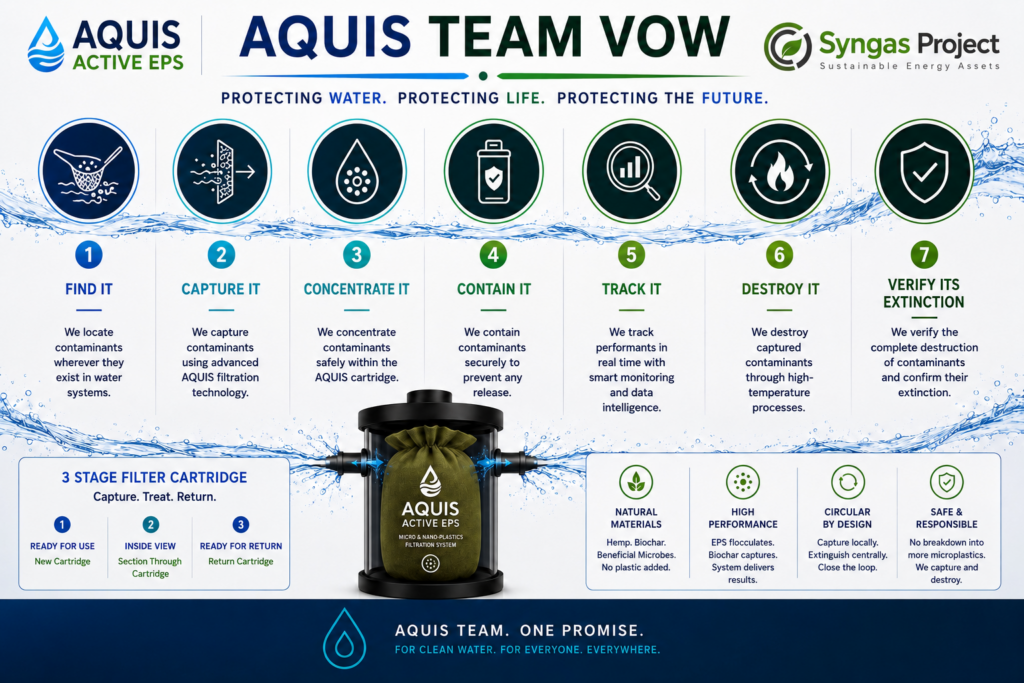
This is the AQUIS Vow.
We will not move pollution from water into sludge, AD digestate, filters, soil or landfill and describe that as completion.
AQUIS begins at TITAN
Every TITAN location creates a substantial water responsibility—and a much larger regional business opportunity.
AQUIS begins on Day One as the specialist team protecting TITAN’s process water, fermentation biology and closed-loop systems.
Water that is potable for people is not automatically suitable for fermentation. Residual disinfectants, changing mineral concentrations and trace contaminants can affect microbial performance.
Recovered water from biomass drying, gas cooling, dewatering, fermentation and equipment cleaning can collect:
- Biomass fines
- Ash and char particles
- Dissolved minerals
- Organic compounds
- Microplastics
- Nanoplastics
- PFAS
- Other persistent contaminants
The microorganisms working inside TITAN are AQUIS’s first and most discerning customers.
By protecting these workers, AQUIS develops the operating evidence, microbial products and treatment systems required to support the wider water industry.
Growing with every cluster
AQUIS’s water jurisdiction increases with every new TITAN cluster.
Each cluster adds process-water demand, fermentation activity, filtration duties, recovered-water streams and closed-loop treatment requirements.
The first AQUIS team supports one cluster managing up to 100,000 litres of water per day.
As each TITAN location develops across three clusters, AQUIS’s water jurisdiction increases to as much as 300,000 litres per day.
Across ten TITAN locations and thirty clusters, this represents up to:
3,000,000 litres—3,000 cubic metres—of water every day.
This is before any additional requirements from the planned Alcohol-to-Jet refineries are included.
The detailed TITAN fermentation configuration remains proprietary. The public commitment is simple:
Every new cluster expands AQUIS’s responsibility for safe water, protected biology and the permanent removal of microplastics, nanoplastics and PFAS.
A biotechnology business—not a conventional water operator
AQUIS will work with established environmental service providers, wastewater operators and AD businesses.
These organisations bring customer networks, infrastructure, logistics, operating knowledge and field-service capabilities.
AQUIS brings:
- Microbial workers
- Biological flocculation
- Controlled microbial formulations
- Biochar-based filtration media
- Sludge and digestate conditioning
- Water-recovery systems
- Carbon and mineral recovery pathways
- Contaminated-media management
- Lifecycle tracking
- Verified final-treatment protocols
TITAN gives AQUIS the home environment in which these products and processes can be developed, tested and improved.
The regions surrounding TITAN provide the markets in which they can be deployed.
The AQUIS Biofoundry Team
At the centre of AQUIS is the Biofoundry.
This is where microbiologists, environmental biotechnologists, fermentation specialists and bioprocess engineers develop microbial workers for specific water, sludge and AD digestate applications.
AQUIS Field Support:
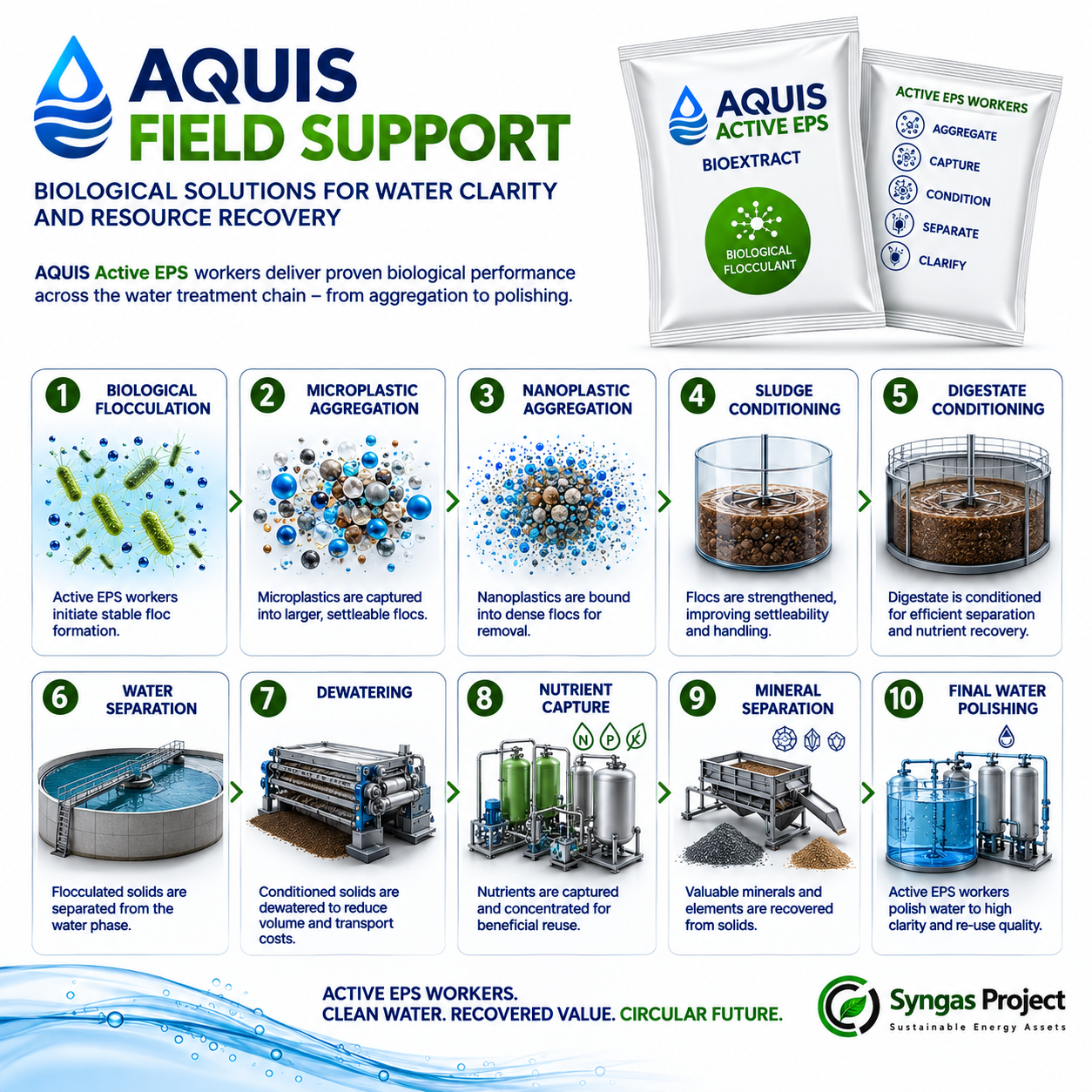
Every AQUIS product must be defined by more than the organism itself.
A complete Microbial Capability includes:
- A controlled culture or microbial community
- A stable formulation
- Defined carriers and nutrients
- A dosing method
- A specified operating window
- Quality and safety controls
- A measurable performance protocol
- Maintenance, proliferation and supply arrangements
This is how microbiology becomes a consistent industrial product that environmental service providers can deploy reliably.
The Water and Process Team
Water engineers, chemists and process-integration specialists will understand the complete journey of water through each AQUIS application.
They will determine:
- Where the water originated
- How its chemistry changed
- Which contaminants it collected
- Where those contaminants became concentrated
- How the water can be recovered safely
- How the contamination leaves the system permanently
Their responsibilities include:
- Process-water specification
- Microbial compatibility
- Water recovery and recycling
- Sludge and digestate dewatering
- Microplastic and nanoplastic monitoring
- PFAS analysis
- Treatment-system integration
- Water-quality verification
- Performance reporting
This team protects TITAN while building the technical evidence behind every AQUIS product.
The Filtration and Carbon Team
AQUIS will develop biochar-based and biotechnology-enabled filtration media.
Carbon provides structure, surface area and contaminant-capture capability. Microbial biotechnology adds targeted biological functions.
Together, these capabilities can support:
- Public and industrial-water polishing
- Sludge-liquor treatment
- Digestate-liquor treatment
- Fermentation protection
- Microplastic capture
- Nanoplastic capture
- PFAS concentration
- Nutrient and mineral separation
Every used filter must remain within a controlled lifecycle.
Each filter must be identifiable. Every change must be recorded. Every contaminated cartridge or carbon medium must be collected and directed towards regeneration, resource recovery or validated final treatment.
AQUIS will not allow its filters to become another route to landfill.
The Sludge and AD Digestate Team
Sewage sludge and AD digestate are two major AQUIS opportunities.
They are not identical materials. They have different origins, compositions, biological conditions and regulatory requirements. They must therefore be contracted and managed under separate specifications.
Before acceptance, each stream must be assessed for:
- Source and production process
- Water and solids content
- Organic and carbon value
- Mineral and nutrient composition
- Biological condition
- Metals and persistent contaminants
- Microplastic content
- Nanoplastic risk
- PFAS profile
- Dewatering performance
- Suitability for resource recovery
- Required final treatment
Microbial workers can improve conditioning, separation and dewatering. Recovered water can return to treatment or controlled reuse. Mineral-rich fractions can connect with STRATA.
Qualified plastic-bearing carbon fractions can be prepared for controlled conversion. PFAS-bearing material must follow the separate AQUIS PFAS protocol.
This gives the stranded carbon contained within sludge and AD digestate a defined destination.
AD needs a responsible final pathway
Anaerobic digestion is a valuable pathway for many wet organic wastes. It produces useful biogas and concentrates dispersed biological material inside a controlled process.
But biogas production is not the end of the material story.
The remaining AD digestate still requires a safe and economically viable destination.
Where digestate is clean, compliant and agronomically valuable, its nutrients and organic matter may support appropriate land applications.
Where it contains microplastics, nanoplastics, PFAS or other unsuitable contaminants, returning it directly to land may redistribute the pollution.
AQUIS creates an alternative.
It can condition the digestate, recover water, separate useful fractions, identify and concentrate contamination and prepare each remaining fraction for the correct downstream pathway.
This allows the AD industry to create more value while protecting the environmental purpose for which anaerobic digestion was developed.
A substantial Polish opportunity
Poland reported 655,119 tonnes of municipal sewage sludge on a dry-solids basis in 2024.
The figure covers the national reporting framework for registered agglomerations with at least 2,000 population equivalent. It provides AQUIS with a verified starting point for evaluating the Polish municipal-sludge opportunity.
Because sludge is predominantly water before drying, the corresponding wet volume is several times larger. The actual relationship depends upon its source, treatment process and level of dewatering.
Source: Polish Government—2024 National Municipal Wastewater Treatment Programme report.
This figure does not include the complete Polish AD digestate market.
Smaller wastewater systems, industrial biological sludges and compatible AD digestate streams create additional potential. AQUIS will quantify these markets region by region rather than publish unsupported national estimates.
Each TITAN location can become the centre of a regional sludge-and-digestate catchment.
A career with purpose
AQUIS offers water and environmental professionals the opportunity to build an entirely new business around one of humanity’s most important environmental missions.
We will need:
- Water and wastewater engineers
- Sludge and dewatering specialists
- AD and digestate specialists
- Microbiologists
- Fermentation scientists
- Environmental biotechnologists
- Analytical chemists
- Microplastic and nanoplastic specialists
- PFAS specialists
- Laboratory and quality technicians
- Carbon and filtration specialists
- Process and commissioning engineers
- Field-application technicians
- Data and performance specialists
- Sludge and digestate offtake managers
- Regional technical and commercial leaders
Experienced professionals will provide operating knowledge and leadership. Apprentices and graduates will become the next generation of biotechnology, water and resource-recovery specialists.
People can begin with the first TITAN cluster, build experience across an expanding location and progress into regional or international AQUIS responsibilities.
This is not simply a collection of jobs.
It is the opportunity to create a new professional community with a common purpose.
The Home Team and Regional Teams
The AQUIS Home Team will hold:
- The Biofoundry
- Microbial-product knowledge
- Laboratory and analytical standards
- Water and carbon expertise
- Sludge and digestate knowledge
- Filtration-media development
- PFAS management protocols
- Lifecycle and extinction verification
Regional teams surrounding TITAN locations will develop sludge and AD digestate relationships, deploy AQUIS products, coordinate sampling and integrate AQUIS technology into customer applications.
Field experience and performance data will return to the Home Team, where every microbial product, filtration medium and treatment process can be improved.
AQUIS will grow as one fluid organisation: learning at home, proving its capabilities in the field and carrying successful solutions into every region where TITAN develops.
A calling humanity cannot afford to miss
Microplastics travel through the water system.
As they travel, they can fragment into nanoplastics that are smaller, more mobile and more difficult to recover.
PFAS travel with water and can become concentrated in sludge, digestate and filtration media without being destroyed.
This creates a narrow but powerful opportunity: intercept all three threats where public water treatment and anaerobic digestion have already brought them together.
We cannot afford to capture them in a filter and then bury the filter.
We cannot remove them from water and return them to land through contaminated sludge.
We cannot recover biogas and ignore the contamination remaining in AD digestate.
We cannot describe the creation of smaller plastic fragments as successful biodegradation.
AQUIS will focus its biology on collecting these threats from water, concentrating them and keeping them visible until their destruction has been verified.
That is a worthy calling.
Building the teams, products and regional infrastructure required to deliver it is an exciting and expanding business.
Find them. Capture them. Concentrate them. Contain them. Track them. Destroy them. Verify their extinction.
Join the AQUIS Team—and help make microplastics, nanoplastics and PFAS extinct.