Publish date: 30 April 2026
(Przewiń w dół, aby zobaczyć wersję polską.)
One of the biggest challenges in the renewable molecule economy is not chemistry.
It is logistics.
Europe possesses large volumes of renewable carbon in the form of forestry residues, agricultural residues and other biogenic resources. Much of this material already exists across regional landscapes in fragmented and low-density form.
The problem is not whether the carbon exists.
The problem is how to collect it efficiently.
For decades, industrial systems were designed around highly concentrated fossil resources. Coal, oil and gas could be extracted at large scale from centralised locations and transported through mature infrastructure networks. Renewable carbon does not behave the same way.
Biomass is distributed.
It is seasonal. It varies in moisture content, density and handling characteristics. Transport distances matter. Weather matters. Storage matters. Fuel preparation matters.
This means the future renewable molecule economy will require a new generation of regional logistics infrastructure.
This is where Reach & Cache becomes important.
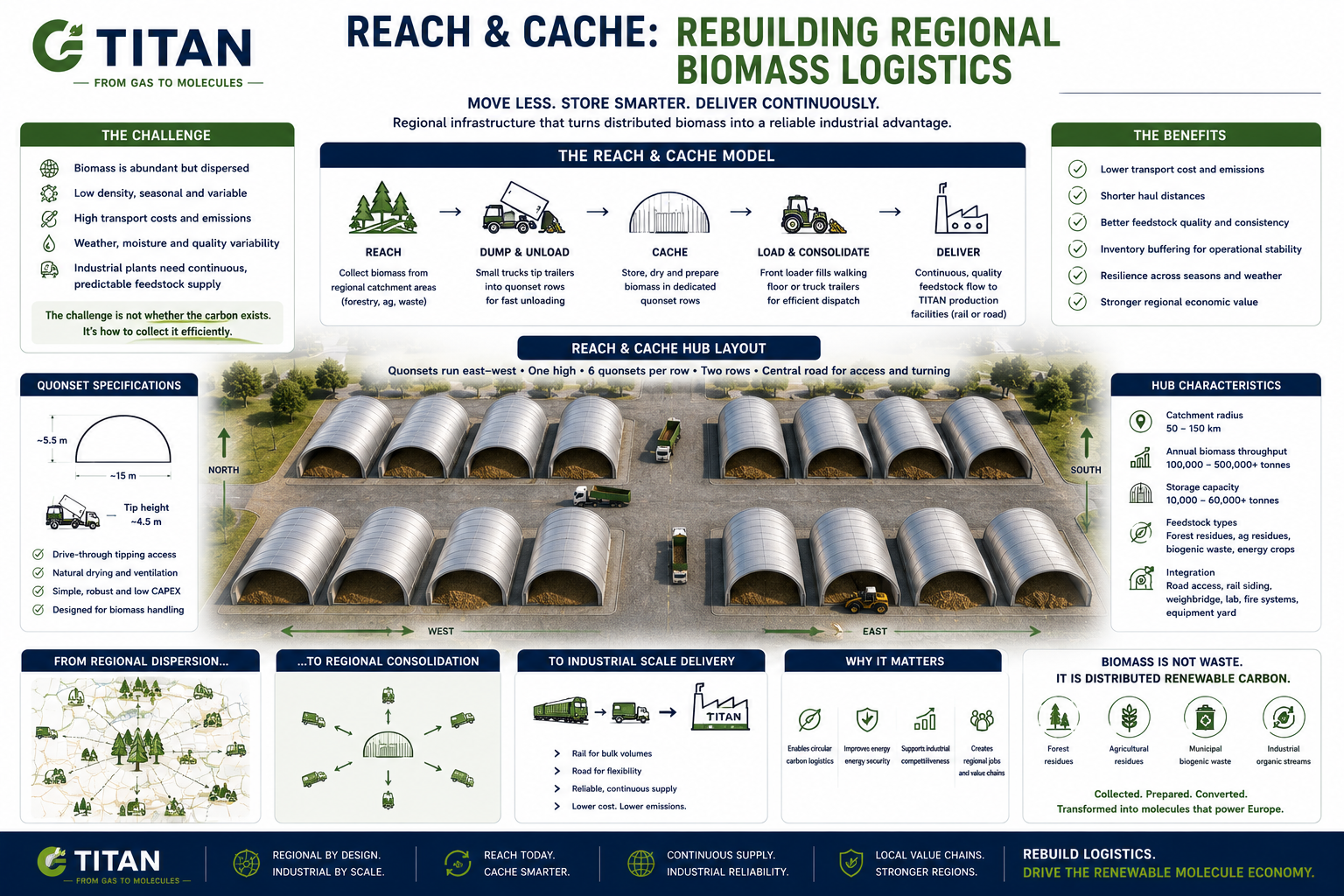
Reach & Cache is the logistical philosophy behind TITAN’s biomass supply model.
Instead of relying entirely on long-distance trucking or fragmented supply chains, the system creates regional collection, preparation and consolidation hubs designed specifically for renewable carbon logistics.
The objective is simple:
Reduce transport inefficiency while increasing regional feedstock resilience.
Under the Reach & Cache model, biomass is collected from regional catchment areas and moved into dedicated aggregation sites. At these locations, material can be stored, dried, processed, chipped and prepared for onward transport into TITAN production facilities.