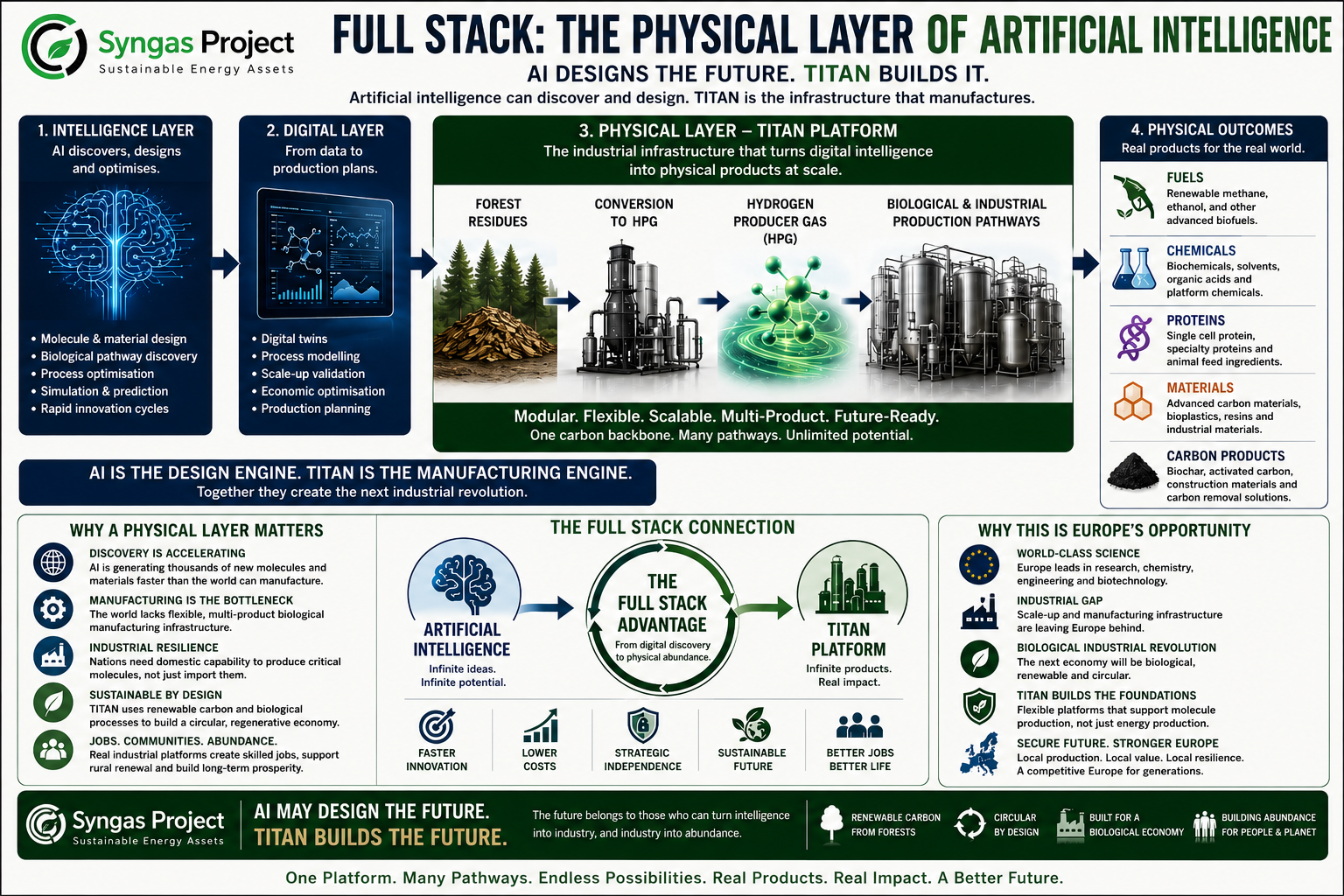
Full Stack: The Physical Layer of Artificial Intelligence

Publish Date: 2 May 2026

(Przewiń w dół, aby zobaczyć wersję polską.)

Artificial intelligence is rapidly becoming the defining technology race of the 21st century.

Every week brings announcements about larger models, faster processors, more capable software agents and increasingly advanced machine reasoning systems. Governments are investing billions. Technology companies are competing for dominance. Data centres are expanding across the world at extraordinary speed.

Most discussion focuses on computation.

But very little discussion focuses on what artificial intelligence ultimately needs in the physical world.

Because intelligence alone does not manufacture anything.

Artificial intelligence can design molecules.
It can optimise biological pathways.
It can simulate new materials.
It can improve industrial systems.
It can accelerate chemistry and biotechnology research.

But eventually, something physical must manufacture the result.

This is where the next industrial bottleneck may emerge.

The future may not belong only to countries that control computation.

It may also belong to countries that control biological manufacturing platforms capable of turning digital intelligence into physical products.

That distinction is becoming increasingly important.

Artificial intelligence is already beginning to transform chemistry, material science, pharmaceutical research, biological engineering and industrial process optimisation. The speed of discovery is accelerating dramatically. New materials, proteins, enzymes, carbon structures and biological production pathways are being identified faster than traditional industrial systems can adapt.

But discovery is only one half of the equation.

Manufacturing remains the other half.
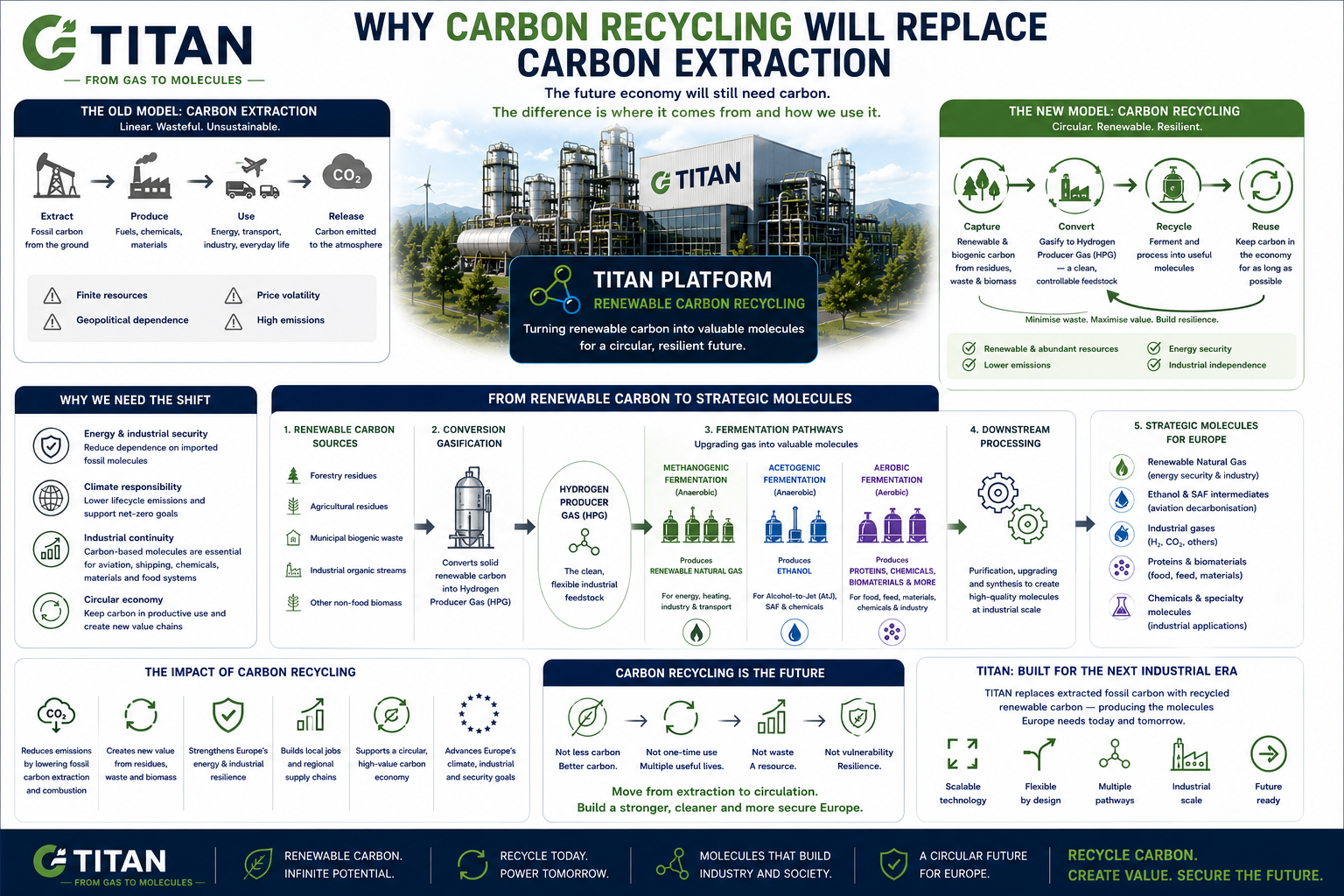
Why Carbon Recycling Will Replace Carbon Extraction

Publish date: 1 May 2026

(Przewiń w dół, aby zobaczyć wersję polską.)

For more than a century, industrial growth has depended on carbon extraction.

Coal, oil and natural gas were taken from the ground, refined, transported and converted into energy, fuels, chemicals and materials. This model powered the modern economy. It created mobility, manufacturing, aviation, plastics, fertilisers and global trade.

But it also created a structural problem.

The industrial economy became dependent on fossil carbon.

Carbon was extracted once, used briefly, and then released into the atmosphere. This linear model was efficient during the age of cheap fossil resources, but it is no longer compatible with Europe’s long-term climate, industrial and security objectives.

The next industrial era will require a different model.

Carbon cannot simply be treated as something to extract, burn and discard.

It must be treated as something to recover, recycle and reuse.

This is the logic of carbon recycling.

Carbon recycling does not mean stopping the use of carbon. That would be impossible for many parts of the economy. Aviation, shipping, chemicals, materials, agriculture, food systems and industrial manufacturing all depend on carbon-based molecules.

The real question is not whether society will use carbon.

The question is where that carbon comes from.

In the old model, carbon came from fossil extraction.

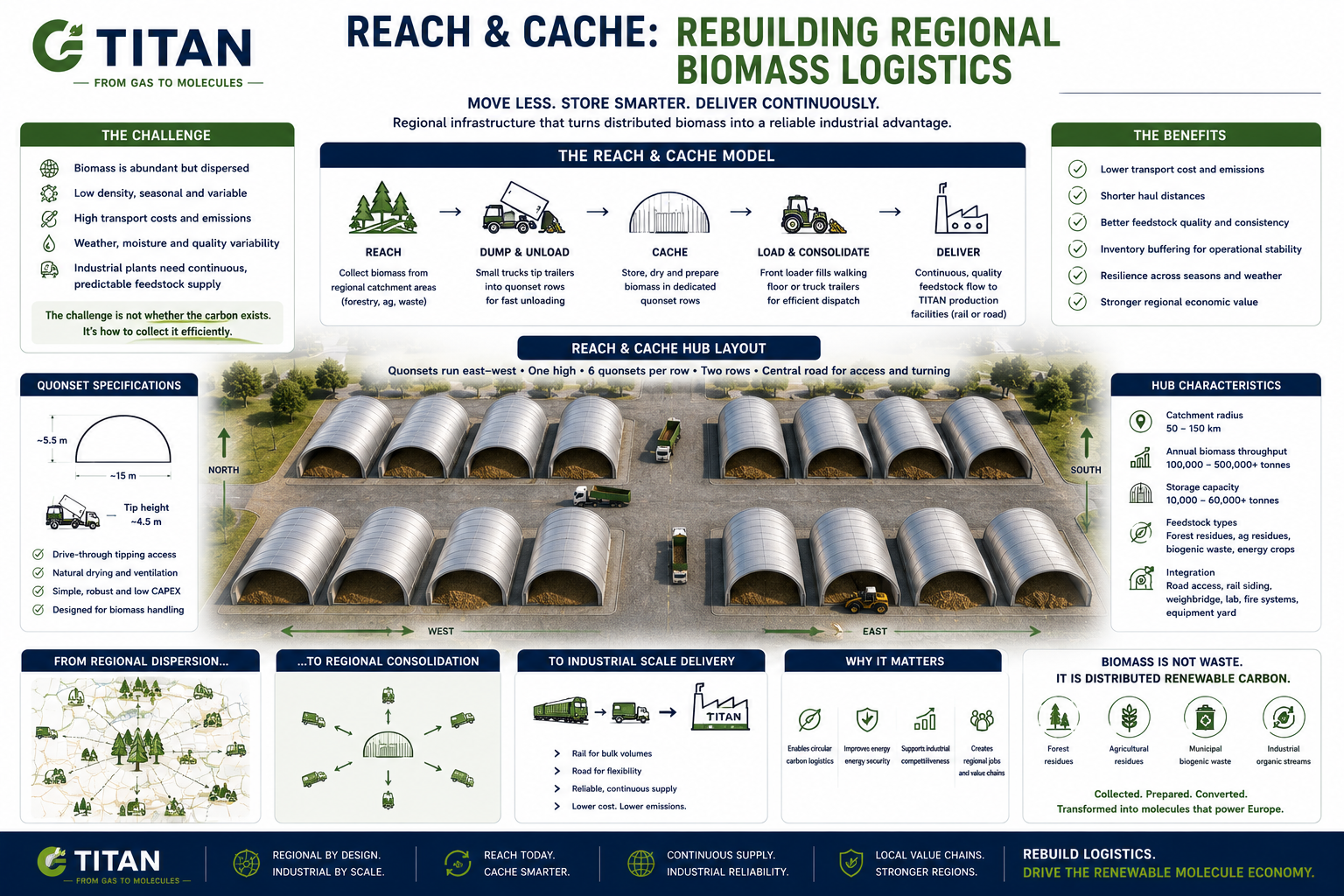
Reach & Cache: Rebuilding Regional Biomass Logistics

Publish date: 30 April 2026

(Przewiń w dół, aby zobaczyć wersję polską.)

One of the biggest challenges in the renewable molecule economy is not chemistry.

It is logistics.

Europe possesses large volumes of renewable carbon in the form of forestry residues, agricultural residues and other biogenic resources. Much of this material already exists across regional landscapes in fragmented and low-density form.

The problem is not whether the carbon exists.

The problem is how to collect it efficiently.

For decades, industrial systems were designed around highly concentrated fossil resources. Coal, oil and gas could be extracted at large scale from centralised locations and transported through mature infrastructure networks. Renewable carbon does not behave the same way.

Biomass is distributed.

It is seasonal. It varies in moisture content, density and handling characteristics. Transport distances matter. Weather matters. Storage matters. Fuel preparation matters.

This means the future renewable molecule economy will require a new generation of regional logistics infrastructure.

This is where Reach & Cache becomes important.

Reach & Cache is the logistical philosophy behind TITAN’s biomass supply model.

Instead of relying entirely on long-distance trucking or fragmented supply chains, the system creates regional collection, preparation and consolidation hubs designed specifically for renewable carbon logistics.

The objective is simple:

Reduce transport inefficiency while increasing regional feedstock resilience.

Under the Reach & Cache model, biomass is collected from regional catchment areas and moved into dedicated aggregation sites. At these locations, material can be stored, dried, processed, chipped and prepared for onward transport into TITAN production facilities.

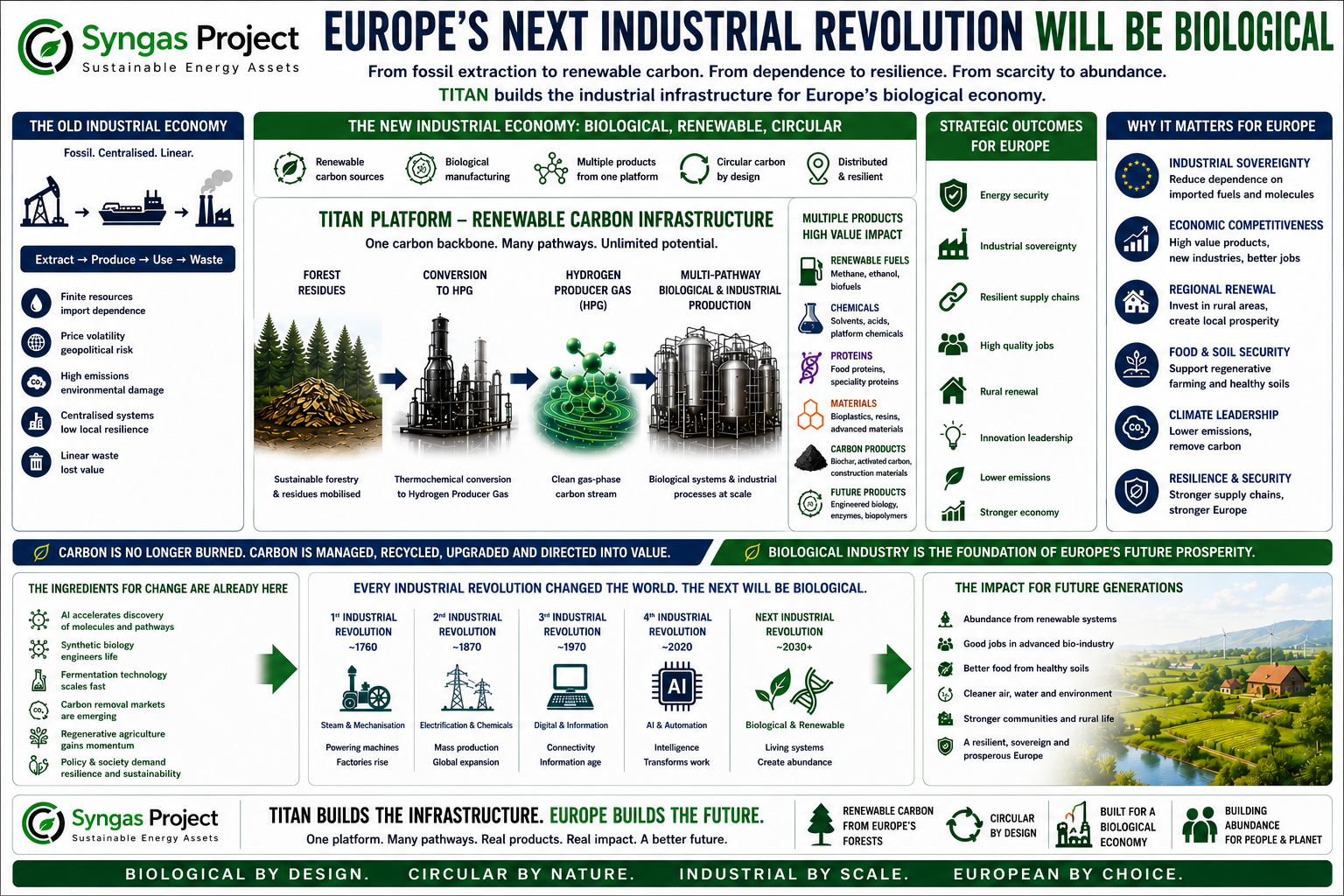
Europe’s Next Industrial Revolution Will Be Biological

Publish Date 27 April 2026

(Przewiń w dół, aby zobaczyć wersję polską.)

Europe was built on industrial revolutions.

The first industrial age was powered by coal, steam and mechanisation. The second was built around oil, gas, chemicals and mass electrification. The digital era transformed communications, finance and information systems.

The next industrial revolution may be biological.

Not in the science-fiction sense.

In the industrial sense.

The global economy is beginning to move away from extracting fossil carbon from underground and toward managing renewable carbon flows above ground. This transition will affect far more than energy production. It will reshape fuels, chemicals, agriculture, food systems, materials, manufacturing and industrial supply chains.

This matters because modern economies do not run on electricity alone.

They also run on molecules.

Fuels.
Chemicals.
Plastics.
Solvents.
Proteins.
Materials.
Industrial gases.
Carbon products.

For more than a century, most of these products originated from oil, coal and gas extraction. The fossil economy did not only produce energy. It produced the molecular foundation of industrial civilisation.

That foundation is now beginning to change.

Europe faces a strategic challenge.

The continent has world-class science, engineering and biotechnology capability. But it imports large quantities of critical molecules and remains structurally dependent on external energy and feedstock systems. Geopolitical instability, supply chain disruption and rising resource competition are exposing the risks of this dependence.

The solution may not simply be replacing fossil electricity generation.

The solution may be rebuilding Europe’s molecule economy around renewable carbon systems.

This is where biological manufacturing becomes important.

Biological systems are extraordinarily efficient molecular factories. Microbes, enzymes and fermentation systems can already produce fuels, proteins, chemicals and specialist compounds. Artificial intelligence is now accelerating the discovery of entirely new biological pathways and material possibilities.

But these systems require industrial platforms capable of operating at scale.

That is where TITAN positions itself.

After AI – Warm Robots

The Machines That Heal—and the Circular Economy They’re Building

She looks almost human. Porcelain skin, careful eyes, anatomical symmetry—delicate, not threatening. A beautiful contradiction. The image evokes a future we’ve long imagined: robots that walk beside us, feel with us, care for us.

But this isn’t the warm robot we meant.

Because the real warm robots—ours—don’t smile or stand. They don’t blink, speak, or age.
They are microbes.
Alive, invisible, programmable.

They live in tanks. They breathe carbon. They manufacture the building blocks of the post-pollution world: fuels, chemicals, nutrients, and materials. And now, aided by generative AI, they are evolving—stacking complexity, mimicking natural processes, and operating with the efficiency of the human brain and the regenerative elegance of skin and bone.

We call this new capability Industrial Lifestacking.
It’s not robotics. It’s regeneration.
Not imitation—but biological infrastructure, scaled.

The Living Stack

Long before artificial intelligence could speak, microbes were building. While generative models were still learning language, fermentation vessels were already producing ethanol, biodegradable polymers, and essential proteins from nothing more than carbon waste and biological design.

What makes this possible is a structure we call the Living Stack—a three-layered system that turns industrial chaos into organic precision:

AI serves as the design layer, where biological systems are mapped, metabolic pathways are simulated, and yield efficiency is optimised.
Gene Editing functions as the software layer, rewriting microbial DNA to perform intentional functions—from synthesising alcohols to building amino acid chains.
Targeted Microbial Fermentation (TMF) forms the hardware layer, where gas-fed microbes in controlled environments transform design and code into physical product.

This stack doesn’t run on electricity alone. It runs on carbon. It doesn’t output noise or abstraction. It outputs life.

Leveraging Direct Air Capture (DAC) for Targeted Microbial Fermentation

Harnessing PEGASUS: Direct Air Capture Meets HPG + TMF in the Race to Regenerate Carbon

How TITAN and ASMARA transform carbon from problem to product in line with EU priorities

As Europe confronts rising temperatures, tightening emissions targets, and increasing resource instability, a fundamental shift is underway: carbon is no longer seen only as waste, but as feedstock. This shift is visible in new industrial strategies, circular economy goals, and bioeconomy frameworks—but it needs infrastructure to deliver.

That’s where PEGASUS, a modular Direct Air Capture (DAC) system developed for integration with the TITAN and ASMARA platforms, enters the picture. It offers a breakthrough solution: capturing carbon from the air or industrial sources and transforming it into fuels, chemicals, materials, or even nutrients, via the microbial fermentation infrastructure already embedded within TITAN and ASMARA.

This is not speculative. It is already working in pilot, and it fits squarely within existing and forthcoming EU directives.

TITAN and ASMARA: Carbon-Circular by Design

TITAN, built for rural zones, converts forest and agricultural waste into hydrogen-rich gas (HPG) and uses microbial fermentation (TMF) to convert that gas into second-generation ethanol, biochemicals, and energy. ASMARA performs the same function in urban areas using sorted municipal solid waste (MSW). These platforms are modular, scalable, and already aligned with Europe’s Green Deal, REPowerEU, and Fit for 55 objectives.

Adding PEGASUS enhances these platforms by introducing a steady, high-purity stream of captured CO₂, which TMF microbes can metabolise directly. Rather than storing the carbon underground, as most current DAC-to-CCS models propose, PEGASUS routes the carbon into productive pathways—ensuring economic as well as ecological value.

This becomes especially powerful when blending CO₂ from multiple sources. For example:

  • Captured emissions from cement or steel plants (typically high in volume but lower in purity),
  • Ambient CO₂ captured via PEGASUS DAC (typically lower in volume but high in purity).

Blending both streams produces an optimised fermentation feedstock suitable for high-volume biofuels or specialised bio-based outputs. In fact, the purity of DAC opens entirely new metabolic pathways, allowing the production of advanced molecules such as bio-based solvents, high-purity organic acids, or even smart proteins like insulin analogues and bioactive lipids.

This is not just a carbon-negative process. It is biomanufacturing from thin air.

Syngas Project Pioneering Solutions for a Healthier Future

 Mr Hyde

Reclaiming Insulin Sovereignty: TITAN and ASMARA Platforms for Mass Biomanufacturing in Europe

Breaking the Cartel: Insulin, Inequality, and the Opportunity for European Leadership

At the heart of the global diabetes crisis lies a quiet but devastating monopoly: a life-saving medicine held hostage by a handful of manufacturers. Despite insulin being off-patent for decades, just three global pharmaceutical giants dominate the market—dictating pricing, supply, and access. This concentration of control has limited the availability of affordable insulin, especially in regions already under economic pressure.

In the United States, insulin prices have soared beyond reason. Europe, including Poland and other Central and Eastern European nations, now faces similar systemic risks: rising diabetes rates, increasing healthcare costs, and inadequate local production capacity. But amid this crisis lies a chance to rewrite the pharmaceutical supply chain—through a bold, sovereign European solution: the TITAN and ASMARA platforms.

The Insulin Crisis: A Manufactured Scarcity

Insulin is not a rare or exotic molecule. It has been biosynthesised for over 40 years using recombinant DNA technology. The science is well-understood. The demand is clear. And yet, millions of people globally still struggle to access it due to pricing structures, regulatory lock-ins, and lack of local production.

  • Patients ration insulin to make it last—resulting in amputations, blindness, kidney failure, and death.
  • Governments overspend on cartel-priced imports—diverting budgets from prevention and education.
  • Local biomanufacturing is nearly nonexistent—especially in rural or post-industrial regions where new health infrastructure is most needed.

Europe’s current strategy, relying on imports and foreign-owned production, offers no resilience, no price control, and no autonomy.

TITAN and ASMARA: A Platform for Pharmaceutical Sovereignty

The TITAN (rural) and ASMARA (urban) platforms are not pharma factories in the traditional sense. They are modular, circular, multi-output bio-industrial systems. Originally designed to transform biomass and waste into hydrogen producer gas (HPG) and ethanol, these platforms now represent the future of distributed biomanufacturing—including insulin.

Each platform features:

  • Renewable, 24-hour power and heat, generated from local waste streams
  • Targeted Microbial Fermentation (TMF) stations, already capable of industrial protein synthesis
  • CO₂-ready infrastructure for enhanced fermentation using waste or captured carbon
  • A scalable, cookie-cutter design that enables low-cost replication across the EU

By adding a dedicated pharmaceutical-grade fermentation unit, any TITAN or ASMARA site can pivot to produce biosynthetic insulin using engineered microbial strains like E. coli or yeast—in clean, stable, sovereign-controlled conditions.

This isn’t hypothetical. TITAN’s ethanol lines already handle 50,000 litres per day. The same bioreactors and feedstock management protocols can be adapted to pharmaceutical production with minimal redesign.

Why we need be concerned for LOT, not CPK

Rafał M. Socha

Friday 26 January, Warsaw Poland.

Syngas Project has been at the forefront of innovation with the development of the TITAN platform in Poland for almost a decade; specifically tailored for the production of 2nd generation ethanol (2G EtOH), a vital intermediary for fuelling Sustainable Aviation Fuel (SAF) refineries.

Despite the urgency of the situation, the groundbreaking TITAN platform finds itself still sitting on the sidelines, facing the challenge of not yet finalising the allocation of funding required to propel it through the final leg of the EPC tender. This step is crucial in making TITAN investment-ready and leading to groundbreaking, initiating a 25-year-plus construction roll-out. The financial hurdle currently faced by the project puts it in a state of uncertainty, which is particularly frustrating given the imminent 2% EU Sustainable Aviation Fuel (SAF) mandate scheduled for next year and the daunting 20% EU SAF mandate for 2030 looming on the horizon. TITAN’s potential to revolutionise SAF production in Poland and contribute to meeting these mandates makes the need for support and the release of funding even more pressing.

As the destiny of CPK teeters on the brink, the imperative to address LOT’s Sustainable Aviation Fuel (SAF) requirements becomes increasingly urgent. With each passing moment of delay, the pressure mounts on an already precarious situation, akin to an inflated balloon atop the proposed 46 billion Euro bill for CPK. Time is of the essence, and failure to swiftly meet LOT’s SAF needs jeopardises not only the realisation of CPK’s vision but also risks losing an airline and leaving behind a significant financial burden. Swift action is essential to avert this outcome and ensure the sustainable future of aviation in Poland.

ASMARA: Unlocking Pandora’s Box for Municipal Waste

The problem with MSW is the three C’s: Comingled, Cogglomerated and Contaminated

Pandoras Box

In mythology, Pandora’s Box released the world’s evils. In the case of ASMARA, opening the box reveals something far more hopeful: the transformation of society’s most problematic waste streams into usable, nature-like resources. At its core, ASMARA is a hydrogen producer gas (HPG) and fermentation platform tailored for the complex challenge of Municipal Solid Waste (MSW). It is TITAN’s urban twin—engineered for cities, built for resilience, and future-proofed for circularity.

The ASMARA Breakthrough: Turning Plastic Waste into Resource

Most cities today are drowning in non-recyclable plastic waste—films, containers, food packaging, multi-layer composites, and even rubber tires, often contaminated with paper labels or bonded with incompatible polymers. These conglomerates clog sorting lines, evade recycling plants, and are routinely landfilled or incinerated.

ASMARA turns this problem on its head.

Unlocking the Future: Syngas Project’s TITAN and the Evolution of Sustainable Bioeconomy

Steve Walker Warsaw 27:11:2023

In the heart of Poland, Syngas Project, in collaboration with technical partners and innovators, is embarking on a groundbreaking journey, tendering the first of twelve TITAN installations poised to revolutionize the utilization of forest waste. This endeavour is not just about energy production but the orchestration of a holistic supply chain, strategically designed to yield more than 500,000 litres per day of Sustainable Aviation Fuel (SAF) and Biodiesel through the Alcohol-to-Jet (ATJ) pathway. The vision extends beyond conventional paradigms, with a keen focus on next-generation outcomes propelled by cutting-edge technologies like CRISPR.

In April 2023, the European Union approved the ReFuelEU Aviation proposal which imposes blending mandates on synthetic fuels for aviation, increasing from 0.7% in 2030 to 28% in 2050.

Setting the Stage: TITAN’s Forest Waste Transformation

TITAN, the cornerstone of Syngas Project’s innovative portfolio, is not merely a waste-to-energy solution; it is a catalyst for systemic change. The first twelve TITAN installations are strategically positioned to convert forest waste, addressing the environmental challenge of residues from clear-cut logging activities. By harnessing this otherwise underutilized resource, TITAN is poised to deliver a daily output of 2nd generation ethanol (2G EtOH), laying the foundation for a sustainable supply chain.

Supply Chain Dynamics: From Forest Waste to SAF and Biodiesel

The supply chain orchestrated by Syngas Project and its technical partners is a symphony of efficiency and sustainability. As TITAN transforms forest waste into 2G EtOH, this high-value bioethanol becomes a precursor for the production of SAF and Biodiesel. The Alcohol-to-Jet pathway, a proven and eco-friendly method, unlocks the potential to cater to the aviation industry’s growing demand for sustainable alternatives. The envisioned daily output of more than 500,000 litres is a testament to the scalability and impact of TITAN in shaping the renewable energy landscape.

Beyond Conventional Boundaries: CRISPR and Next-Generation Outcomes

In the quest for sustainability, Syngas Project’s technical partners and innovators stand at the forefront of innovation, utilizing advanced tools like CRISPR to engineer microbes for multiple high-yield outcomes. Bacteria, yeast, and other microorganisms, traditionally associated with specific functions, are now being reprogrammed to serve a broader purpose. This groundbreaking approach allows for the customization of microbial behavior, opening avenues for the production of not only fuels but also chemicals and polymers.