
(Przewiń w dół, aby zobaczyć wersję polską.)
Publish April 30 2026
Europe does not have a gas problem. It has a gas origin problem.
Methane remains essential. It fuels industry, supports energy resilience, underpins logistics and provides the backbone for large parts of the economy that cannot simply electrify. The system that distributes methane is already built. What is changing is not the need for gas, but where that gas comes from.
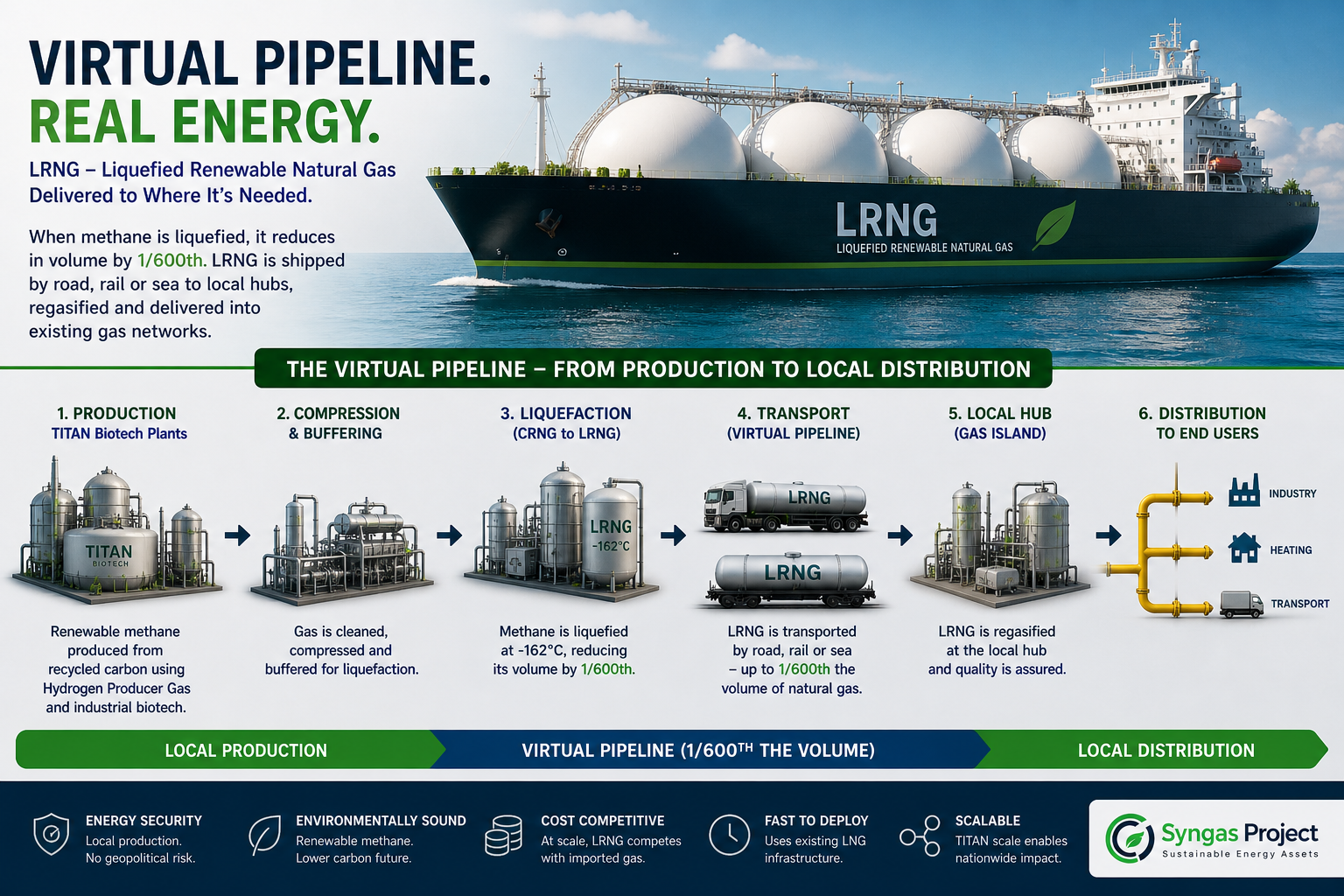
Today, gas is distributed increasingly in liquefied form. LNG has already proven the model. Methane is cooled, liquefied and reduced to around 1/600th of its original volume. It is then transported efficiently by ship, rail or road tanker, delivered to a local hub, regasified and supplied into the network.
This is not a workaround. It is the system.
Many still think LNG distribution is an excuse for not having pipelines. That is wrong. LNG is a more targeted delivery system. The local hub receives the gas it ordered, not a blended molecule that entered a pipeline thousands of kilometres away. The control point moves from the pipeline to the destination.
The real legacy of the gas system is not the intercontinental pipeline.
It is the local gas network.
Historically, gas was produced locally and distributed locally. Towns and industrial centres had their own gas production linked directly to local demand. Long-distance pipelines came much later. They replaced local producers and centralised supply, often for convenience and scale. For a period, that worked.
Today, that model is under pressure.
Russia to the east is no longer a reliable source. Conflict in the Middle East continues to destabilise global energy flows. The United States is becoming less dependable as a long-term strategic partner. Norway carried Europe through the immediate crisis, but it is past peak. It delivered when needed, but production will not keep expanding. The longer global instability continues, the more pressure is placed on a limited northern supply base.
Europe is still climbing an import ladder that is no longer secure.
At some point, that ladder has to be left behind.
Poland has an alternative.
Poland already operates a distributed gas system. The LNG terminal near Szczecin has been built out from approximately 6 billion cubic metres toward 8 billion cubic metres of capacity. More importantly, more than 100 LNG regasification gas islands developed by PSG already form a decentralised distribution network across the country.
These are not temporary assets. They are long-life infrastructure.