
AQUIS — ROMANIA AD MARKET DUE DILIGENCE
AQUIS Services, AQUIS Active EPS, CUMULUS and CAMPUS market-entry assessment
Assessment date: 31 July 2026
Priority: 4.5/5 — High-Potential Strategic Market
Master format: Poland 23-section country standard
Controlling-data notice
This report separates:
- Romania’s operating AD and biogas service market.
- Actual annual biogas production converted into average continuous MW.
- Announced biomethane projects and future national potential.
- Physical AQUIS Island capacity supported by verified conditioned feedstock.
Plant count, installed electrical capacity and target accounts do not prove AQUIS Island capacity.
The planned 15–20 MW DN AGRAR–BSOG Energy biomethane project, the Seleuș project and other announced developments are excluded from today’s operating wheel.
Missing information remains Incomplete data. It is not converted to zero.
1. Executive Summary
Romania is one of Europe’s most underdeveloped biogas markets relative to its population, agricultural scale and organic-resource base.
The reconciled operating baseline is:
- 28 operating biogas plants
- Approximately 23 MW installed biogas-based electrical capacity
- Approximately 300 GWh/year current biogas production
- 34.25 MW average continuous biogas energy output
- No confirmed commercial-scale operating biomethane plant
- 19.05 million inhabitants
- 1.47 operating plants per million inhabitants
- 1.17% of Germany’s deployment density
- Two initial target accounts under a strict 10% objective without upward rounding
Romania’s current market is dominated by biogas used for electricity and heat. The national wheel is therefore almost entirely green. Planned biomethane plants are important commercial evidence, but they do not belong in the operating wheel.
The country’s strategic value comes from the gap between current deployment and future potential. Romania has:
- a large agricultural sector;
- substantial cattle, pig and poultry production;
- extensive crop-residue availability;
- municipal organic-waste exposure;
- underused wastewater-sludge resources;
- an established natural-gas system;
- domestic industrial gas demand;
- emerging biomethane regulation;
- projects moving towards commercial scale.
Romania’s revised energy planning identifies a 4.27 TWh biomethane consumption objective for 2030, representing approximately 5% of gas-network volume. Government Emergency Ordinance 9/2026 has now introduced biogas and biomethane into the national gas regulatory framework and supports a minimum 5% biomethane share by 2030.
The leading development project is the DN AGRAR–BSOG Energy facility in Alba. It is planned with an initial production capacity of up to 15 MW and potential expansion beyond 20 MW. It remains a development project and is not included in current production.
Romania should be treated as a High-Potential Strategic Market. The immediate opportunity is AQUIS Services and AQUIS Active EPS across the existing fleet and major agricultural, wastewater and municipal projects. Physical Island capacity requires site-level mass, moisture and energy verification.
2. How to Interpret the Model
AQUIS Services
AQUIS Services addresses operating AD plants, wastewater digesters and organic-waste facilities requiring improved management of:
- digestate;
- filtrate;
- process water;
- nutrient loading;
- ammonia and phosphorus;
- mineral recovery;
- scaling;
- siloxanes;
- microplastics and nanoplastics;
- PFAS exposure;
- residue conditioning;
- water reuse.
Romanian operators can retain ownership of their digesters and biogas production. AQUIS can provide post-digestion water, contamination and residue services.
AQUIS Active EPS
AQUIS Active EPS provides modular treatment, filtration, microbial-worker and monitoring services to operators that do not initially require a full AQUIS Services programme.
AQUIS Island
One AQUIS Island is controlled by:
- 35 MW conditioned feedstock input
- 364 operating days per year
- 11.2 MJ/kg conditioned feedstock
- Approximately 98,280 tonnes/year conditioned feed
- Approximately 25 MW RNG/LRNG output
The alternative configuration produces approximately 80,000 litres/day of second-generation ethanol.
RNG/LRNG and ethanol are alternative outputs. They are never added together.
CAMPUS
A Romanian CAMPUS would aggregate several farms, food processors, wastewater operators or municipal systems around shared conditioning, gas treatment, water treatment, logistics and conversion infrastructure.
3. Market Definition
The Romanian AQUIS market includes facilities processing:
- cattle manure;
- pig slurry;
- poultry litter;
- crop residues;
- food-processing residues;
- dairy-processing wastewater;
- slaughterhouse residues;
- municipal organic waste;
- sewage sludge;
- landfill gas;
- industrial organic wastewater;
- energy crops where legally and environmentally acceptable.
The immediate commercial market consists of the 28 identified operating biogas plants.
The development market includes:
- conversion of existing biogas plants to biomethane;
- new manure-based biomethane plants;
- municipal and regional waste projects;
- gas-grid injection;
- industrial biomethane supply;
- BioCNG;
- BioLNG;
- biofertiliser production;
- gasification of eligible dry residues;
- regional feedstock hubs.
Landfill-gas sites may be relevant to CUMULUS and gas treatment, but landfill gas does not automatically produce a digestate stream suitable for an AQUIS Island.
4. National Market Scale
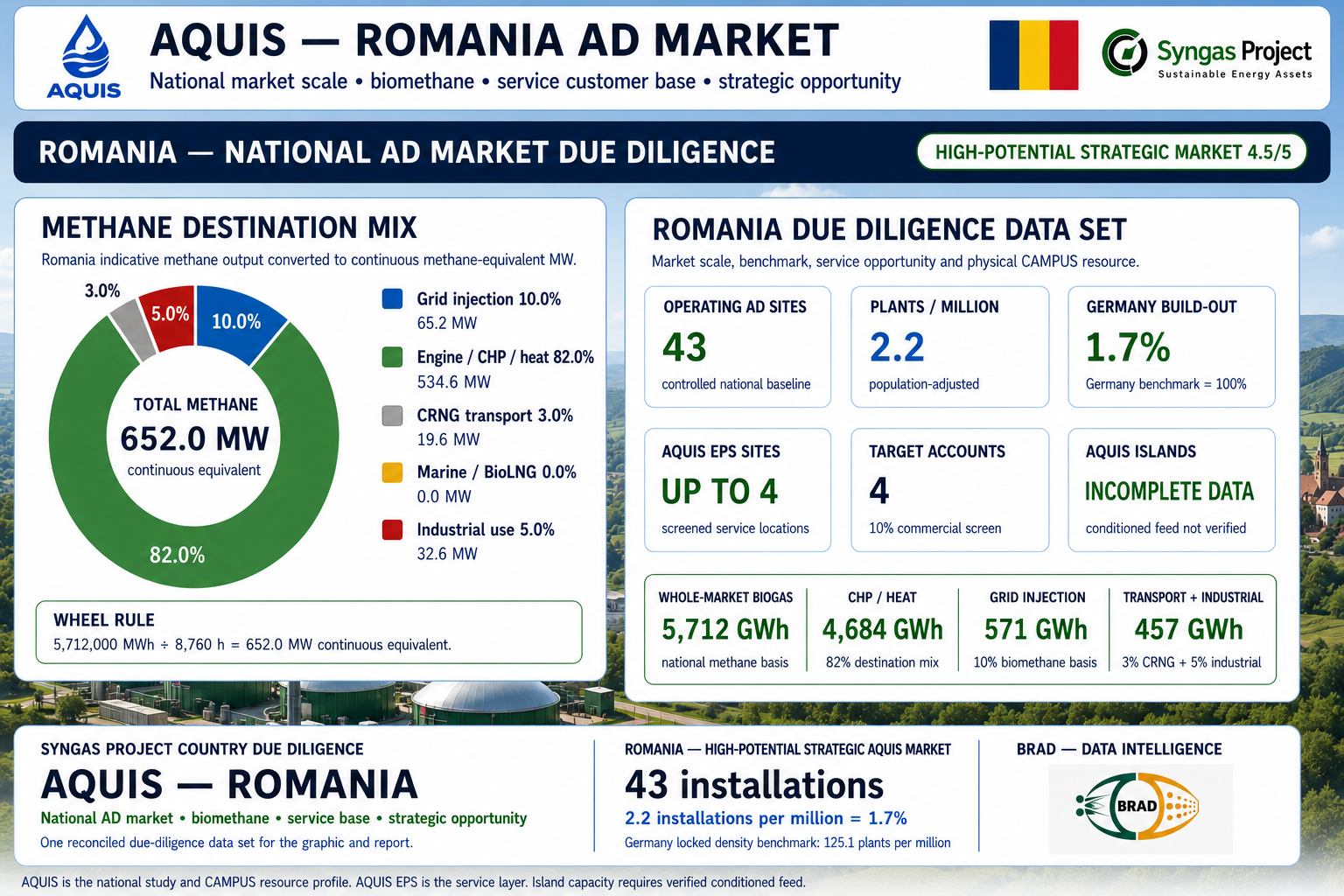
Available market evidence identifies approximately 28 operating Romanian biogas plants with around 23 MW of installed biogas-based electrical capacity.
Current biogas production is approximately 300 GWh/year.
AQUIS AD Services Register
| Measure | Romania controlling position |
| Operating AD/biogas installations | 28 |
| Installed biogas electrical capacity | Approximately 23 MW |
| Operating commercial biomethane plants | 0 confirmed |
| Grid-injecting biomethane plants | 0 confirmed |
| Dedicated operating BioCNG plants | 0 confirmed |
| Operating BioLNG plants | 0 confirmed |
| Current biogas production | Approximately 300 GWh/year |
| Average continuous biogas output | 34.25 MW |
| National wet digestate | Incomplete data |
| Verified conditioned Island feedstock | Incomplete data |
| Full AQUIS Islands presently supported | 0 |
| Principal operating data year | 2022–2024 |
| Population basis | 19,051,562 |
| Strict 10% commercial objective | 2 accounts |
The 23 MW figure is installed electrical capacity. The 34.25 MW figure is average continuous energy output calculated from annual biogas production. They measure different things and must not be substituted for one another.
5. Germany Benchmark
Germany remains fixed at:
- 10,455 operating installations
- 83.60 million inhabitants
- 125.1 installations per million inhabitants
Romania has:
- 28 operating installations
- 19.05 million inhabitants
- 1.47 installations per million inhabitants
Therefore:
- Romania has 0.27% of Germany’s absolute operating plant count.
- Romania has 1.17% of Germany’s deployment density.
- Germany’s deployment density is approximately 85 times greaterthan Romania’s.
If Romania matched Germany’s present density, it would have approximately 2,383 operating installations. This is a comparison, not a forecast.
The extremely low present density demonstrates the scale of Romania’s development gap. It also means that AQUIS can enter while national standards, regional supply chains and biomethane commercial models are still being established.
6. Renewable Methane Position
Romania’s operating biogas is currently used predominantly for electricity and heat.
No commercial-scale operating biomethane production has been confirmed for the controlling baseline. The announced DN AGRAR–BSOG project is still under development.
Controlling national energy wheel
| Wheel route | Annual energy | Average continuous output | Wheel share |
| Green — engine, CHP, heat and unupgraded biogas | 300 GWh | 34.25 MW | 100.00% |
| Blue — grid-injected biomethane | 0 confirmed | 0 MW confirmed | 0% confirmed |
| White — CBG transport | 0 confirmed | 0 MW confirmed | 0% confirmed |
| Yellow — LBG/BioLNG | 0 confirmed | 0 MW confirmed | 0% confirmed |
| Red — direct industrial biomethane | 0 confirmed | 0 MW confirmed | 0% confirmed |
| Total operating production | 300 GWh | 34.25 MW | 100.00% |
This is one of the clearest differentiating wheels in the AQUIS register: Romania remains an electricity-and-heat biogas market awaiting its first commercial biomethane transition.
The future hero must not include the planned 15 MW Alba project until commercial operation is verified.
7. Market Direction
Romania is moving from a limited electricity-led biogas market towards a regulated biomethane sector.
Important developments include:
- a proposed 5% biomethane share in the gas network by 2030;
- a 4.27 TWh biomethane consumption objective for 2030;
- inclusion of biogas and biomethane within the national gas framework through Government Emergency Ordinance 9/2026;
- Modernisation Fund support for biomass and biogas CHP;
- plans for additional biogas and biomass capacity;
- development of large manure-based biomethane projects;
- increasing interest in biofertiliser and digestate valorisation;
- stronger EU obligations covering methane emissions, waste, water and renewable fuels.
Romania’s revised energy planning envisages approximately 150 MW of biomass and biogas generation capacity by 2030, supported partly through the Modernisation Fund.
The development direction is positive, but several commercial elements remain incomplete:
- detailed grid-injection rules;
- connection cost allocation;
- biomethane certification;
- guarantees of origin;
- long-term price support;
- digestate standards;
- access to finance;
- reliable regional feedstock contracts.
AQUIS should not wait for all of these matters to be resolved. The existing agricultural and waste market can be screened immediately.
8. Plant and Feedstock Structure
Romania’s sustainable biomethane opportunity centres on four main feedstock groups:
- Crop residues
- Animal manure
- The organic fraction of municipal solid waste
- Wastewater sludge
Industrial food-processing waste provides an additional high-value stream.
Feedstock position
| Feedstock | Romanian position | AQUIS interpretation |
| Cattle manure | Large dairy and beef sector | Strong regional base-feed opportunity |
| Pig slurry | Concentrated production in agricultural regions | Suitable for cluster screening |
| Poultry litter | Large livestock and poultry industry | Higher-solids opportunity subject to conditioning |
| Crop residues | Large cereal and maize production | Significant but competing uses must be assessed |
| Food-industry residues | Dairy, meat, sugar, brewing and processing | High-priority industrial feedstock |
| Municipal biowaste | Underdeveloped separation and recovery | Strong future opportunity with contamination risk |
| Sewage sludge | Identified as underused | Strong AQUIS Services opportunity |
| Landfill gas | Existing waste-sector resource | Gas treatment opportunity; limited digestate relevance |
| Forestry and wood residues | Potential gasification resource | Must follow cascading-use and RED III requirements |
EU sustainability rules limit reliance on food and feed crops grown specifically for energy. This increases the importance of manure, waste, crop residues and wastewater sludge.
Romania’s potential should therefore be developed through waste treatment and pollution reduction, not through large-scale displacement of food production.
9. Digestate and Water Exposure
Romania’s manure-led biomethane strategy will create large digestate and process-water streams.
The principal issues are:
- high moisture content;
- costly transport;
- seasonal land-application windows;
- limited storage;
- ammonia emissions;
- nutrient runoff;
- nitrate exposure;
- phosphorus concentration;
- heavy metals;
- veterinary residues;
- antibiotics;
- microplastics;
- PFAS and persistent chemicals;
- pathogen control;
- odour;
- variable fertiliser value.
Digestate can replace part of the mineral-fertiliser requirement, but only when its composition is tested, controlled and matched to agricultural demand.
AQUIS can improve this position through:
- solid–liquid separation;
- process-water treatment;
- ammonia and phosphorus management;
- mineral recovery;
- contaminant capture;
- residue drying and conditioning;
- water recycling;
- production of a more stable HPG or biofertiliser product.
The national wet-digestate quantity remains Incomplete data. It cannot be calculated reliably from plant count or biogas output.
10. Municipal Organic-Waste Exposure
Romania remains heavily dependent on landfill and has historically recorded one of the EU’s lowest municipal-waste recycling rates.
This creates a large long-term opportunity for:
- separate biowaste collection;
- anaerobic digestion;
- composting;
- landfill diversion;
- methane capture;
- regional organic-waste infrastructure;
- improved residue quality.
However, mixed municipal waste creates significant contamination risks. The organic fraction can contain:
- plastic films;
- packaging fragments;
- synthetic fibres;
- glass;
- metals;
- household chemicals;
- batteries;
- persistent organic contaminants.
Mechanical separation does not prove that the digestate is suitable for land application.
AQUIS should prioritise projects using separately collected food and green waste while retaining contamination screening. Selective collection improves feedstock quality but does not eliminate plastic liners, packaging, coated paper or chemical contamination.
Municipal waste should be screened regionally rather than converted directly into national Island capacity.
11. Microplastic and Nanoplastic Position
Romanian AD facilities can receive microplastics through:
- sewage sludge;
- mixed municipal waste;
- agricultural films;
- silage covers;
- fertiliser bags;
- synthetic textiles;
- road runoff;
- food packaging;
- industrial wastewater.
Digestion does not establish permanent destruction. Microplastics captured in sludge or digestate may be transferred to agricultural soil.
The AQUIS public position remains:
AQUIS does not manage microplastics. It removes them permanently from the water system.
The required treatment chain is:
- Identify the contaminated stream.
- Flocculate or capture the particles.
- Separate them from water.
- Concentrate them into a controlled fraction.
- destroy or convert the captured fraction at high temperature;
- Verify that the pollutant has not simply moved into soil, water or a commercial product.
Romania’s expanding waste and wastewater infrastructure creates an opportunity to build contaminant control into new projects from the beginning.
12. PFAS Position
No national Romanian PFAS concentration has been assigned to digestate or sewage sludge in this DD.
Potential entry routes include:
- municipal wastewater;
- landfill leachate;
- industrial wastewater;
- firefighting foams;
- food packaging;
- treated textiles;
- household chemicals;
- sewage sludge.
AQUIS should include PFAS screening in BRAD assessments for municipal-waste, wastewater and mixed industrial sites.
Capture is only the first stage. The captured PFAS fraction must remain inside a controlled thermal-treatment route. Destruction claims require verification of:
- temperature;
- residence time;
- gas treatment;
- secondary products;
- monitored emissions;
- second-pass performance where required.
European water, wastewater and chemical rules will increase the commercial value of verified contaminant control.
13. AQUIS Services
The strict 10% objective is:
28 operating plants × 10% = 2.8 accounts
Without upward rounding, the initial controlling objective is two accounts.
A third account can remain in the qualified reserve.
Recommended initial allocation
- One direct AQUIS Services account
- One AQUIS Active EPS account
- One reserve account pending evidence
The strongest direct-service candidate should be a substantial manure, wastewater or food-industry operator with measurable digestate and process-water exposure.
The first Romanian AQUIS Services programme should include:
- BRAD site assessment;
- complete feedstock mass balance;
- digestate and filtrate testing;
- dewatering assessment;
- contaminant screening;
- nutrient and mineral analysis;
- gas-quality assessment;
- water-reuse assessment;
- residue-energy testing;
- commercial outlet assessment.
The DN AGRAR group is a high-priority development counterparty because its planned project combines concentrated manure supply, a long-term feedstock contract and commercial-scale biomethane development. This does not imply an existing agreement with AQUIS.
14. AQUIS Active EPS
AQUIS Active EPS can enter Romanian sites before a complete Island or CAMPUS project is justified.
Potential applications include:
- EXTRACT for mineral, metal and phosphorus recovery;
- FLOCC for microplastic and nanoplastic capture;
- GUARD for scaling, siloxane and fermentation conditioning;
- PFAS capture support;
- POLISH for ammonia, nitrate and phosphate reduction;
- returnable filtration;
- process-water treatment;
- digestate conditioning;
- monitoring and operator support.
Priority EPS customers include:
- smaller agricultural digesters;
- dairy processors;
- slaughterhouses;
- food and beverage plants;
- municipal wastewater operators;
- regional waste companies;
- new biomethane developers.
The EPS route provides faster market entry and creates the operational evidence required for larger investment decisions.
15. AQUIS Island Opportunity
Romania has a strong theoretical physical opportunity, but the current national data do not provide a verified quantity of conditioned, contractable feedstock at the required specification.
Controlling Island basis
| Requirement | One AQUIS Island |
| Feedstock input | 35 MW |
| Operating basis | 364 days/year |
| Conditioned energy content | 11.2 MJ/kg |
| Conditioned feedstock requirement | Approximately 98,280 t/year |
| RNG/LRNG output | Approximately 25 MW |
| Alternative 2G ethanol output | Approximately 80,000 litres/day |
Current approved position
| Measure | Romania result |
| National conditioned feedstock | Incomplete data |
| Current Island-equivalents | Incomplete data |
| Full Islands supported without upward rounding | 0 |
| Future physical potential | High, subject to regional verification |
The announced Seleuș plant is expected to process approximately 60,000 tonnes/year of livestock and agricultural waste. That is useful project evidence, but it is raw input and remains below the controlling 98,280-tonne conditioned-feed requirement.
The DN AGRAR–BSOG project is rated by intended biomethane output, not by a published conditioned-feedstock mass balance. It cannot yet be converted into AQUIS Islands.
The first Romanian Island should only be approved after a regional audit confirms:
- annual contractable tonnage;
- moisture;
- dry matter;
- net energy;
- contamination;
- seasonality;
- current competing uses;
- transport radius;
- delivered cost.
16. Cluster and CAMPUS Position
Romania is better suited to regional agricultural and industrial clusters than to a single national feedstock model.
Transylvania and Alba
- large dairy and cattle operations;
- DN AGRAR feedstock base;
- planned 15–20 MW biomethane project;
- food-processing residues;
- potential biofertiliser production.
This is the leading first CAMPUS screen.
Western Romania and Arad
- intensive agriculture;
- crop residues;
- livestock manure;
- Seleuș project;
- access towards Hungary and Central European gas markets.
Prahova and Southern Romania
- food-processing industry;
- Genesis Biopartner operating experience;
- industrial gas demand;
- access to Bucharest and gas infrastructure.
Bucharest–Ilfov
- municipal organic waste;
- wastewater sludge;
- industrial wastewater;
- high waste concentration;
- strong service-market potential.
Constanța and the Black Sea corridor
- gas infrastructure;
- port access;
- industrial demand;
- potential BioLNG and export routes;
- BSOG energy experience.
Moldova and northeastern Romania
- agriculture;
- livestock;
- food processing;
- weaker infrastructure requiring regional aggregation.
A Romanian CAMPUS should combine farms, food processors, wastewater treatment, AQUIS Services, CUMULUS gas treatment, residue conditioning and shared logistics.
17. LRNG Equivalent
One approved AQUIS Island supports approximately:
- 25 MW RNG/LRNG output
- 218.4 GWh/year at 364 operating days
Romania’s present approved Island count is zero, so no national AQUIS LRNG total is claimed.
The future LRNG opportunity is supported by:
- Black Sea port access;
- Danube transport;
- heavy road freight;
- agricultural machinery;
- industrial gas demand;
- regional cross-border markets;
- sites located away from economic grid connections.
Yellow must remain zero in the current wheel. It can only be introduced after operating LBG or BioLNG production is verified.
A planned biomethane plant capable of future liquefaction is not the same as confirmed BioLNG production.
18. Alternative 2G Ethanol Equivalent
One qualified AQUIS Island can alternatively produce approximately 80,000 litres/day of second-generation ethanol.
Romania has a potentially strong ethanol feedstock position because of its:
- cereal industry;
- maize production;
- straw and stalk residues;
- food-processing residues;
- eligible lignocellulosic material.
However:
- food and feed crops should not be diverted without justification;
- agricultural residues have soil and competing-use value;
- feedstock removal must protect soil carbon and fertility;
- ethanol and RNG/LRNG outputs must never be added;
- no national ethanol total can be calculated without an approved Island count.
The ethanol route should be assessed where dry agricultural residues and liquid-fuel offtake provide a stronger commercial case than biomethane.
19. CUMULUS Gas Treatment
Romania’s existing biogas fleet creates an immediate CUMULUS opportunity.
Potential treatment requirements include:
- hydrogen sulphide removal;
- siloxane control;
- moisture removal;
- ammonia control;
- volatile organic compounds;
- engine protection;
- gas polishing;
- methane-loss monitoring;
- upgrading preparation.
For future biomethane plants, CUMULUS can support:
- gas-quality conditioning;
- grid-specification compliance;
- BioCNG preparation;
- liquefaction preparation;
- biogenic CO₂ separation;
- monitoring and control.
Romania also has longer-term gasification potential. CUMULUS should therefore cover both conventional digester gas and syngas-derived renewable methane.
20. Commercial Entry Model
Phase 1 — Establish the operating register
Verify the status, feedstock, operator and output of all 28 identified plants.
Phase 2 — Select two initial accounts
Prioritise:
- one large agricultural or food-industry operator;
- one wastewater, municipal-waste or mixed-feedstock operator.
Maintain one additional reserve account.
Phase 3 — Complete BRAD assessments
Each site must provide:
- annual feedstock;
- digestate mass;
- moisture;
- dry matter;
- contaminants;
- water balance;
- gas quality;
- disposal costs;
- logistics;
- existing product outlets.
Phase 4 — Deploy AQUIS Services and Active EPS
Use operating sites to establish Romanian performance evidence.
Phase 5 — Develop the first regional CAMPUS
The leading candidates are:
- Alba and central Transylvania
- Arad and western Romania
- Bucharest–Ilfov
- Constanța and the Black Sea corridor
Phase 6 — Approve physical Island capacity
No Island should be approved until at least 98,280 tonnes/year of conditioned feedstock is contractually and technically verified.
21. Priority Assessment
Score: 4.5/5 — High-Potential Strategic Market
| Assessment factor | Romania position |
| Existing operating fleet | Small |
| Present biomethane production | Not yet confirmed commercially |
| Agricultural resource | Very strong |
| Livestock and manure opportunity | Very strong |
| Municipal biowaste opportunity | Strong |
| Wastewater opportunity | Strong and underused |
| Industrial organic-waste opportunity | Strong |
| Gas infrastructure | Strong |
| Policy direction | Improving |
| Project pipeline | Emerging at commercial scale |
| Current conditioned-feed evidence | Incomplete |
| AQUIS service relevance | Very high |
| CAMPUS potential | Very high |
Romania’s priority comes from its development gap and resource concentration, not from the size of its current fleet.
It offers AQUIS the opportunity to enter before biomethane becomes established and to influence how water, digestate, contaminants and regional feedstock are managed.
The country is less immediately mature than Poland, Norway or Portugal, but its long-term physical and regional-development potential is substantial.
22. Risks and Limitations
- Plant-count uncertainty
Public registers do not provide a single continuously updated list of operating plants. - Mixed data years
Plant, capacity and production evidence spans several reporting periods. - Operating-status risk
Some historically reported plants may be idle or operating below capacity. - Pipeline risk
Announced projects may be delayed by finance, permits or regulation. - No operating biomethane baseline
Current renewable-gas routes remain unproven at commercial scale. - Feedstock competition
Crop and forestry residues may have higher-value uses. - EU sustainability constraints
Food crops, feed crops and wood resources face limitations under RED III and cascading-use principles. - High water content
Manure and sludge can be uneconomic to transport over long distances. - Seasonality
Crop and food-industry residues may not provide stable year-round supply. - Digestate quality
Fertiliser value depends on nutrients, contamination, certification and application timing. - Infrastructure variation
Rural sites may lack economical gas-grid, road, water or power connections. - Municipal-waste contamination
Mixed waste can introduce plastics, metals and persistent chemicals. - Community acceptance
Odour, traffic and industrial development can create local opposition. - Island evidence gap
National resource potential is not the same as conditioned, contractable feedstock.
23. Recommended Next Actions
- Approve the Romania text before creating the hero.
- Lock the operating hero wheel to:
- Green: 34.25 MW — 100%
- Blue: 0 MW confirmed
- White: 0 MW confirmed
- Yellow: 0 MW confirmed
- Red: 0 MW confirmed
- Verify all 28 operating plants by operator, location and operating status.
- Keep the 23 MW installed electrical capacity separate from the 34.25 MW average continuous gas-energy output.
- Build the two-account initial target list plus one reserve account.
- Prioritise DN AGRAR–BSOG Energy for development screening without counting the planned plant as operating.
- Screen Genesis Biopartner and the Seleuș project for operating and development evidence.
- Identify large wastewater digesters in Bucharest and other major cities.
- Obtain site-level manure, sludge, digestate and process-water quantities.
- Complete the first BRAD assessment in Alba or central Transylvania.
- Test western Romania as a cross-border CAMPUS with agricultural and gas-market access.
- Assess Constanța for future LRNG, industrial and port-linked demand.
- Do not calculate Romanian Islands until conditioned feedstock is verified.
Sources
- Energy Policy Group — Untapping Romania’s Biogas and Biomethane Potential
- European Commission — Romania Biomethane Country Fiche
- Romanian Ministry of Energy — Draft Updated National Energy and Climate Plan
- Romanian National Institute of Statistics — Usually Resident Population, 1 January 2025
- DN AGRAR — Biomethane Partnership
- Black Sea Oil & Gas — DN AGRAR Development and Supply Contracts
- Reuters — Planned 15 MW Romanian biomethane project
- European Biogas Association — Statistical Report 2024 preview
- European Union — Revised Urban Wastewater Treatment Directive