Warsaw 03:08:2026 Steve Walker
Europe’s New Methane Economy: Keeping Anaerobic Digestion Firmly in the Loop
Europe is building a new renewable methane economy. Energy security, industrial competitiveness and climate policy are now pushing Member States to increase domestic gas production and reduce their dependence on imported fossil fuels. Under REPowerEU, the European Union is targeting 35 billion cubic metres of annual biomethane production by 2030, requiring an estimated €37 billion of investment. Renewable methane is therefore moving from the margins of waste management into the centre of European energy infrastructure. (Energy)
Anaerobic digestion, or AD, provides the established foundation for this expansion. It converts wet biological materials—including food waste, manure, agricultural residues and sewage-derived feedstocks—into biogas. This gas can be used for electricity and heat or upgraded into biomethane for grid injection, transport, industry and marine applications.
AD consequently has substantial policy and investment tailwinds. It manages wet organic materials effectively, produces dispatchable renewable gas and can be deployed locally throughout Europe.
However, the sector also faces important downstream headwinds.
These headwinds do not arise because AD has become less relevant. They arise because European authorities are increasingly examining what remains after wastewater treatment, filtration and digestion. Microplastics, nanoplastics and per- and polyfluoroalkyl substances—PFAS—may be removed from water, but they can subsequently become concentrated in filters, sewage sludge, biosolids and digestate.
Capture is not the same as destruction.
When these materials are land-spread, landfilled or transferred into another unmanaged waste stream, the contaminants may be redistributed rather than eliminated. The future challenge for AD is therefore not simply to increase gas production. It is to demonstrate that its downstream materials can be managed safely within a tightening European regulatory environment.
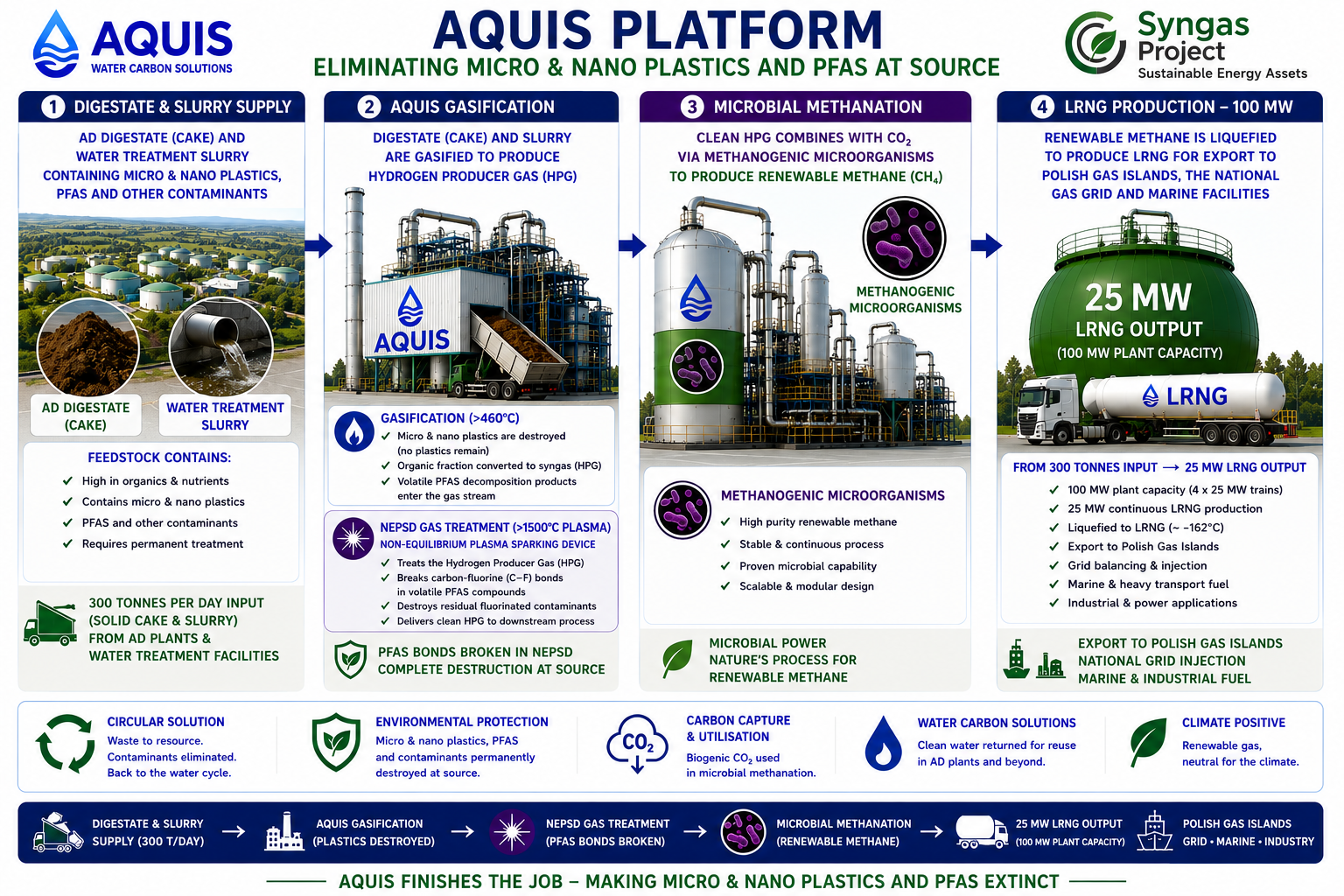
This is the challenge that Syngas Project intends to deflect through AQUIS.