
United Kingdom — AQUIS AD Market Due Diligence
Status: Country text complete
Reference year: 2025 operational and energy data, published July 2026
Priority: Very high
Recommended position: Core AQUIS market
1. Executive Summary
The United Kingdom is one of Europe’s most commercially developed anaerobic-digestion markets. It combines a large operating fleet, substantial food-waste and agricultural feedstock availability, an established biomethane-to-grid industry, a growing renewable-gas transport market and a major water-sector sludge-treatment system.
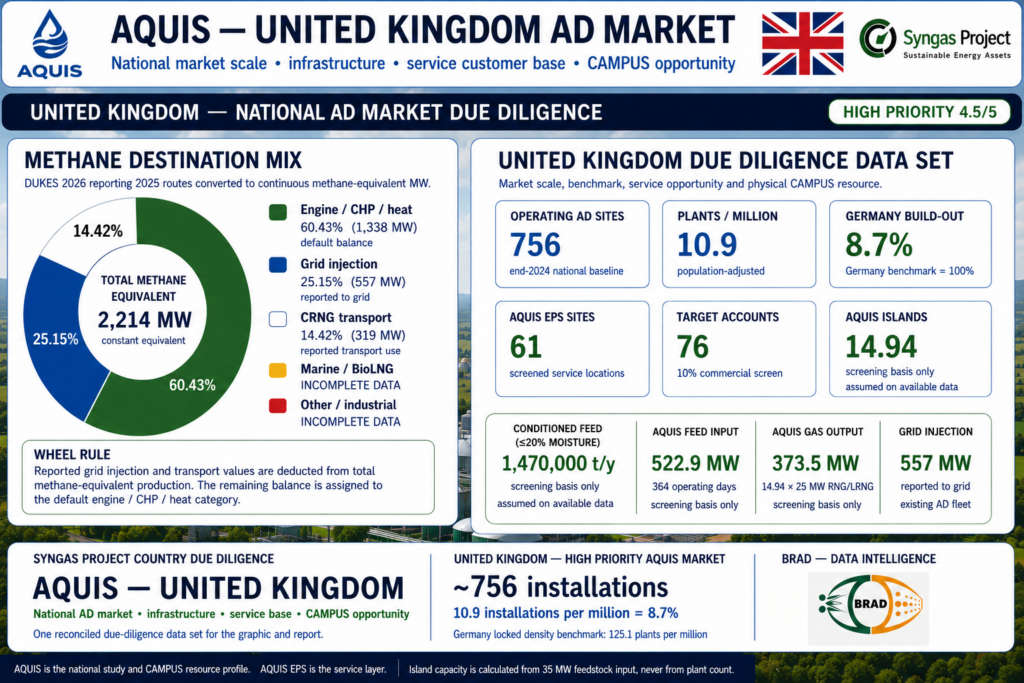
The UK has approximately 756 operational AD plants, processing around 36 million tonnes of organic material annually. The latest identified fleet includes approximately 139 operational biomethane-to-grid plants. The remainder is dominated by combined heat and power, heat production and specialist agricultural, industrial, food-waste and wastewater applications. ADBA reports 756 plants and 36 million tonnes; its 2024 market report identified 139 operational biomethane plants.
Using the latest official DUKES 2026 energy balances, the principal UK AD and biomethane routes represent approximately:
- 19.40 TWh per year of gas-energy input
- 2,214 MW continuous gas-energy equivalent
- 60.43% engine, CHP and useful-heat routes
- 25.15% biomethane injected into the gas grid
- 14.42% biomethane used in transport
The UK therefore differs significantly from markets dominated almost entirely by CHP. Its grid-injection and transport routes are already material, giving AQUIS an immediate market for gas cleaning, upgrading protection, methane-loss reduction, digestate treatment, contaminant management and water recovery.
The principal AQUIS opportunity is not simply construction of more digesters. It is improving the environmental and commercial performance of an extensive existing asset base. Digestate quality, plastic contamination, PFAS, wastewater, nutrient concentration, storage, land spreading, methane slip and ageing gas-treatment systems are increasingly important.
The UK is outside the European Union. EU legislation does not automatically apply across Great Britain. Nevertheless, EU standards remain commercially relevant through Northern Ireland, exported food and agricultural products, corporate supply chains, finance and customer environmental requirements. Domestic UK regulation is also tightening independently.
The recommended initial commercial universe is:
- 76 priority operating-plant accounts, representing approximately 10% of the operational fleet
- 15 Services-led accounts
- 61 Active EPS-led accounts
- 14 biomethane plants for initial CUMULUS qualification, contained within the 76-account programme
No national AQUIS Island should yet be entered as confirmed. Although the UK has extremely large digestate and sewage-sludge flows, an Island calculation requires an identified, controlled and tested stream of conditioned material at no more than 20% moisture. National wet-feedstock or biosolids statistics do not prove this condition.
2. How to Interpret the Model
The AQUIS wheel measures the energy contained in nationally reported AD-derived gas by its immediate destination. It does not represent plant count.
The wheel uses one energy basis throughout:
- Annual energy is converted into average continuous megawatts.
- Electricity and heat routes use the gas-energy input before engine conversion losses.
- Grid injection represents biomethane entering the gas network.
- Transport represents biomethane reported in the national transport-fuel balance.
- Shares total 100% across the verified routes.
- The centre of the wheel reports the total gas-energy equivalent in MW.
The wheel must not combine electricity output with raw-gas input or compare plant capacity with annual production.
Landfill gas is excluded from the core AD wheel because it is not produced by controlled anaerobic digestion. Sewage gas is also shown separately as an adjacent water-sector opportunity so it is not accidentally counted inside both the AD fleet and the municipal-sludge market.
3. Market Definition
The addressable UK market contains five related segments:
- Agricultural AD using manure, slurry, crops and agricultural residues.
- Commercial and municipal food-waste AD.
- Industrial AD treating food, beverage and manufacturing residues.
- Biomethane plants producing grid-quality renewable gas.
- Wastewater and sewage-sludge digestion operated by water companies.
The market includes operating sites requiring optimisation, not only greenfield developments.
AQUIS-relevant problems include:
- Feedstock contamination
- Plastic fragments and microplastics
- PFAS and other persistent chemicals
- Digestate dewatering and treatment
- Nutrient and ammonia management
- Process-water recovery
- H₂S, moisture, siloxane and VOC removal
- Methane slip and off-gas management
- Engine and upgrading-system protection
- Treatment of residual solids
- Conversion of qualified residues into higher-value energy products
Landfill-gas projects should be recorded in a separate market register. They may be relevant to CUMULUS, but they must not inflate the AD plant count or the AD energy wheel.
4. National Market Scale
| Indicator | United Kingdom |
| Operational AD plants | 756 |
| Biomethane-to-grid plants | Approximately 139 |
| Organic material processed | Approximately 36 million t/y |
| UK population benchmark | 69.3 million |
| Plants per million inhabitants | 10.9 |
| Germany-equivalent plant density | 8.7% |
| Verified gas-energy equivalent | 2,214 MW |
| Initial 10% commercial target | 76 plants |
The latest official estimate places the UK population at approximately 69.3 million in mid-2024. ONS population projections use 69.3 million as the mid-2024 base.
The national average plant processes approximately 47,600 tonnes per year if 36 million tonnes is divided across 756 plants. This average must not be applied directly to individual opportunities: agricultural, food-waste, industrial and sewage-sludge plants have markedly different scales and feedstocks.
5. Germany Benchmark
The fixed Germany benchmark is:
- 10,455 plants
- 83.60 million inhabitants
- 125.1 plants per million inhabitants
The UK calculation is:
756 \div 69.3 = 10.91\text{ plants per million}
10.91 \div 125.1 = 8.72\%
The UK therefore has approximately 8.7% of Germany’s plant density.
This does not mean the UK market is weak. UK plants are frequently larger, more centralised and more strongly connected to commercial food-waste contracts, wastewater infrastructure and the gas grid. The comparison indicates considerable theoretical headroom, but future development is likely to favour larger waste-based plants and conversion of existing CHP assets rather than replication of Germany’s historically decentralised agricultural fleet.
6. Renewable Methane Position
The latest DUKES 2026 Table 6.4 reports the following 2025 routes:
| Route | Energy | Average MW | Wheel share |
| Engine, CHP and heat | 1,007.92 ktoe | 1,338 MW | 60.43% |
| AD biomethane injected into grid | 419.46 ktoe | 557 MW | 25.15% |
| Biomethane used as transport fuel | 240.60 ktoe | 319 MW | 14.42% |
| Verified LRNG/BioLNG or marine subdivision | Incomplete data | — | — |
| Verified direct industrial route outside other categories | Incomplete data | — | — |
| Total verified allocation | 1,667.98 ktoe | 2,214 MW | 100.00% |
Conversion basis:
1\text{ ktoe}=11.63\text{ GWh}
1,667.98\text{ ktoe}\times11.63=19.40\text{ TWh/y}
19,398.7\text{ GWh}\div8,760=2,214\text{ MW}
Wheel specification
- Centre: 2,214 MW
- Green: 60.43% — 1,338 MW
- Blue: 25.15% — 557 MW
- White: 14.42% — 319 MW
- Yellow: Incomplete data
- Red: Incomplete data
DUKES does not provide a sufficiently clear national split between compressed and liquefied biomethane within the transport total. The verified transport quantity is therefore retained in the white transport route. No portion should be moved into the yellow LRNG/BioLNG route without an auditable subdivision.
The underlying figures come from the DUKES renewable-energy statistics and Table 6.4 workbook. The accompanying DUKES 2026 report confirms that biogas is increasingly serving heat, grid injection and transport.
7. Market Direction
The UK market is moving from a subsidy-led electricity model toward a more diversified renewable-gas system.
Important developments include:
- Conversion of mature CHP plants to biomethane production
- Growth in gas-grid injection
- Rapid growth in biomethane transport demand
- Corporate renewable-gas purchase agreements
- Greater interest in renewable gas for industrial heat
- Increased capture of food waste through mandatory separate collection
- More scrutiny of digestate, sludge and land-spreading practices
- Emerging BECCS and biogenic-CO₂ opportunities
- Greater attention to methane leakage and whole-system carbon performance
Between 2024 and 2025, DUKES recorded approximately:
- 2% growth in AD gas used for electricity
- 6% growth in AD-derived grid injection
- 29% growth in transport biomethane
The Green Gas Support Scheme remains open to new applications until 31 March 2028 and supports eligible AD biomethane injected into the Great Britain gas grid. Ofgem’s current guidance confirms the application deadline.
The direction is favourable to AQUIS because more valuable gas routes generally demand better contaminant control, gas specification, monitoring and methane-loss management.
8. Plant and Feedstock Structure
The UK plant fleet is heterogeneous.
Agricultural plants
These plants process combinations of:
- Cattle and pig slurry
- Poultry manure
- Farmyard manure
- Maize and other energy crops
- Crop residues
- Vegetable and packhouse waste
Agricultural plants can offer reliable local feedstock but may face seasonal variation, nutrient-management constraints and long transport distances.
Food-waste plants
These are commonly larger and more centralised. They receive:
- Household food waste
- Commercial catering waste
- Supermarket waste
- Food-manufacturing residues
- Packaged and out-of-specification products
Their main AQUIS exposure is physical contamination, packaging fragments, grit, plastics, variable salt content, cleaning chemicals and wastewater.
Industrial plants
Breweries, distilleries, dairies, sugar processors, starch plants, meat processors and other food manufacturers may operate dedicated digestion or send residues to third-party sites.
These sites are attractive because treatment can be linked directly to:
- Waste-disposal savings
- Process-water recovery
- Heat demand
- Renewable-gas procurement
- Corporate carbon targets
Sewage-sludge plants
The water sector represents a separate, highly concentrated group of large operators. It has extensive digestion infrastructure and particularly strong exposure to PFAS, microplastics, siloxanes and other contaminants entering through domestic and industrial wastewater.
9. Digestate and Water Exposure
Processing approximately 36 million tonnes of predominantly wet organic material produces a very large national digestate flow. The exact output cannot be calculated by applying one universal ratio, but much of the incoming water and non-converted material remains in the digestate.
This creates recurring costs for:
- Storage
- Tank and lagoon capacity
- Transport
- Land availability
- Seasonal spreading
- Nitrogen and phosphorus compliance
- Odour and ammonia control
- Runoff prevention
- Water abstraction and discharge
- Removal of physical contaminants
England replaced the former digestate Quality Protocol with an Anaerobic Digestate Resource Framework in October 2025. It defines how qualifying digestate from source-segregated biodegradable waste can demonstrate end-of-waste status and requires suitable quality assurance and protection of human health, soil and the environment. Anaerobic Digestate Resource Framework.
The change is commercially important because it increases the value of:
- Better front-end depackaging
- Lower plastic contamination
- Reliable sampling
- Batch traceability
- Digestate polishing
- Water separation
- Demonstrable compliance
England, Scotland, Wales and Northern Ireland do not operate under one completely identical waste and agricultural regulatory system. AQUIS must produce a four-nation compliance matrix rather than treating “UK compliance” as a single permit condition.
10. Municipal Organic-Waste and Sludge Exposure
WRAP estimates that UK households generated 6.0 million tonnes of food and drink waste in 2022. Earlier complete-system analysis estimated approximately 10.7 million tonnes of total UK food waste, including household and commercial sources. WRAP household food-waste report.
England’s Simpler Recycling rules require household food waste to be separately collected by default from 31 March 2026. Government household recycling guidance. Comparable separation systems are already established or developing under devolved policies in Wales, Scotland and Northern Ireland.
The consequence should be:
- More separately collected food waste
- More municipal supply contracts
- Increased demand for AD capacity
- Greater depackaging requirements
- Higher scrutiny of contamination
- More digestate requiring compliant outlets
The water sector is equally important. In 2024, English water companies produced more than 800,000 tonnes of biosolids, with 93% reused in soil and agriculture. Environment Agency Chief Regulator’s evidence.
DUKES separately records a significant sewage-gas market. This is an adjacent AQUIS opportunity but is excluded from the core AD wheel to prevent double counting.
11. Microplastic and Nanoplastic Position
Wastewater treatment can remove a high proportion of microplastics from treated water, but “removal” from effluent often means transfer into sewage sludge. It does not mean that the plastic has been destroyed.
The Environment Agency reports that up to 99% of microplastics passing through wastewater treatment can be captured, creating a corresponding sludge-management problem. Its Chemicals Investigation Programme is now monitoring microplastics across wastewater influent, effluent, sludge, surface water and other environmental compartments. Environment Agency monitoring evidence.
Food-waste AD is also exposed through:
- Plastic bags and liners
- Packaged food
- Labels and films
- Depackaging losses
- Synthetic fibres
- Road and yard contamination
- Cleaning products
The UK banned microbeads in rinse-off cosmetics in 2018, but that measure addresses only one source. It does not eliminate fibres, tyre particles, fragmented packaging or nanoplastics. UK microbead ban.
AQUIS should position microplastic control as a measurable treatment and compliance programme:
- Characterise incoming material.
- Measure contamination after depackaging.
- Determine partitioning between liquid and solid fractions.
- Reduce recirculation into process water.
- produce auditable digestate-quality data.
- Route concentrated rejects to controlled treatment.
No absolute claim of nanoplastic elimination should be made without validated analytical evidence.
12. PFAS Position
PFAS creates a particularly important UK opportunity because conventional biological wastewater treatment does not reliably destroy these compounds. Some PFAS remain in water, while others partition into sludge.
The UK Government’s February 2026 PFAS Plan specifically includes:
- Reviewing PFAS risks from sewage sludge spread to land
- Consulting on stronger regulation of agricultural sludge use
- Researching treatment options for PFAS and other sludge contaminants
The immediate AQUIS role should be:
- Source and risk mapping
- Sampling-plan design
- Liquid and solid mass-balance analysis
- Separation of higher-risk streams
- Prevention of uncontrolled recirculation
- Treatment-route qualification
- Monitoring before agricultural use
- Identification of residual disposal liabilities
AQUIS must not claim that a thermal system destroys all PFAS merely because it operates at elevated temperature. Destruction claims require compound-specific validation, temperature and residence-time evidence, off-gas analysis and confirmation that harmful partial-decomposition products are not created.
13. AQUIS Services
AQUIS Services should be the entry route for complex and highly regulated sites.
Recommended services include:
- Plant performance and loss audit
- Feedstock and contamination mapping
- Gas-quality profiling
- Methane-slip assessment
- Digestate and process-water mass balance
- PFAS and microplastic sampling plans
- Nutrient and land-bank assessment
- Dewatering and drying trials
- Engine and upgrading-system protection review
- Regulatory and end-of-waste gap analysis
- Carbon-intensity and product-route assessment
- Island feed qualification
The initial Services target is 15 accounts.
Priority customers are major water companies, food-waste operators, biomethane portfolio owners, food manufacturers and sites facing digestate-capacity or land-spreading constraints.
14. AQUIS Active EPS
Active EPS should address repeatable equipment-led requirements across the wider fleet.
The principal application areas are:
- Solids and grit separation
- Digestate dewatering
- Process-water recovery
- Filtration and polishing
- Contaminant concentration
- Reduction of storage and transport volume
- Protection of downstream drying and thermal systems
- Modular upgrading of ageing plant infrastructure
The initial Active EPS target is 61 accounts.
Sites should be ranked using:
- Annual feedstock throughput
- Digestate volume
- Water cost
- Disposal and transport cost
- Contamination risk
- Storage restrictions
- Gas-treatment failures
- Ability to replicate the solution across an operator’s portfolio
15. AQUIS Island Opportunity
The AQUIS Island standard is:
- 109,500 tonnes per year of conditioned material
- Maximum 20% moisture
- Approximately 35 MW feed input
- One full Island only when the entire physical stream is documented and available
The UK clearly possesses enough national residual material to contain multiple potential Islands. It does not yet possess a sufficiently defined national dataset of conditioned material under 20% moisture to book any of them.
Therefore:
- Confirmed UK Islands: 0
- Potential status: Very high, but unqualified
- Required evidence: site-controlled mass, moisture, calorific value, ash, chlorine, sulphur, fluorine, metals, PFAS, plastics, seasonality and existing contractual destination
The first qualification programme should examine:
- A large wastewater biosolids centre.
- A major municipal food-waste AD plant.
- An agricultural digestate cluster.
- A multi-site operator capable of aggregating residues.
- A site with restricted land-spreading capacity.
Wet feedstock tonnage, total digestate production and plant count must never be divided directly by 109,500 tonnes to declare Islands.
16. Cluster and CAMPUS Position
The recommended first CAMPUS geography is the Midlands–Yorkshire–Lincolnshire corridor.
This region combines:
- Agricultural and food-processing residues
- Large food-manufacturing operations
- Water-company sludge assets
- Existing biomethane plants
- Gas-grid access
- Central road logistics
- Industrial renewable-gas customers
- Access to ports on both sides of the country
Secondary clusters are:
- North West England: food manufacturing, utilities, chemicals and industrial heat.
- South West England and South Wales: dairy, manure, food waste and constrained digestate logistics.
- East Anglia: intensive agriculture, food processing and biomethane.
- Scottish Central Belt and North East Scotland: wastewater, food, whisky and agricultural residues.
- Northern Ireland: high agricultural and AD concentration, but with a separate policy, grid and regulatory structure.
A UK CAMPUS should combine feedstock aggregation, analytical services, dewatering, water recovery, gas treatment and preparation of qualified Island feed. It should not begin as a single-product fuel project.
17. LRNG Equivalent
One qualified AQUIS Island can support approximately:
- 25 MW LRNG production capacity
Because no complete UK Island feed stream has yet been qualified:
- Confirmed LRNG equivalent: 0 MW
- Conditional equivalent per qualified Island: 25 MW
LRNG could serve long-haul road transport, off-grid industry, ports or marine applications. The commercial destination must be selected only after feed qualification, fuel-standard review and offtake analysis.
The 25 MW LRNG case is an alternative Island output. It must not be added to the ethanol case.
18. Alternative 2G Ethanol Equivalent
One qualified AQUIS Island can alternatively support approximately:
- 80,000 litres per day of second-generation ethanol
Current UK result:
- Confirmed 2G ethanol equivalent: 0 litres/day
- Conditional equivalent per qualified Island: 80,000 litres/day
Ethanol may offer access to transport-fuel, chemical and industrial markets. However, it competes with LRNG for the same Island feed input.
The two opportunities are alternatives:
\text{One Island}=\text{25 MW LRNG}
or
\text{One Island}=\text{80,000 L/day 2G ethanol}
They must never be combined as simultaneous output.
19. CUMULUS Gas Treatment
The approximately 139 operational biomethane plants form the most immediate CUMULUS opportunity.
An initial 10% screen gives:
- 14 priority biomethane sites
These 14 are a subset of the 76 target accounts and must not be added to the account total.
CUMULUS qualification should investigate:
- Hydrogen sulphide
- Siloxanes
- Ammonia
- Water and hydrocarbon dew point
- Oxygen
- VOCs
- Particulate carryover
- Carbon-dioxide removal
- Compressor protection
- Methane slip
- Upgrading tail gas
- Grid-specification failures
- Odorisation and enrichment requirements
Water-sector sewage gas is a second important CUMULUS segment because domestic and industrial wastewater can introduce siloxanes, sulphur compounds and persistent contaminants.
The commercial proposition should focus on gas yield retained, maintenance avoided, operating availability and methane emissions reduced—not simply the sale of another filter.
20. Commercial Entry Model
Initial account allocation
| Route | Accounts |
| AQUIS Services | 15 |
| AQUIS Active EPS | 61 |
| Total priority accounts | 76 |
| CUMULUS biomethane subset | 14 |
Phase 1 — Market construction
- Reconcile the complete 756-plant register.
- Separate agricultural, food-waste, industrial and wastewater assets.
- Confirm which fleet counts include sewage plants.
- Record owner, operator, feedstock, throughput, gas route and digestate route.
- Identify all multi-plant portfolio owners.
Phase 2 — Qualification
- Rank the first 76 accounts.
- Conduct 15 Services diagnostic engagements.
- Screen 61 Active EPS candidates.
- Select 14 biomethane plants for CUMULUS assessment.
- Obtain representative digestate, water and gas data.
Phase 3 — Demonstration
- Run dewatering and water-recovery trials.
- Establish contaminant mass balances.
- Validate gas-treatment improvements.
- Quantify transport, storage and disposal savings.
- Qualify at least one conditioned Island feed stream.
Phase 4 — Replication
- Convert successful work into portfolio agreements.
- Establish the first regional AQUIS CAMPUS.
- Use the UK results as a reference for Ireland and selected northern European markets.
21. Priority Assessment
| Criterion | Assessment |
| Existing market scale | Very high |
| Biomethane maturity | Very high |
| Food-waste availability | Very high |
| Wastewater and sludge opportunity | Very high |
| Digestate pressure | High |
| Microplastic exposure | Very high |
| PFAS regulatory momentum | High and increasing |
| Gas-grid infrastructure | Very high |
| Island feed readiness | Unconfirmed |
| Competitive intensity | High |
| Overall AQUIS priority | Very high |
The UK should be treated as a core market alongside Poland, Sweden, Norway, Spain, Portugal and Switzerland.
Its strongest feature is not plant density. It is the combination of established operators, monetised waste flows, gas infrastructure, tightening environmental controls and customers capable of purchasing multi-site solutions.
22. Risks and Limitations
- The 756-plant industry total requires reconciliation against water-sector and regulator datasets.
- The 139 biomethane-plant figure is the latest clearly documented fleet number found, but commissioning and closure dates must be updated in the working register.
- DUKES transport biomethane does not provide a complete CNG-versus-LNG subdivision.
- Grid-injected gas may ultimately serve buildings, industry or transport; those downstream allocations must not be counted again.
- England, Scotland, Wales and Northern Ireland have different regulatory responsibilities.
- EU environmental law does not apply uniformly to the UK after Brexit.
- National wet-feedstock and biosolids figures cannot establish Island capacity.
- Digestate contamination varies materially by feedstock and depackaging method.
- PFAS destruction must not be claimed without validated operating and emissions evidence.
- Agricultural land outlets can be affected by weather, nutrient limits, crop rotations and public acceptance.
- Gas-grid capacity and propane-enrichment requirements can alter biomethane economics.
- Existing subsidy contracts may discourage premature conversion from CHP.
- The market contains experienced, well-financed competitors.
- Planning, odour, traffic and community acceptance can delay larger projects.
- Northern Ireland requires a distinct market and grid assessment within the UK programme.
23. Recommended Next Actions and Sources
Immediate actions
- Acquire and reconcile the full UK operating-plant database.
- Confirm the current operating status of every biomethane plant.
- Build the 76-account target list.
- Identify the first 15 Services customers.
- Select the 14 CUMULUS biomethane sites.
- Map England’s 2025 digestate framework against Scottish, Welsh and Northern Irish requirements.
- Secure representative sludge and digestate samples from five clusters.
- Begin PFAS, plastics, moisture and calorific-value screening.
- Qualify one wastewater and one food-waste stream against the Island standard.
- Develop the UK hero only after the country-text series is complete.
Principal sources
- DUKES 2026 renewable-energy statistics
- DUKES 2026 Chapter 6
- ADBA operational fleet and feedstock figures
- ADBA biomethane market report
- Green Gas Support Scheme guidance
- Anaerobic Digestate Resource Framework
- Simpler Recycling household guidance
- WRAP household food-waste report
- UK PFAS Plan
- Environment Agency sludge and biosolids evidence
United Kingdom DD status: complete.
Confirmed wheel centre: 2,214 MW.